
If you handle customer or employee data in the UK, you’re already subject to the UK General Data Protection Regulation, whether you’ve read it or not. Since Brexit, this sits alongside the Data Protection Act 2018 as the legal backbone for how organisations collect, store, and process personal information, and the fines for getting it wrong start at eye-watering figures and go up from there.
This article explains exactly what the UK GDPR covers, how it compares with the EU regulation, and what the Data Protection Act 2018 adds on top. We’ll walk through the key principles, the rights your customers and staff hold over their own data, and the practical obligations that fall on your business, from lawful bases for processing to breach notification timelines.
At TrustedIA, we spend a lot of time helping businesses turn data protection regulations into workable processes rather than a compliance headache, often alongside our ISO 27001 work. Whether you’re building a compliance programme from scratch or checking your current setup holds up, this guide gives you the grounding you need before you dig into the detail.
Why UK GDPR matters for your business
Most business owners assume data protection rules are something for tech companies or huge corporations to worry about. That assumption is wrong, and it’s the fastest route to a painful surprise. If you keep a spreadsheet of customer emails, run a payroll system, or store CCTV footage from your shop floor, you’re processing personal data and the general data protection regulation and why it matters applies to you in full. Understanding why this matters isn’t an academic exercise, it shapes how you protect business data, train staff, and respond when something goes wrong.

It applies to almost every organisation that touches personal data
Scale doesn’t exempt you. A five-person consultancy holding client contact details faces the same legal obligations as a 500-person manufacturer, though the resources available to meet them obviously differ. The UK data protection regulations cover names, email addresses, IP addresses, HR records, CCTV images, and even opinions written about someone in an internal email. If your business collects, stores, shares, or deletes information about identifiable people, you’re a data controller or processor under the law, and both roles carry real duties.
This breadth catches out a lot of SMBs who think GDPR is someone else’s problem. A recruitment agency holding CVs, a dentist’s surgery with patient records, a builder with a customer database on a laptop, all of them sit squarely within scope. Trustedia works with organisations across sectors precisely because this reach is so wide, and few businesses realise how much of their day-to-day activity counts as regulated data processing until an audit spells it out.
The financial and reputational cost of getting it wrong
The Data Protection Act 2018 and UK GDPR hand the Information Commissioner’s Office (ICO) serious enforcement teeth. Fines can reach £17.5 million or 4% of global annual turnover, whichever is higher, for the most serious breaches. Lower-tier breaches still carry penalties up to £8.7 million or 2% of turnover. Those numbers exist to be used, not just to sit in the legislation as a deterrent.
A single unreported data breach can cost more than years of compliance work would have.
Beyond the fine itself, there’s the damage you don’t see coming as clearly: customer churn, damaged supplier relationships, and the operational disruption of an ICO investigation running alongside your normal business. Cyber insurers and loss adjusters increasingly ask hard questions about your data protection posture before a claim gets paid, which is one reason TrustedIA’s CyberSOS incident response service works so closely with the insurance sector.
| Breach tier | Maximum fine | Example scenario |
|---|---|---|
| Standard breach | £8.7m or 2% of global turnover | Poor record-keeping, missed subject access request deadlines |
| Serious breach | £17.5m or 4% of global turnover | Unlawful processing, failure to report a major breach within 72 hours |
| Reputational fallout | No fixed cap | Lost contracts, customer attrition, negative press coverage |
Trust has become a genuine competitive advantage
Customers and business partners now ask about data handling before they sign contracts, not after. Procurement teams routinely request evidence of your compliance with GDPR data protection requirements as part of due diligence, and larger clients often won’t work with suppliers who can’t demonstrate a credible information security posture. This is where compliance stops being a defensive exercise and starts paying commercial dividends.
Demonstrating strong practice around general data protection regulations also feeds directly into frameworks like ISO 27001 certification support, which many of TrustedIA’s clients pursue alongside their GDPR work because the two overlap heavily in terms of risk assessment, access controls, and incident response planning. Get one right and the other becomes far easier to achieve.
Employees notice too. Staff increasingly expect their personal data, from payroll details to performance reviews, to be handled with the same care you’d want extended to your own customers. A visible, well-run data protection programme signals operational maturity to everyone who interacts with your business, not just regulators.
How to comply with UK GDPR: a step-by-step guide
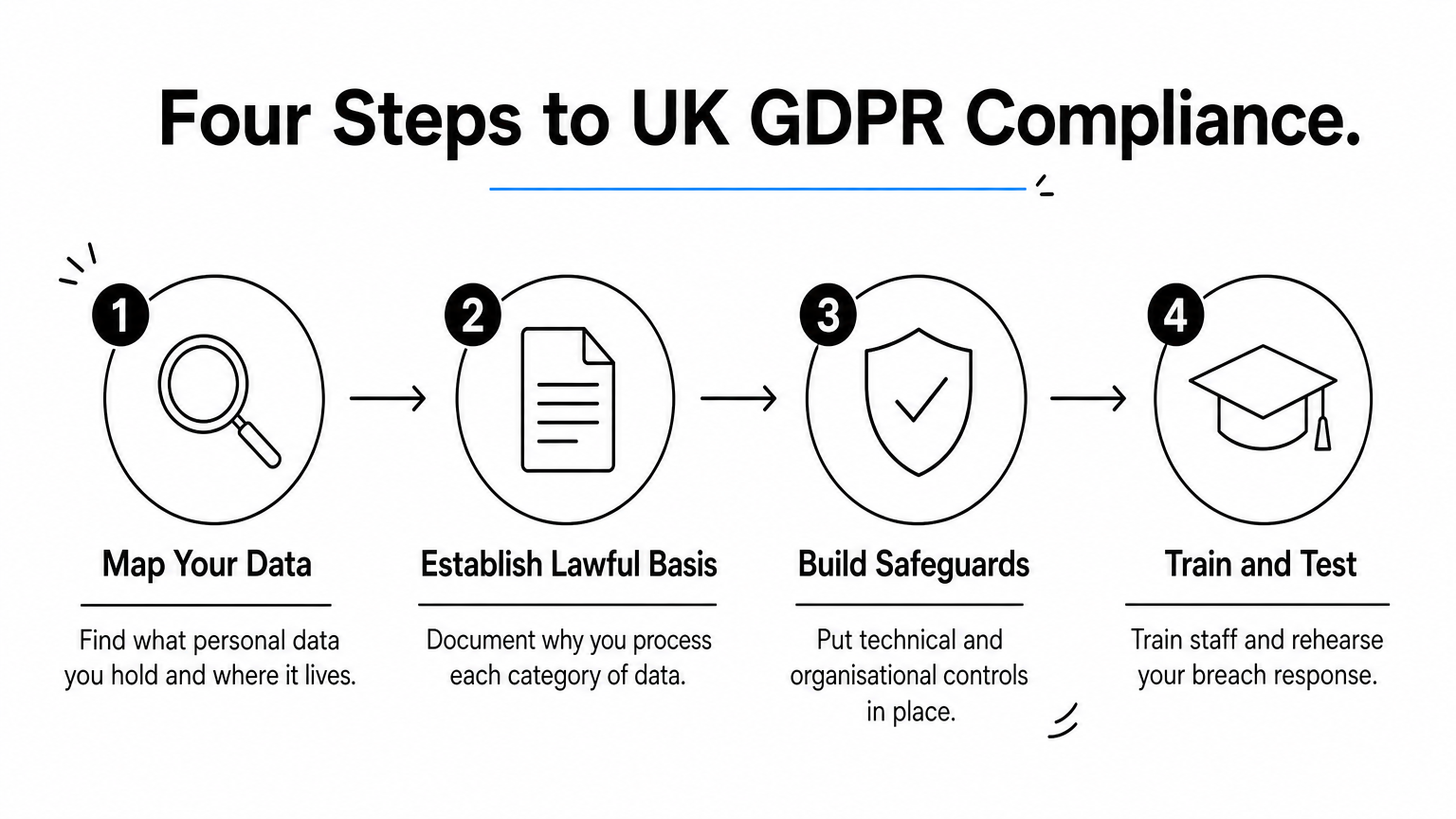
Getting compliant doesn’t require reinventing your entire operation overnight. It requires a structured sequence of steps that, taken together, satisfy both the requirements GDPR compliance sets out and the Data Protection Act 2018. Rushing straight to policy documents without doing the groundwork underneath is the most common mistake we see, and it usually means rewriting everything six months later once the gaps surface.
Map your data before you do anything else
Start by finding out exactly what personal data you hold, where it lives, and why. Most businesses are surprised by how scattered this turns out to be, spread across CRM systems, shared drives, old email accounts, and forgotten spreadsheets nobody remembers creating. This exercise, often called a data mapping or data audit, forms the foundation everything else sits on.
You can’t protect data you don’t know you’re holding.
Work through these questions systematically:
- What personal data do you collect, and from whom?
- Where is it stored, and who has access?
- Why do you hold it, and how long do you keep it?
- Do you share it with third parties or processors?
Establish your lawful basis and documentation
Once you know what you hold, you need a lawful basis for processing each category of data, whether that’s consent, contract, legal obligation, or legitimate interest. Document this decision for every processing activity, because the ICO will ask for it if a complaint lands on their desk, and the ICO’s published GDPR guidance sets out what it expects to see. This is also when you draft or update your privacy notices, retention schedules, and records of processing activities (ROPA), the paperwork that proves your compliance rather than just asserting it.
Build the technical and organisational safeguards
Documentation only carries weight if the technical controls behind it actually work. Article 32 of the UK GDPR requires "appropriate technical and organisational measures," which in practice means access controls, encryption, patching, and monitoring proportionate to your risk. This is where TrustedIA’s managed security services, including vulnerability assessments and endpoint detection, plug directly into your compliance programme rather than sitting alongside it as a separate project.
Practical measures worth prioritising:
- Multi-factor authentication on all systems holding personal data
- Role-based access controls, reviewed quarterly
- Encrypted backups with tested restore procedures
- Regular vulnerability scanning and penetration testing
- A documented incident response plan with named responsibilities
Train your people and test your response
Technology and paperwork mean little if your staff click phishing links or mishandle a subject access request. Regular incident response training for employees, backed by phishing simulation exercises, turns policy into habit. Under both the UK GDPR and Data Protection Act 2018, you also need a tested breach response process, since you have just 72 hours to notify the ICO once you become aware of what counts as a reportable breach. Testing that timeline before a real incident forces it is far cheaper than discovering the gaps live.
The key principles of UK GDPR explained
Seven general data protection principles sit at the heart of the UK GDPR, and every obligation elsewhere in the regulation traces back to one of them. Get these right and most of your compliance work follows naturally. Ignore them and you’ll find yourself patching holes in a system that was never built on solid ground in the first place.
The seven principles at a glance
Before digging into detail, it helps to see all seven principles side by side, since they overlap and reinforce each other constantly.
| Principle | What it means in practice |
|---|---|
| Lawfulness, fairness, transparency | Process data with a valid legal basis and tell people how |
| Purpose limitation | Only use data for the reason you collected it |
| Data minimisation | Collect only what you actually need |
| Accuracy | Keep records correct and up to date |
| Storage limitation | Delete data once it’s no longer needed |
| Integrity and confidentiality | Keep data secure against loss or misuse |
| Accountability | Prove compliance, don’t just claim it |
Lawfulness, fairness, and purpose limitation
Starting with the first principle, you need a documented legal basis before you touch anyone’s personal data, and you must be upfront about what you’re doing with it. Consent, contract, legal obligation, vital interests, public task, and legitimate interest are the six recognised bases, and picking the right one matters because it affects what rights the individual can exercise later. Purpose limitation then locks that data to the reason you collected it. If you gathered an email address for order confirmations, using it later for marketing without fresh consent breaches the principle even if the original collection was entirely lawful.
Collecting data for one reason and using it for another is one of the fastest ways to breach UK data protection regulations without realising it.
Minimisation, accuracy, and storage limits
Data minimisation asks a simple question before every collection form goes live: do you actually need this field? Plenty of businesses collect date of birth, job title, or marital status out of habit rather than necessity, and every unnecessary field is extra risk sitting on your servers for no benefit. Accuracy requires you to correct or delete wrong records promptly, particularly relevant for HR systems and CRMs that quietly drift out of date over years of use. Storage limitation then forces the harder conversation: setting retention periods and actually deleting data once they expire, rather than keeping everything indefinitely because deletion feels riskier than retention.
Integrity, confidentiality, and accountability
Security sits explicitly within the principles themselves, not as a bolt-on requirement. Integrity and confidentiality demand technical and organisational measures proportionate to the sensitivity of what you hold, which is where how to run a vulnerability assessment fits directly into principle-level compliance rather than sitting as a separate exercise. Accountability closes the loop by requiring you to demonstrate compliance actively, through records, policies, and evidence, rather than simply asserting you follow the rules. Together these seven principles form the backbone that every subject access request, breach notification, and audit ultimately gets measured against.
Your rights and obligations under UK GDPR
The UK GDPR grants individuals a set of rights over their own data, and every one of those rights creates a corresponding obligation on your business to respond within a fixed timeframe. Knowing these rights in detail matters because a poorly handled request is one of the most common triggers for an ICO complaint, often from someone who was otherwise a perfectly satisfied customer or employee.
The eight individual rights you need to know
Each right below places a specific duty on you as a controller, and most carry a one-month response deadline unless the request is complex enough to justify an extension.
| Right | What it means for the individual | Your obligation |
|---|---|---|
| Right to be informed | Know what data you hold and why | Clear privacy notices at the point of collection |
| Right of access | Request a copy of their personal data | Respond within one month, free of charge |
| Right to rectification | Correct inaccurate or incomplete data | Update records promptly once verified |
| Right to erasure | Ask for data to be deleted | Comply unless a legal ground to retain it exists |
| Right to restrict processing | Limit how their data is used | Pause processing while a dispute is resolved |
| Right to data portability | Receive data in a usable format | Provide a structured, machine-readable export |
| Right to object | Object to certain processing, including marketing | Stop processing unless you can show overriding grounds |
| Rights related to automated decisions | Avoid decisions made solely by algorithm | Offer human review on request |
Subject access requests deserve particular attention because they arrive more often than most businesses expect, frequently from disgruntled ex-employees rather than customers. Build a process now, because scrambling to locate scattered emails and HR files within a one-month deadline is where most organisations fail.
A right that takes you a month to fulfil under pressure should take you a day once the process is built.
What this means practically for your business
Turning these rights into working procedures means assigning ownership internally, usually to whoever holds the data protection lead role, and giving that person the authority to pull records from every system without chasing approvals. Logging every request, along with the date received and the date actioned, gives you the audit trail the ICO will ask for if a complaint ever lands.
Beyond individual rights, the general data protection uk framework also imposes standing obligations regardless of whether anyone ever exercises a specific right. You must maintain records of processing activities, carry out data protection impact assessments for high-risk processing such as large-scale monitoring or new technology rollouts, and work out whether you need a Data Protection Officer because you’re a public authority or engage in large-scale systematic monitoring. Smaller businesses often assume a DPO isn’t relevant to them, and in many cases that’s correct, but the underlying accountability obligations still apply even without a named DPO in place.
Breach notification sits alongside these as one of the sharpest-edged obligations you carry. Once you become aware of a breach likely to risk people’s rights and freedoms, the clock starts on a 72-hour window to notify the ICO, and in higher-risk cases you must also tell the affected individuals directly. Rehearsing that process, ideally using the eight steps of a solid breach response TrustedIA builds into its managed security services, is the difference between a controlled disclosure and a chaotic scramble under regulatory pressure.
UK GDPR vs the Data Protection Act 2018
Business owners often use "GDPR" and "Data Protection Act" interchangeably, but they’re not the same document, and knowing the difference matters when you’re trying to work out exactly what applies to your situation. Both sit side by side in UK law, and neither one replaces the other. The UK GDPR is what remains of the EU regulation after Brexit, retained in domestic law with tweaks to reflect that the UK is no longer bound by EU institutions. What the Data Protection Act covers is a separate piece of UK legislation that predates that split and does the additional work the GDPR text doesn’t cover on its own.
How the two laws fit together
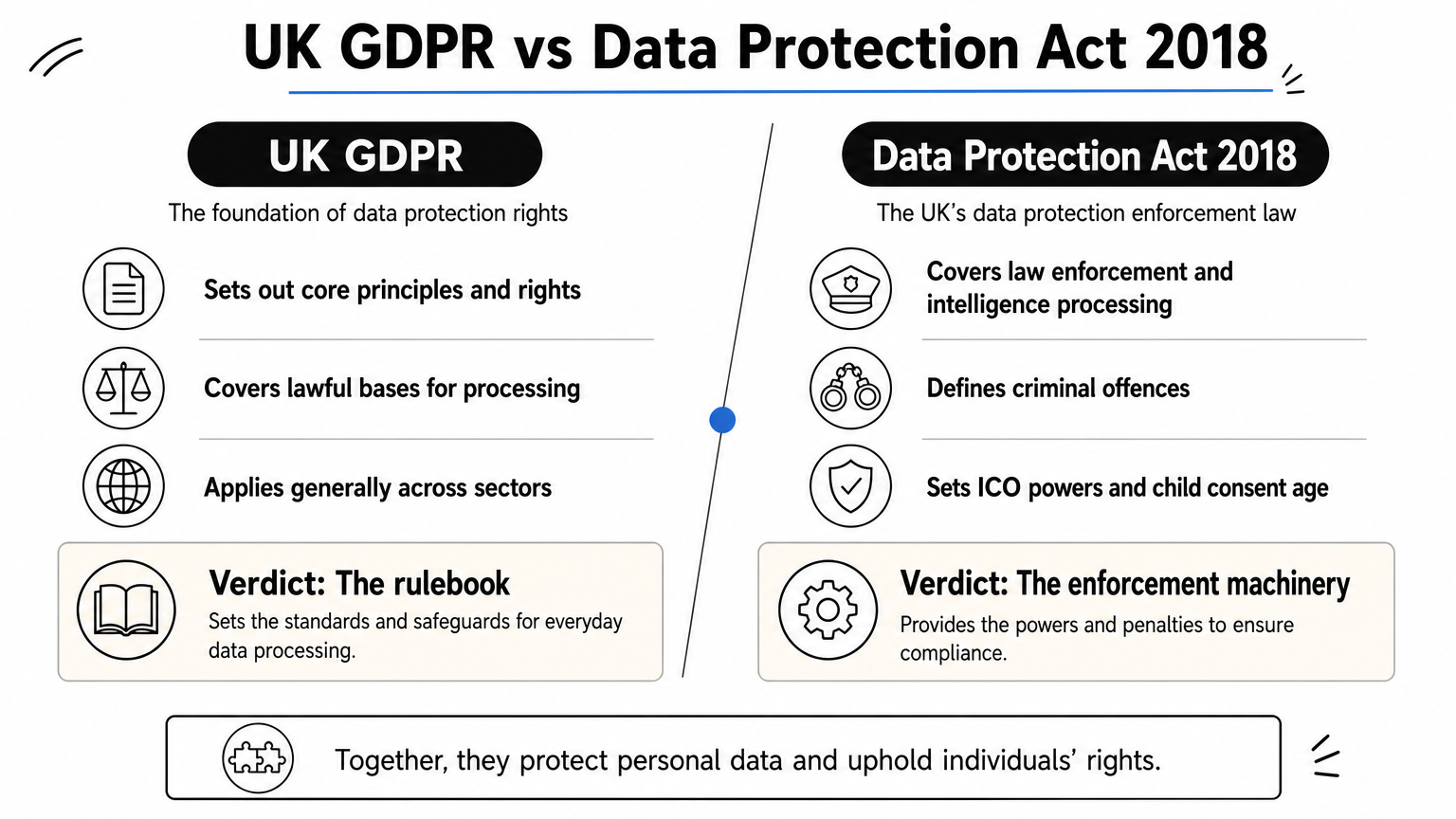
Think of the UK GDPR as setting out the core rules, the principles, the lawful bases, and the individual rights we covered earlier. The Data Protection Act 2018 then fills in the gaps that a European-wide regulation couldn’t sensibly address, things specific to UK institutions and UK criminal law. It covers processing by law enforcement agencies, intelligence services, and it sets out the ICO’s own powers and enforcement procedures in detail. Without the Act, the GDPR alone wouldn’t tell you how the ICO can actually investigate a complaint or issue a penalty notice.
The UK GDPR sets the rules, the Data Protection Act 2018 gives them teeth and fills in what Europe-wide law never covered.
Where the Data Protection Act 2018 goes further
Several areas exist almost entirely within the 2018 Act and the duties it creates rather than the regulation itself. It creates specific exemptions, for journalism, research, and immigration control, that businesses in those sectors need to understand precisely because the GDPR text alone wouldn’t give them that latitude. It also lowers the age at which a child can consent to data processing for online services to 13, a detail the regulation left for member states to decide domestically. And it sets out the criminal offences around data protection, including unlawfully obtaining or disclosing personal data, which sit outside the civil fining regime most people associate with gdpr data protection act compliance.
| Aspect | UK GDPR | Data Protection Act 2018 |
|---|---|---|
| Core principles and rights | Sets these out in full | Refers back to the GDPR |
| Law enforcement processing | Not covered | Covered in detail |
| National security and intelligence | Not covered | Covered in detail |
| Criminal offences | Not covered | Defines specific offences |
| ICO powers and procedure | General framework | Detailed enforcement provisions |
| Age of consent for children | Left to national law | Set at 13 |
For most SMBs, day-to-day compliance work focuses almost entirely on the UK GDPR‘s principles and rights, with the Act operating in the background as the legal machinery that makes enforcement possible. That said, don’t skip it entirely. If you handle law enforcement data, work with under-18s online, or operate in a sector with a specific statutory exemption, the Act is where you’ll find the detail the regulation itself simply doesn’t address. TrustedIA’s compliance reviews always check both documents together, because treating the uk data protection regulations as a single unified rulebook, rather than two documents working in tandem, is exactly how gaps slip through unnoticed.
Penalties and enforcement for non-compliance
Getting the theory right means little if you don’t understand how enforcement actually plays out in practice. The way the ICO enforces data protection doesn’t depend on a whistleblower or a journalist, though both do trigger investigations regularly. It runs its own audit programme, responds to individual complaints, and increasingly cross-references breach notifications against what businesses report elsewhere, including to cyber insurers. Falling foul of the general data protection regulation gdpr uk framework rarely happens through a single dramatic failure; it’s usually the accumulation of small gaps the ICO uncovers once it starts looking properly.
How an ICO investigation typically unfolds
Investigations usually start with a complaint, a breach notification, or a routine audit request, and the process follows a fairly predictable path from there.
- Initial contact requesting information about the incident or complaint
- Formal information notice if your response raises further questions
- Assessment notice allowing the ICO to inspect your systems and records directly
- Enforcement notice requiring specific corrective action within a deadline
- Penalty notice setting out the fine, if one applies, and the reasoning behind it
Having your documentation in order at step one, rather than scrambling to produce it at step three, changes the entire tone of the investigation. Regulators respond very differently to organisations that clearly have a functioning compliance programme versus those improvising answers on the spot.
The fines aren’t theoretical
British Airways, Marriott, and Ticketmaster have all faced multi-million pound penalties under this regime, and smaller organisations get caught too, often for far less dramatic failures like a misdirected email containing sensitive HR data, so it pays to understand the consequences of breaching the Data Protection Act. The two-tier fine structure exists precisely so the punishment scales with severity: administrative failures sit at the lower end, while unlawful processing or ignoring a breach notification duty sits at the top. You can read the ICO’s own enforcement action reports on the Information Commissioner’s Office website to see exactly what triggers action and how the penalties are calculated in real cases.
Fines punish the failure, but they rarely match the cost of the trust you lose alongside them.
Beyond the fine itself
Financial penalties are only part of the picture. The ICO can also issue enforcement notices forcing you to change how you process data, which sometimes means suspending a whole system or service until you fix the underlying problem. Reputational damage compounds this further; once a breach becomes public, customers and partners start asking questions you can’t always answer satisfactorily, and procurement teams elsewhere start marking you down in future tenders.
Reducing your enforcement risk
Alongside the technical safeguards, a few practical habits reduce your exposure significantly:
- Report breaches within the 72-hour window, even if your investigation isn’t complete
- Keep a clear paper trail of every compliance decision and its rationale
- Review your incident response plan annually, not just after an actual incident
- Treat ICO correspondence as urgent, never as routine admin to deal with later
TrustedIA’s CyberSOS incident response service exists precisely for the window between discovering a breach and reporting it, when decisions made under pressure often determine whether an investigation ends with a warning or a substantial penalty.
Staying on top of UK GDPR compliance
Compliance with the UK General Data Protection Regulation isn’t a project you finish and file away. It’s an ongoing discipline built on mapping your data, documenting your lawful basis, training your people, and rehearsing your breach response before you ever need it for real. Get the seven principles right, respect the rights individuals hold over their data, and understand how the Data Protection Act 2018 sits alongside the regulation, and most of the ICO’s expectations fall into place naturally.
Businesses that treat this as a genuine operational habit, rather than a box-ticking exercise revisited once a year, avoid the fines and the reputational damage that follow a mishandled breach. They also win contracts that demand proof of a credible security posture before ink hits paper.
If you want expert eyes on your current setup, talk to TrustedIA about fast-tracking your UK GDPR and DPA 2018 compliance and turning those obligations into a system that actually holds up under pressure.