
When the UK left the EU, data protection law didn’t simply carry over unchanged. The UK GDPR vs EU GDPR differences might seem minor on the surface, but for businesses operating across both jurisdictions, they create real compliance headaches. Understanding exactly what shifted, and what stayed the same, is essential if you want to avoid regulatory trouble on either side of the Channel.
Both frameworks share the same DNA: the EU’s General Data Protection Regulation. But since Brexit, the UK has started to diverge. Different supervisory authorities, separate adequacy decisions, distinct approaches to international data transfers, and evolving amendment proposals mean that treating them as identical is a risk. If your organisation processes personal data of individuals in both the UK and the EU, you likely need to comply with both regimes simultaneously, which requires identifying where the gaps are.
At TrustedIA, we help businesses build and maintain robust information security frameworks, including ISO 27001 implementation and certification. Data protection compliance sits at the heart of that work. Our experience across cyber security audits, risk management, and compliance consulting means we see first-hand how organisations struggle with overlapping regulatory obligations, and how to cut through the confusion.
This article breaks down the specific legal and operational differences between UK GDPR and EU GDPR, explains what changed post-Brexit, and gives you a clear picture of what your compliance obligations look like heading into 2026 and beyond. We’ll cover supervisory authority roles, international transfers, enforcement, and the practical steps to stay compliant in both jurisdictions.
What stayed the same between UK GDPR and EU GDPR
Before examining the specific UK GDPR vs EU GDPR differences that affect your compliance programme, it helps to understand how much the two frameworks have in common. The UK GDPR is essentially the EU GDPR transposed into domestic law through the European Union (Withdrawal) Act 2018. At the point of Brexit, the text was nearly identical to the EU version. That means a significant portion of your existing compliance infrastructure built for the EU GDPR carries over under the UK GDPR, reducing duplication when managing obligations across both regimes.
Core principles and lawful bases
The seven data protection principles are identical in both frameworks. Personal data must be processed lawfully, fairly, and transparently; collected for specified and legitimate purposes; kept accurate; stored only as long as necessary; and secured appropriately. These principles underpin both regimes equally, so your existing policies built around them remain valid on both sides of the Channel.
Both frameworks also recognise the same six lawful bases for processing: consent, contract, legal obligation, vital interests, public task, and legitimate interests. If your organisation relies on legitimate interests, the balancing test is worded identically in both versions, which means one well-documented legitimate interests assessment can support your position under both, as long as you reference both regimes in your records of processing activities.
Because both frameworks share the same six lawful bases, you do not need to rebuild your legal basis documentation from scratch when managing dual compliance.
Individual rights
Data subject rights align closely across both frameworks. Individuals in the UK and the EU hold the same core rights: access, rectification, erasure, restriction of processing, data portability, the right to object, and rights related to automated decision-making. Response timelines match too, with one calendar month as the standard deadline, extendable by two further months for complex or numerous requests.
Your privacy notice can serve as a shared foundation for compliance with both UK and EU requirements. The substantive disclosures required are the same. You will need to identify the correct supervisory authority for each jurisdiction, but the content requirements are sufficiently consistent that a single well-structured notice, adapted with jurisdiction-specific references, can cover both without duplicating the entire document.
Controller and processor obligations
Both frameworks place substantially identical obligations on controllers and processors. You must maintain records of processing activities, appoint a Data Protection Officer where the thresholds are met, and carry out Data Protection Impact Assessments for high-risk processing activities. The 72-hour breach-notification window to the relevant supervisory authority applies under both regimes, as does the obligation to notify affected individuals when a breach poses a high risk to their rights and freedoms.
Contracts with third-party processors must also meet the same minimum requirements under both frameworks. The mandatory clauses set out in Article 28 of the EU GDPR and the equivalent UK GDPR provision are worded in the same way, so agreements drafted to satisfy one will largely satisfy the other, with targeted adjustments to references to supervisory authorities and transfer mechanism clauses where needed.
What changed post-Brexit at a glance
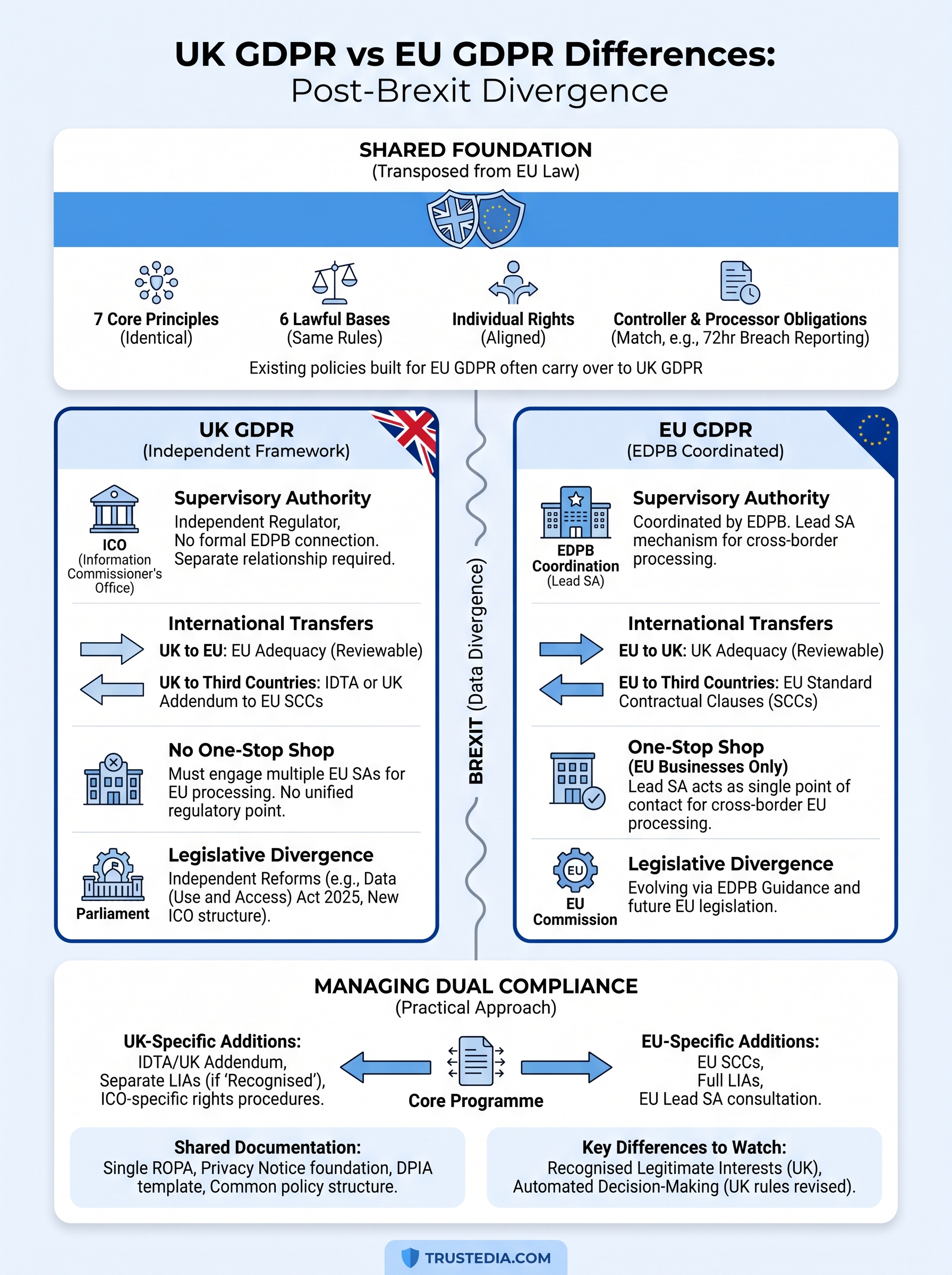
Understanding the differences between the UK GDPR and the EU GDPR requires focusing on the points where the two frameworks have genuinely diverged since the UK left the EU. While the foundations remain shared, Brexit introduced four significant structural changes that directly affect how you manage compliance: the split in supervisory authority jurisdiction, separate transfer mechanisms, the loss of the one-stop shop, and growing legislative divergence as the UK pursues its own reform agenda.
The supervisory authority split
The Information Commissioner’s Office (ICO) now regulates UK GDPR independently, with no formal connection to the European Data Protection Board (EDPB), which coordinates EU supervisory authorities. Before Brexit, a UK-based business with cross-border EU operations could designate the ICO as its lead supervisory authority under the one-stop shop mechanism, giving it a single regulatory point of contact for all EU processing activities.
That option no longer exists for UK organisations handling data of EU residents. If your business has an establishment in an EU member state, you must now engage a lead supervisory authority within the EU, separate from your relationship with the ICO, which means maintaining two distinct regulatory channels.
If you operate in both the UK and EU, you may need to manage active relationships with two entirely separate regulatory bodies simultaneously.
Transfer mechanisms and adequacy
The EU granted the UK adequacy decisions in June 2021, allowing personal data to flow freely from the EU to the UK without additional safeguards. However, those decisions are not permanent and remain subject to ongoing review by the European Commission. For transfers moving in the opposite direction, the UK introduced its own mechanism: the International Data Transfer Agreement (IDTA), which replaces the old EU Standard Contractual Clauses for contracts governed by UK law.
Key transfer tools now differ between the two regimes:
- EU to UK: covered by the UK adequacy decision (reviewable)
- UK to EU: no additional mechanism needed (EU adequacy covers this)
- UK to third countries: requires the IDTA or UK Addendum to EU SCCs
- EU to third countries: requires EU Standard Contractual Clauses
Legislative divergence
Perhaps the most significant long-term shift is that the UK is now independently amending its data protection law. The Data (Use and Access) Act 2025 introduced reforms to the way the ICO operates, the application of legitimate interests in certain contexts, and the functioning of automated decision-making rules in practice.
The EU continues to develop its regulatory position through EDPB guidance separately. Over time, this divergence will likely widen, meaning you cannot assume both regimes will remain aligned and must monitor each independently.
Which GDPR applies to your business
One of the most practical uk gdpr vs eu gdpr differences questions is simply: which law do you need to follow? The answer depends on two tests – the establishment test and the targeting and monitoring test. Many businesses incorrectly assume that only one framework applies to them, but both can apply simultaneously, depending on where your organisation is based and whose personal data you process.
The establishment test
If your organisation has a place of business in the UK – whether that is a main office, a branch, or any stable arrangement through which you carry out real and effective activity – UK GDPR applies to your processing activities. Similarly, if you have an establishment in any EU member state, EU GDPR governs your processing there. The physical location of your servers, or where data is actually processed, does not determine which regime applies. What matters is where your organisation conducts its activities.
For businesses with dual establishment (offices in both the UK and an EU member state), both frameworks apply, and you must comply with each independently. There is no longer a mechanism to consolidate your regulatory obligations under a single supervisory authority across both jurisdictions.
When both regimes apply, regardless of the establishment
Even if your business has no physical presence in the UK or the EU, you may still fall within the scope of either framework based on your activities. EU GDPR applies to organisations outside the EU that offer goods or services to individuals in the EU, or that monitor the behaviour of individuals in the EU. UK GDPR contains an equivalent extra-territorial provision that mirrors this approach.
If you run a website that targets UK and EU customers, both frameworks likely apply to your business even if your servers and offices are elsewhere.
In practical terms, this means a US-based business selling software subscriptions to UK and EU customers must comply with both UK GDPR and EU GDPR simultaneously. Identifying which regime applies is not a one-time exercise. As your business grows into new markets or changes how it collects and uses data, your jurisdictional exposure can shift, so review your territorial scope regularly and document your conclusions as part of your records of processing activities.
Regulators, enforcement, and the one-stop shop
One of the most operationally significant differences between UK GDPR and EU GDPR is how enforcement works. Before Brexit, a UK-based business with EU-wide data processing could work with a single lead supervisory authority under the one-stop shop mechanism. That consistency is gone, and understanding what replaced it is essential for managing your regulatory relationships correctly.
The ICO and EU supervisory authorities
The Information Commissioner’s Office (ICO) is the UK’s independent data protection regulator. It operates entirely separately from the European Data Protection Board (EDPB), which coordinates enforcement across EU member states. The ICO issues its own guidance, conducts its own investigations, and sets its own enforcement priorities. ICO decisions do not bind EU supervisory authorities, and the ICO has no formal vote or standing in EDPB decisions that affect UK organisations processing EU residents’ data.
This means your organisation faces two distinct regulatory relationships if you handle data from both jurisdictions. You cannot resolve an EU complaint through the ICO, and you cannot use an ICO ruling to satisfy an EU supervisory authority’s enquiry. Each regulator operates on its own timeline, with its own procedures and penalty framework.
If your business processes data from both UK and EU individuals, treat the ICO and your relevant EU supervisory authority as completely separate relationships requiring separate management.
What does losing the one-stop shop mean in practice?
Under the EU GDPR one-stop shop, a business with multiple EU establishments could designate the supervisory authority in its main EU establishment as its lead regulator for all cross-border EU processing. That arrangement simplified compliance considerably for businesses with operations spread across several member states.
UK organisations no longer qualify for that arrangement in the EU. If your business has an establishment in France, Germany, or any other EU member state, you must engage the relevant national supervisory authority in that country directly. If you operate across multiple EU member states, you can still designate a lead EU supervisory authority based on where your main EU establishment sits, but the ICO plays no part in that process.
Your compliance team also needs to handle how complaints are routed differently under each regime. An EU resident making a complaint about your processing will engage an EU supervisory authority, not the ICO. Monitoring both regulatory channels requires a dedicated internal resource or external compliance support to avoid missing enforcement actions or guidance updates that affect your obligations.
International data transfers between the UK and the EU
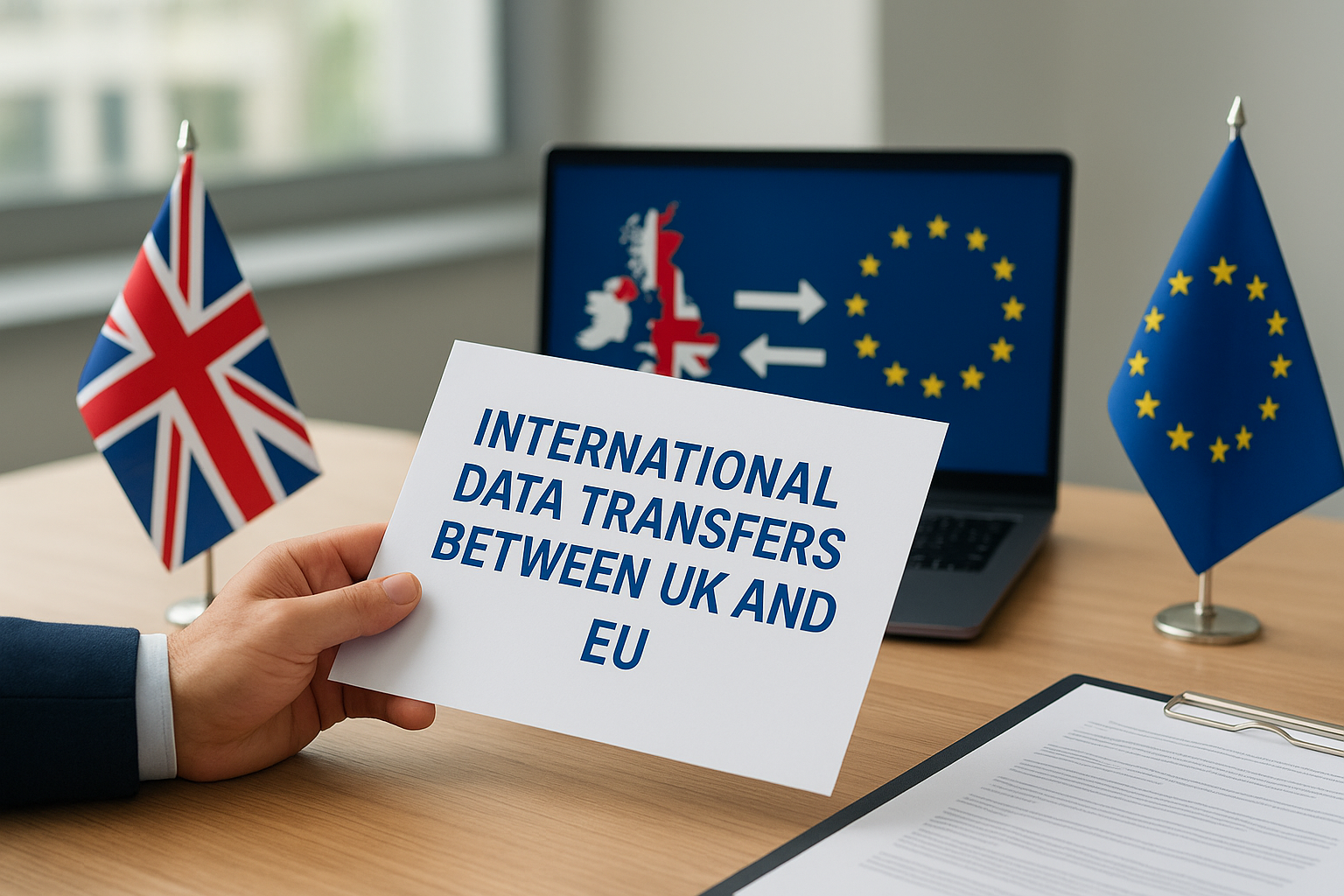
One of the most practically significant differences between UK GDPR and EU GDPR concerns how personal data moves across borders. Before Brexit, data flows between EU member states and the UK operated within a single legal framework. That changed immediately when the UK left, and the arrangements now in place are not permanent, which means you need to actively monitor this area rather than treat it as settled.
The EU adequacy decision and what it means for you
The European Commission granted the UK two adequacy decisions in June 2021, one covering the UK GDPR and the other covering the Law Enforcement Directive. These decisions allow personal data to flow freely from the EU to the UK without your organisation needing to implement additional safeguards. In practical terms, if you receive personal data from an EU-based business partner or customer, you do not need standard contractual clauses or binding corporate rules to legitimise that transfer under EU GDPR.
The EU adequacy decisions are subject to periodic review, and the European Commission can suspend or revoke them if the UK’s data protection standards are found to have diverged too significantly.
Your organisation should closely monitor the adequacy review process and include contingency clauses in your contracts with EU partners so you can quickly switch to alternative transfer mechanisms if adequacy is withdrawn. The next scheduled review point is a direct prompt to make this contingency planning a standing item on your annual compliance calendar, rather than addressing it reactively.
Transfers from the UK to other countries
When your organisation sends personal data from the UK to a country outside the UK, you cannot rely on EU Standard Contractual Clauses for contracts governed by UK law. The UK introduced the International Data Transfer Agreement (IDTA) as its domestic replacement, along with a UK Addendum to the EU SCCs for situations where the underlying contract is governed by non-UK law but you still need to satisfy UK GDPR transfer requirements.
For transfers from the EU to third countries, EU organisations must use the current EU Standard Contractual Clauses, updated by the European Commission in 2021. If your business handles both directions of data flow across multiple jurisdictions, you may need both sets of instruments in place simultaneously, adding a layer of contract-management complexity that requires careful coordination between your legal and compliance teams.
Key UK-specific differences to watch
Beyond the structural changes already covered, several specific provisions within UK GDPR have begun to diverge from their EU equivalents in ways that directly affect your day-to-day compliance. Understanding these UK-specific developments is essential for any organisation that treats the two frameworks as interchangeable.
Recognised legitimate interests
One of the most notable UK GDPR vs EU GDPR differences introduced by the Data (Use and Access) Act 2025 is the introduction of a new category of recognised legitimate interests. These are specific processing purposes in which the balancing test is effectively pre-satisfied, thereby removing the need to document a full legitimate interests assessment. Qualifying purposes include processing for the detection or prevention of unlawful acts, safeguarding individuals, and certain public interest activities.
EU GDPR contains no equivalent recognised legitimate interests category, which means your legitimate interests documentation strategy needs to differ between jurisdictions.
Your EU compliance process still requires a full balancing test for each legitimate-interest reliance. Under UK GDPR, where your activity falls within a recognised purpose, you can rely on a lighter documentation approach, provided your processing stays within the defined boundaries.
Automated decision-making
The UK has moved away from the EU’s approach to automated decision-making under Article 22. The Data (Use and Access) Act 2025 restructured how these rules apply, broadening the circumstances under which you can make solely automated decisions that have significant effects on individuals. EU GDPR maintains stricter default restrictions on this type of processing, with more limited exceptions.
If your business uses automated scoring, profiling, or decision tools that affect individuals in both the UK and EU, you may need different safeguards in place for each jurisdiction. What is permissible under the revised UK rules may still require explicit consent or another qualifying condition under EU GDPR, so document your approach for each regime separately.
ICO accountability and enforcement powers
The Data (Use and Access) Act 2025 also reformed the ICO’s structure and accountability. The legislation introduced new oversight mechanisms for the ICO’s enforcement decisions and updated the regulator’s requirements for handling complaints and publishing enforcement outcomes. These changes affect your regulatory relationship with the ICO but have no direct parallel in EU GDPR, which continues to operate under the EDPB coordination model.
Monitoring ICO guidance and publications closely matters here. The ICO’s updated approach to issuing reprimands, fines, and compliance notices reflects these new accountability structures, and staying current is a core part of maintaining effective UK GDPR compliance.
How to run dual compliance without duplication
Managing the UK GDPR vs EU GDPR differences does not have to mean building two entirely separate compliance programmes. The frameworks share enough common ground that a well-structured approach lets you maintain a single core programme with targeted additions for each jurisdiction, rather than duplicating every policy, procedure, and record from scratch. The key is identifying which elements of your compliance infrastructure work for both regimes and which require separate treatment.
Build a shared compliance foundation.
Start by documenting your processing activities in a format that captures the fields required by both frameworks. Since the core record-keeping obligations are identical, one register works for both, provided you include a column to flag the applicable regime for each processing activity. Your privacy notices, data subject rights procedures, and processor contracts can follow the same approach: build a master version that satisfies both frameworks, then add jurisdiction-specific sections covering transfer mechanisms and the relevant supervisory authority for each.
A single records of processing register, structured to flag UK and EU applicability per activity, reduces administrative overhead significantly without sacrificing compliance accuracy.
Your Data Protection Impact Assessment template can also serve both jurisdictions. The threshold test and the structure of the assessment are functionally the same under both frameworks, so a single template with references to both regimes is sufficient for most organisations. Where your DPIA identifies high-risk processing involving EU residents, ensure your consultation procedure names the correct EU supervisory authority. For UK residents, take that step through the ICO.
Where to maintain separate documentation
Some areas genuinely require separate documentation. Your transfer mechanism contracts need to reflect the correct instrument for each direction of data flow: the IDTA for UK-governed outbound transfers and EU Standard Contractual Clauses for EU-governed transfers. Attempting to use a single contract template across both will create gaps in your legal basis for transfers that a regulator on either side could challenge.
Your legitimate interests assessments also need to be jurisdiction-specific where the recognised legitimate interests category under UK GDPR applies. For the same processing activity, you may need to include a full balancing test in your EU documentation, while your UK documentation references the recognised purpose provision. Keep these in separate annexes rather than as entirely separate documents, so your compliance team can review and update them together during periodic reviews without losing the distinctions each regime requires.
Final takeaways
The UK GDPR vs EU GDPR differences matter more as the two frameworks continue to diverge. While they share common foundations in principles, lawful bases, and individual rights, the structural differences are real: separate regulators, distinct transfer mechanisms, and evolving UK-specific provisions such as recognised legitimate interests and revised automated decision-making rules. Treating both frameworks as identical is no longer a safe assumption.
Your best approach is a single core compliance programme with clearly separated documentation where the frameworks genuinely differ, particularly for transfer contracts and legitimate interests assessments. Monitor the EU adequacy review, track updates to ICO guidance, and regularly review your territorial scope as your business changes. These are not one-time tasks; they require ongoing attention.
Data protection compliance is a core part of a stronger information security posture. If you want expert support building that posture, speak to the team at TrustedIA to find out how we can help.



