
The ICO’s GDPR guidance is the most authoritative resource available to any UK organisation seeking to get data protection right. Published by the Information Commissioner’s Office, the UK’s independent supervisory authority, it covers everything from lawful bases for processing to data breach reporting, individual rights, and accountability obligations. If you handle personal data, this guidance isn’t optional reading.
But the ICO’s website hosts hundreds of pages of documentation, and knowing where to start can be a challenge in itself. Many businesses waste hours searching for the specific resource they need, or, worse, misinterpret requirements because they read outdated or third-party summaries instead of going straight to the source. That gap between intention and implementation is where compliance failures tend to happen.
At TrustedIA, we work with organisations across the UK to build practical, standards-driven security and compliance frameworks, including support for ISO 27001 certification and cyber assurance services. GDPR compliance is a core part of that work, and we’ve seen first-hand how proper use of ICO resources makes the difference between box-ticking and genuine data protection maturity.
This article breaks down the key ICO GDPR guidance documents, explains what each one covers, and gives you practical steps to apply them within your organisation.
What ICO GDPR guidance covers and who needs it
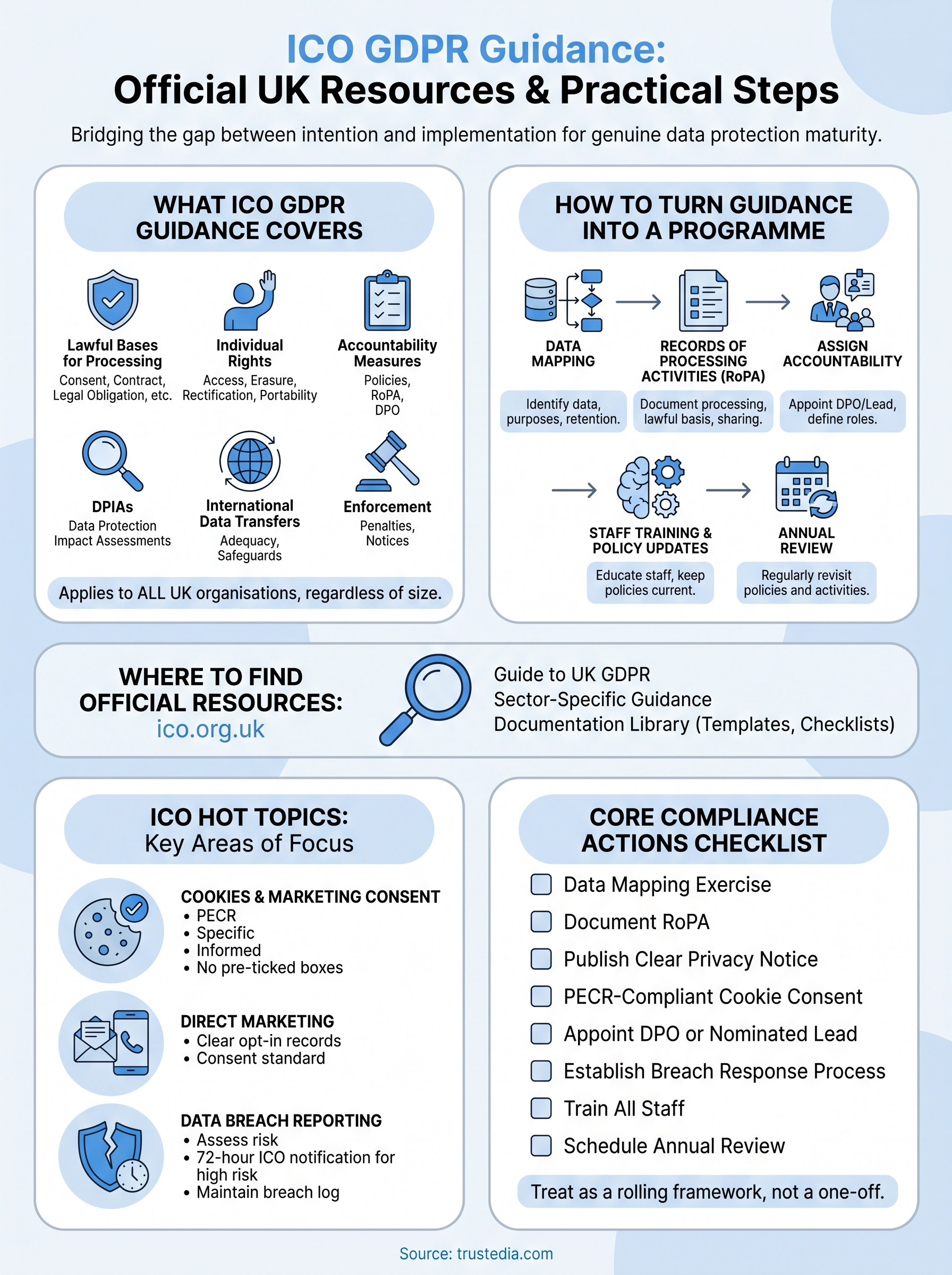
The ICO GDPR guidance spans the full lifecycle of personal data handling. It addresses lawful bases for processing, data subject rights, accountability measures, data protection impact assessments (DPIAs), international data transfers, and enforcement. Think of it as the definitive reference for any decision your organisation makes about how it collects, stores, uses, or shares personal data.
The scope of UK GDPR requirements
UK GDPR applies to any organisation that processes personal data about individuals in the UK, regardless of where the organisation itself is based. The ICO’s guidance covers the six lawful bases for processing in detail, helping you identify which applies to each activity. It also explains the rights individuals hold over their data, including access, erasure, rectification, and portability.
Getting your lawful basis wrong at the start is one of the most common compliance mistakes, because it affects almost every downstream decision you make about that data.
Beyond the basics, the guidance addresses special category data, such as health information, biometrics, and criminal records, which entail stricter obligations and require explicit justification before processing.
Who needs to read it?
If your organisation handles any personal data, the ico gdpr guidance applies to you. This includes sole traders, SMBs, large enterprises, charities, and public sector bodies. The obligation does not scale with company size. A five-person business that collects customer email addresses operates under the same legal framework as a multinational handling millions of records.
Decision-makers, including IT Managers, Compliance Officers, Marketing leads, and HR professionals, all carry specific obligations under UK GDPR, and the ICO publishes role-specific guidance to help each function understand its responsibilities without wading through the full legislation.
Where to find the official ICO UK GDPR resources
The ICO publishes all its official documentation on ico.org.uk, structured around topic areas rather than legislation chapters. This makes navigation practical if you know what you’re looking for. The ICO GDPR guidance is in the UK GDPR section, which you can access directly from the homepage under “For organisations.”
The ICO’s Guide to UK GDPR
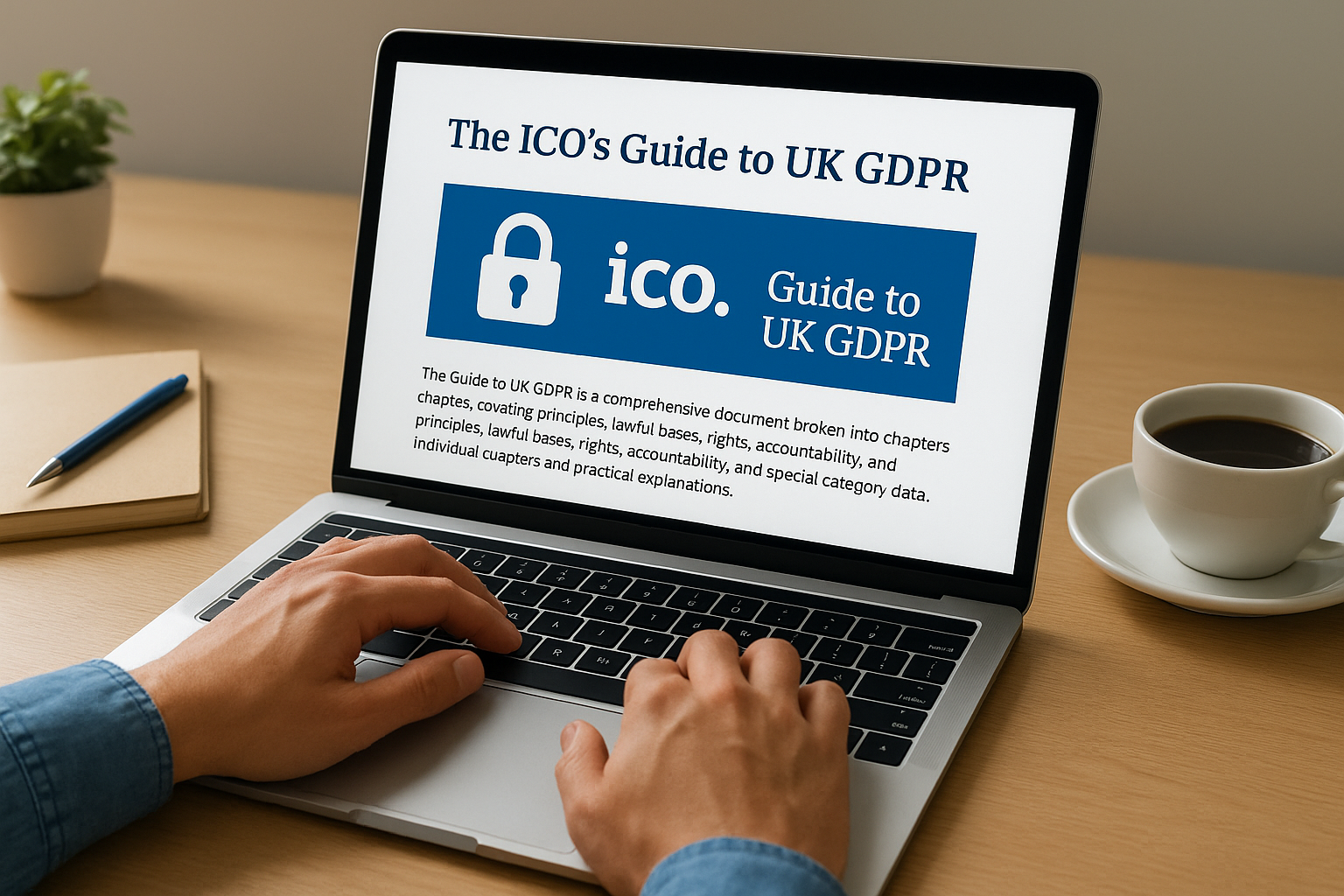
Your starting point should be the Guide to UK GDPR, a comprehensive document broken into chapters covering principles, lawful bases, rights, accountability, and special category data. Each chapter includes worked examples and practical explanations that go well beyond a plain reading of the legislation. You can bookmark individual chapters and return to them as specific questions arise within your organisation.
The ICO also maintains a documentation library with templates, checklists, and self-assessment tools you can download and adapt for your own compliance work.
Sector-specific guidance
Beyond the main guide, the ICO publishes sector-specific resources for industries including health, education, finance, and law enforcement. Reading the sector guide alongside the main resource gives you a much clearer picture of your organisation’s specific obligations, particularly where your data flows carry higher risk. Key sector pages to check include:
- Health and social care
- Education and child protection
- Financial services
- Employment and HR data handling
How to turn ICO guidance into a compliance programme
Reading the ico gdpr guidance is only the first step. Turning that reading into a working compliance programme requires a structured approach that maps requirements to your actual data processing activities. Start by conducting a data mapping exercise to identify every category of personal data your organisation holds, why you hold it, and how long you retain it.
Without an accurate data map, no compliance programme will reflect your real-world risk.
Build your records of processing activities
The UK GDPR requires most organisations to maintain Records of Processing Activities (RoPA), a living document that captures what data you process, the lawful basis for each activity, and any third-party data sharing. Your RoPA becomes the backbone of your compliance programme and the first document the ICO will request during an investigation.
Each entry should cover the purpose of processing, data categories, retention periods, and any external recipients. Review it at least annually, or whenever a new processing activity begins.
Assign accountability within your team
Designating clear ownership for data protection tasks prevents compliance work from falling through the cracks. Appoint a Data Protection Officer (DPO) or nominated lead responsible for monitoring adherence, handling subject access requests, and reporting breaches within the ICO’s required timeframes.
Your nominated lead should also coordinate staff training and policy updates, ensuring your organisation keeps pace with any changes the ICO publishes to its guidance.
ICO hot topics: cookies, marketing, and breach reporting
Three areas consistently draw ICO enforcement action: cookies, direct marketing, and data breach reporting. The ico gdpr guidance on each topic is detailed and regularly updated, so checking the ICO’s dedicated pages rather than relying on general summaries is worth prioritising.
Cookies and marketing consent
Your website’s cookie banner and consent mechanism must meet the ICO’s specific requirements under PECR (Privacy and Electronic Communications Regulations), which works alongside UK GDPR. Consent must be freely given, specific, and informed before any non-essential cookies fire.
Pre-ticked boxes and “legitimate interests” as a lawful basis do not apply to cookies under PECR. The same consent standard applies to direct marketing emails and SMS, where you must maintain clear opt-in records for every contact on your list.
Failing to meet the ICO’s consent requirements is one of the most consistent triggers for enforcement notices against UK businesses.
Reporting a data breach
When a personal data breach occurs, UK GDPR requires you to assess its risk to individuals immediately. If the breach is likely to result in risk to people’s rights and freedoms, you must notify the ICO within 72 hours of becoming aware of it. High-risk breaches also require direct notification to affected individuals.

Maintaining a breach log for all incidents, whether reported or not, is a legal obligation and strengthens your overall accountability position.
A practical UK GDPR checklist for busy organisations
Even with the ico gdpr guidance bookmarked, day-to-day compliance can slip without a clear reference point. The checklist below provides a quick, structured overview of the core actions your organisation should have addressed, regardless of size or sector.
Core compliance actions to complete
Use this checklist to audit your current position and identify gaps before they become enforcement issues. Each item maps to a specific obligation under the UK GDPR or PECR, so ticking them off confirms that your programme covers the minimum required foundations.
- Complete a data mapping exercise covering all personal data categories your organisation holds
- Document your Records of Processing Activities (RoPA) with lawful bases confirmed for each activity
- Publish a clear and accurate privacy notice on your website and at every data collection point
- Confirm your cookie consent mechanism meets PECR requirements, with no pre-ticked boxes.
- Appoint a Data Protection Officer or nominated lead with defined responsibilities
- Establish a breach response process with a 72-hour ICO reporting window built in
- Train all staff who handle personal data on their specific obligations
- Schedule an annual review of all policies and processing activities
Completing this checklist once is not enough. Treat it as a rolling framework you revisit whenever your business processes, technology stack, or data flows change in any meaningful way.
Key takeaways and next steps
The ico gdpr guidance gives you everything you need to build a working compliance programme, but the resource only delivers value when you act on it. Start with the ICO’s Guide to UK GDPR, map your data, document your lawful bases, and assign clear ownership for ongoing compliance tasks. These are not one-off exercises; they require regular review as your organisation and its data flows change.
Regulatory pressure on UK businesses continues to rise, and the ICO has made it clear it will take enforcement action against organisations of all sizes. Waiting until a breach or complaint occurs before reviewing your position is a risk you cannot afford to carry.
Frequently Asked Questions:
Authority and Scope of ICO GDPR Guidance:
The ICO’s GDPR guidance is the definitive resource for UK organisations seeking to achieve data protection compliance, covering every stage of personal data handling and addressing key topics such as lawful bases, data subject rights, and breach reporting.
Who Needs to Read the Guidance:
Any organisation that processes personal data in the UK, regardless of size or sector, including sole traders, SMBs, charities, and public bodies, must understand and implement the ICO’s GDPR guidance.
Accessing Official ICO Resources:
The ICO provides comprehensive documentation, including the main ‘Guide to UK GDPR,’ sector-specific guides, templates, and checklists, all accessible on its website, to help organisations navigate compliance requirements.
Turning Guidance into Practical Compliance:
Organisations should conduct data mapping, maintain Records of Processing Activities (RoPA), assign accountability, and develop breach-response procedures to translate ICO guidance into an effective compliance program.
Key Compliance Areas and Practical Steps:
Core actions include data mapping, policy documentation, cookie consent validation, staff training, and regular reviews, which together form the minimum foundation for GDPR compliance and progressively strengthen data protection maturity.
If you need support translating these requirements into a practical, auditable compliance framework, TrustedIA works with organisations across the UK to do exactly that. Find out how our team can support your compliance goals at TrustedIA cybersecurity managed services.



