A network penetration testing guide matters because too many organisations treat pen testing as a checkbox exercise, something they do once a year to satisfy an auditor, then forget about it until the next review. That approach leaves gaps. Real attackers don’t follow audit schedules, and the businesses that understand this are the ones that actually improve their security posture over time.
At TrustedIA, we run penetration tests as part of our managed security services and ISO 27001 compliance support. We’ve seen first-hand how a well-scoped test uncovers risks that vulnerability scans alone miss, and how a poorly planned one wastes time and budget. That experience shapes everything in this guide, from the types of pen testing we break down to the methodology we walk through.
This article covers what network penetration testing is, the different types (internal, external, black box, white box, grey box), the phases a tester follows from reconnaissance to reporting, and the tools used at each stage. Whether you’re commissioning your first test or looking to strengthen an existing programme, you’ll leave with a clear, practical understanding of how the process works and what to expect.
Why network penetration testing matters
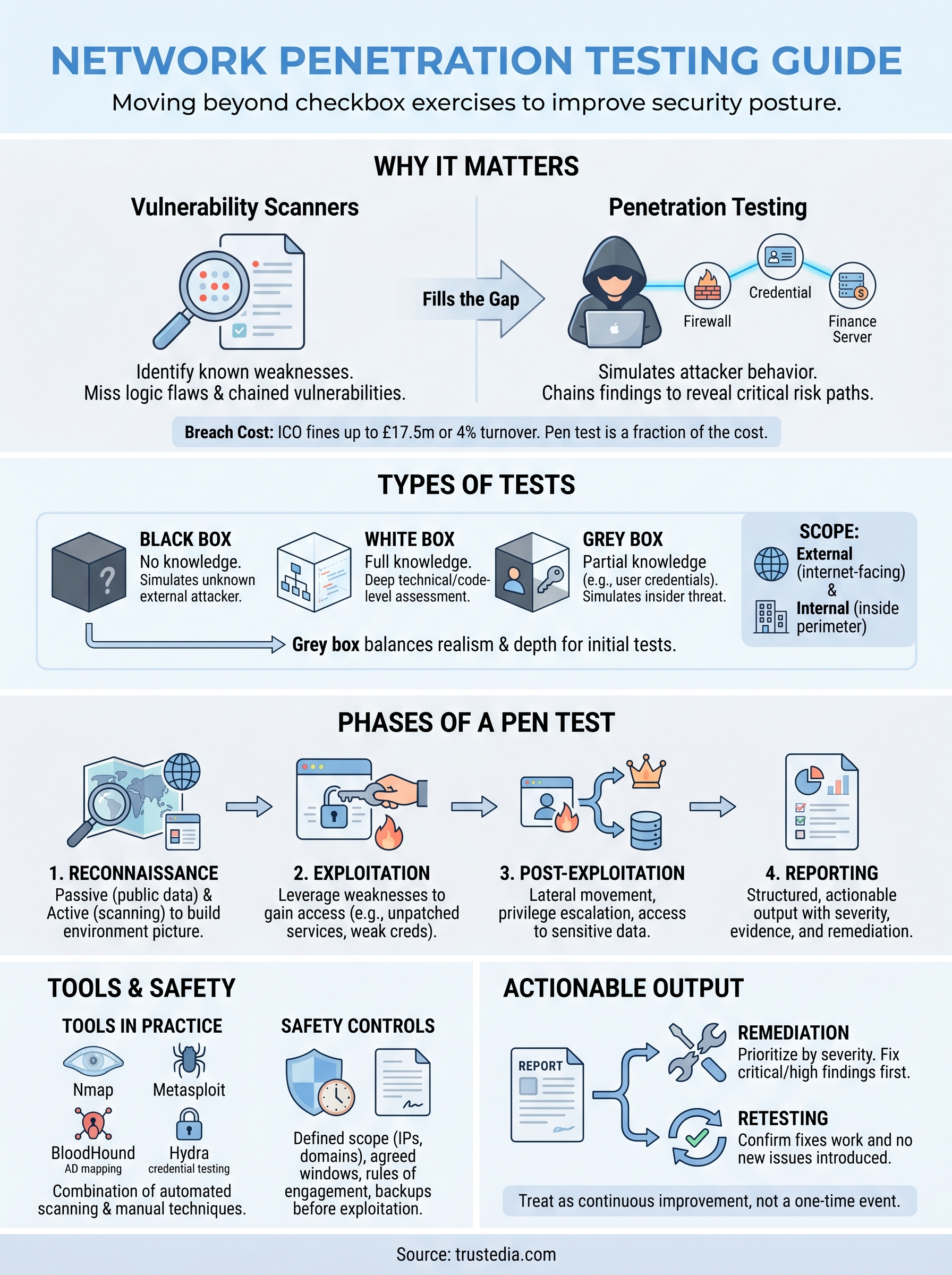
Most organisations run vulnerability scanners regularly and assume that covers their exposure. It doesn’t. Scanners identify known weaknesses in software versions and configurations, but they don’t think like an attacker. They don’t chain findings together, they don’t test whether a misconfigured firewall rule can be combined with a weak credential to reach your finance server, and they don’t adapt when they hit a dead end. Network penetration testing fills that gap by putting a real person, or a skilled team, in the role of the attacker and asking them to get in by any means available within an agreed scope.
The cost of a breach versus the cost of a test
A single data breach costs UK businesses far more than most expect. The UK Information Commissioner’s Office (ICO) can issue fines of up to £17.5 million or 4% of global annual turnover under UK GDPR, whichever is higher. That figure doesn’t include operational downtime, legal fees, reputational damage, or the cost of notifying affected customers. A penetration test costs a fraction of that, and it gives you the information you need to close vulnerabilities before an attacker exploits them.
The question isn’t whether your business can afford a penetration test. It’s whether it can afford to skip one.
What penetration testing reveals that scanners miss
Automated tools work from a list. They compare what they find against a database of known vulnerabilities and flag matches. That’s useful, but it misses logic flaws, weak authentication patterns, overly permissive access controls, and the kind of lateral movement an attacker uses once they’re inside your network. A skilled penetration tester thinks about how findings connect, and that chain of connected findings is often where the real risk sits.
Take a common example: a scanner flags an outdated service running on an internal server as medium severity and stops there. A penetration tester notices that the same server holds a trust relationship with a domain controller, and that the outdated service is exploitable without credentials. What the scanner marked as medium is actually a critical path to your most sensitive systems, and without a human-led test, that chain of risk stays invisible until an attacker finds it first.
How penetration testing supports compliance and governance
If you’re working towards [ISO 27001 certification](https://www.trustedia.com/types-of-cyber-security-audits/) or maintaining compliance with frameworks like Cyber Essentials Plus, penetration testing isn’t optional; it’s expected. ISO 27001 Annex A includes controls around vulnerability management and technical reviews, and auditors want to see evidence that you’ve tested your controls, not just documented them. Penetration testing provides that evidence in a form that stands up to scrutiny.
Beyond compliance, a well-run test strengthens your position with cyber insurers. Insurers are asking harder questions about security posture at renewal, and businesses that can demonstrate a regular, documented testing programme are better placed to negotiate favourable terms. Whether you’re reading this network penetration testing guide to prepare for your first engagement or to sharpen an existing security programme, understanding why testing matters is the foundation on which everything else builds.
Types of network penetration tests
Not all penetration tests look the same, and choosing the wrong type for your situation wastes budget and leaves blind spots in your security coverage. Before you engage a testing provider, you need to understand two main dimensions that define any network penetration test: the network boundary being tested (external or internal), and the level of knowledge given to the tester (black box, white box, or grey box). Getting this decision right from the start determines how useful your results will be.
External and internal tests
An external penetration test targets the systems and services your organisation exposes to the internet, such as web applications, email servers, VPNs, and firewalls. The tester operates from outside your network, exactly as an attacker with no prior access would. This type of test answers a specific question: can someone on the internet break in, and if so, how far could they get?
Internal penetration testing starts from inside your network and simulates what happens after an attacker gains a foothold, whether through phishing, a compromised credential, or a rogue device on your premises. This is where lateral movement, privilege escalation, and access to sensitive internal systems get tested. Many organisations run external tests regularly but skip internal ones, which means they never discover how far an attacker could reach once past the perimeter.
Black box, white box, and grey box
The level of knowledge you give a tester directly affects what they find and how long the engagement takes. Each approach suits a different scenario, and the right choice depends on what you’re trying to learn about your environment and how closely you want to simulate a real attack.

| Test type | What the tester knows | Best used for |
|---|---|---|
| Black box | Nothing about your environment | Simulating an unknown external attacker |
| White box | Full access to documentation, architecture, and credentials | Deep technical review or code-level assessment |
| Grey box | Partial information, such as user-level credentials | Simulating an insider threat or a phished employee |
Grey box testing often delivers the best balance of realism and depth, particularly for organisations working through a network penetration testing guide for the first time.
Most organisations benefit from starting with a grey-box external test, then layering in internal and white-box assessments as their security programme matures. Your testing provider should help you match the type to your specific risk profile rather than defaulting to the same approach every engagement cycle.
Phases of a network penetration test
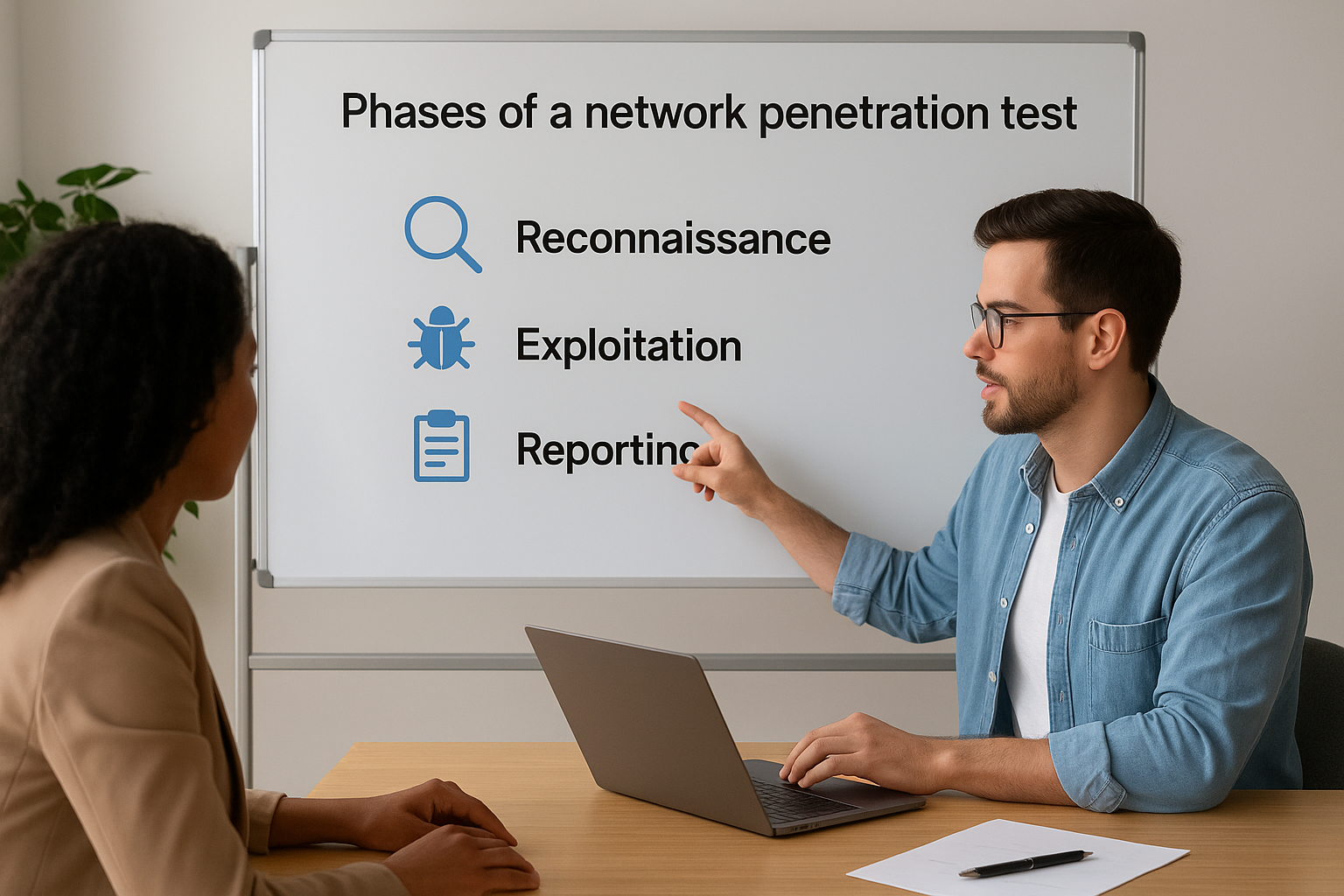
Every network penetration test follows a structured sequence of phases, regardless of the type or scope you’ve agreed. Understanding these phases helps you set realistic expectations with your provider, ask the right questions during the engagement, and make sense of the findings when the report lands. Skipping or rushing any phase weakens the entire exercise and reduces the value you get from the investment.
Reconnaissance and scanning
Reconnaissance is where the tester builds a picture of your environment before touching anything directly. In the passive stage, they gather information from public sources: DNS records, domain registration data, job postings, and publicly exposed infrastructure. This mirrors exactly what an attacker does before launching a targeted attack. In the active stage, the tester begins direct interaction with your systems, using port scanning and service enumeration to identify what’s running, what versions are in use, and where the attack surface sits.
The reconnaissance phase often surfaces sensitive information your organisation didn’t realise was publicly accessible, making it one of the most immediately actionable stages in any network penetration testing guide.
Exploitation and post-exploitation
Once the tester has a clear map of your environment, they move into exploitation, attempting to leverage identified weaknesses to gain unauthorised access. This might involve exploiting an unpatched service, testing default credentials, or combining several lower-severity findings into a viable attack path. The goal isn’t destruction; it’s demonstrating real-world impact in a controlled way.
Post-exploitation is where many engagements reveal the most serious risks. After gaining initial access, the tester explores how far they can move laterally through your network, whether they can escalate privileges, pivot to other systems, or reach sensitive data such as domain controllers, backups, or financial records. This phase answers the question your board actually cares about: if someone gets in, how bad does it get?
Reporting
The final phase converts everything the tester found into structured, actionable output that your team can use. A good report separates findings by severity, explains how each vulnerability was discovered and exploited, maps each finding to a business risk, and provides clear remediation guidance. Technical findings should be readable by your IT team, while an executive summary should be usable by senior leadership without a security background. The report is the deliverable you’ll reference during remediation, retesting, and any future audit or compliance review.
Tools and techniques you will see in practice
The tools a penetration tester reaches for depend on the phase they’re working through, but understanding the common categories helps you evaluate whether your provider is doing thorough work or cutting corners. No single tool covers everything, and experienced testers use a combination of automated scanning and manual techniques to build a complete picture of your environment. Knowing what to expect also makes it easier to have informed conversations with your provider before and during the engagement.
Reconnaissance and scanning tools
During reconnaissance, testers rely on tools that map your attack surface without triggering alerts. Nmap is the most widely used network scanner; it identifies open ports, running services, and software versions across your infrastructure. Testers also use Shodan and Censys to find internet-facing assets your own team may have forgotten about, such as exposed management interfaces or legacy systems still reachable from the outside. OSINT frameworks like Maltego help trace publicly available relationships between domains, IP ranges, and personnel.
Discovering that a forgotten server is still internet-facing during reconnaissance is exactly the kind of finding that separates a real penetration test from a basic vulnerability scan.
Exploitation frameworks and credential testing
Once the tester moves into exploitation, Metasploit is the framework you’ll see referenced most in reports. It provides a structured environment for launching and managing exploits against identified vulnerabilities, and it’s used legitimately by security professionals across the industry. For credential testing, tools like Hydra and Medusa perform controlled brute-force attempts against login interfaces to identify weak or default passwords. These aren’t used recklessly; they operate within the scope and rules agreed before the engagement starts.
Post-exploitation work leans on tools like BloodHound, which maps Active Directory relationships to show how an attacker could escalate privileges through existing trust paths in your network. Mimikatz is another tool testers use to demonstrate credential extraction from memory on Windows systems, highlighting whether your detection controls would catch this activity in practice. Any solid network penetration testing guide should acknowledge that the tools themselves aren’t the risk; it’s the gaps they expose that matter, and your job after the engagement is to close them.
Scoping, rules of engagement, and safety
Before a tester runs a single scan, you and your provider need to agree on exactly what is in scope, what is out of scope, and what happens if something goes wrong during the engagement. Getting this wrong creates real risk: systems tested without proper authorisation can cause outages, and findings from an unscoped test are difficult to defend in a compliance audit. A solid scope agreement protects both sides and sets the conditions for a test that actually reflects your real environment.
Defining your scope
Your scope document should specify the exact IP ranges, domain names, and systems that the tester is authorised to target. If you exclude certain systems because they’re production-critical or managed by a third party, say that explicitly. Ambiguity leads to either a tester avoiding useful areas out of caution or, worse, touching systems they shouldn’t. Most organisations find it helpful to provide an asset inventory before the engagement starts so the tester can identify gaps in their own visibility alongside any vulnerabilities they find.
Vague scoping is one of the most common reasons a network penetration testing guide doesn’t translate into a useful real-world engagement; specificity protects your business and improves the quality of findings.
Your scope should also define agreed testing windows, particularly for internal engagements where active exploitation could affect system stability. If your provider plans to run any resilience tests that simulate denial-of-service conditions, your operations team needs to know when and be on standby. Scheduling active phases outside business hours reduces availability risk and gives your team time to respond if anything behaves unexpectedly.
Rules of engagement and safety controls
Rules of engagement go beyond the scope document and cover how the tester behaves throughout the engagement. This includes what happens if they discover a critical vulnerability mid-test, whether social engineering is permitted, and how they communicate findings in real time. Your provider should provide a named point of contact available throughout the engagement, and you should have a clear escalation path if something needs to be stopped immediately.

Safety controls are the technical safeguards that prevent a test from causing unintended damage. These include snapshot backups taken before exploitation attempts on sensitive systems, agreed rollback procedures, and written confirmation that destructive techniques are excluded unless you explicitly authorise them. Treat these controls as non-negotiable before any engagement begins.
Deliverables, remediation, and retesting
The report you receive at the end of an engagement is only valuable if it drives action. Too many organisations file the document away after a quick read and never close the vulnerabilities it identifies. Every network penetration testing guide should be clear on this point: the report is the starting line for your security improvement work, not the finish line. What you do with it in the weeks that follow determines whether the engagement delivered real value or just a paper record.
What a good report contains
A well-structured penetration test report gives your IT team and senior leadership everything they need without requiring them to read the same document twice. Technical findings should sit alongside business-impact statements so a CISO or board member can understand why a given vulnerability matters, not just what it is. Every finding should include a severity rating, a description of how it was exploited, evidence such as screenshots or output logs, and a specific remediation recommendation rather than a generic suggestion to “patch and review.”
A strong report typically covers the following components:
- Executive summary with overall risk rating and top findings
- Detailed technical findings with evidence and exploit paths
- Business risk mapping linking each finding to operational impact
- Prioritised remediation steps ordered by severity and effort
- Methodology overview explaining how the test was conducted
Ask your provider whether their report format maps findings to a recognised framework such as CVSS scoring or MITRE ATT&CK; this makes it far easier to communicate risk to auditors and insurers.
Remediation and retesting
Once your team receives the report, prioritise remediation by severity, not convenience. Critical and high findings that provide a direct path to sensitive systems need to be addressed first, even if they require more effort than the lower-severity items. Your provider should be available during this phase to clarify findings and advise on remediation approaches if your internal team needs guidance; this is a reasonable expectation and worth confirming before you sign the engagement.
Retesting is the step most organisations skip, and it significantly weakens the value of the original engagement. After your team addresses the identified vulnerabilities, a targeted retest confirms that the fixes work as intended and haven’t introduced new issues during remediation. Treat retesting as a mandatory part of the cycle, not an optional extra.
Next steps
This network penetration testing guide has walked you through everything from choosing the right test type to what a strong remediation cycle looks like. The core principle running through all of it is straightforward: a penetration test only delivers value when you treat it as a continuous improvement tool, not a one-time event. Properly scoping it, acting on the report, and retesting after remediation are what separate organisations that genuinely reduce risk from those that merely collect documents.
Your next move is to get an honest assessment of where your current security programme stands. If you haven’t run a penetration test recently, or if your last engagement didn’t produce findings your team could actually act on, that’s a clear signal to change your approach. TrustedIA works with businesses across the UK to scope, run, and follow through on meaningful penetration testing engagements. Talk to our team to find out where your network exposure actually sits.