Ask five people in your business what a vulnerability actually is and you’ll likely get five different answers. Some confuse it with a threat, others with the risk itself, and that confusion costs real money when it shapes how you prioritise patching, spending, and audits. Understanding risk management vulnerability properly is not academic; it’s the difference between fixing what actually matters and chasing whatever alert fired most recently.
A vulnerability is simply a weakness, a gap in your systems, processes, or people that something else can exploit. It only becomes dangerous when paired with a threat capable of exploiting it and an impact worth worrying about. That combination is what produces risk. Get this distinction right and your entire security programme becomes sharper and easier to justify to the board.
This article breaks down what vulnerability means within risk-based vulnerability management, how it sits alongside threat and risk in practice, and why treating them as separate ideas changes how you assess and reduce exposure. We’ll also look at how this thinking plays out in real cybersecurity programmes, including ours at TrustedIA.
Why vulnerability matters in risk management
Understanding vulnerability in risk management starts with a hard truth: without vulnerabilities, threats have nothing to work with. A determined attacker with every tool going gets nowhere against a system with no exploitable weaknesses. That’s why vulnerability sits at the centre of any serious risk conversation. It’s the raw material that turns intent into incident, and the one variable your business actually has direct control over. You can’t stop criminals wanting to attack you, but you can close the gaps they’d use to do it.

A vulnerability is the one part of the risk equation you can actually control, so it deserves the most attention.
The link between vulnerability and business exposure
Businesses that treat vulnerability tracking as a box-ticking exercise usually discover the cost later, when an incident forces the issue. Every unpatched server, misconfigured firewall, or untrained employee is a small door left ajar. Most stay closed simply because nobody’s tried them yet, not because they’re secure. That’s a dangerous position to build a security strategy on. Once you start mapping vulnerabilities properly, patterns emerge fast: the same weak points show up in the same systems, the same departments skip the same training, and the same legacy software keeps causing headaches long after it should have been retired.
What happens when vulnerability management slips
Organisations that lose track of their vulnerabilities tend to see the same set of consequences play out, regardless of size or sector:
- Patch backlogs grow silently. Teams focus on new alerts while older, unresolved vulnerabilities pile up in the background, often for months, which is one reason the difference between patch management and vulnerability management matters.
- Audit findings repeat year after year. The same gaps get flagged in every ISO 27001 or Cyber Essentials review because nobody actioned them the first time.
- Incident response takes longer. Without a clear map of known weaknesses, responders spend the first hours of a breach figuring out what went wrong instead of containing it.
- Insurance and compliance costs rise. Insurers and auditors increasingly ask for evidence of vulnerability management, and gaps here can affect premiums or certification outcomes.
- Board confidence erodes. Repeated incidents traced back to known, unaddressed weaknesses make it hard to justify future security spend.
Government guidance backs this up. The National Cyber Security Centre points out that most successful attacks exploit vulnerabilities that were already known and, in many cases, already had a fix available. That’s not a technology failure. It’s a process failure, and it’s entirely preventable with the right visibility.
Turning vulnerability data into decisions
Collecting vulnerability data is only useful if it changes what you do next. A spreadsheet full of CVE numbers means little to a board without context on which ones threaten revenue, customer trust, or regulatory standing, which is why dashboards that track vulnerabilities are built around business impact rather than raw counts. This is where risk-based thinking, the kind that underpins a proper cyber risk assessment, earns its keep. Ranking vulnerabilities by their real-world exploitability and business impact, rather than by severity score alone, lets you spend limited time and budget where it actually reduces exposure. A critical-rated flaw on an isolated test server matters far less than a medium-rated one on a customer-facing payment system.
Teams that get this right build vulnerability data into their wider risk register, not as a separate IT concern but as a business input alongside financial, operational, and reputational risk. That’s the approach we take at TrustedIA when running vulnerability assessments for clients: the goal isn’t a long list of findings, it’s a prioritised action plan tied to what actually keeps the business running. Vendors selling scanning tools rarely frame it that way, because their job ends at the report. Ours starts there.
Getting this right also changes conversations with insurers, auditors, and customers who ask about your security posture. Showing that you actively identify, prioritise, and remediate vulnerabilities, rather than reacting only after something breaks, is one of the clearest signals of a mature security programme. It’s also, increasingly, a contractual requirement rather than a nice-to-have.
Vulnerability, risk and threat: how they differ

Most confusion around risk management vulnerability comes down to three words being used interchangeably when they describe completely different things. A vulnerability is a weakness. A threat is whoever or whatever might exploit that weakness. Risk is the likely outcome if the two meet, measured against what it would actually cost you. Keeping these separate isn’t pedantry; it changes what you measure, what you report to the board, and what you spend money fixing.
Confusing vulnerability with risk means you end up fixing the wrong things in the wrong order.
Breaking down the three terms
Think of an unlocked back door. The unlocked door is the vulnerability, a gap that exists whether or not anyone ever tries it. A burglar walking the street is the threat, the actor with intent and capability. Risk is what happens when you multiply the chance that burglar tries your door by the value of what’s inside your house. Remove the vulnerability and the threat becomes irrelevant, because there’s nothing to exploit. Reduce the threat and the vulnerability still exists, waiting for the next opportunist to find it. Only by addressing both, and understanding the potential impact, do you actually manage the risk.
| Term | What it is | Example | Who controls it |
|---|---|---|---|
| Vulnerability | A weakness in a system, process, or person | Unpatched software, weak password policy | Your organisation, largely |
| Threat | An actor or event capable of exploiting a weakness | Ransomware gang, disgruntled employee, natural disaster | Outside your direct control |
| Risk | The likely impact if a threat exploits a vulnerability | Financial loss, downtime, reputational damage | Managed through both vulnerability and threat controls |
Why the distinction changes your priorities
Security teams that conflate these terms tend to chase headlines instead of exposure. A newly disclosed zero-day makes for an alarming threat, but if it targets software your business doesn’t run, the vulnerability doesn’t exist for you and the risk is zero. Meanwhile, a boring, unglamorous misconfiguration sitting quietly on a customer database for two years might carry far greater risk than anything trending in the security press that week. Separating vulnerability in risk management from sector-relevant threat intelligence lets you judge each on its own merits rather than letting noise dictate your workload.
Teams that get this right build their risk register around all three layers, not just one. You track vulnerabilities as an ongoing inventory, monitor the threat landscape relevant to your sector, and calculate risk as the product of both against realistic business impact, which is threat and vulnerability management in practice. That’s the model we apply during a cybersecurity audit at TrustedIA, where clients often arrive assuming their biggest exposure is the newest vulnerability scanner finding, when it’s actually a threat they’ve never modelled against a weakness they’ve had for years.
How to identify and assess vulnerabilities
Finding vulnerabilities is only half the job. You need a repeatable way to surface them and then judge which ones actually matter to your business. Most organisations start with tools and stop there, which leaves them with a pile of findings and no clear sense of what to fix first. Identifying vulnerabilities in risk management properly means combining automated discovery with human judgement about context, exposure, and what a failure would actually cost.
Discovery methods that actually work
No single tool catches everything, so a proper identification process layers several approaches together:
- Vulnerability scanning. Automated tools sweep networks, endpoints, and applications for known weaknesses, missing patches, and misconfigurations, and it’s worth understanding the difference between internal and external scanning before you rely on either. Good for breadth, weak on context.
- Penetration testing. What a pen test involves is skilled testers attempting to exploit weaknesses the way a real attacker would, revealing chains of small issues that scanners miss individually.
- Configuration reviews. Manual checks against hardening standards catch settings that scanners often overlook, like overly permissive access rights or forgotten admin accounts.
- Phishing simulations. These test the human layer, exposing which staff and departments need training rather than technical fixes.
- Dark web monitoring. Surfacing leaked credentials or exposed company data before criminals use them against you.
Running these together, rather than relying on one, gives you a far more complete picture of where the gaps actually sit. That combination is exactly what we build into our vulnerability assessment work and penetration testing at TrustedIA, because scanning alone tends to miss the weaknesses that matter most.
A vulnerability scan tells you what’s broken. Only proper assessment tells you what’s worth fixing first.
Assessing severity and business context
Once you’ve found a list of weaknesses, scoring them correctly is where most teams go wrong. A generic severity rating from a scanner ignores whether the affected system holds customer data, sits on the open internet, or connects to anything critical. Assessing vulnerability in risk management properly means asking three questions about every finding: how easily could it be exploited, what would an attacker gain if it were, and how exposed is it right now. A high-severity flaw on an internal test box behind three layers of network segmentation carries less real risk than a moderate one sitting on a public-facing login page.
Teams that skip this step end up patching in the wrong order, fixing what looks scary on paper while leaving quieter, more exploitable gaps untouched. Building this assessment into a regular cycle, following the steps for running a vulnerability assessment properly, matters just as much as the initial discovery. Threats evolve, new software gets deployed, and yesterday’s low-priority finding can become tomorrow’s open door if the surrounding environment changes. Regular reassessment, not a single audit, is what keeps a vulnerability list honest and useful.
How risk-based vulnerability management works
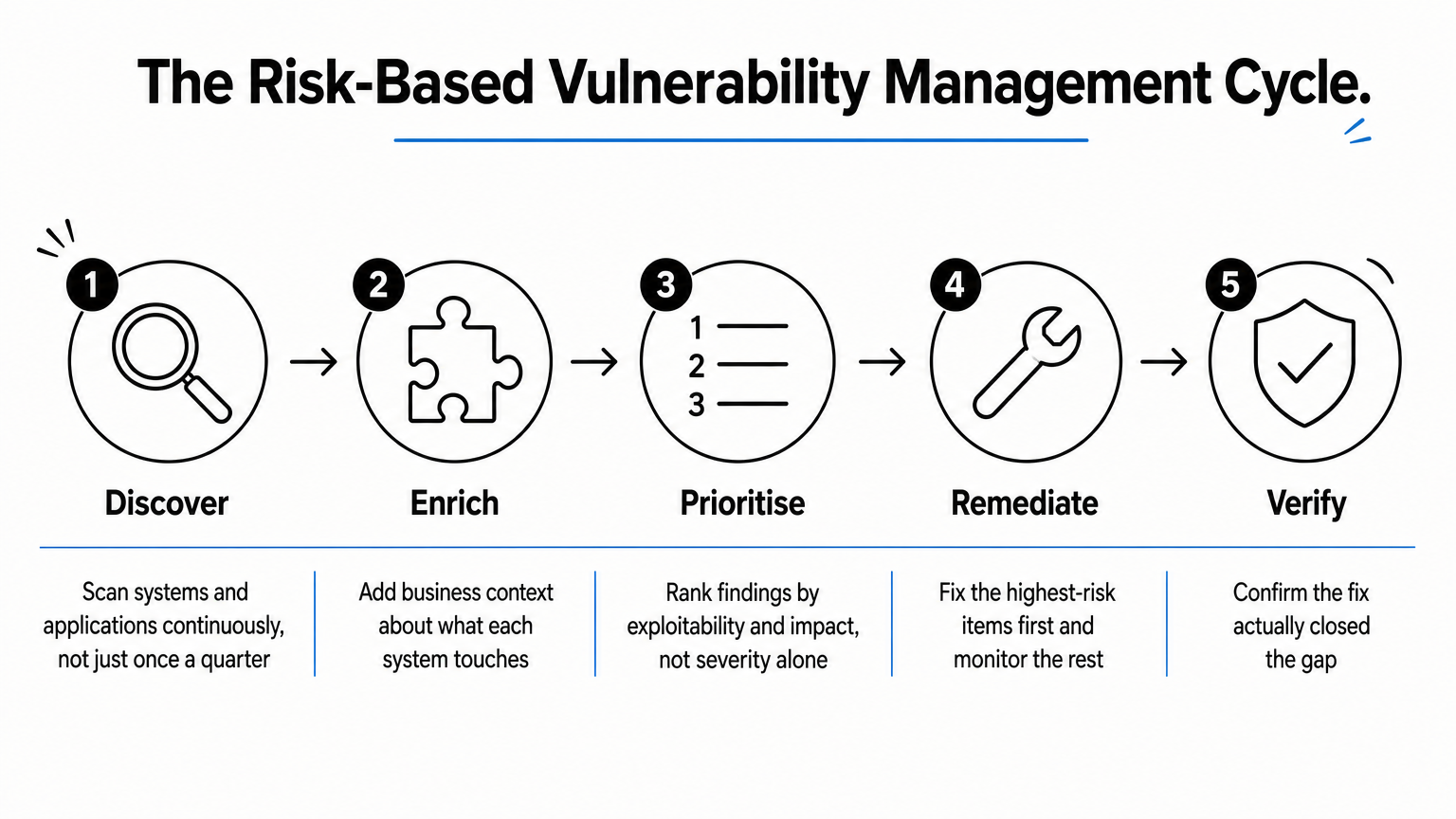
Traditional vulnerability management treats every finding the same way: scan, list, patch in order of severity score, repeat. Risk-based vulnerability management flips that logic. Instead of working through a list top to bottom, you rank findings by the actual damage they could cause your specific business, then fix in that order. Two organisations running identical software can have wildly different risk profiles depending on what’s exposed to the internet, what data sits behind it, and how quickly a fix could realistically be deployed. This is the model most mature security teams have moved to, it underpins the NIST vulnerability management framework, and it’s the one we build into every engagement at TrustedIA.
The stages of a risk-based cycle
A working risk-based programme runs on a repeating cycle rather than a single project with an end date. Each stage feeds the next, and skipping one weakens the whole process:
- Discover. Scan systems, applications, and configurations continuously, not just once a quarter.
- Enrich. Add business context to each finding: what does this system touch, who relies on it, what data sits behind it.
- Prioritise. Rank findings by exploitability and impact, not raw severity score alone.
- Remediate. Fix the highest-risk items first, accepting or monitoring lower-risk ones deliberately rather than by accident.
- Verify. Confirm the fix actually closed the gap, rather than assuming a patch note means the job’s done.
- Reassess. Feed new discoveries and changed conditions back into the cycle, because the environment never stops moving.
Fixing vulnerabilities in the wrong order is often worse than not fixing them at all, because it burns time you needed for the risk that mattered.
Why context beats a raw severity score
A scanner might flag two vulnerabilities as equally critical, yet one sits on an internal server nobody’s touched in years while the other faces the open internet on a system holding customer payment data. Treating them the same wastes effort on the wrong target. Risk-based scoring pulls in factors a generic severity number can’t see: exposure, existing compensating controls, exploit availability, and what the business actually stands to lose.
| Approach | Prioritises by | Typical result |
|---|---|---|
| Traditional patching | Severity score alone | Time spent on low-impact fixes, real exposure left open |
| Risk-based vulnerability management | Exploitability and business impact | High-risk gaps closed first, resources matched to actual exposure |
Organisations shifting to this model usually find they’re already spending enough time on vulnerabilities, they’ve just been spending it on the wrong ones. Redirecting that same effort by risk, rather than volume, tends to cut real exposure faster than adding more headcount or tools. That’s the outcome a Security Operations Centre is built around: continuous visibility paired with prioritisation that reflects what actually matters to your business, not just what a dashboard flags as red.
Common types of vulnerabilities to watch for
Not every weakness looks like a piece of unpatched software. When you’re assessing risk management vulnerability across a business, you’re looking at technical gaps, process failures, and human behaviour all at once, because attackers don’t care which category a weakness falls into, only whether it gets them in. Grouping vulnerabilities this way helps you spot blind spots that a single scanning tool never will.

Technical and system weaknesses
Unpatched software remains the single most exploited category, and it’s the one the NCSC repeatedly flags as the root cause behind most successful breaches. Misconfigured cloud storage, exposed remote access ports, and default admin credentials left unchanged sit close behind. Legacy systems cause particular pain here, because vendors stop issuing patches long before businesses stop relying on the software, leaving a known gap that never closes.
The most dangerous vulnerabilities are rarely the newest ones. They’re the old ones nobody’s got round to fixing.
Human and process gaps
People remain the softest target in almost every environment, and no amount of technical control fixes that on its own. Phishing susceptibility tops the list, followed by weak or reused passwords, and staff who bypass security steps because they slow down their working day. Process failures compound this: no formal offboarding when someone leaves, no clear ownership of who patches what, and no defined escalation path when something looks wrong. Simulated phishing exercises consistently show the same pattern across clients: a small group of repeat clickers, usually in departments under the most day-to-day pressure, account for a disproportionate share of risk. That’s exactly the pattern an employee phishing test is designed to surface and correct.
A quick reference by category
| Category | Common examples | Typical exposure |
|---|---|---|
| Technical | Unpatched software, exposed ports, weak encryption | External attackers, automated exploit tools |
| Configuration | Default credentials, excessive permissions, open cloud storage | Both external and internal actors |
| Human | Phishing susceptibility, weak passwords, poor training | Social engineering, credential theft |
| Process | No offboarding, unclear ownership, slow patch cycles | Delayed detection, repeated incidents |
| Third-party | Unvetted suppliers, shared access, weak vendor controls | Supply chain compromise |
Third-party and supply chain exposure
Outsourced software, shared platforms, and supplier access all extend your attack surface well beyond systems you directly control. A vendor with lax security practices can hand an attacker a route straight into your network, regardless of how tightly you’ve locked down your own environment. Reviewing supplier access as part of your vulnerability in risk management process, rather than assuming it’s someone else’s problem, closes a gap that’s easy to overlook and increasingly common in real incidents. Treat every connected third party as an extension of your own attack surface, because that’s exactly how attackers see it.
Best practices for managing vulnerabilities effectively
Knowing the theory behind risk management vulnerability counts for little if your day-to-day process doesn’t hold up under pressure. The businesses that manage vulnerabilities well share a handful of habits, and none of them are complicated. They’re just consistently applied, which is where most programmes fall down.
Build a programme, not a one-off project
Setting up a scanning tool and running it once a year isn’t vulnerability management, it’s a snapshot that goes stale within weeks. Continuous scanning, paired with a defined owner for every stage of the process, keeps your risk register honest rather than aspirational. Someone needs to be accountable for triage, someone for remediation, and someone for verifying the fix actually worked. Without clearly defined vulnerability management responsibilities, findings drift for months because everyone assumes someone else is handling it.
A vulnerability programme without a clear owner is just a spreadsheet waiting to become an incident report.
Set remediation timelines that match real risk
Applying the same patching deadline to every finding, regardless of severity, either slows down critical fixes or burns effort on low-risk noise. Sensible programmes set tiered service level targets instead:
- Critical, internet-facing findings: fix within days, not weeks.
- High-risk internal systems: fix within a defined sprint cycle, typically two to four weeks.
- Medium and low findings: batch into scheduled maintenance windows rather than firefighting each one individually.
- Accepted risks: document why a finding isn’t being fixed and who signed off on that decision.
Written timelines also give you something concrete to show auditors and insurers, rather than a vague promise that things get "looked at eventually."
Keep training and testing continuous
One phishing simulation a year tells you almost nothing useful, whatever the nine steps for simulating phishing well would suggest about frequency. Repeated, varied simulations build a real picture of where human risk sits and whether training is actually changing behaviour, not just ticking a compliance box. The same logic applies to technical testing: annual penetration tests catch a moment in time, while combining them with ongoing vulnerability scanning and periodic configuration reviews catches drift as systems change throughout the year.
Involve leadership in the process
Vulnerability management fails quietly when it stays buried in IT and never reaches the board. Leadership needs visibility into open findings, remediation timelines, and accepted risks, because under any set of cyber security governance principles they’re the ones ultimately accountable for the fallout if something goes wrong. Regular, plain-language reporting, rather than raw scanner output, keeps that conversation productive instead of overwhelming.
Treat it as a partnership, not a purchase
Buying a scanning licence and calling it done misses the point entirely. Effective vulnerability management blends the right tools with people who understand your business context well enough to prioritise correctly. That’s the model we run at TrustedIA through our managed security services, pairing continuous monitoring with the judgement needed to turn findings into an actual reduction in exposure, not just a longer list.
The bigger picture on vulnerability and risk
Getting risk management vulnerability right comes down to one habit: treating vulnerability, threat, and risk as three separate things that only matter together. Vulnerabilities are the weaknesses you control. Threats are the actors you can’t. Risk is what happens when the two meet, measured against what it would actually cost your business. Everything in this article, from discovery methods to remediation timelines, exists to help you act on that distinction rather than just talk about it.
Businesses that build this thinking into a proper programme, rather than a once-a-year scan, spend their time and budget where it actually reduces exposure. That’s a completely different outcome to chasing whatever alert looks scariest that week.
If you want that visibility without building it all in-house, talk to TrustedIA about a vulnerability assessment of your IT systems with a prioritised remediation plan.