Every laptop, server, and mobile device connected to your network is a potential doorway for attackers. Traditional antivirus checks files against known threats and stops there, which leaves a gap for anything new, disguised, or already inside your systems. That gap is exactly where what is endpoint detection and response becomes a question worth answering properly, because the tools built to close it work very differently from the software most businesses grew up trusting.
In short, endpoint detection and response (EDR) is a security approach that continuously monitors devices for suspicious behaviour, records what happens, and gives your team the ability to investigate and contain threats before they spread. Rather than relying on a static list of known malware, EDR watches for patterns, such as unusual file access or unexpected network connections, that signal an attack in progress. It’s the difference between locking your front door and having a live security camera running inside the house.
This article breaks down how EDR actually works behind the scenes, what separates it from antivirus and other endpoint tools, and why it has become a baseline expectation for businesses managing real cyber risk rather than just ticking a compliance box.
Why endpoint detection and response matters
Attackers rarely smash through the front door anymore. Most breaches start quietly, a phishing email opens a backdoor, a stolen credential lets someone log in as a trusted user, and then nothing obvious happens for days or weeks. During that time, the intruder is exploring your network, escalating privileges, and identifying which files are worth stealing or encrypting. Endpoint detection and response exists precisely for that window, because it’s built to notice the small, odd behaviours that precede a full-blown incident, not just the moment malware finally executes.
The cost of staying blind to endpoint activity
Dwell time, the gap between an attacker gaining access and someone actually noticing, is where the real damage happens. According to the UK government’s Cyber Security Breaches Survey, a large share of businesses hit by a cyber attack in the past year didn’t identify the breach through internal detection at all; they found out from a third party or after the damage was already visible. Without continuous endpoint monitoring, you’re relying on luck or on the attacker making themselves obvious, and by then you’re usually looking at data loss, ransomware, or a costly recovery rather than a contained incident.
The businesses that recover fastest from a cyber attack are the ones that spotted it in hours, not weeks.
Regulatory and insurance pressure is rising
Boards, insurers, and auditors have caught up with this reality. Cyber insurance underwriters increasingly ask specific questions about endpoint detection and response tools before they’ll issue or renew a policy, and a growing number of frameworks expect it as a baseline control rather than a nice-to-have. If you’re working towards ISO 27001 certification, including the steps, costs and timeline involved, demonstrating that you can detect and respond to security events on your endpoints feeds directly into the standard’s requirements around monitoring, incident management, and continual improvement. TrustedIA’s clients pursuing certification often find that a proper EDR security deployment closes several audit gaps in one move, alongside our ISO 27001 professional services.
Why the stakes are different for SMBs
Smaller businesses sometimes assume attackers target only large enterprises. That assumption is backwards. Criminal groups run automated scans looking for any exposed endpoint, and smaller organisations often make easier targets because they lack a security operations team watching for anomalies around the clock. Recovering from a serious incident without EDR in place, meaning without a clear record of what happened, when, and how far it spread, can take weeks and cost far more than the tooling would have. That’s the gap our managed endpoint detection service is built to close, giving smaller teams the same visibility that larger organisations rely on.
Ultimately, EDR matters because it shifts your security posture from reactive to active. Instead of finding out about a breach when a customer complains or your systems grind to a halt, you get an alert while the attacker is still moving through your network, with enough evidence to understand exactly what they touched. That difference, hours instead of weeks, is what separates a contained incident from a genuine business crisis.

How endpoint detection and response works
Underneath the dashboard, how an EDR platform actually works comes down to a continuous loop of collecting data, analysing it, and acting on what it finds. A lightweight agent sits on every laptop, server, and endpoint device, quietly recording process activity, file changes, registry edits, and network connections. That raw telemetry gets shipped to a central platform, often cloud-based, where it’s compared against behavioural models and threat intelligence feeds rather than a fixed list of known malware signatures. This is what makes endpoint threat detection fundamentally different from older tools: it’s watching behaviour, not just checking a file’s name against a blacklist.
Behind that telemetry sits the analysis engine, and this is where the real value shows up. Machine learning models and rule sets flag anomalies such as a process trying to disable security software, a user account logging in from two countries within an hour, or a script quietly encrypting files in the background. Analysts on TrustedIA’s security operations centre review these alerts around the clock, filtering out noise so your team only sees the incidents that genuinely need attention.
A good EDR platform doesn’t just tell you something happened, it tells you exactly what happened, in what order, and where it started.
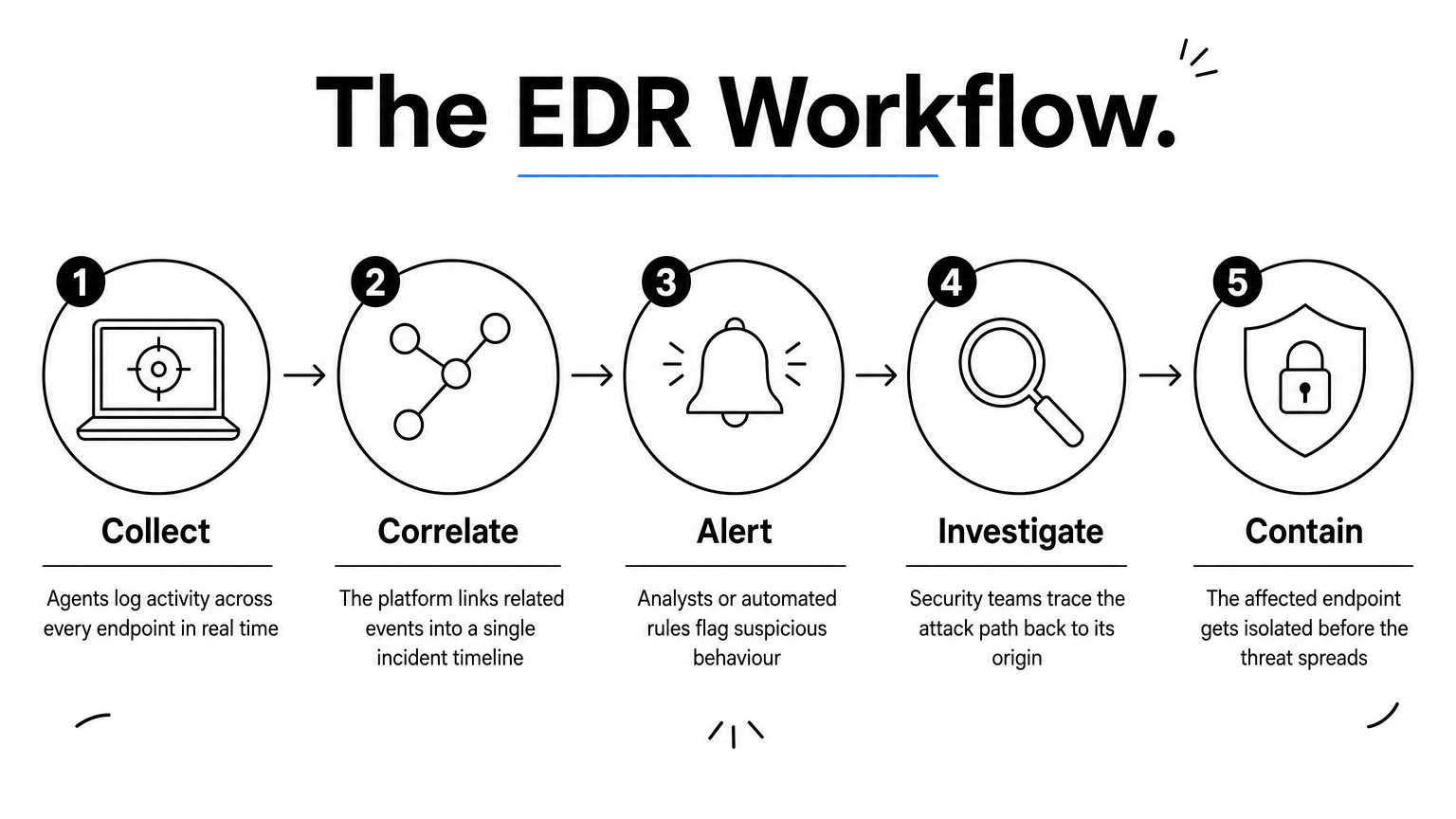
Containment is the final piece, and it’s what turns detection into actual defence. Once a threat is confirmed, the platform can isolate the affected device from the network, kill the malicious process, and roll back changes, all without someone physically walking to that machine. In practice, a typical EDR workflow looks like this:
- Collect: agents log activity across every endpoint in real time
- Correlate: the platform links related events into a single incident timeline
- Alert: analysts or automated rules flag suspicious behaviour
- Investigate: security teams trace the attack path back to its origin
- Contain: the affected endpoint gets isolated before the threat spreads
- Remediate: files and settings are restored to a known-good state
Quarantining a single infected laptop within minutes, rather than discovering a network-wide ransomware outbreak days later, is the practical difference this workflow makes. That speed comes from automation working alongside human judgement, not from replacing it entirely.
Key features to look for in an EDR solution
Not every product marketed as EDR software delivers the same depth of protection, which is why it pays to compare the leading EDR solutions before committing. Some tools log activity but leave analysis to your team; others automate almost everything but bury you in false positives. Knowing what separates a genuinely capable platform from a box-ticking exercise saves you from buying something that looks good on paper but fails during a real incident.
Real-time visibility and behavioural analytics
Start with visibility. A strong platform gives you a live view of every process, connection, and file change across your estate, not a summary that updates once an hour. Look for the kind of next generation endpoint security that flags anomalies based on how a device normally behaves, rather than matching against a static signature list. This is what catches attacks nobody has seen before.
If your endpoint tool can’t show you what happened five minutes ago, it’s not going to help you when it matters.
Automated response and integration
Detection without action is just noise. Prioritise solutions with automated incident response, meaning the platform can isolate a compromised device or kill a malicious process without waiting for a human to click a button at 2am. Equally important is how well the tool integrates with your existing stack, firewalls, identity systems, and a wider SOC, and what a security operations centre actually does, so alerts don’t sit in isolation.
| Feature | Why it matters |
|---|---|
| Continuous endpoint telemetry | Gives investigators a full timeline, not gaps |
| Behavioural detection engine | Catches novel threats, not just known malware |
| Automated isolation | Stops spread before a human even responds |
| Threat intelligence feeds | Keeps detection current against emerging tactics |
| Rollback and remediation | Restores files without a full rebuild |
| Reporting for audits | Supports ISO 27001 and insurer requirements |
Remediation deserves its own mention. After containment, the platform should be able to roll back malicious changes and restore affected files, rather than leaving your team to rebuild machines from scratch. Vendor support matters too: a tool is only as good as the analysts backing it, which is why TrustedIA pairs its endpoint detection and AV service with a team watching the alerts, not just software running unattended. Without that human layer, even the best telemetry can go unread until it’s too late.
EDR versus antivirus, XDR and MDR
Confusion between these terms costs businesses money, because vendors often blur the lines to make their product sound more advanced than it is. Antivirus, EDR, XDR, and MDR all sit under the same umbrella of endpoint protection, but they solve different problems and suit different levels of risk and resourcing. Understanding where each one starts and stops helps you avoid paying for capability you don’t need, or worse, assuming you’re covered when you’re not.
EDR versus antivirus
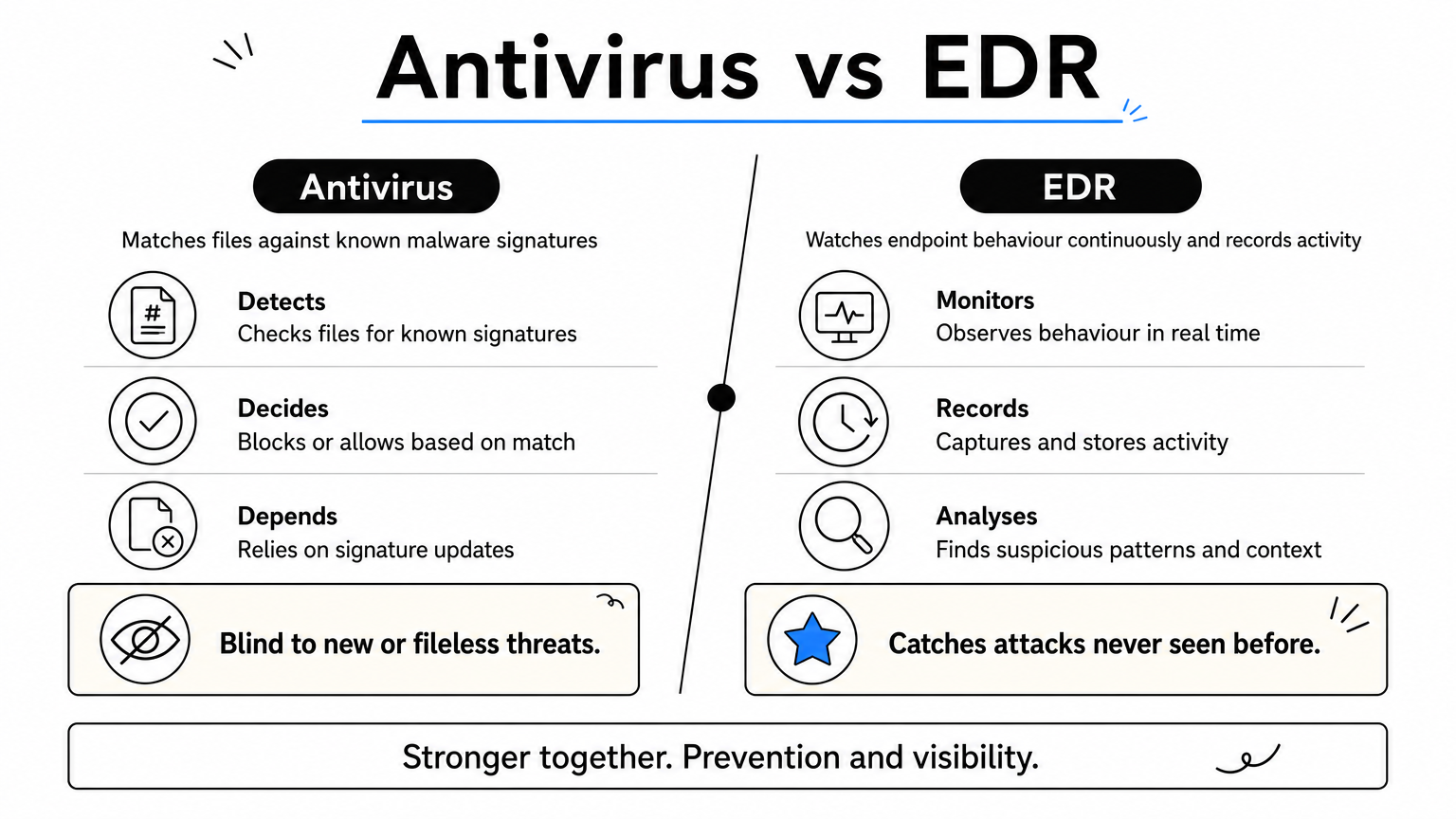
Traditional antivirus compares files against a database of known malware signatures and blocks matches before execution. That works fine against threats security researchers have already catalogued, but it’s blind to anything new, disguised, or fileless. Endpoint detection and response goes further by watching behaviour continuously, so it catches attacks that have never been seen before, and it keeps a full record for investigation after the fact. Antivirus stops known threats at the door; EDR watches what happens once something gets past that door.
EDR versus XDR versus MDR
Extended detection and response, or XDR, pulls telemetry from endpoints, email, cloud workloads, and network traffic into a single platform, giving you a wider view than EDR alone provides. Managed detection and response, or MDR, is different again: it’s not really a technology category but a delivery model, where a third party runs the detection tooling and staffs the analysis around the clock. Many businesses without an in-house security team choose MDR precisely because owning EDR software without the analysts to watch it defeats the purpose.
Buying EDR without someone monitoring the alerts is like installing a burglar alarm nobody’s listening to.
| Approach | What it covers | Best suited to |
|---|---|---|
| Antivirus | Known malware signatures | Baseline hygiene, low-risk devices |
| EDR | Continuous endpoint behaviour | Businesses needing real detection depth |
| XDR | Endpoints plus network, cloud, email | Larger, complex environments |
| MDR | Managed EDR/XDR with 24/7 analysts | Teams without in-house security staff |
Rather than treating this as an either-or decision, most SMBs land on managed EDR backed by a security operations centre, which is exactly what TrustedIA’s managed SOC with round-the-clock triage delivers alongside endpoint tooling.
Common use cases where EDR proves its worth
Theory only goes so far. The real test of endpoint detection and response is what happens the moment something goes wrong, and that’s where the tooling earns its cost back many times over.
Stopping ransomware before it spreads
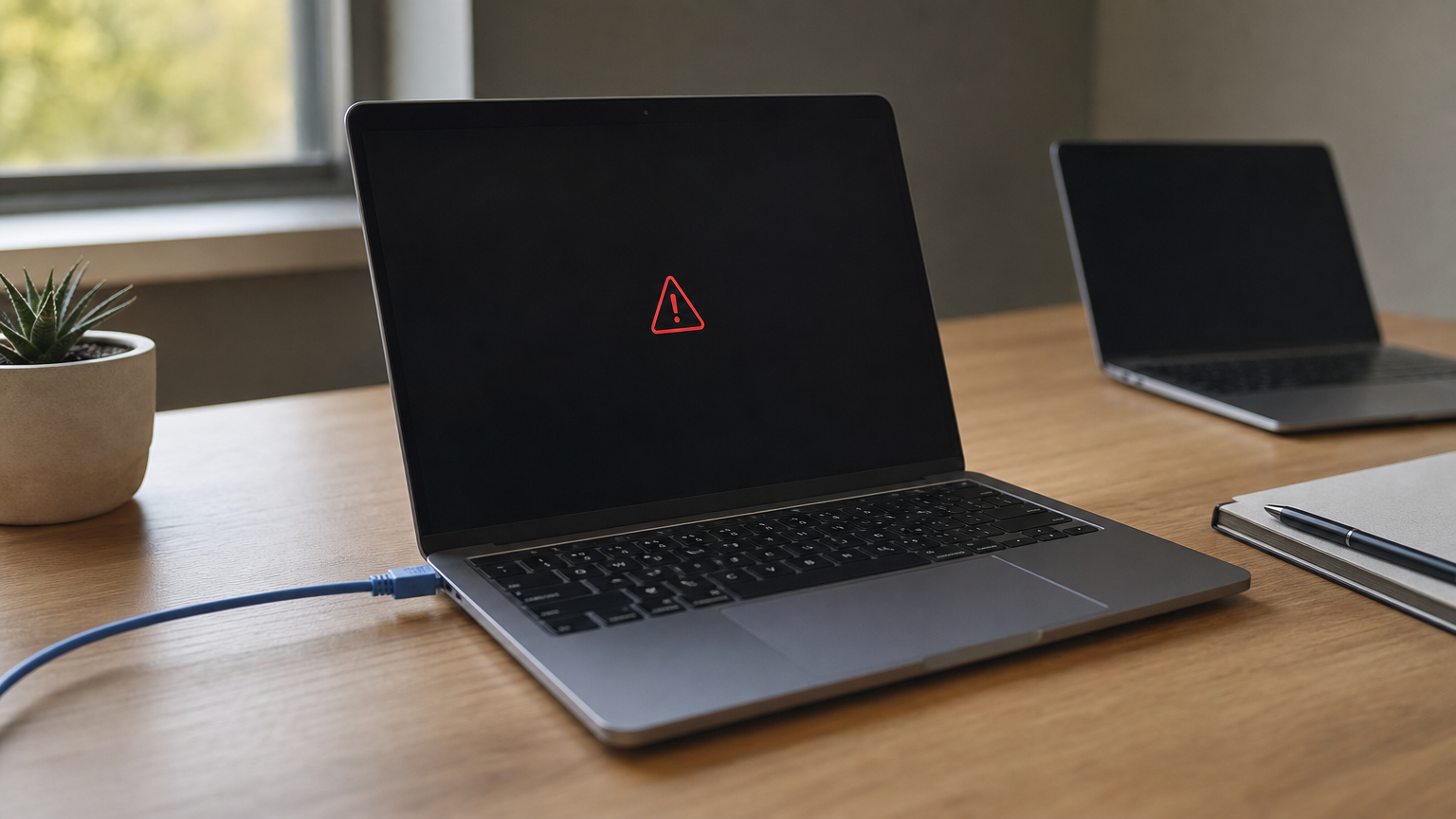
Ransomware rarely announces itself with a single dramatic file. It usually starts with one compromised endpoint quietly encrypting files in the background while it probes for shared drives and backup locations. Behavioural detection catches that encryption pattern early, isolates the device automatically, and stops the attack from jumping to the next machine on the network. Businesses without EDR often only notice once dozens of machines are locked, at which point recovery means restoring from backup rather than simply cleaning one laptop.
Ransomware caught on one endpoint costs a few hours; ransomware caught after it spreads costs weeks.
Catching lateral movement after a phishing click
Someone will click a phishing link eventually, no matter how much training your team gets. What matters is what happens next. Endpoint monitoring flags the unusual login attempts, privilege escalation, and internal scanning that follow a stolen credential, giving your team a chance to shut the account down before the attacker reaches anything valuable. Pairing EDR with a regular employee phishing test reduces how often that first click happens in the first place.
Securing remote and hybrid teams
Devices leaving the office network don’t stop being a risk just because nobody’s watching them directly. Laptops connecting from home Wi-Fi, coffee shops, or personal hotspots need the same continuous visibility as anything sitting on your office LAN. EDR agents keep collecting telemetry regardless of where the device connects, so a compromised remote laptop gets flagged just as fast as one sitting at head office.
Supporting incident response and insurance claims
When an incident does happen, the recorded timeline EDR provides becomes essential evidence. Insurers and loss adjusters expect a clear account of what was accessed and when, and that’s exactly what feeds into TrustedIA’s rapid containment and recovery support when businesses need help after an attack.
Making EDR part of your cyber defence
Endpoint detection and response isn’t a luxury reserved for large enterprises with dedicated security teams. It’s the difference between spotting an attacker within hours and finding out weeks later from a customer, an insurer, or a ransom note. Endpoint detection and response gives you the visibility antivirus never could, the behavioural analysis that catches what signatures miss, and the containment speed that stops one infected laptop becoming a network-wide crisis.
Getting this right means choosing tooling with real behavioural depth, backing it with analysts who actually watch the alerts, and treating it as one part of a wider defence that includes training, monitoring, and tested response plans. None of that needs to be built alone. TrustedIA has spent over 30 years helping businesses close exactly these gaps, from managed endpoint tooling through to full incident response. If you’re ready to see where your current setup falls short, explore managed EDR that cuts dwell time and speeds response and build a defence that actually holds up under pressure.