Every week brings a fresh batch of CVEs, and most IT teams simply cannot patch everything at once. If you have ever stared at a vulnerability scan with 400 findings and no idea where to start, you already understand why threat & vulnerability management exists. It is the discipline that turns that overwhelming list into a workable plan, so you fix what actually matters before an attacker finds it first.
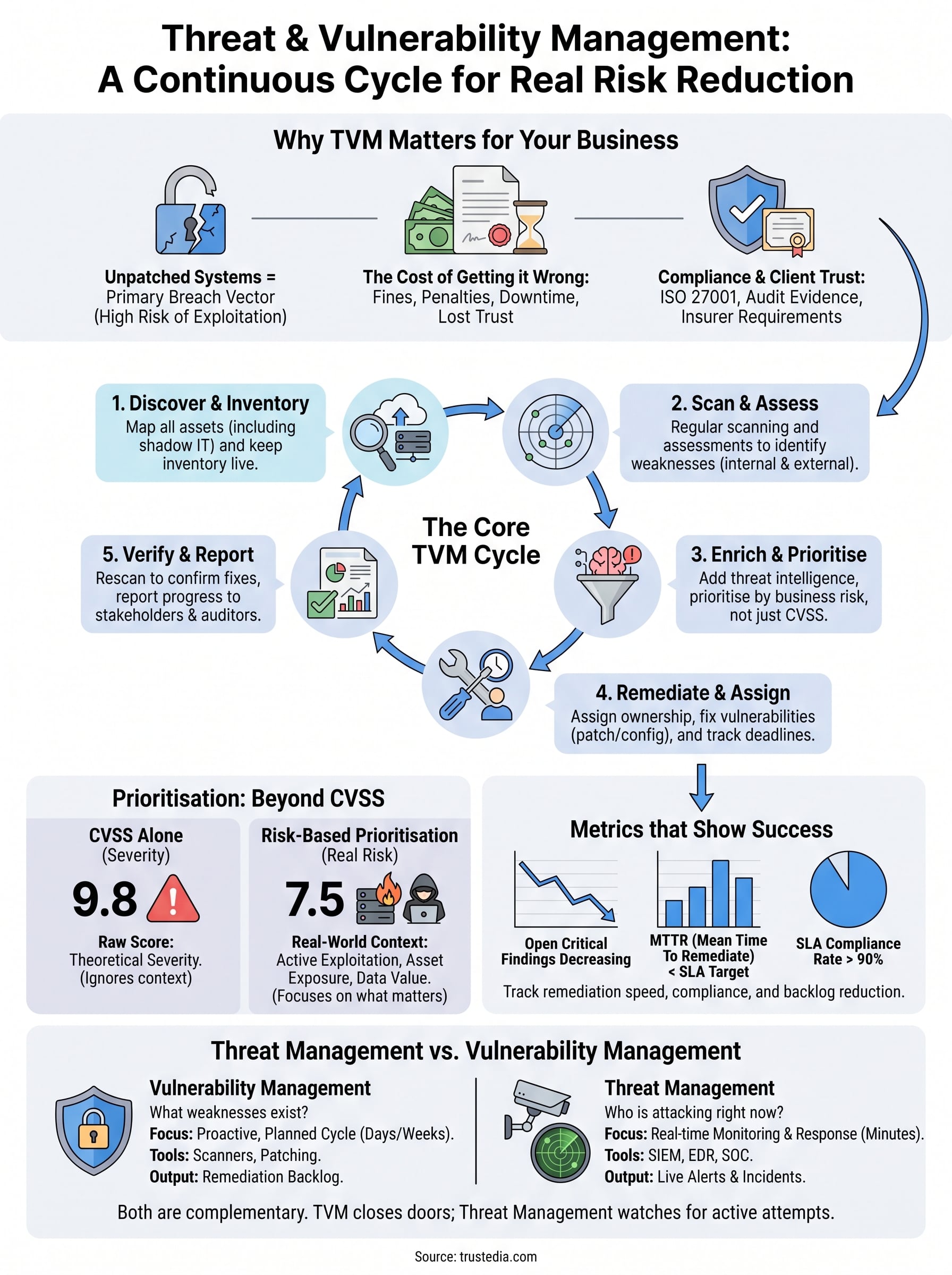
At its core, threat and vulnerability management (TVM) is a continuous cycle: identify weaknesses across your systems, assess how likely they are to be exploited, and remediate in order of real business risk rather than raw severity scores. It combines automated scanning, threat intelligence, and human judgement to keep your attack surface honest and manageable, not just theoretically secure.
In this article, we break down what TVM actually involves, how the process works stage by stage, and which tools and techniques organisations rely on to identify, prioritise, and close security gaps. Drawing on what we see day to day running vulnerability assessments and penetration testing for clients, we will also flag the mistakes that leave businesses exposed despite having a scanner running.
Why threat & vulnerability management matters for your business
Unpatched systems are not a minor housekeeping problem, they are the single most common way attackers get in. Verizon’s Data Breach Investigations Report has repeatedly found that the exploitation of vulnerabilities is one of the top initial access methods used in confirmed breaches, and the gap between a CVE being published and it being weaponised keeps shrinking. Threat & vulnerability management exists precisely because that gap is where most damage happens. Without a structured programme, businesses rely on luck: hoping the next scan catches the flaw before someone else finds it first.
A vulnerability you know about but haven’t fixed is not a risk you’re managing, it’s a risk you’re gambling on.
The real cost of getting it wrong
Breaches rarely stay contained to the technical side of the business. A single exploited vulnerability can trigger regulatory fines, contract penalties, and weeks of lost productivity while systems are rebuilt from scratch. The IBM Cost of a Data Breach Report consistently puts the average cost of a breach well into seven figures once you factor in detection, containment, notification, and lost business. Insurers have noticed too: many cyber insurance policies now require evidence of ongoing vulnerability scanning and patching cadence before they will even quote a premium, let alone pay out on a claim. That is a direct financial reason to run a formal programme rather than patching reactively whenever something breaks.
Compliance and client expectations
Standards bodies have also caught up with this reality. The ISO 27001 standard, the framework most of our clients are working towards, explicitly requires organisations to manage technical vulnerabilities as part of Annex A controls, meaning you cannot pass a certification audit on hope alone. Beyond formal certification, more procurement teams now ask suppliers for evidence of vulnerability management and penetration testing services before signing contracts, particularly in finance, healthcare, and public sector supply chains. If you want to win or keep those contracts, a documented programme is no longer optional.
The scale problem no team can ignore manually
Businesses today run far more exposed infrastructure than five years ago: cloud workloads, remote endpoints, SaaS integrations, and shadow IT that nobody officially approved. Each of those is a potential entry point, and the number of published CVEs has grown year on year, with thousands logged annually across common software stacks. Trying to track that manually in a spreadsheet stops working once you pass a few dozen assets. This is why structured vulnerability assessments, run on a schedule rather than ad hoc, matter so much for organisations of any size.
Here is what tends to happen to businesses without a formal programme, based on what we see when we’re brought in after an incident:
- Patch backlog grows silently until a routine update becomes a multi-week remediation project.
- Critical fixes get missed because nobody owns the process end to end.
- Audit findings repeat year after year because the same gaps never get closed.
- Insurance claims get disputed when insurers find evidence of known, unpatched vulnerabilities.
- Incident response takes longer because nobody has an accurate picture of what was exposed and where.
None of these outcomes are inevitable. They are what happens when vulnerability management is treated as a tool you switch on rather than a discipline you run continuously. The businesses that avoid this pain are not necessarily the ones with the biggest security budgets, they are the ones that treat identification, prioritisation, and remediation as a repeatable cycle rather than a one-off project.
Threats vs vulnerabilities: understanding the distinction
People often use "threat" and "vulnerability" interchangeably, but conflating the two is exactly how prioritisation goes wrong. A vulnerability is a weakness in your systems, an unpatched server, a misconfigured firewall rule, a weak password policy. A threat is the actor or event that could exploit that weakness: a ransomware gang, a phishing campaign, a malicious insider. You can have a vulnerability with no active threat targeting it, and you can face a threat that has no matching vulnerability to exploit. Risk only materialises when the two meet.
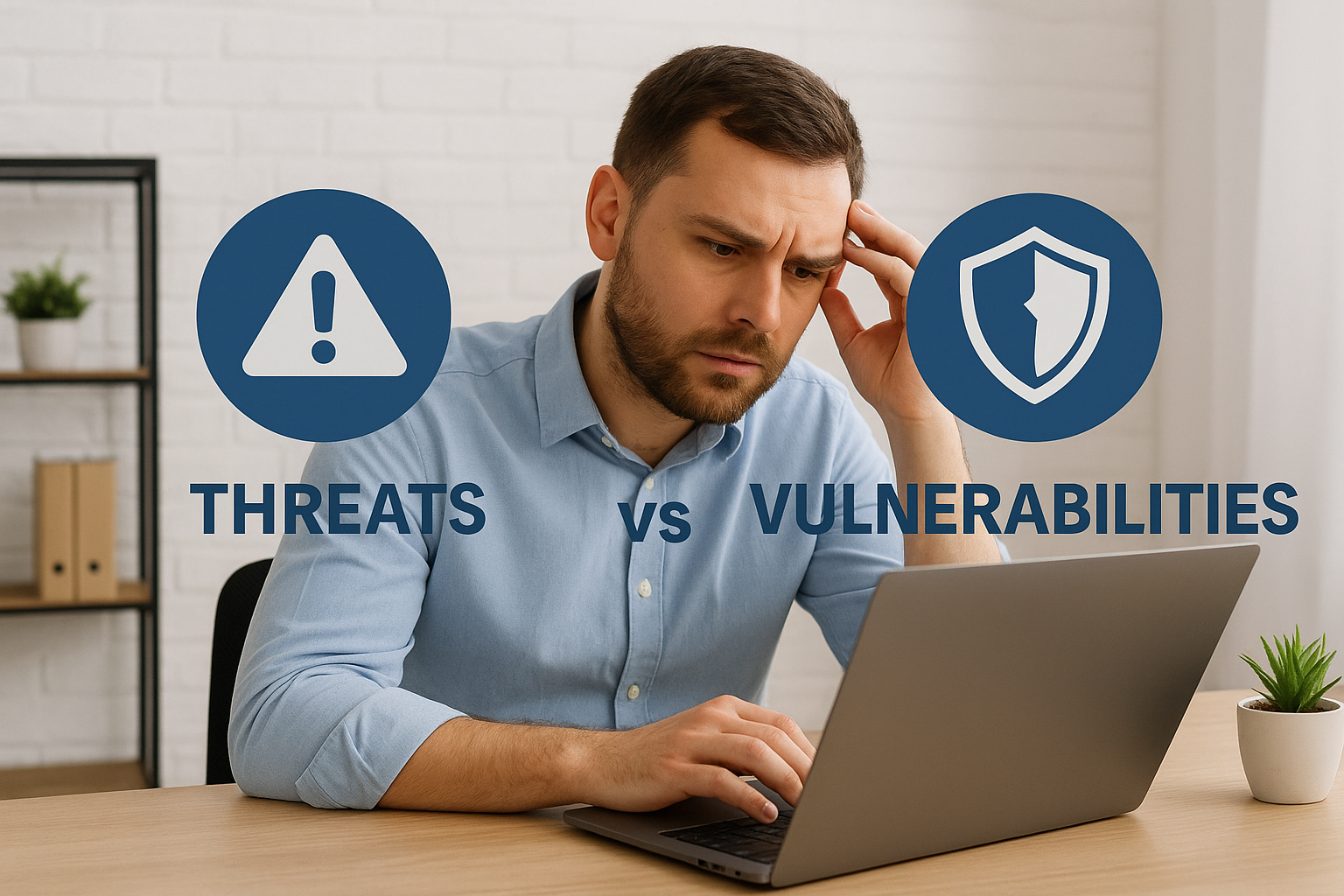
A vulnerability without a threat is a maintenance task. A vulnerability with an active threat is an emergency.
What counts as a vulnerability
Vulnerabilities are almost always technical and measurable. Scanners assign them a CVE identifier and a CVSS score, which gives you a baseline severity rating before you factor in real-world context. Common examples include unpatched software, exposed remote desktop ports, weak encryption, and default credentials left on network devices. None of these are inherently catastrophic on their own, they simply widen the door for something else to walk through.
What counts as a threat
Threats, by contrast, are dynamic and driven by human intent or external events. Organised criminal groups, nation-state actors, opportunistic script kiddies, and even natural disasters or hardware failure all count. Threat intelligence feeds track which vulnerabilities are being actively exploited in the wild right now, which is precisely the context that turns a generic CVSS score into an actionable priority.
| Aspect | Vulnerability | Threat |
|---|---|---|
| Nature | Static weakness in a system | Dynamic actor or event |
| Source | Code, configuration, process | People, malware, external conditions |
| Measured by | CVSS score, CVE ID | Likelihood, intent, capability |
| Example | Unpatched server | Ransomware group scanning for it |
Why the distinction shapes your response
Separating the two is what makes threat & vulnerability management effective rather than just a scanning exercise. A low-severity vulnerability actively targeted by a known threat actor deserves faster attention than a high-severity one sitting on an isolated, air-gapped system nobody can reach. Treating every finding as equally urgent burns your team out and buries the fixes that genuinely matter under noise that doesn’t.
Key components of a threat & vulnerability management programme
A working programme is not just a scanner running on a schedule, it’s a set of interlocking components that each cover a different part of the risk lifecycle. Miss one and the whole chain weakens, no matter how good your tooling looks on paper. Below is the shortlist every mature threat & vulnerability management setup includes, whether it’s run in-house or handled by a managed provider.
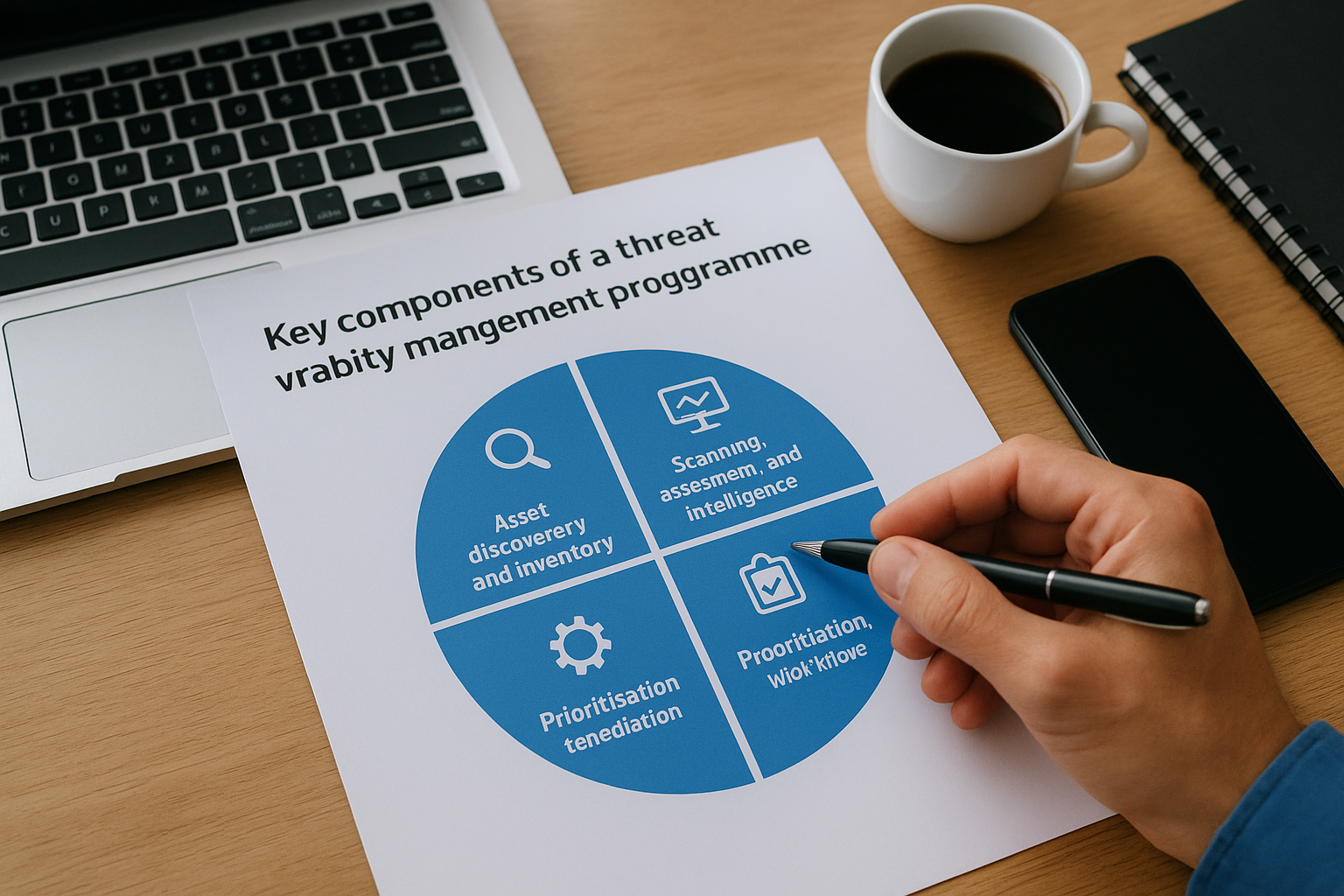
Asset discovery and inventory
You cannot protect what you don’t know exists. Discovery means building and maintaining an accurate inventory of every digital entry point: every server, endpoint, cloud instance, and SaaS connection touching your network, including the shadow IT nobody officially signed off. Continuous discovery matters more than a one-off audit, because new assets appear the moment a team spins up a test server or connects a personal device.
You can’t manage a vulnerability on an asset you don’t know you own.
Scanning, assessment, and intelligence
Once assets are mapped, regular scanning identifies weaknesses, while structured vulnerability assessments and periodic penetration testing go deeper than automated tools alone, probing how weaknesses chain together in practice. Feeding threat intelligence into that data tells you which findings are being actively exploited elsewhere, turning a static CVSS score into something you can actually act on with confidence.
Prioritisation, remediation, and reporting
The final pieces close the loop: risk-based prioritisation decides what gets fixed first, a remediation workflow assigns clear ownership and deadlines, and reporting proves the work happened, which matters for audits and insurers alike.
| Component | Core purpose |
|---|---|
| Asset inventory | Know what exists on your network |
| Vulnerability scanning | Find weaknesses systematically |
| Threat intelligence | Add real-world exploitation context |
| Risk prioritisation | Decide what to fix first |
| Remediation workflow | Assign ownership and track fixes |
| Reporting | Prove progress to auditors and insurers |
Skip any row in that table and the programme has a blind spot somewhere. That’s precisely why TrustedIA builds its vulnerability assessments and penetration testing around all six components rather than treating scanning as the whole job.
How to implement threat & vulnerability management step by step
Getting a programme off the ground doesn’t require a six-month project plan. Most organisations can have a working threat & vulnerability management cycle running within a few weeks if they follow a clear, repeatable sequence of steps rather than trying to fix everything from day one. The steps below reflect the order we walk clients through when standing up a programme from scratch.
Map your scope before you scan anything
Before a single scanner runs, decide what’s in scope: which networks, cloud accounts, endpoints, and third-party connections count as part of your environment. Skipping this step is the most common reason programmes stall later, because gaps in scope surface as "surprise" assets during an audit rather than during setup. Asset scoping should include anything with a network address, not just the servers IT remembers buying.
Run the operational cycle
Once scope is agreed, the day-to-day cycle looks like this:
- Discover every asset in scope and keep the inventory live, not a one-off snapshot.
- Scan internal and external systems on a fixed cadence, weekly for internet-facing systems, monthly for internal ones at minimum.
- Enrich findings with threat intelligence to flag which CVEs are being actively exploited.
- Prioritise using business context, not just CVSS score.
- Assign each finding a named vulnerability management owner and a remediation deadline tied to its risk tier.
- Remediate through patching, configuration change, or compensating controls where patching isn’t possible yet.
- Verify the fix with a rescan before closing the ticket.
- Report progress to management and, where relevant, auditors or insurers.
A programme only works if every finding has a named owner and a deadline, not just a severity label.
Set service levels before you need them
Service level agreements turn good intentions into enforceable practice. Agree remediation windows in advance, for example critical findings within 72 hours, high within 14 days, medium within 30, so nobody has to negotiate urgency mid-incident. Tie those windows to your remediation workflow, not to whoever happens to be free that week, and review them quarterly against what’s actually achievable.
Automate what you can, review what you can’t
Tooling should handle discovery, scanning, and enrichment automatically wherever possible, freeing your team to focus on judgement calls: which fixes need testing before rollout, which risks warrant a compensating control instead of a patch. Organisations without in-house capacity to run this cycle continuously often hand the operational load to a managed provider, which is exactly the gap TrustedIA’s vulnerability assessments service is built to close.
How to prioritise vulnerabilities effectively
Scanners hand you a severity score, not a priority list, and treating those as the same thing is how teams burn weeks fixing the wrong things first. Vulnerability prioritisation means layering business context on top of the raw CVSS number before anyone touches a patch schedule. Get this step wrong and you’ll patch a theoretical flaw on an isolated test server while a moderate one on your customer database sits untouched for months.
Why CVSS alone isn’t enough
A CVSS score tells you how severe a flaw could be in a vacuum, not how exposed it actually is on your network. It doesn’t know whether the affected system faces the internet, holds sensitive data, or sits behind three layers of network segmentation nobody’s ever bothered to map. Two servers can share the exact same CVE and carry completely different real-world risk, which is why relying on score alone leaves genuinely dangerous gaps buried under a pile of technically-higher-rated noise.
Fix what’s exploitable and exposed first, not what merely scores highest on paper.
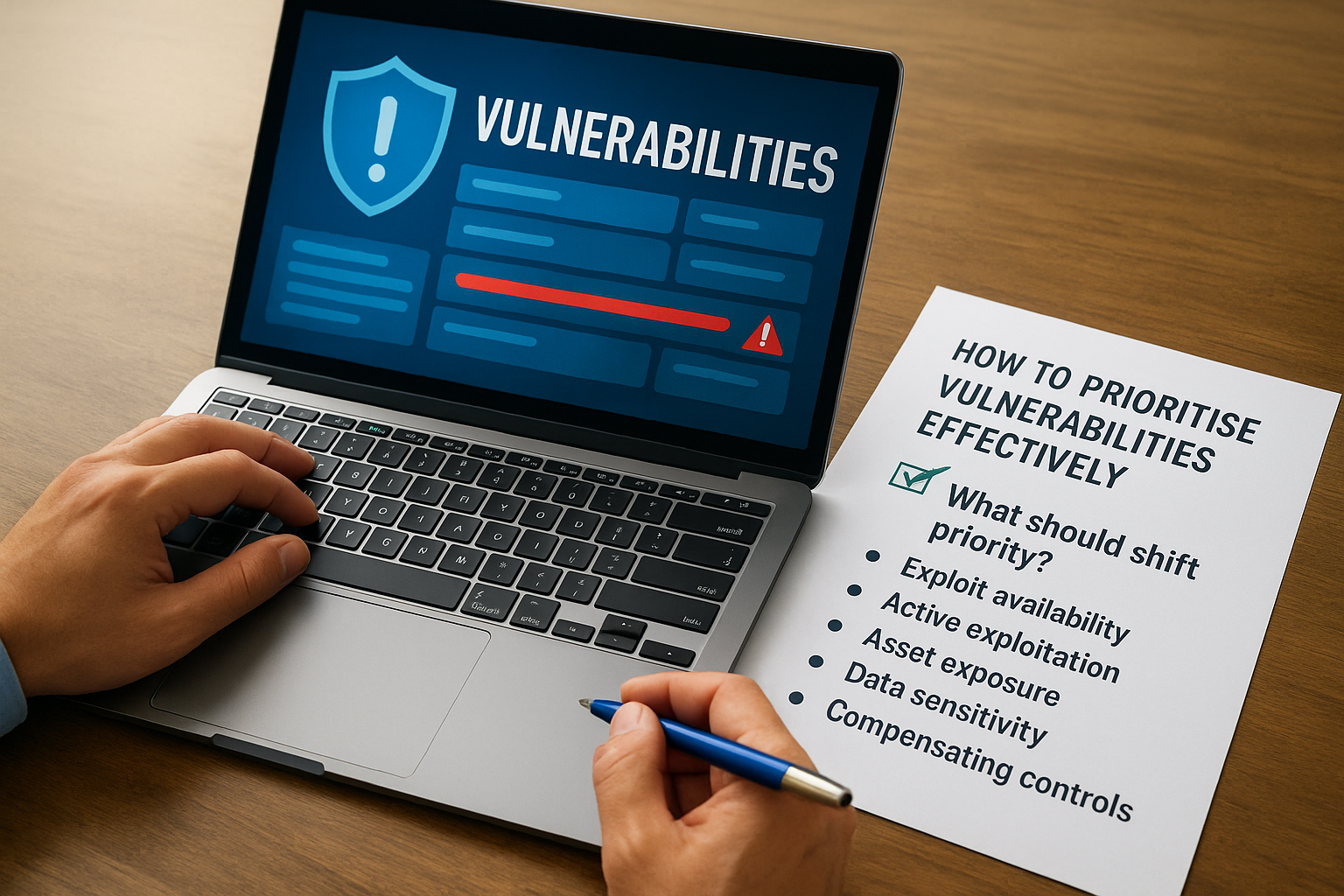
Factors that should shift priority
Build your prioritisation model around a handful of factors that actually change outcomes, not just the ones a scanner reports by default:
| Factor | Why it matters |
|---|---|
| Exploit availability | Public exploit code shortens the window to attack |
| Active exploitation | Threat intelligence confirming real-world attacks in progress |
| Asset exposure | Internet-facing systems carry far more risk than internal ones |
| Data sensitivity | Systems holding customer or financial data raise the stakes |
| Compensating controls | Existing firewalls or segmentation can lower urgency |
Running findings through this filter, rather than sorting by CVSS descending, is what separates a mature risk-based vulnerability management process from a spreadsheet exercise.
A workable prioritisation framework
A practical model most teams can adopt quickly:
- Flag anything with confirmed active exploitation as critical regardless of its base score.
- Cross-reference exposure: internet-facing plus high severity jumps to the top of the queue.
- Downgrade findings on isolated or heavily controlled systems, even if the raw score is high.
- Reassess weekly, since exploitation status changes faster than most patch cycles.
Combining CVSS with threat intelligence, exposure, and asset value gives you a ranked list your team can actually work through in order, rather than a wall of red severity flags with no obvious starting point.
Common challenges and how to overcome them
Even organisations that adopt every step above still hit friction, because running a threat & vulnerability management programme day to day is harder than designing one on paper. The challenges below are the ones we see most often when we’re brought in to review an existing setup, along with what actually fixes them.
Alert fatigue and scanner noise
Scanners generate hundreds of findings per sweep, and teams that try to triage every single one burn out within a quarter. The fix is not a bigger team, it’s tighter filtering: apply the exposure and exploitability factors covered earlier so only genuinely actionable findings reach a human inbox.
A team drowning in low-priority alerts will miss the one that matters.
Patching without breaking production
Remediation deadlines mean nothing if patches keep breaking production systems, which is why many teams quietly let critical fixes slip past their agreed window. Staging environments and change windows solve this, but only if patch testing is built into the remediation workflow from the start rather than bolted on after the first outage.
Skills gaps and stretched teams
Most internal IT teams are sized for support tickets, not continuous threat analysis, so vulnerability management gets squeezed between everything else on their plate. Organisations without the headroom to run scanning, enrichment, and triage every week often route the workload to a 24/7 SOC monitoring service instead, which is precisely the gap TrustedIA’s Security Operations Centre is designed to fill.
Fragmented tooling and inconsistent data
Separate tools for scanning, threat intelligence, and ticketing rarely talk to each other cleanly, leaving analysts reconciling spreadsheets instead of fixing systems. Consolidating findings into a single vulnerability management dashboard, or a provider that already does this for you, removes the manual reconciliation step that eats hours every week.
No executive visibility until something breaks
Boards and finance teams often only hear about vulnerability management after an incident forces the conversation, which weakens the case for ongoing investment. Regular, plain-language reporting on remediation rates and open risk keeps leadership engaged before a breach makes the decision for them, and it gives you the evidence trail insurers and auditors increasingly expect to see.
None of these challenges are unusual, and none require a complete rebuild to solve. What they need is a process that treats prioritisation, ownership, and reporting as non-negotiable parts of the cycle rather than nice-to-haves squeezed in when time allows.
Threat management vs vulnerability management: how they differ
TVM gets treated as one discipline, but threat management and vulnerability management actually run on different timescales and answer different questions. Vulnerability management asks "what weaknesses exist in our environment right now?" and works on a cycle measured in days or weeks: scan, assess, patch, verify. Threat management asks "who is actively trying to get in, and what are they doing?" and works closer to real time, watching network traffic, endpoint behaviour, and threat intelligence feeds for signs of an attack already under way.
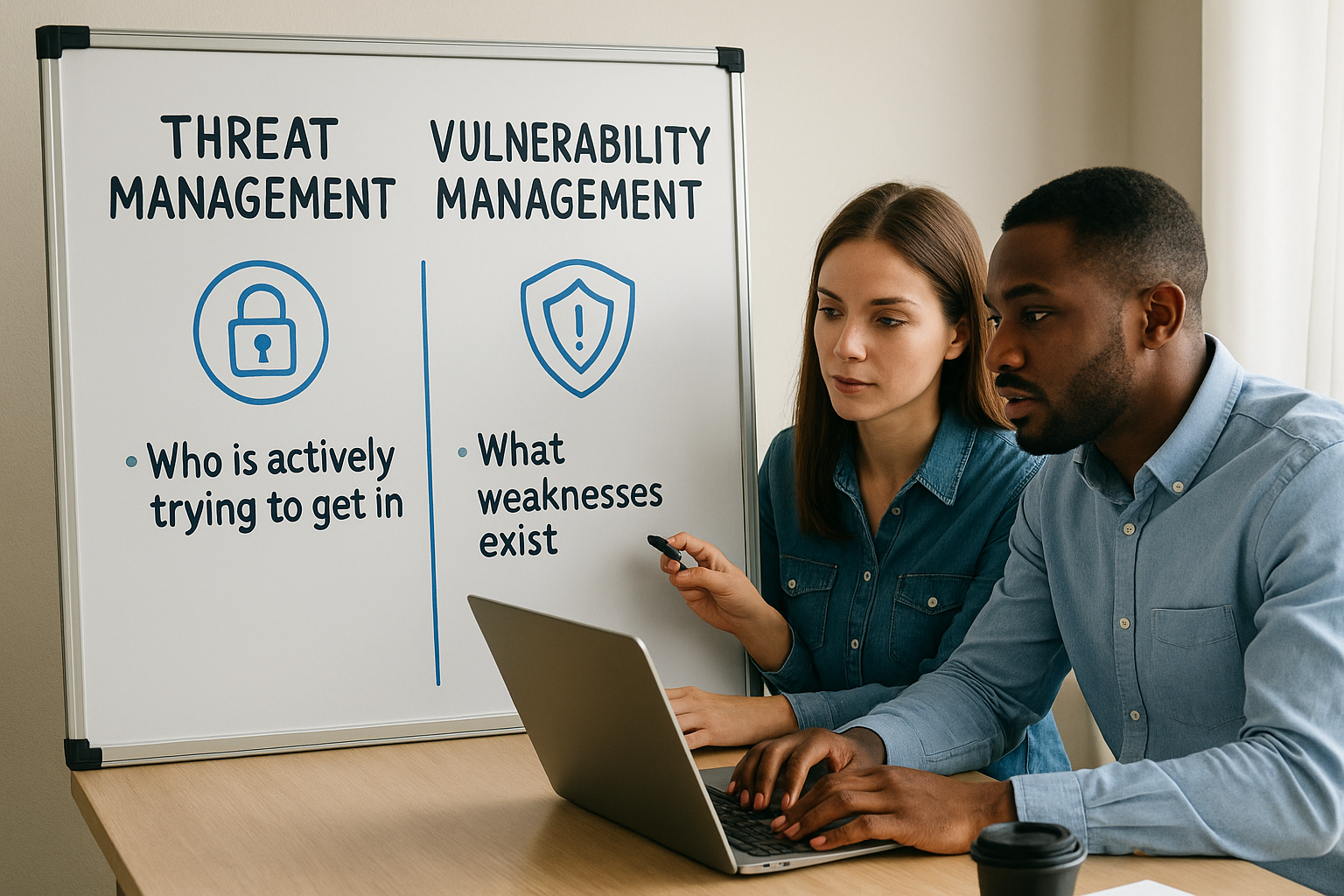
Vulnerability management closes doors before they’re tried. Threat management watches for someone already turning the handle.
Different tools, different rhythms
Vulnerability management leans on scheduled scanners, patch management systems, and periodic penetration testing. Threat management leans on continuous monitoring tools such as SIEM platforms, endpoint detection and response, and a Security Operations Centre watching alerts around the clock. One produces a backlog you work through methodically; the other produces alerts you respond to within minutes, because a live intrusion doesn’t wait for your next scheduled scan.
| Aspect | Vulnerability management | Threat management |
|---|---|---|
| Core question | What weaknesses exist? | Who is attacking us right now? |
| Timescale | Days to weeks | Real time |
| Primary tools | Scanners, patch management | SIEM, EDR, SOC monitoring |
| Output | Prioritised remediation backlog | Live alerts and incident response |
| Failure mode if ignored | Growing patch debt | Undetected active breach |
Why you need both, not either
Running vulnerability management without threat management leaves you patching methodically while an active intrusion goes unnoticed between scans. Running threat management without vulnerability management leaves you detecting attacks that a basic patch would have prevented outright, which is an expensive way to learn a lesson you already knew. Mature security programmes run both in parallel and feed data between them: threat intelligence sharpens vulnerability prioritisation, and knowledge of unpatched systems tells your monitoring team where to watch hardest.
This is exactly why TrustedIA pairs vulnerability assessments with round-the-clock monitoring through its Security Operations Centre, rather than offering one without the other. Treat threat and vulnerability management as complementary halves of one strategy, not competing budget lines, and you close both the doors that are already open and the ones someone is actively trying to force.
Measuring success: metrics that show your programme works
Running scans every week means nothing if you can’t show whether the programme is actually reducing risk over time. Measuring success means tracking a handful of metrics consistently, not producing a different report every quarter because someone asked a different question. The businesses that get the most value from threat & vulnerability management are the ones that can answer "are we getting safer?" with numbers, not a feeling.
If you can’t measure it, you can’t prove the programme is working, to your board or your insurer.
The metrics worth tracking
Focus on a small set of numbers that map directly to risk reduction, rather than vanity stats like total scans run. Each one should tell you something a stakeholder actually cares about, whether that’s an auditor, an insurer, or your own leadership team.
| Metric | What it tells you |
|---|---|
| Mean time to remediate (MTTR) | How fast critical findings actually get fixed |
| SLA compliance rate | Percentage of findings closed within agreed windows |
| Vulnerability recurrence rate | Whether the same gaps keep reappearing after fixes |
| Percentage of assets scanned | Coverage gaps hiding in your inventory |
| Open critical findings over time | Whether your backlog is shrinking or growing |
| Exploited-in-the-wild findings resolved | How well prioritisation matches real threat activity |
Turning numbers into decisions
Tracking MTTR alongside SLA compliance shows you whether your remediation windows are realistic or just aspirational targets nobody hits. If critical findings consistently blow past their 72-hour deadline, that’s a resourcing problem, not a discipline problem, and the fix is different depending on which one you’re facing. Watching the recurrence rate matters just as much: a vulnerability that closes and reopens three months later points to a root-cause fix that never happened, usually a configuration issue papered over with a one-off patch.
Visibility into open critical findings over time is the single chart most boards actually want to see, because it answers the only question that matters to them: is our exposure going up or down. Pair that trend line with exploited-in-the-wild resolution rates and you’ve got evidence that your prioritisation model is working, not just that scans are running on schedule.
Reporting cadence that keeps trust intact
Share these metrics monthly with IT leadership and quarterly with the board or audit committee, using the same format each time so trends are easy to spot rather than buried in a redesigned slide deck. Consistent reporting like this is also exactly what insurers and ISO 27001 auditors expect to see as evidence your vulnerability management programme runs continuously, not just when someone remembers to check.
Building a stronger security posture from here
Getting threat & vulnerability management right isn’t about buying another scanner, it’s about running the full cycle consistently: knowing what you own, scanning it on schedule, prioritising by real exposure, and proving the work happened. Skip any one of those steps and the gaps you’re missing are exactly the ones an attacker will find first.
Most businesses don’t lack the tools, they lack the time and headroom to run this cycle every single week without it slipping when something more urgent comes up. That’s the gap a managed partner closes, bringing continuous scanning, threat intelligence, and a remediation workflow that doesn’t depend on whoever happens to be free that day.
If you’d rather have experts running that cycle for you than chase it in-house, talk to TrustedIA about a vulnerability assessment with a prioritised remediation plan that actually holds up under audit, insurer scrutiny, and real attacks.