If you’re staring down an ISO 27001 audit process for the first time, the certification stages can feel opaque. Nobody tells you upfront that it’s actually two separate audits, spread weeks apart, each looking for different things. Get either one wrong and you’re back to square one with the certification body, losing months and budget you’d earmarked elsewhere.
This article breaks down exactly how the process works, from the Stage 1 documentation review through to the Stage 2 certification audit, and the surveillance visits that follow every year after. You’ll see what auditors actually examine, which evidence they expect to see, and where most organisations trip up.
We’ve supported businesses through this journey for over 30 years, so what follows isn’t theory. It’s a practical walkthrough covering audit preparation steps, common nonconformities, and how to build a management system that survives scrutiny rather than just ticking boxes for one visit.
Why the ISO 27001 audit process matters
An ISO 27001 audit isn’t a paperwork exercise you push through once and forget. It’s the mechanism that keeps your information security management system (ISMS) honest. Certification bodies send accredited auditors to test whether the controls you claim to have on paper actually exist in practice, and whether they work under pressure. Skip this scrutiny and you end up with a policy binder nobody reads and a false sense of security that unravels the moment a real incident hits.
The commercial stakes are real
Most businesses don’t pursue ISO 27001 out of curiosity. They pursue it because a client, insurer, or procurement team demanded proof. Public sector contracts, financial services partnerships, and larger enterprise clients increasingly list ISO 27001 as a contractual prerequisite, not a nice-to-have. Fail your audit or let certification lapse, and you can lose access to entire tender pipelines overnight.
A failed audit doesn’t just cost you certification, it costs you the contracts that required it.
We’ve seen this play out with clients in insurance and logistics, sectors where loss adjusters and underwriters now routinely ask for evidence of an active ISMS before they’ll even discuss terms. The audit process is what generates that evidence in a form third parties trust, because it’s been independently verified rather than self-declared.
It forces discipline you wouldn’t otherwise build
Beyond the commercial pressure, the audit cycle does something valuable internally: it forces your organisation to actually operate the controls you’ve designed. Anyone can write a risk treatment plan. Far fewer businesses run it consistently for six months, generate the logs, review the outputs, and correct course when something drifts. Auditors ask for records precisely because records prove behaviour, not intention.
This matters because cyber risk doesn’t sit still. New vendors get onboarded, staff turnover creates access control gaps, and threat actors adjust their tactics faster than most internal teams can track unaided. The audit cycle gives you a recurring, external forcing function to catch these drifts before they become breaches.
What happens if you get it wrong
The consequences of a poorly managed audit process go beyond a delayed certificate. Consider what’s actually at stake:
- Lost tender eligibility – many public and enterprise contracts require valid certification as a bid condition, not a bonus
- Insurance implications – some cyber insurance policies now factor ISO 27001 status into premium calculations and claims handling
- Reputational exposure – a certificate suspended for major nonconformities is visible to clients who check your status with the certification body
- Repeated costs – failed audits mean rescheduled visits, extra auditor days, and internal hours spent fixing gaps that should have been caught earlier
| Outcome of a weak audit process | Practical impact |
|---|---|
| Major nonconformity raised | Certification withheld until closed out, typically 90 days |
| Minor nonconformities pile up | Closer scrutiny at next surveillance visit |
| Certificate lapses or is suspended | Loss of contracts requiring active certification |
| Poor evidence trail | Longer audit days, higher consultancy and audit fees |
It’s also about resilience, not just compliance
The deeper reason the ISO 27001 audit process matters is that certification is a proxy for something harder to measure: whether your business can actually withstand a cyber incident and keep operating. Auditors aren’t just checking that you have a business continuity plan filed somewhere. They’re checking that people know it exists, have tested it, and can execute it under stress.
Zero in on this distinction and the whole process starts making more sense. You’re not preparing for an audit. You’re preparing your organisation to survive an incident, and the audit happens to be the independent check that confirms you’ve done the work. Businesses that treat it this way tend to sail through Stage 2 with minor findings at most. Those that treat it as a box-ticking exercise usually get caught out, because auditors are trained to spot the gap between documented process and operational reality within the first hour of interviews.
How to prepare for an ISO 27001 audit
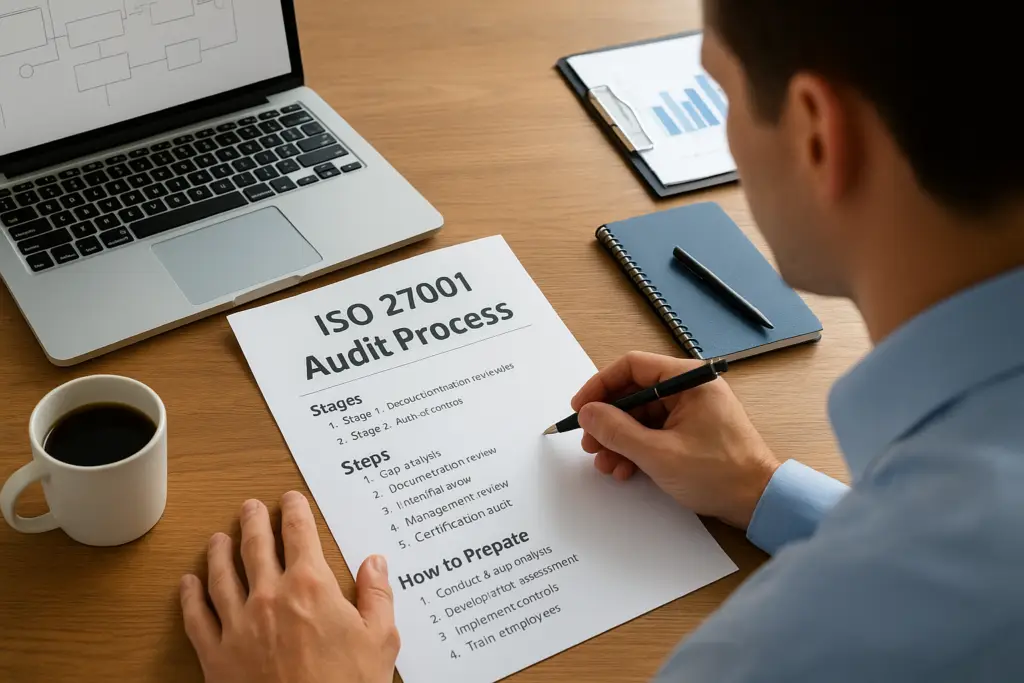
Preparation for the ISO 27001 audit process should start months before you book a certification body, not weeks. Rushing the groundwork is the single biggest reason organisations fail Stage 1. You need a working ISMS, not a folder of templates copied from the internet the week before the auditor arrives. That means real risk assessments, real policies that staff have actually read, and real evidence that controls have been operating long enough to generate records.

Start with a gap analysis
Before anything else, run a gap analysis against Annex A controls to see where your current setup falls short of the standard. This tells you exactly which controls need building, which need strengthening, and which you can already evidence. Skipping this step means you discover the gaps during Stage 1, in front of an auditor, which costs you time and confidence you’d rather keep in reserve.
You can’t fix what you haven’t measured, so the gap analysis has to come first.
Build the evidence trail early
Once you know your gaps, focus on generating audit-ready evidence rather than just writing policy documents. Auditors want proof that controls run continuously, not a snapshot from last week.
- Risk assessments reviewed and updated on a defined schedule
- Access control logs showing joiners, movers, and leavers processed correctly
- Incident records, even minor ones, showing your response process actually triggers
- Training completion records tied to named staff, not a generic attendance sheet
- Internal audit reports and management review minutes covering at least one full cycle
Run an internal audit first
A proper internal audit, ideally by someone independent of the day-to-day ISMS operation, catches most of the issues an external auditor would flag. This is also where a solution-agnostic partner earns its fee: an outside reviewer with no stake in the outcome tends to spot blind spots that internal teams miss because they’re too close to the system.
Get leadership genuinely involved
Auditors interview management as part of Stage 2, and a director who can’t explain the risk treatment plan in their own words is a red flag every experienced auditor recognises immediately. Leadership needs to understand the ISMS well enough to answer questions confidently, because Clause 5 leadership commitment is tested directly through these conversations, not just through signed policy documents.
Set a realistic timeline
Most organisations underestimate how long meaningful preparation takes. As a rough guide:
| Preparation stage | Typical duration |
|---|---|
| Gap analysis and scoping | 2 to 4 weeks |
| Building policies and controls | 6 to 12 weeks |
| Operating controls to generate evidence | 3 to 6 months minimum |
| Internal audit and management review | 2 to 4 weeks |
Budget for this properly and the certification audit stops feeling like a gamble.
The certification audit: stage 1 and stage 2
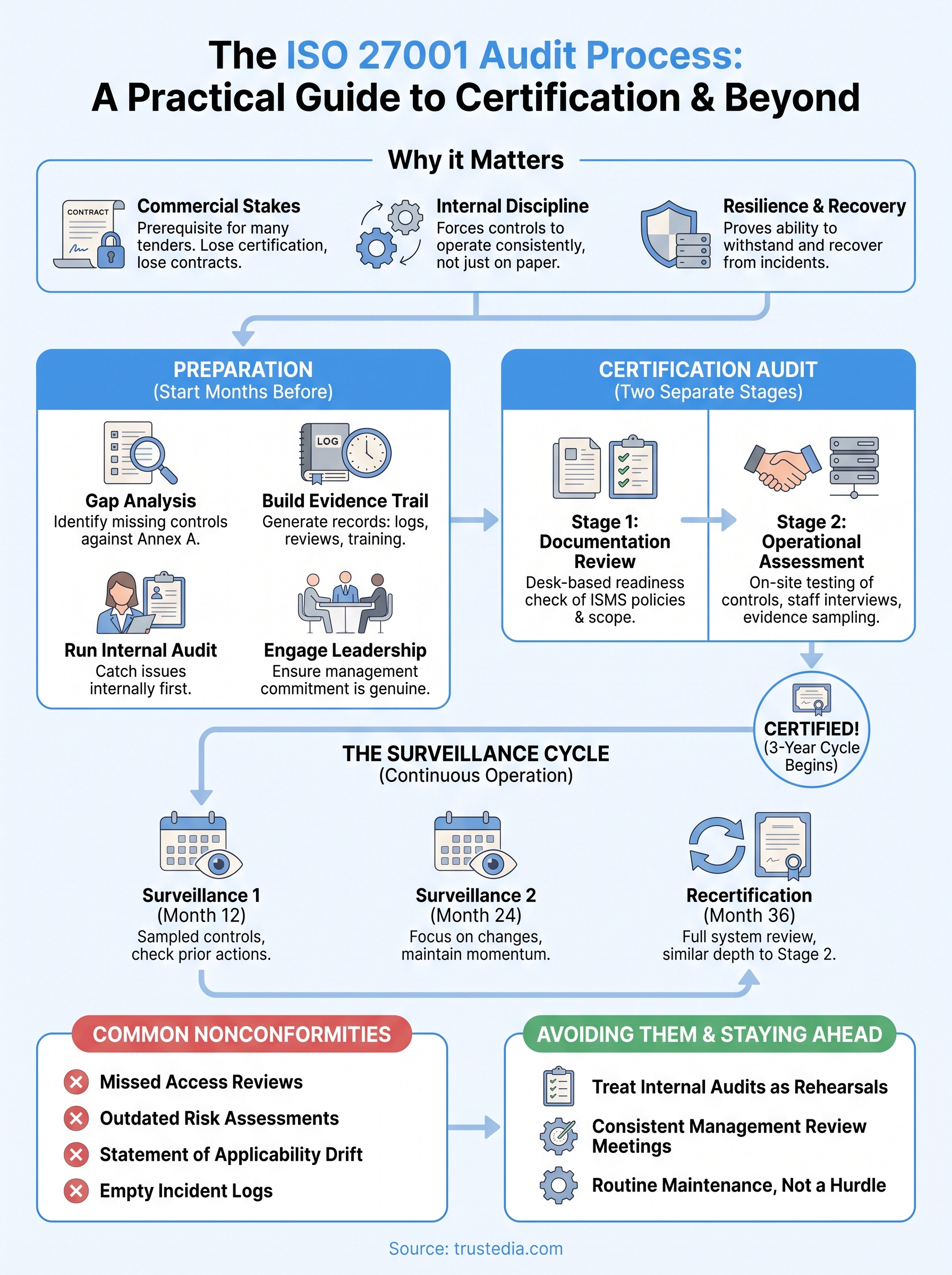
Once your ISMS has been operating long enough to generate real evidence, the certification body schedules the two-stage audit that actually awards the certificate. This isn’t one visit, it’s two, typically spaced two to six weeks apart, and each has a distinct job. Confusing the two, or treating Stage 1 as a formality, is where a surprising number of businesses stumble during the ISO 27001 audit process.
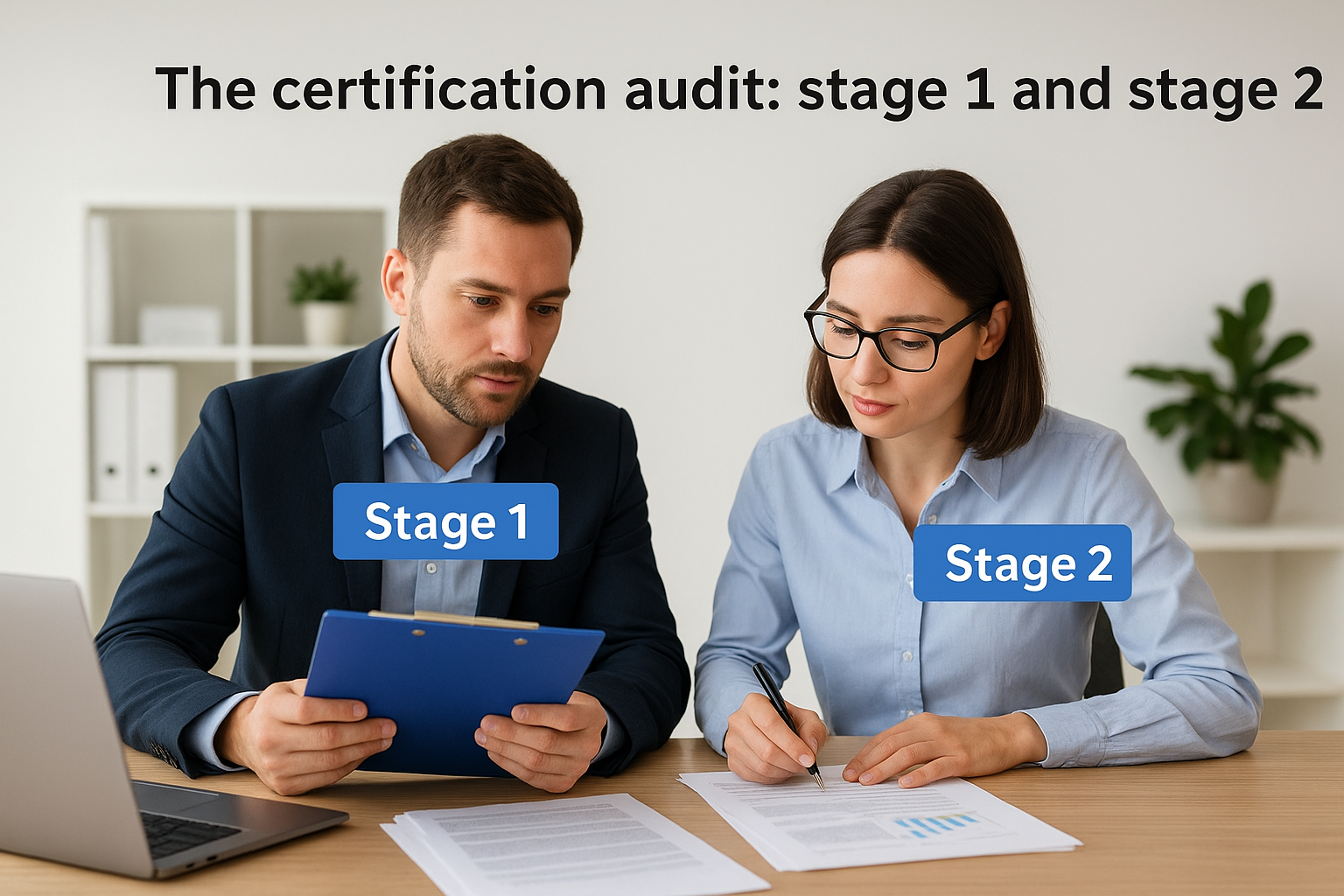
Stage 1 checks whether you’re ready to be assessed; Stage 2 checks whether the system actually works.
Stage 1: the documentation review
Stage 1 is largely a desk-based review of your ISMS documentation: the scope statement, risk assessment methodology, Statement of Applicability, and key policies. The auditor is checking whether your paperwork aligns with the requirements of ISO/IEC 27001 and whether you’re genuinely ready for the deeper Stage 2 assessment. They’ll usually visit your site briefly too, so they can sense-check that what’s written down matches what they see on the ground.
- Confirming the ISMS scope is clearly defined and justified
- Reviewing the Statement of Applicability against Annex A controls
- Checking risk assessment methodology and outputs
- Identifying any glaring gaps before Stage 2 is booked
Clearing Stage 1 with only minor observations sets a good tone heading into Stage 2. Failing it outright, which does happen, means rescheduling and paying for another visit before you can move forward at all.
Stage 2: the operational assessment
Stage 2, often called the certification audit, is where auditors test whether your controls actually operate as described on paper. Expect staff interviews, sampled records, system walkthroughs, and pointed questions about incident handling, access management, and business continuity testing. This stage typically runs longer than Stage 1, often two to five days depending on your organisation’s size and the scope you’ve defined.
| Audit stage | Focus | Typical duration |
|---|---|---|
| Stage 1 | Documentation review, readiness check | 1 day |
| Stage 2 | Operational testing, staff interviews, evidence sampling | 2 to 5 days |
Nonconformities raised at Stage 2 fall into two categories: minor findings you close out with a corrective action plan, and major findings that block certification until resolved and independently re-verified. Reaching certification means addressing both promptly and showing evidence the fix has genuinely taken hold, not just offering a promise that it will.
Surveillance and recertification audits explained
Getting certified isn’t the finish line. Your certification body will keep checking on you for the full three-year cycle, and treating those follow-up visits as an afterthought is how businesses lose certificates they worked hard to earn. Surveillance audits exist because an ISMS that looked solid on day one can quietly decay over eighteen months if nobody’s actively maintaining it.
The surveillance rhythm
Expect a surveillance audit roughly once a year, usually in months 12 and 24 after certification, with a full recertification audit at month 36 that resembles a mini Stage 2. Surveillance visits are shorter than the original certification audit, typically one day for smaller organisations, but the auditor still samples records, checks that corrective actions from previous visits actually closed out, and verifies your ISMS is still operating rather than gathering dust.
| Audit type | When it happens | Typical duration | What’s checked |
|---|---|---|---|
| Surveillance audit 1 | Month 12 | 1 day | Sampled controls, prior action items |
| Surveillance audit 2 | Month 24 | 1 day | Sampled controls, scope changes |
| Recertification audit | Month 36 | 1 to 3 days | Full system review, similar depth to Stage 2 |
Why the gaps between visits are risky
Most certificate withdrawals don’t happen because of a dramatic failure at Stage 2. They happen because a business coasts after certification, staff turnover erodes institutional knowledge, and by the time the next surveillance visit rolls round, records have gaps nobody noticed. Auditors are trained to spot exactly this pattern: policies frozen in time while the actual business has changed shape around them.
Certification decays quietly between audits unless someone keeps the ISMS running deliberately.
Scope changes make this worse if you don’t flag them. New offices, new systems, acquisitions, or a shift to remote working all affect your ISMS boundary, and auditors expect to see that you’ve updated your risk assessment and Statement of Applicability accordingly. Turn up to a surveillance visit having quietly expanded your scope without telling anyone, and you’ll hand the auditor an easy nonconformity.
Preparing for the long game
Running your own internal audits annually, keeping management review meetings on a fixed schedule, and refreshing risk assessments whenever something material changes will keep surveillance visits routine rather than stressful. Organisations that outsource ongoing monitoring, whether through a managed SOC, regular vulnerability assessments, or a partner who tracks control performance between visits, tend to walk into recertification with far less scrambling. It’s also worth reviewing guidance directly from the ISO/IEC 27001 standard whenever you make structural changes, since auditors will measure you against the current requirements, not the version you were certified under three years earlier if it’s since been revised.
Recertification itself resets the three-year clock but carries real weight: a lapsed or withdrawn certificate means starting the entire Stage 1 and Stage 2 process again, at full cost, with no shortcut for having held it before.
What auditors check and how to avoid nonconformities
Auditors work from a consistent checklist rooted in the Annex A controls and the clauses of the management system itself, so it pays to know exactly what they’ll be looking at before they arrive. Every finding they raise gets classified, and understanding that classification helps you triage your response instead of panicking over every comment in the report.
The three categories of findings
Certification bodies sort observations into three tiers, and knowing the difference changes how urgently you need to act:
| Finding type | What it means | Response required |
|---|---|---|
| Opportunity for improvement | Auditor suggestion, not a failure | Optional, good practice to consider |
| Minor nonconformity | Isolated gap, control mostly working | Corrective action plan, verified next visit |
| Major nonconformity | Control absent or systemic failure | Must close before certification is granted or kept |
Where nonconformities actually come from
In our experience, the same handful of weak spots generate most findings across different clients and sectors. Watch these closely:
- Access reviews not happening on the stated schedule, or leavers still holding active accounts weeks after departure
- Risk assessments that haven’t been updated after a genuine change, like a new supplier or system
- Statement of Applicability drifting out of sync with controls actually in place
- Training records that show attendance but not comprehension or follow-through
- Incident logs that are suspiciously empty, which reads as under-reporting rather than a clean record
Auditors don’t fail you for having gaps, they fail you for gaps you clearly haven’t noticed.
How to avoid them in practice
Closing these gaps starts with treating your internal audit programme as a genuine rehearsal, not paperwork. Sample the same records an external auditor would sample, ask the same awkward questions, and fix what you find before anyone external sees it. Documenting the fix matters as much as making it, because auditors want a trail showing you identified the issue yourself and corrected it under your own steam.
Management review is the other lever worth pulling harder. Feed every internal audit finding, every incident, and every risk change into that meeting, and keep minutes that show decisions were actually made, not just discussed. This single habit, done consistently over each audit cycle, closes off the majority of nonconformities before an external auditor ever gets the chance to raise them, and it turns the whole ISO 27001 audit process into routine maintenance rather than a recurring crisis.
Staying ahead of your next audit
Getting through the ISO 27001 audit process once proves you can build a working ISMS. Staying certified proves you can run one. That’s the real shift most businesses need to make: stop treating each visit as a hurdle and start treating the whole cycle, Stage 1 through recertification, as routine maintenance for a system that protects contracts, client trust, and your ability to recover from an incident.
None of this needs to be a solo effort. The businesses that handle audits with the least drama usually have a partner watching their controls between visits, not just showing up for the paperwork beforehand. Thirty years of running clients through Stage 1, Stage 2, and every surveillance visit after has taught us where the gaps actually appear, and how to close them before an auditor ever finds them.
If you’d rather walk into your next audit prepared than scrambling, talk to TrustedIA about your ISO 27001 certification.