

If you handle personal data in the UK, you answer to the Information Commissioner’s Office, whether you’ve registered yet or not. Every year we speak to business owners who assume data protection is someone else’s job, right up until a customer complaint or a breach lands them on the ICO’s radar. That’s usually when the questions start: who exactly is the Information Commissioner, and what do they actually enforce?
The short answer is that the ICO data protection remit covers everything from UK GDPR compliance to the statutory data protection fee that almost every organisation processing personal data must pay. Miss that fee, get your registration wrong, or mishandle a subject access request, and you’re looking at fines, formal notices, or worse. This article explains the ICO’s powers plainly, without the legal jargon.
We’ll walk through what the Information Commissioner does, how data protection ICO registration and renewal actually work, what triggers an investigation, and where the fee bands sit for 2026. If you’re not sure whether your business needs to register or you want to tighten up compliance before an audit, this is your starting point, and TrustedIA’s ISO 27001 specialists can take it further from there.
Why the ICO matters for your business
The Information Commissioner’s Office is the UK’s independent regulator for data protection and information rights. It was set up to enforce the UK GDPR, the Data Protection Act 2018, and a handful of other laws that govern how organisations collect, store, and use personal data. Unlike a trade body or advisory service, the ICO has statutory powers to investigate, fine, and prosecute. That distinction matters because plenty of business owners still treat data protection as a best-practice nicety rather than a legal obligation with teeth.
What the Commissioner actually does
Beyond issuing fines, the office runs a wide remit that touches almost every part of how a business handles information. Its core functions include:
- Regulating compliance with UK GDPR and the Data Protection Act 2018
- Investigating data breaches and complaints from members of the public
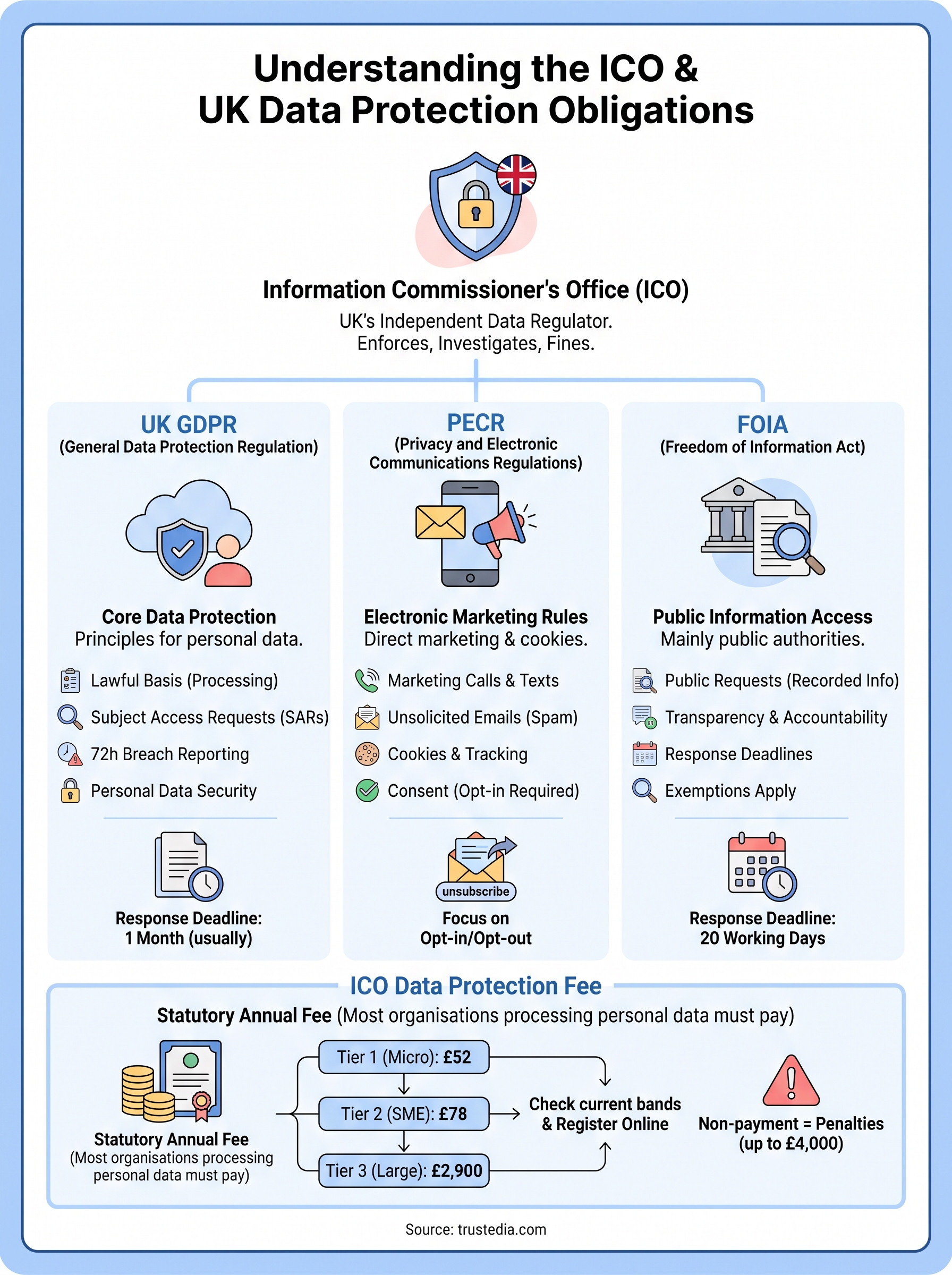
- Enforcing the Privacy and Electronic Communications Regulations (PECR) around marketing calls, texts, and emails
- Overseeing Freedom of Information requests made to public authorities
- Publishing guidance, codes of practice, and enforcement action against non-compliant organisations
- Running the data protection fee register that funds much of its work
Understanding this scope helps explain why information commissioner data protection rules apply so broadly. It’s not just large corporations processing millions of records. A five-person consultancy holding client email addresses on a CRM falls under the same framework as a national retailer.
Why this affects smaller businesses too
Owners often assume enforcement targets big data breaches at household-name companies. That assumption is wrong. The ICO regularly takes action against small and medium-sized firms for basic failures: unregistered data processing, ignored subject access requests, or marketing emails sent without proper consent. A single complaint from an unhappy customer can trigger an ICO enquiry, and once that enquiry starts, the regulator can request evidence of your policies, your training records, and your technical safeguards.
The ICO doesn’t wait for a headline-grabbing breach before it acts; a routine complaint is often enough to open a file.
That’s precisely where most SMBs get caught out. They’ve never mapped what personal data they hold, never assigned responsibility for data protection internally, and never tested whether their security controls would survive scrutiny.
The business case for taking it seriously
Treating ICO compliance as a formality rather than a genuine risk management task costs businesses in three ways. First, there’s the direct financial exposure from fines and enforcement notices. Second, there’s the reputational damage that follows any public enforcement action, which is searchable and permanent. Third, and often overlooked, is the operational disruption an investigation causes. Staff time gets diverted to answering the regulator’s questions, legal advice gets expensive fast, and customer trust takes a hit that marketing spend can’t easily repair.
Getting ahead of these risks isn’t complicated, but it does require structure. That means knowing your registration status, having a documented data protection policy, training staff on what counts as personal data, and running periodic checks on how that data is stored and shared. Businesses that build this into their operations rarely end up on the ICO’s enforcement list. Those that don’t, eventually do.
How to register with the ICO and pay the fee
Most organisations that process personal data must pay the data protection fee, a legal requirement under the Data Protection (Charges and Information) Regulations 2018. Registration isn’t optional guidance, it’s a statutory duty enforced separately from any breach or complaint investigation. You register directly through the ICO’s official registration service, and the process takes most businesses under fifteen minutes once you know your turnover and staff numbers.

Who actually needs to register
Exemptions exist, but they’re narrower than most owners assume. You typically need to register if you’re a limited company, sole trader, partnership, or public authority processing personal data for anything beyond staff administration or advertising your own goods and services. Charities, some small clubs, and organisations processing data purely for personal or household purposes may qualify for exemption, but you should confirm this against the ICO’s self-assessment tool rather than assume it applies to you.
Fee bands and what determines your tier
Fees are tiered by company size and annual turnover, not by how much data you actually hold. That surprises a lot of business owners who expect the charge to reflect risk rather than headcount.
Registering late doesn’t reduce what you owe, it just adds the risk of a penalty notice on top of the fee itself.
| Tier | Criteria | Approximate Annual Fee |
|---|---|---|
| Tier 1 | Micro organisations, turnover under £632,000 or fewer than 10 staff | £52 |
| Tier 2 | Small and medium organisations, up to 250 staff | £78 |
| Tier 3 | Large organisations, over 250 staff | £2,900 |
Check the current bands on the ICO site before paying, as figures are reviewed periodically.
Paying and renewing without missing deadlines
Once registered, you’ll receive a renewal reminder roughly a month before your fee is due, and payment runs annually unless you cancel your registration. Setting up ICO data protection payments by card rather than waiting for an invoice avoids the gap where cover technically lapses. Practically speaking:
- Register or renew online through the ICO’s self-service portal
- Pay by debit or credit card for immediate confirmation
- Update your registration promptly if turnover, staff numbers, or business activities change
- Keep your registration certificate accessible, since clients and auditors sometimes ask for it directly
Treat renewal as a fixed date in your compliance calendar, not something you’ll get to eventually.
What happens if you don’t comply with the ICO
Ignoring the information commissioner data protection rules doesn’t make the obligation disappear, it just delays the consequences and usually makes them worse. The ICO has a graduated set of enforcement powers, and it doesn’t jump straight to the maximum fine for most cases. But every stage carries real cost, and businesses that assume they’ll get a quiet warning first are often wrong.

The enforcement ladder
Actually, the ICO tends to work through a sequence rather than escalating instantly, though serious breaches can skip straight to the top. Understanding where you sit on that ladder helps you gauge how urgently you need to act:
- Informal advice or warning: a first step for minor, low-risk issues
- Enforcement notice: a formal order requiring specific changes within a set timeframe
- Monetary penalty notice: a fine, which can reach £17.5 million or 4% of global annual turnover for the most serious UK GDPR breaches
- Prosecution: reserved for criminal offences, such as unlawfully obtaining or disclosing personal data
- Audit or assessment notice: a mandated review of your data protection practices, often following a complaint
A fine is rarely the first thing that happens, but it’s almost always the last thing you want to happen.
Failing to register or pay the fee
Businesses that skip the data protection fee altogether face a separate, more mechanical enforcement path. The ICO can issue a penalty notice of up to £4,000 simply for non-payment, regardless of whether any data breach occurred. This catches out a surprising number of small firms who registered years ago, changed structure, and never renewed. Check your status directly rather than assuming an old registration still covers you.
The knock-on damage beyond fines
Beyond the direct penalty, non-compliance triggers costs that don’t show up on the ICO’s website. Clients and insurers increasingly ask for proof of registration and a documented data protection policy before signing contracts. Losing that paperwork trail can cost you the deal before the ICO even gets involved. Legal fees mount quickly once an enforcement notice lands, and staff time spent responding to regulator queries pulls focus from actual operations. None of this is abstract risk. It’s the practical cost of treating data protection as paperwork rather than a genuine operational discipline.
How the ICO relates to GDPR, PECR and FOIA
Confusion often creeps in here because the ICO enforces several different laws, not just one, and each has its own scope. Understanding which rule applies to which situation stops you wasting effort fixing the wrong problem when a complaint or audit request lands on your desk.
UK GDPR: the backbone of data protection
General compliance work for most businesses centres on the UK GDPR, which sets out the principles for lawfully collecting, storing, and using personal data. It covers things like having a lawful basis for processing, responding to subject access requests within a month, and reporting notifiable breaches to the ICO within 72 hours. When people talk about ico data protection obligations day to day, they’re usually talking about UK GDPR compliance specifically, even if they don’t use that term.
PECR: the rules behind marketing
Privacy and Electronic Communications Regulations sit alongside UK GDPR but govern something narrower: how you contact people electronically. Cold calls, marketing texts, cookies on your website, and unsolicited emails all fall under PECR rather than the broader data protection framework. A business can be fully UK GDPR compliant and still breach PECR by sending marketing emails to people who never opted in. The ICO issues separate fines for PECR breaches, and it does so regularly, particularly against firms running aggressive telemarketing or email campaigns without proper consent records.
Being GDPR compliant doesn’t automatically make your marketing legal, PECR is a separate test entirely.
FOIA: a different audience altogether
Freedom of Information Act obligations apply almost exclusively to public authorities, councils, NHS trusts, universities, and government bodies, rather than private businesses. It gives members of the public the right to request recorded information those organisations hold, and the ICO oversees compliance with response deadlines and exemptions. Most SMBs in TrustedIA’s client base never encounter FOIA directly unless they’re contracted to deliver public services, in which case some obligations can flow through into their own record-keeping.
Why the distinction matters practically
Separating these three frameworks matters because each carries different registration requirements, different deadlines, and different enforcement routes. Data protection ico compliance reviews that only check UK GDPR paperwork while ignoring marketing consent records or, for public bodies, FOIA response times, leave real gaps exposed. A thorough compliance check needs to test all three where they apply, not just the one that’s easiest to document.
Staying on top of your data protection duties
Getting right with the Information Commissioner’s Office isn’t a one-off task you tick and forget. Registration, the annual fee, marketing consent, breach reporting: each needs ongoing attention, not a single burst of effort before an audit. Ignoring that reality is exactly how businesses end up on the wrong side of an enforcement notice they never saw coming.
Hopefully this has cleared up what the ICO actually enforces and where your obligations sit under UK GDPR, PECR, and FOIA. Knowing the rules is one thing; building them into daily operations is another. Regular reviews, documented policies, and staff who understand what personal data actually means will keep you off the regulator’s radar far more reliably than good intentions.
If you’d rather have specialists handle the detail while you run the business, talk to TrustedIA’s ISO 27001 experts about tightening your compliance before it becomes a problem.



