
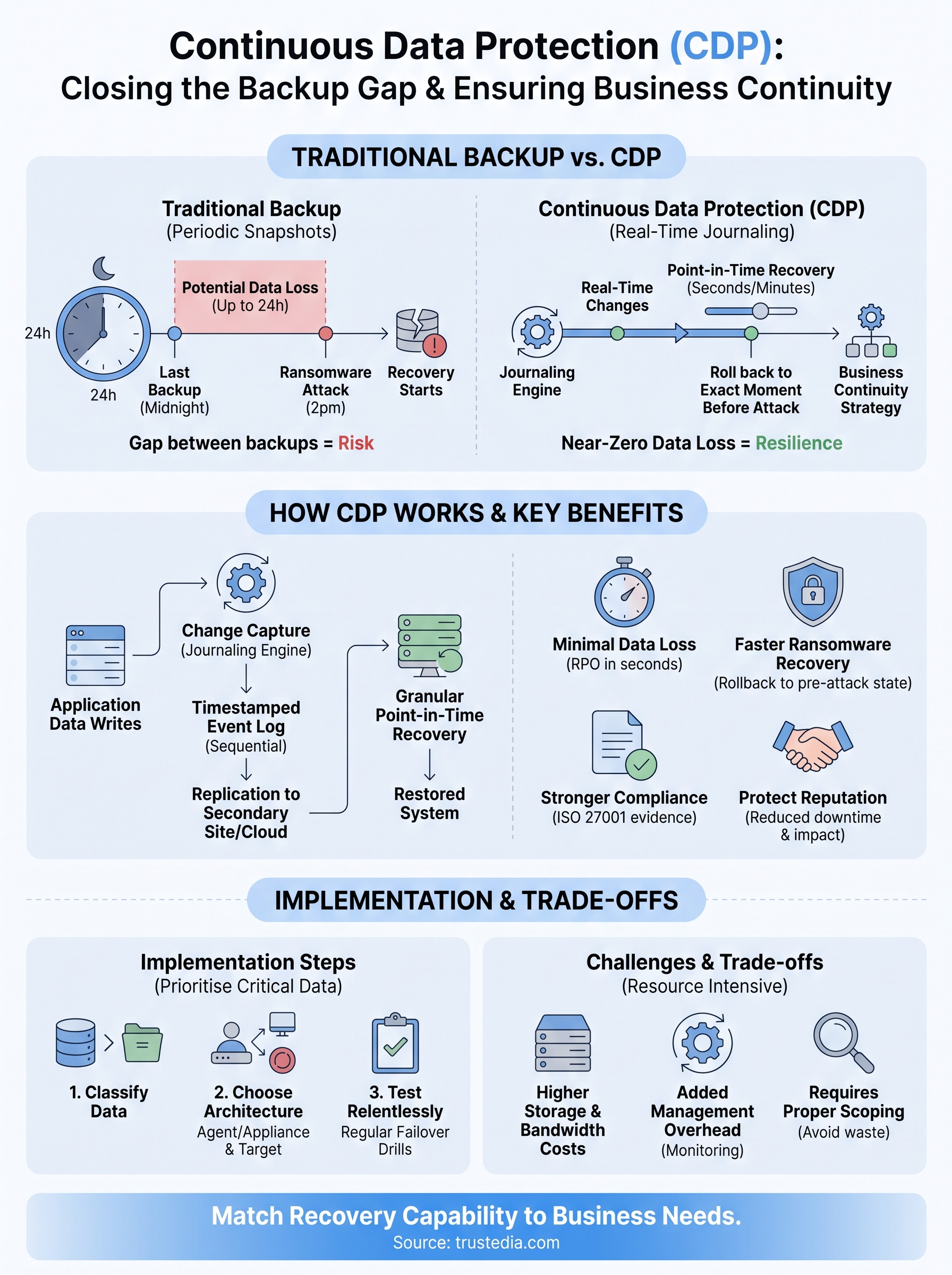
A ransomware attack doesn’t wait for your nightly backup window. If it hits at 2pm and your last backup ran at midnight, you lose a full day of orders, emails, and customer records the moment recovery starts. That gap between backups is exactly what continuous data protection was built to close, and it’s why more IT managers and compliance officers are asking about it instead of settling for the traditional overnight job.
Continuous data protection, or CDP, works by capturing every change to your data as it happens, rather than taking periodic snapshots. Instead of restoring to last night’s version, you can roll back to the exact point just before an incident occurred, sometimes down to the second. That difference matters enormously when you’re dealing with ransomware recovery or accidental deletion, where every hour of lost data translates into real operational and financial damage.
This article breaks down how CDP actually works under the hood, how it differs from traditional backup and snapshot-based approaches, and where it fits into a wider business continuity strategy. We’ll also cover the practical benefits and trade-offs, so you can judge whether it’s the right fit for your organisation’s recovery point objectives and budget.
Why continuous data protection matters for your business
Businesses lose money the moment data stops flowing, not just when a breach makes headlines. A manufacturing firm running nightly backups can lose a full shift’s worth of orders and production data if ransomware strikes mid-afternoon. A solicitor’s practice could lose a day of client correspondence and case notes, information that’s often irreplaceable and legally sensitive. Continuous data protection shrinks that exposure window from hours to seconds, which changes the entire calculation around recovery point objectives (RPO) and how much data loss your business can actually tolerate.
The gap between your last backup and the moment disaster strikes is the single biggest variable in how much a cyber incident actually costs you.
Regulatory and insurance pressure is rising
Compliance frameworks like ISO 27001 increasingly expect organisations to demonstrate robust, tested recovery capabilities, not just a backup schedule on paper. Cyber insurers are asking harder questions too, often requiring evidence of granular recovery points before they’ll underwrite a policy or pay out on a claim. According to the National Cyber Security Centre, ransomware remains one of the most significant cyber threats facing UK organisations, and recovery speed is consistently the factor that determines whether an incident becomes a minor disruption or a business-ending event.
It protects reputation, not just data
Customers and partners notice when systems go down for days rather than hours. Reducing downtime with near-instant recovery points helps you meet contractual SLAs, maintain client trust, and avoid the reputational fallout that often outlasts the technical fix.
How continuous data protection works
CDP relies on a journaling engine that sits between your applications and storage, logging every write operation as it happens rather than waiting for a scheduled job. Each change gets timestamped and stored as a discrete event, which means you can rewind to any point in time rather than being locked into whatever moment last night’s snapshot captured. This is the core distinction from snapshot-based backup, where you’re limited to fixed intervals no matter how the data behaves in between.

The journal and recovery point mechanics
Behind the scenes, most CDP systems use a combination of block-level or byte-level change tracking alongside a rolling journal that retains a defined history window, often 24 to 72 hours depending on storage capacity and policy.
A properly configured journal turns recovery from a guessing game into a precise, second-by-second rewind.
- Change capture: every write is intercepted and logged in real time
- Journaling: changes are stored sequentially with timestamps
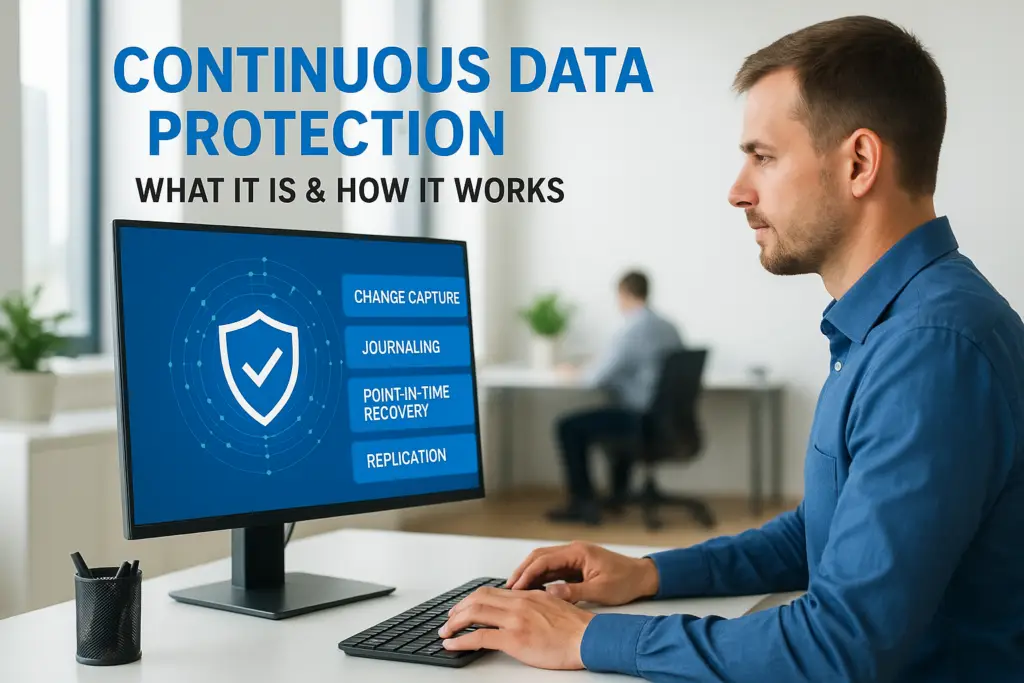
- Point-in-time recovery: you select the exact moment before corruption or attack
- Replication: journaled data is mirrored to a secondary site or cloud target
This architecture is why CDP pairs so well with disaster recovery planning, since it minimises both data loss and downtime simultaneously.
How to implement continuous data protection
Getting continuous data protection running properly starts with knowing what actually needs it. Not every system justifies the cost and complexity of real-time journaling, so map your critical applications first and work outward from there.
Start with a data classification exercise
Sort your systems by how much data loss they can tolerate. Customer databases, transaction logs, and email servers usually sit at the top of that list, while archived files or test environments can stay on traditional nightly backup. This exercise also feeds directly into your recovery point objectives, giving you a defensible reason for where CDP gets deployed and where it doesn’t.
Choose the right architecture and test it relentlessly
- Agent-based or appliance-based: decide whether software agents on each server or a dedicated appliance suits your infrastructure better
- Replication target: pick a secondary site or cloud destination with enough bandwidth to keep pace with change volume
- Retention window: set journal length based on how quickly incidents are typically detected
- Failover testing: schedule regular recovery drills, not just annual box-ticking
A CDP system nobody has tested is just an expensive assumption.
Skipping the testing step is where most implementations quietly fail when it matters most.
Continuous data protection versus traditional backup methods
Comparing the two side by side makes the trade-offs obvious fast. Traditional backup methods, whether nightly full backups or periodic snapshots, always leave a gap between your last capture and the moment something goes wrong. Continuous data protection closes that gap almost entirely, but it demands more storage, bandwidth, and management attention than a simple overnight job. Neither approach is universally right, which is why most organisations end up running a hybrid model rather than replacing one with the other outright.
| Factor | Traditional backup | Continuous data protection |
|---|---|---|
| Recovery point | Hours to a full day | Seconds to minutes |
| Storage demand | Lower, scheduled jobs | Higher, constant journaling |
| Best suited for | Archives, low-change data | Databases, transaction logs, email |
| Recovery speed | Slower, full restore often needed | Fast, granular point-in-time restore |
| Cost profile | Lower upfront and ongoing | Higher infrastructure and licensing |
Understanding where each method fits helps you avoid overspending on systems that don’t need second-by-second protection, while making sure your genuinely critical data never sits exposed for hours.
Key benefits and challenges to weigh up
Getting continuous data protection right means being honest about what it costs as well as what it fixes. It’s not a silver bullet you bolt on and forget; it’s a trade-off between near-zero data loss and the resources needed to sustain that level of protection.
The benefits are hard to ignore
- Minimal data loss: recovery points measured in seconds rather than hours
- Faster incident response: less time spent working out what was lost before restoring
- Stronger compliance evidence: granular recovery logs support ISO 27001 audits and insurer requirements
- Reduced ransomware impact: roll back to the moment before encryption started
The real value of CDP isn’t the technology itself, it’s the certainty it gives you during the worst hour of your business’s year.
The challenges are real too
- Higher storage and bandwidth costs from constant journaling
- Added management overhead, since journals and replication targets need monitoring
- Not every system needs it, so poor scoping wastes budget fast
Weighing these honestly, rather than assuming CDP suits every workload, keeps your business continuity strategy realistic and affordable.
Making CDP work for your organisation
Continuous data protection isn’t about chasing the newest technology for its own sake. It’s about matching your recovery capability to what your business can actually survive losing. A day’s worth of orders, client emails, or transaction records shouldn’t disappear just because your last backup ran hours before an attack hit. Getting this right means classifying your data properly, choosing the right architecture, and testing failover until it’s routine rather than theoretical.
None of that happens by accident, and few in-house teams have the bandwidth to run journaling, replication, and disaster recovery drills alongside everything else on their plate. That’s where a partner who’s spent decades building resilient recovery strategies earns their keep, scoping CDP against real recovery point objectives rather than guesswork. If you’re ready to close that backup gap properly, get in touch with TrustedIA to talk through what your organisation actually needs.



