
If you’ve been asked to explain how your business handles personal data, you need more than a vague sense that you’re
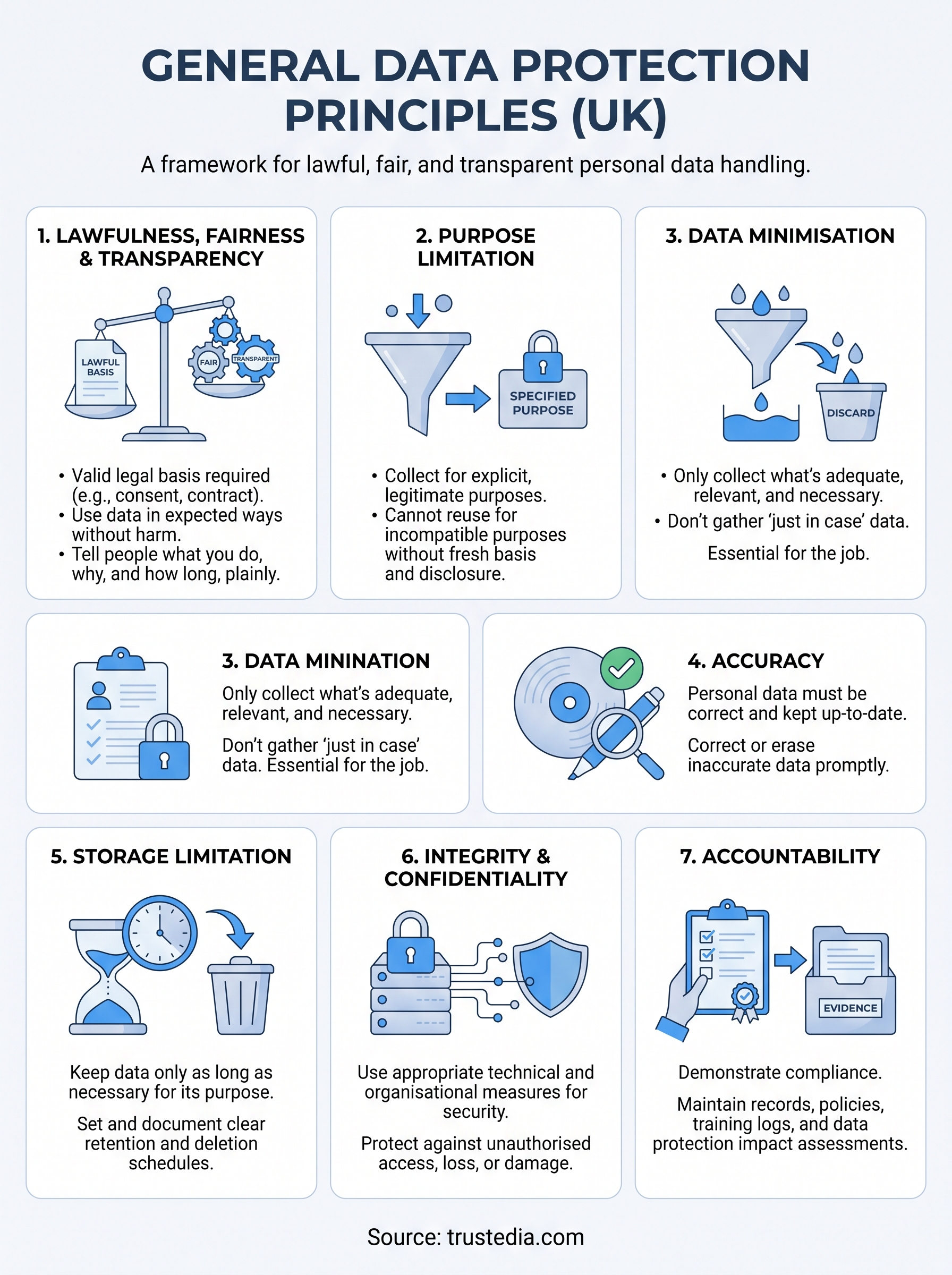
1. Lawfulness, fairness and transparency
This is the principle everything else in the general data protection principles framework builds on, and it’s usually the one that trips businesses up first. It’s not one rule but three linked tests, and you need to satisfy all of them before you touch a single piece of personal data.
What it means
Lawfulness means you must have a valid legal basis before you collect or use personal data, such as consent, a contract, a legal obligation, or legitimate interests. Fairness means you can’t use data in ways people wouldn’t reasonably expect or that could cause them harm, even if you’ve technically got a legal basis. Transparency means telling people, in plain language, what you’re doing with their data, why, and for how long. Together these three tests form the opening line of both the UK GDPR and the Data Protection Act 2018, and they set the tone for every other principle that follows.
Why it matters
Getting this wrong is where most enforcement action starts, because regulators treat a missing or shaky legal basis as a fundamental failure, not a technicality. Customers notice too. Buried privacy notices, pre-ticked consent boxes, and data used for purposes nobody agreed to are exactly what erodes trust and invites complaints to the ICO.
Without a clear legal basis and honest disclosure, nothing else you do with personal data can be considered compliant.
How to comply in practice
Start by mapping every data flow in your business against a specific lawful basis, and document your reasoning rather than assuming consent covers everything. Then check your privacy notices actually reflect what you do, not what a template says.
- Identify the lawful basis for each processing activity before it starts, not after
- Write privacy notices in plain English, avoiding legal jargon that hides real meaning
- Avoid pre-ticked boxes or bundled consent for unrelated purposes
- Review third-party data sharing arrangements to confirm they match your stated purposes
- Keep a record of your lawful basis decisions in case a regulator or customer asks
Businesses that skip this groundwork often only discover the gap during an audit or after an incident, which is a costly time to find out. A structured cyber audit from a partner like TrustedIA can surface these gaps early, checking your data flows and documentation against what the law actually requires rather than what you assumed it required.
2. Purpose limitation
Once you’ve established a lawful basis, the next of the general data protection principles asks a simpler question: what did you actually tell people the data was for? Purpose limitation stops businesses collecting data for one reason and then quietly repurposing it for another, and it’s one of the easier principles to breach without realising it.
What it means
You must collect personal data for specified, explicit and legitimate purposes, and you can’t then use it in a way that’s incompatible with those original purposes. If you gathered email addresses for order confirmations, you can’t start using that same list for marketing campaigns without a fresh legal basis and clear disclosure. Some further use is allowed, such as archiving or statistical analysis, but only where safeguards are in place and the new use doesn’t undermine what people originally agreed to.
Why it matters
Regulators view purpose creep as a breach of trust as much as a technical failure, because it means the original consent or contract no longer covers what you’re actually doing. Customers who signed up for one thing and end up receiving another often complain, and those complaints tend to reveal wider gaps in how a business tracks its own data uses.
Data collected for one purpose can’t quietly become the answer to a different business problem.
How to comply in practice
Map every dataset back to its original stated purpose and flag anywhere the actual use has drifted. Build a simple approval step before any team repurposes existing data, so marketing, sales, or product teams can’t reuse a list without checking it’s compatible with what customers were told. TrustedIA’s audit services help identify exactly this kind of drift, comparing documented purposes against real-world data usage across your systems.
3. Data minimisation
The third of the general data protection principles asks a blunt question: do you actually need all this data? Data minimisation means collecting only what’s necessary for the job at hand, not everything you could conceivably gather "just in case" it proves useful later.

What it means
Personal data you hold must be adequate, relevant and limited to what’s necessary for the purpose you’re processing it for. A recruitment form asking for a passport number and a driving licence before you’ve even interviewed someone goes beyond what’s needed. So does a checkout page collecting a date of birth when all you’re selling is a t-shirt. If a field isn’t essential to deliver the service, it shouldn’t be mandatory, and often it shouldn’t be there at all.
Why it matters
Excess data is pure liability with no upside. Every extra field you collect is another piece of information that can leak in a breach, another record you must secure, and another thing you’ll struggle to justify if a regulator asks why you needed it.
The safest data you hold is the data you never collected in the first place.
Businesses that hoard data "for future use" usually find that future use never materialises, but the storage risk and audit burden certainly do.
How to comply in practice
Review every form, database field, and API call that captures personal data, and ask whether each one is truly necessary right now, not hypothetically useful someday.
- Strip optional fields down to what’s genuinely required for the transaction
- Set default settings to collect the least data possible, adjusting only where there’s a clear justified need
- Challenge any "nice to have" field a team wants to add before it goes live
- Periodically re-check older forms and systems for fields that crept in over time
TrustedIA’s network auditing work often flags legacy systems still hoarding fields nobody uses anymore, a quiet but real risk sitting in plain sight.
4. Accuracy
The fourth of the general data protection principles is one most businesses assume they’ve already nailed, right up until a customer flags an outdated address or a duplicate record with two different phone numbers. Accuracy means the personal data you hold has to reflect reality, and you need a process for fixing it when it doesn’t.
What it means
Personal data must be accurate and, where necessary, kept up to date. That doesn’t mean you’re liable for every typo a customer makes when filling in a form, but it does mean you must take reasonable steps to correct or erase data that’s wrong once you know about it. Inaccurate data left uncorrected, especially data that influences a decision about someone, is a breach of this principle regardless of how it got there.
Why it matters
Inaccurate records cause real harm: wrong addresses delay deliveries, outdated employment details skew reference checks, and stale contact information means marketing lands with people who’ve long since left a company. Beyond the operational mess, data accuracy failures undermine every decision built on that data, from credit checks to fraud screening.
Data that’s wrong is arguably worse than no data at all, because it looks trustworthy right up until it isn’t.
How to comply in practice
Give customers an easy way to check and update their own records, and don’t bury the option three menus deep in a portal nobody uses.
- Set a review cadence for key datasets, particularly ones tied to decisions like credit or employment
- Correct or delete inaccurate data as soon as it’s flagged, and log that you did
- Cross-check data pulled from third parties before it feeds into your own systems
- Train staff to spot and escalate obvious inconsistencies rather than ignore them
TrustedIA’s audit services can test whether your correction processes actually work in practice, not just on paper.
5. Storage limitation
The fifth of the general data protection principles deals with something businesses often overlook entirely: how long you keep personal data after you’ve finished using it. Storage limitation says data shouldn’t sit in your systems indefinitely just because deleting it feels like extra work.
What it means
Personal data must only be kept for as long as necessary for the purpose it was collected for. Once that purpose is fulfilled, the clock starts ticking, and you need a genuine reason to keep holding the data, not just inertia. Some sectors have statutory retention periods, but outside those, data retention decisions should be deliberate, documented, and tied to an actual business or legal need.
Why it matters
Old data that outlives its purpose is dead weight with real risk attached. It expands your attack surface in a breach, complicates subject access requests, and often includes records nobody remembers the justification for. Regulators expect a retention schedule, and "we might need it someday" doesn’t count as one.
Data you no longer need is just risk sitting on a server, waiting for someone to find it.
How to comply in practice
Build a retention schedule that assigns a clear timeframe and deletion trigger to every category of personal data you hold, not a single blanket rule for everything.
- Set automatic deletion or anonymisation once a retention period lapses
- Document the justification for any retention period longer than the industry norm
- Audit backups and archives too, since deleted data often lingers there unnoticed
- Review retention schedules annually as purposes and legal requirements change
TrustedIA’s audit services regularly uncover forgotten data stores that should have been purged years ago, a common finding that surprises even well-organised businesses.
6. Integrity and confidentiality
The sixth of the general data protection principles is the one most people associate with cyber security itself, even though it’s only one piece of the wider framework. Integrity and confidentiality means personal data must be handled with appropriate security, protecting it against unauthorised access, loss, or damage.

What it means
Organisations must use appropriate technical and organisational measures to keep personal data secure, covering everything from encryption and access controls to physical security and staff training. There’s no single checklist that satisfies this principle for every business, because "appropriate" depends on the nature of the data, the risk of harm if it’s exposed, and what’s reasonably achievable for your size and sector.
Why it matters
Breaches under this principle tend to be the most visible and damaging, because they usually involve real harm to real people, not just a paperwork gap. Weak access controls, unpatched systems, and untrained staff are the usual routes in, and regulators expect you to have addressed the obvious ones before an incident, not after.
Security isn’t a bolt-on to data protection, it’s the principle that decides whether all the others hold up under pressure.
How to comply in practice
Assess your current defences honestly rather than assuming existing tools are enough, and treat this as an ongoing programme rather than a one-off project.
- Deploy endpoint detection and access controls proportionate to the data you hold
- Run regular vulnerability assessments and penetration testing to find gaps before attackers do
- Encrypt sensitive data both at rest and in transit
- Train staff to recognise phishing and social engineering attempts
TrustedIA’s managed security services combine these controls with a dedicated Security Operations Centre, giving businesses continuous monitoring rather than a periodic check.
7. Accountability
The seventh of the general data protection principles is different from the previous six because it’s not about a specific data handling practice, it’s about proving you take the other six seriously. Accountability means you can’t just comply with data protection law, you have to be able to demonstrate that compliance whenever a regulator, customer, or auditor asks.
What it means
Organisations must take responsibility for how they handle personal data and keep evidence showing they’ve met their obligations under every other principle. That means policies, training records, data protection impact assessments, and a documented decision trail, not just good intentions sitting in someone’s head. Larger organisations and those processing higher-risk data also need a designated Data Protection Officer, while smaller businesses still need someone clearly accountable even without that formal title.
Why it matters
Regulators don’t take your word for it, they ask for the paperwork. Businesses that can produce records, policies, and evidence of ongoing review sail through scrutiny, while those relying on "we’ve always done it this way" struggle to justify even sound practices. Accountability also forces genuine internal ownership, because someone has to actually check the other principles are being followed rather than assuming they are.
If you can’t show your work, regulators will assume you haven’t done any.
How to comply in practice
Appoint clear ownership for data protection decisions, even if that’s a shared responsibility rather than a dedicated role.
- Maintain a record of processing activities covering what data you hold and why
- Run data protection impact assessments for higher-risk projects before they launch
- Keep policies, training logs, and audit findings in one accessible place
- Review accountability measures alongside every other principle, not as a separate exercise
TrustedIA’s ISO 27001 professional services build exactly this kind of documented, auditable structure, giving businesses evidence they can hand over with confidence rather than scrambling together after the fact.
Turning the principles into everyday practice
Seven principles sound manageable on paper, but the real challenge is keeping all of them running at once, across every system, form, and team in your business. Data protection principles aren’t a box you tick once a year, they’re a daily discipline that touches how you collect data, how long you keep it, who can access it, and whether you can prove any of that when someone asks. Miss one and the others start to wobble too, since lawfulness means little without accuracy, and accountability means nothing without security behind it.
Most businesses don’t lack good intentions, they lack the structured process and independent check that turns intentions into evidence. That’s where a specialist partner earns its keep, spotting the gaps you’re too close to see and building the documentation to back up what you already do well. If you want a clear picture of where your business actually stands, TrustedIA can help you find out.



