
If a client or auditor has asked whether you’re GDPR compliant and you weren’t quite sure how to answer, you’re not alone. What is General Data Protection Regulation GDPR confuses plenty of business owners, mainly because the term gets thrown around without much explanation of what it actually requires from you day to day.
In short, the General Data Protection Regulation is the UK and EU law governing how organisations collect, store, and use personal data. It sets out strict rules on consent, data security, breach reporting, and individual rights, backed by fines that can reach millions of pounds for serious failures. Understanding it properly means knowing not just the legal definition but what it means for your systems, staff, and suppliers.
This article breaks down exactly what GDPR covers, who it applies to, and the practical steps behind genuine data protection compliance. We work with businesses on this daily through our ISO 27001 and cyber assurance services, so we’ll focus on what actually matters for keeping your organisation on the right side of the regulation, not just the legal theory.
Why GDPR matters for your business
GDPR data protection regulation rules aren’t just a legal box to tick, they shape how clients, insurers, and regulators judge whether your business can be trusted with sensitive information. Ignore the requirements and you’re not only risking fines, you’re risking the contracts and partnerships that depend on you handling data responsibly. Many organisations only take this seriously after a near-miss or a client audit forces the issue, but by then the gaps in your processes are already visible to the people you’re trying to win business from.
Who the regulation actually covers
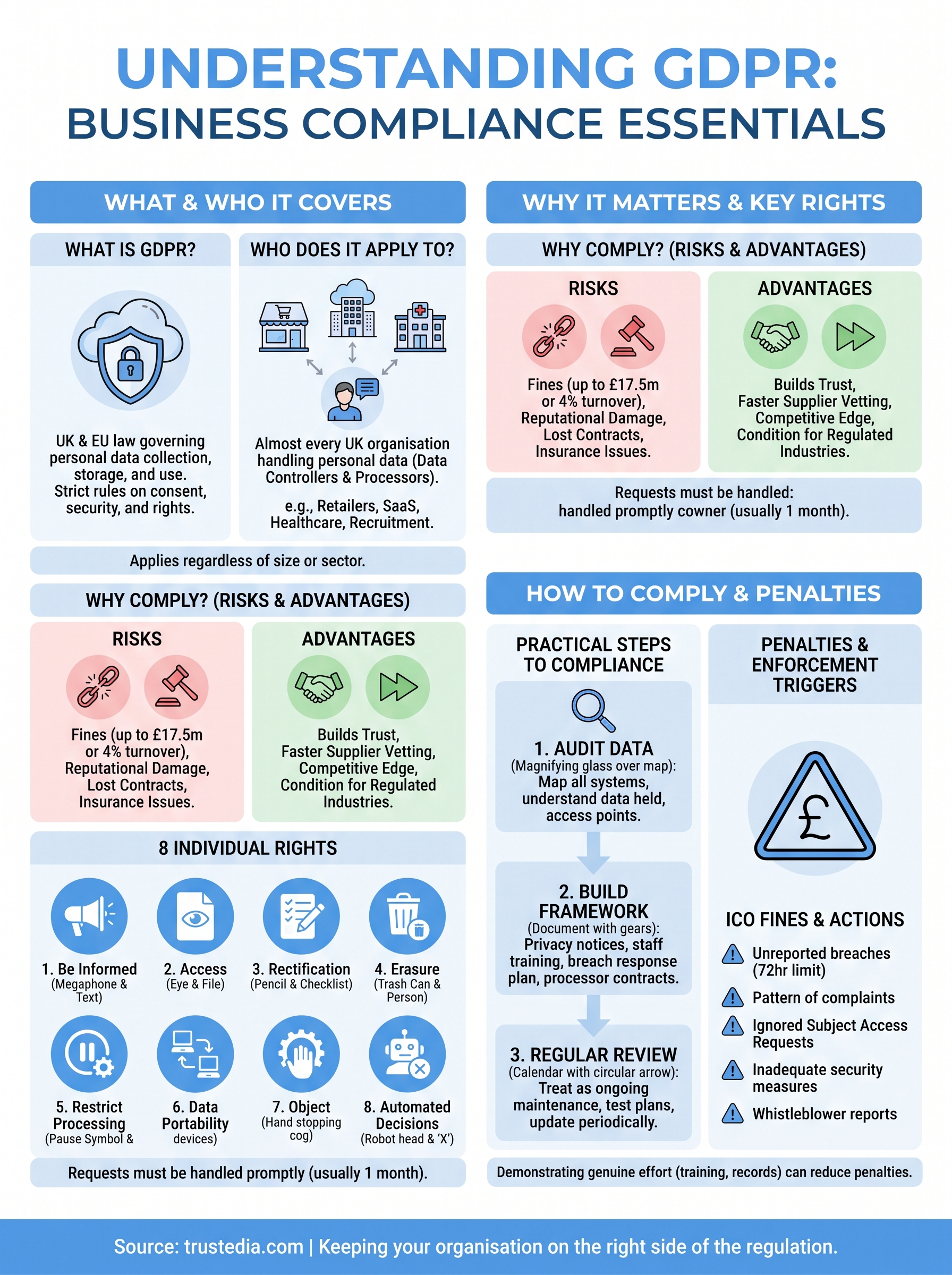
Almost every UK business handling personal data falls under GDPR, regardless of size or sector. It applies whether you’re a data controller deciding how information is used, or a data processor handling it on someone else’s behalf, such as a payroll provider or cloud hosting company. Common examples include:

- Retailers storing customer names, addresses, and payment details
- Recruitment agencies holding CVs and interview notes
- SaaS companies processing user account data on behalf of clients
- Healthcare and legal firms managing sensitive case records
If your organisation touches personal data at any point, from a marketing email list to an HR system, the regulation applies to you.
The business risks beyond the headline fines
Fines get the attention, but the real damage often comes from what happens after an incident. Clients cancel contracts, insurers raise premiums or refuse renewal, and prospective customers walk away from tenders when due diligence uncovers weak data handling. We’ve seen businesses lose long-standing contracts not because of a breach itself, but because they couldn’t demonstrate proper data protection compliance when asked. Reputational damage tends to outlast the financial penalty, and it’s far harder to repair.
Losing a client’s trust in your data handling often costs more than any fine the regulator could issue.
GDPR as a genuine advantage, not just a burden
Treating the general data protection regulation as a minimum standard rather than a threat changes how procurement teams and auditors view your business. Organisations that align their data practices with GDPR and frameworks like ISO 27001 tend to move faster through supplier vetting, win larger contracts, and face fewer objections during tenders. It signals to partners that you take security seriously before anything goes wrong, not just after. For businesses serving regulated industries such as finance, healthcare, or insurance, this alignment is increasingly a condition of doing business at all, not an optional extra. You can read more about the UK’s approach to enforcement directly from the Information Commissioner’s Office, which oversees compliance across England, Scotland, Wales, and Northern Ireland.
How to comply with GDPR in practice
Getting compliant doesn’t require a legal degree, but it does require a system rather than a one-off checklist you complete and forget. Most businesses stumble because they treat GDPR as a document exercise instead of an operational one, filing a policy away without ever changing how staff actually handle data day to day. Data protection compliance has to live in your processes, not just your paperwork.
Start with a data audit
Before you fix anything, you need to know what personal data you hold, where it sits, and who can access it. Map every system, from your CRM to shared drives to old email archives, and note what’s collected, why it’s kept, and how long it’s retained. This is where our CRAFT assessment tooling helps clients, because it flags exposure points that manual spreadsheets miss.
Build the core compliance framework
Once you understand your data landscape, put these elements in place:
- A clear, plain-English privacy notice for customers and staff
- Documented lawful basis for every category of data you process
- Staff training on handling, storing, and reporting data correctly
- A breach response plan with named responsibilities and timelines
- Contracts with processors that specify their GDPR obligations
Review it like you mean it
Compliance isn’t a project with an end date. Suppliers change, systems get replaced, and new data streams appear as your business grows. Quarterly reviews of access permissions and annual reviews of your privacy notices catch drift before it becomes a liability.
Treat GDPR compliance as a maintenance schedule, not a certificate you earn once and file away.
Think about general data protection regulation act requirements the way you’d think about fire safety: policies matter, but only if people actually follow them when it counts. Regular internal audits, ideally aligned with ISO 27001 controls, give you evidence that your compliance is genuine rather than performative, which matters enormously if the ICO or a client ever asks you to prove it.
Key rights GDPR gives to individuals
Understanding GDPR data protection isn’t just about protecting your business from fines, it’s about respecting the rights the law hands to every person whose data you hold. These rights sit at the centre of the regulation, and if your processes don’t accommodate them, no amount of paperwork will save you when someone actually exercises one. Knowing these rights inside out also helps you spot gaps before a customer or employee does.
The eight rights in practice
Every individual covered by data protection regulation GDPR rules can exercise the following:

- Right to be informed: clear, upfront explanation of how their data is used
- Right of access: a copy of the personal data you hold on them
- Right to rectification: correction of inaccurate or incomplete data
- Right to erasure: deletion of their data in certain circumstances (the "right to be forgotten")
- Right to restrict processing: limiting how you use their data without deleting it
- Right to data portability: receiving their data in a usable format to transfer elsewhere
- Right to object: refusing processing for direct marketing or specific purposes
- Rights related to automated decision-making: protection from decisions made solely by algorithms
Every one of these rights becomes a real obligation the moment a customer emails asking to see their data.
Handling requests without panic
Questions about these rights usually arrive as a subject access request, and you have one calendar month to respond under normal circumstances. Requests rarely announce themselves formally, they often turn up as a throwaway line in an email, so staff need to recognise them immediately rather than treating them as routine correspondence. Staff training matters here more than policy documents, because the person answering the phone or reading the inbox is your actual first line of compliance. Setting a clear internal process, who logs the request, who verifies identity, who pulls the data, prevents the scramble that damages trust even when you technically meet the deadline.
GDPR penalties and how to avoid them
Money gets people’s attention faster than any warning about reputation, so let’s talk numbers. Under UK GDPR, the Information Commissioner’s Office can issue fines of up to £17.5 million or 4% of global annual turnover, whichever is higher, for the most serious breaches. Lower-tier infringements, such as poor record-keeping or failure to appoint a Data Protection Officer where required, still carry penalties of up to £8.7 million or 2% of turnover. These aren’t theoretical numbers set for multinationals either. Smaller businesses get fined too, usually for basics like unencrypted laptops going missing or customer databases left exposed on misconfigured servers.
What actually triggers enforcement action
The ICO doesn’t go looking for random businesses to punish. Enforcement typically follows a specific trigger, and knowing these helps you focus your effort where it counts:
- A reported data breach that wasn’t disclosed within 72 hours
- A pattern of customer complaints about how their data was handled
- A subject access request that went unanswered or was badly mishandled
- Evidence of inadequate security measures during an unrelated investigation
- Whistleblower reports from current or former employees
Most fines don’t come from the breach itself, they come from how badly the response was handled afterwards.
Building the paper trail that protects you
Regulators respond far more leniently to organisations that can show genuine effort, even when something goes wrong. Documented risk assessments, staff training records, and a tested incident response plan all demonstrate that a breach was an isolated failure rather than systemic neglect. Practical steps that reduce your exposure include running regular vulnerability assessments, keeping an incident log even for near-misses, and rehearsing your breach response so nobody’s improvising when it matters. Full guidance on penalty calculations sits directly with the Information Commissioner’s Office, and it’s worth reading before you assume your business is too small to attract attention. Prevention costs a fraction of what recovery does, and that gap only widens the longer you wait to close it.
Keeping your business GDPR compliant
Getting to grips with what is General Data Protection Regulation GDPR really means isn’t a one-off exercise you tick off and forget. It’s an ongoing commitment that touches your systems, your staff, and every supplier you work with. The businesses that handle this well treat compliance as part of daily operations, not a document gathering dust in a shared drive. Regulators and clients alike can tell the difference between genuine practice and paperwork built purely to pass an audit.
Staying compliant means auditing your data regularly, training staff properly, and having a breach response plan you’ve actually tested. None of that happens by accident, and few businesses have the time or in-house expertise to manage it alongside everything else on their plate.
If you’d rather have specialists handle the assessments, training, and ongoing compliance work for you, get in touch with TrustedIA and let’s talk through where your business currently stands.