
Patching everything is no longer possible. Scanners now surface thousands of findings per month, attackers weaponise new flaws within days, and most IT teams in UK businesses are small. If you are trying to work out where to focus your security strategy this year, you need a clear view of what is changing, not another generic checklist.
Here is the short answer. The eight vulnerability management trends in this article all point the same way: away from periodic scanning and towards continuous, risk-based exposure management, backed by automation. Severity scores alone no longer decide what gets fixed first. Exploitability, asset value and business impact do.
Below, we cover each trend in turn, from automated remediation and threat-informed prioritisation to continuous exposure management and the growth of the market around it. We draw on more than 30 years of helping organisations through audits, ISO 27001 certification and incident response, so you will also see what each trend means in practice for an SMB or enterprise team with limited resources.
1. Risk-based prioritisation beyond CVSS
What is changing
CVSS has been the default sorting method for a decade, but it measures technical severity, not risk. A 9.8 on an isolated test server can outrank a 7.5 on your internet-facing VPN gateway. Teams are now layering context on top of the score: whether an exploit exists, whether the asset is exposed, and what the business loses if it fails.
This is the most important of this year’s vulnerability management trends, because the others feed into it. A risk-based model typically combines the inputs below.
| Input | Question it answers |
|---|---|
| CVSS base score | How bad could this be technically? |
| Exploit likelihood | Is anyone attacking it, or likely to? |
| Asset criticality | What business process depends on this system? |
| Exposure | Can an attacker reach it from the internet? |
| Compensating controls | Is something already blocking the attack path? |
Why it matters now
Volume is the problem. More than 40,000 CVEs were published in 2024, and only a small minority are ever exploited in the wild. Sorting by score alone means your team burns its limited hours on flaws nobody attacks, while a mid-rated bug on a exposed system waits its turn.
A CVSS score tells you how bad a flaw could be, not how likely it is to hurt you.
Auditors are also asking sharper questions. ISO 27001 (Annex A control 8.8) expects you to manage technical vulnerabilities in a way that reflects your own risk, and a documented, risk-based method is far easier to defend than "we patch criticals first".
Who should act first
Any team whose backlog has grown for two or more quarters should start here. If you are fixing the same number of items each month and the queue still gets longer, your prioritisation is the bottleneck, not your effort.
Smaller organisations gain the most. With one or two IT staff and no dedicated security analyst, you cannot afford to spend a week on a finding that carries little real risk. Businesses with many internet-facing services, or those working towards ISO 27001 certification, should follow close behind.
How to put it into practice
You do not need a new platform on day one. You need a consistent method and accurate asset data. Work through these steps:
- Build an asset list and tag each system as critical, important or low impact.
- Mark which assets are reachable from the internet.
- Add exploit data to your scanner output, using sources such as EPSS and the CISA KEV catalogue (covered in trend 5).
- Set remediation deadlines by risk tier, for example 48 hours for exploited flaws on exposed critical systems and 30 days for the rest.
- Record every exception, with an owner and a review date.
Review the tiers every quarter. If you lack the time or tooling, a vulnerability assessment from an independent provider can give you a ranked starting point.
2. Continuous threat exposure management (CTEM)

Of this year’s vulnerability management trends, CTEM is the broadest. Trend 1 tells you what to fix first. CTEM changes how often you look and how much you look at.
What is changing
Periodic scans are giving way to a continuous cycle of finding, testing and fixing exposures. Gartner introduced the CTEM model in 2022, and it has since become the common reference point for mature programmes.
The scope is wider than a vulnerability list. An exposure covers misconfigurations, over-privileged accounts and forgotten internet-facing services that no CVE describes, alongside missing patches.
Why it matters now
Your attack surface changes daily as cloud workloads, SaaS tools and remote devices appear. A scan run every quarter describes a network that no longer exists, and attackers do not wait for your next cycle.
A vulnerability list shows what is wrong, while an exposure view shows what an attacker can actually use.
Validation is the stage most teams skip. Testing whether an attack path really works separates theoretical risk from real risk, which cuts the noise your team has to chase.
Who should act first
Organisations with fast-changing estates should move first. That means cloud-heavy businesses, firms with many third-party integrations and companies running several sites.
Smaller teams do not need a CTEM platform. You need a monthly habit and one clearly owned scope, which is enough to start.
How to put it into practice
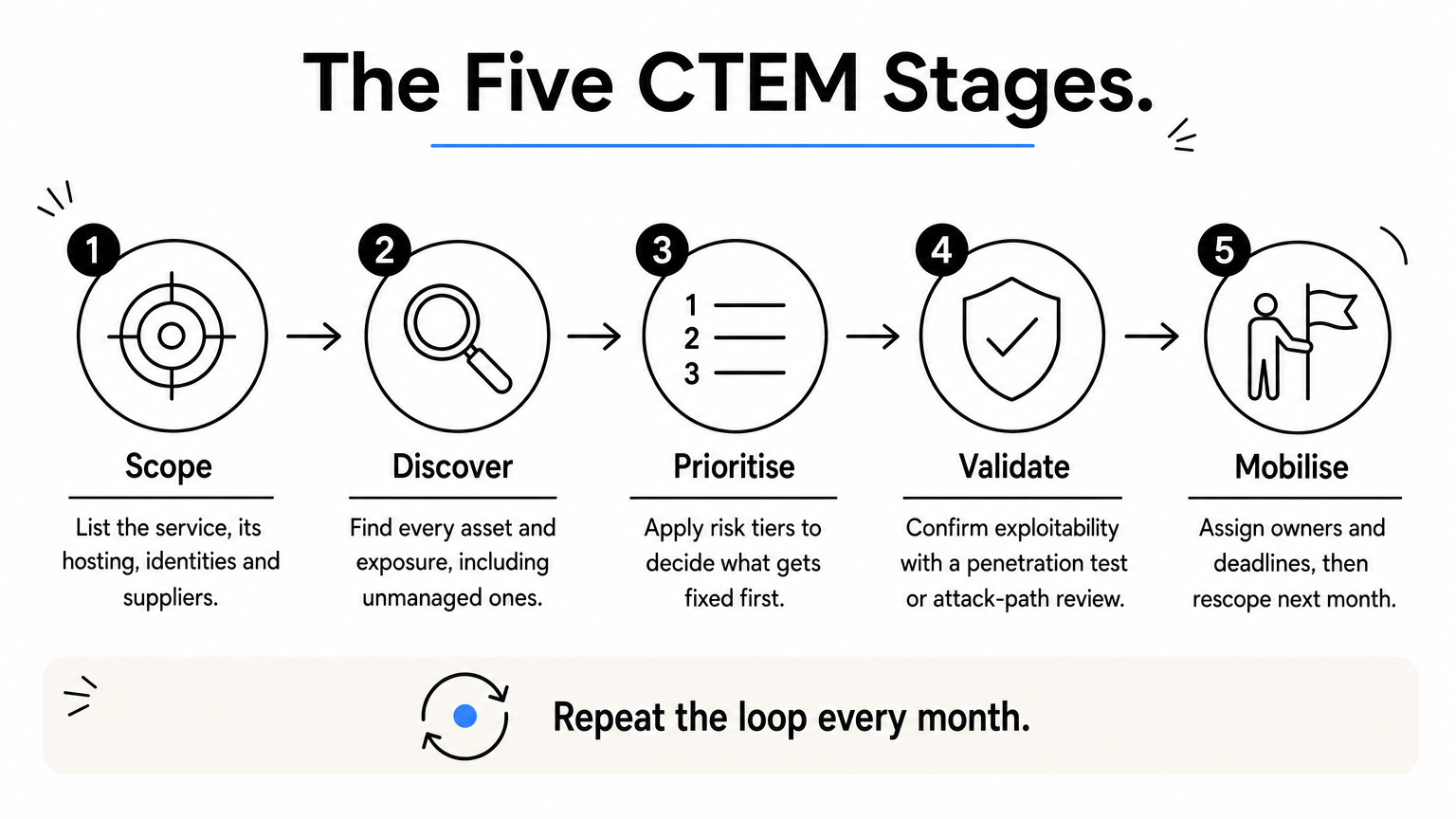
Begin with a single business-critical service and run the five CTEM stages against it. Once the loop works, expand scope gradually rather than trying to cover everything at once.
- Scope: list the service, its hosting, identities and suppliers.
- Discover: find every asset and exposure, including unmanaged ones.
- Prioritise: apply the risk tiers from trend 1.
- Validate: confirm exploitability with a targeted penetration test or attack-path review.
- Mobilise: assign owners and deadlines, then rescope next month.
3. Automation across the remediation workflow
Prioritising well achieves little if the fix then waits in a queue. Among this year’s vulnerability management trends, automation is the one that turns decisions into action, and it is where most teams recover the most time.
What is changing
Scanning was automated years ago. What is changing is everything after the scan: ticket creation, owner assignment, patch deployment and verification. Platforms now connect scanners to service desks and patching tools, so a finding reaches the right team without anyone copying it from a spreadsheet. Typical automated steps include:
- Raising tickets with the asset owner and deadline already filled in
- Deploying routine operating system and browser updates, for example through Windows Autopatch
- Rescanning after a fix and closing the finding automatically
- Escalating items that breach their deadline
Why it matters now
Manual hand-offs are where remediation time disappears. A finding that sits unnoticed for a week has already used a large part of the window attackers need (see trend 7), and the delay has nothing to do with technical difficulty.
Slow remediation is usually a workflow problem, not a skills problem.
Automation also leaves a clear audit trail. Every ticket, approval and rescan is time-stamped, which gives you the evidence an ISO 27001 auditor will ask to see.
Who should act first
Teams buried in repeatable work should go first, especially those patching hundreds of workstations by hand. Small IT teams gain the most, because automation gives them capacity they cannot hire.
Keep people in the loop for business-critical servers, legacy applications and anything with a fragile dependency. Do not automate what you cannot roll back.
How to put it into practice
Start with low-risk, high-volume updates and widen from there. A pilot group catches problems before they reach everyone.
- Automate patching for workstations and browsers, beginning with a pilot group.
- Connect your scanner to your ticketing system so findings create tasks automatically.
- Set auto-close rules that depend on a successful rescan.
- Require human approval for servers and production systems.
- Track mean time to remediate monthly and review every failed deployment.
4. AI-assisted triage and prioritisation
Once automation handles the routine work, AI starts to help with the judgement calls. It is the newest of this year’s vulnerability management trends, and the one with the most hype attached.
What is changing
Vendors now build machine learning and large language models into scanners and exposure platforms. They group duplicate findings, match them against asset data and write a plain-English reason why one flaw ranks above another. Some tools also draft the remediation ticket or suggest a fix.
The output is a recommendation, not a verdict. Treat AI as a fast junior analyst whose work gets checked before anything changes priority.
Why it matters now
Analysts lose hours reading, deduplicating and hunting for context. AI cuts that triage time, which matters when your queue grows faster than your team. The risk is false confidence, because a wrong answer about an exposed system is worse than no answer.
AI should shorten the route to a decision, not make the decision for you.
Models also work only with the data you give them. Poor asset records produce polished but unreliable rankings.
Who should act first
Teams with large, noisy backlogs and few analysts gain the most. If you already have an accurate asset list and risk tiers from trend 1, you are ready.
If your inventory is patchy, wait. Fix your asset data first, because AI will only scale the gaps.
How to put it into practice
Start small and keep a person accountable. Run the tool alongside your manual process before you trust it. Then work through these steps:
- Pick one use case, such as deduplication or ticket summaries.
- Ask the vendor where your findings are sent and whether they train models on your data. This matters under UK GDPR.
- Compare its rankings with your own for a month.
- Name one person who approves any change to priority.
- Log every override and review the pattern quarterly.
5. Threat intelligence signals: EPSS and CISA KEV
Two free data sources now answer the question every backlog needs answered: is anyone actually attacking this? Of this year’s vulnerability management trends, this is the cheapest to adopt and the one that sharpens trend 1 fastest.

What is changing
EPSS, the Exploit Prediction Scoring System, gives each CVE a probability of exploitation in the next 30 days, from 0 to 1. The CISA Known Exploited Vulnerabilities (KEV) catalogue lists flaws with confirmed exploitation in the wild. Scanners and exposure platforms increasingly ingest both feeds automatically.
| Signal | What it tells you | Best used for |
|---|---|---|
| EPSS | Likelihood of future exploitation | Ranking the long tail |
| CISA KEV | Exploitation already happening | Setting urgent deadlines |
Why it matters now
EPSS and KEV cut the list down to what attackers actually use. A flaw on KEV is no longer a prediction, it is an observed attack, and it deserves a fast deadline whatever its CVSS score says.
EPSS predicts what attackers will do, KEV confirms what they already did.
Neither is perfect. EPSS scores move daily, and KEV is skewed towards widely used enterprise products, so a missing entry does not mean safe.
Who should act first
Anyone still sorting by CVSS alone should add these feeds this month. They cost nothing and need no new platform.
Teams running common enterprise software, such as VPNs, firewalls and email servers, benefit most, because that is where KEV entries cluster.
How to put it into practice
Treat the two signals as triggers within your existing risk tiers:
- Check your asset list against KEV weekly, or enable the feed in your scanner.
- Give any KEV match on your estate the shortest deadline, for example 48 hours if exposed.
- Set an EPSS threshold, such as the top 10% of scores, for fast-track review.
- Re-sort the backlog when scores change, rather than once a quarter.
- Record why you accepted any high-EPSS finding you chose not to fix.
6. Wider attack surface: cloud, identity and supply chain
Your estate no longer stops at the office firewall. Of this year’s vulnerability management trends, this one widens what counts as a vulnerability and who owns the fix.
What is changing
Scanners that only check servers and laptops miss many of today’s entry points. Programmes now cover three areas that sit outside the traditional patch cycle, and each one needs its own kind of check:
| Area | Typical exposure |
|---|---|
| Cloud | Public storage, open management ports, misconfigured SaaS |
| Identity | Stale accounts, weak MFA, excessive admin rights |
| Supply chain | Vulnerable third-party software, suppliers with access to your data |
Why it matters now
Attackers take the easiest route, and increasingly that means a stolen login or a misconfigured cloud service. Neither is a CVE, so a CVSS-driven report never mentions them.
Suppliers add another layer. A flaw in software you did not write, or a partner with access to your systems, can expose you through no fault of your own. Your risk view has to follow the dependency, not the contract boundary.
Your attack surface includes every login, cloud setting and supplier you depend on.
Who should act first
Cloud-first businesses and Microsoft 365 users should start here, along with anyone whose suppliers hold admin access or process your data. If you can only pick one area, pick identity, because one compromised admin account can outweigh hundreds of low-rated patches.
Organisations working towards ISO 27001 have another reason. Annex A covers supplier relationships and cloud services, so auditors will expect to see this in your risk assessment.
How to put it into practice
Extend your existing asset list and risk tiers rather than creating a separate process. One register, one set of deadlines keeps the effort manageable.
- Add cloud accounts and SaaS applications to your asset register.
- Run configuration checks against a recognised benchmark, such as the CIS Benchmarks.
- Review privileged accounts monthly and enforce MFA on all of them.
- Ask critical suppliers how quickly they patch and what they will tell you after an incident.
- Request a software bill of materials for your most important third-party applications.
7. Faster exploitation and shrinking remediation windows
What is changing

The gap between disclosure and attack keeps closing. Mandiant’s analysis of 2023 put the average time to exploit at five days, down from more than a month in earlier years. Public proof-of-concept code and automated scanning mean attackers no longer need weeks to build an attack.
The patch cycle you set is the window you give attackers.
Some flaws are also abused as zero-days, before any patch exists. That makes this one of the vulnerability management trends that rewards speed of response as much as speed of patching.
Why it matters now
A fixed monthly cycle was designed for a slower threat. If you patch on the second Tuesday and a flaw is exploited on the third day, you were exposed for the whole gap, and nothing in your process flagged it.
External expectations are tightening too. Cyber Essentials requires critical and high-risk updates within 14 days, and insurers increasingly ask how quickly you fix exposed systems. For internet-facing assets, 14 days is now a ceiling, not a target.
Who should act first
Start with anyone running VPNs, firewalls, remote access tools or mail servers. These are the first systems attackers probe after a public disclosure, and a delay there costs the most.
Then look at your out-of-hours cover. A flaw announced on Friday afternoon can be under attack all weekend, so a team with nobody watching until Monday carries extra risk.
How to put it into practice
Shorten the window in stages, beginning with the systems attackers reach first. You need a fast lane for emergencies and a clear fallback when no patch exists.
- Create an emergency patch route for KEV-listed flaws, with change approval agreed in advance.
- Set deadlines by tier: 48 hours for exploited and exposed, 14 days for critical, 30 days for the rest.
- Subscribe to vendor and NCSC alerts for your key products.
- Prepare mitigations, such as disabling a service or blocking a port, for when no patch is available.
- Measure time to remediate by tier and report it monthly.
8. Compliance-driven programmes and outcome-based metrics
This is the last trend on the list, but it decides whether the other seven survive a budget review. Among this year’s vulnerability management trends, it is the one that proves your programme works to auditors, insurers and your board.
What is changing
Compliance used to mean handing over a scan report. Auditors and insurers now ask for evidence of outcomes: how fast you fix exposed flaws, how many exceptions are open and whether the numbers improve over time.
Activity metrics are being replaced by measures of risk reduction:
| Activity metric | Outcome metric |
|---|---|
| Vulnerabilities found | Mean time to remediate, by risk tier |
| Patches deployed | Share of KEV-listed flaws fixed within deadline |
| Scans completed | Percentage of known assets scanned |
| Total open findings | Overdue findings and open exceptions |
Why it matters now
Counts flatter or punish you for the wrong reasons. Scanning more assets raises your finding total, so a better programme can look worse on a raw chart. Outcome metrics avoid that trap.
A programme you cannot measure is a programme you cannot defend.
External pressure is also rising. ISO 27001 surveillance audits, Cyber Essentials renewals and supplier questionnaires from larger customers all expect documented, repeatable evidence, and a clear trend line answers most of those questions in one page.
Who should act first
Organisations holding or pursuing ISO 27001 or Cyber Essentials should start here, because the auditor will ask for these numbers anyway. The same goes for anyone who regularly completes customer security questionnaires.
IT managers who report to non-technical directors benefit too. A board understands "critical flaws on exposed systems are fixed in 48 hours, 96% of the time" far better than a list of 3,000 open findings.
How to put it into practice
Keep the set small, and choose measures you can pull from existing tools. Four or five is enough to change behaviour. Begin with these:
- Mean time to remediate for each risk tier.
- Percentage of KEV-listed flaws fixed within deadline.
- Asset coverage, meaning scanned assets against your register.
- Number of overdue findings and open exceptions.
- Percentage of exceptions with an owner and a review date.
Report them monthly with a short note on what moved and why. Review the targets each quarter, and tie them to your ISO 27001 risk treatment records so one set of evidence serves both purposes.
Putting these trends to work
These vulnerability management trends share one idea: fix what attackers can actually use, and fix it fast. Risk-based prioritisation, threat signals and CTEM tell you where to look. Automation and AI-assisted triage give you the capacity to act. Outcome-based metrics prove it worked to auditors, insurers and your board.
You do not need to adopt all eight at once. Start with an accurate asset list and clear risk tiers, add KEV and EPSS data, then shorten your deadlines for exposed systems. Each step makes the next one easier, and steady progress beats a big platform purchase that nobody has time to run.
If you want an expert view of where your gaps are, talk to TrustedIA about a vulnerability assessment and ISO 27001 support. You will get a solution-agnostic plan matched to your team and budget.