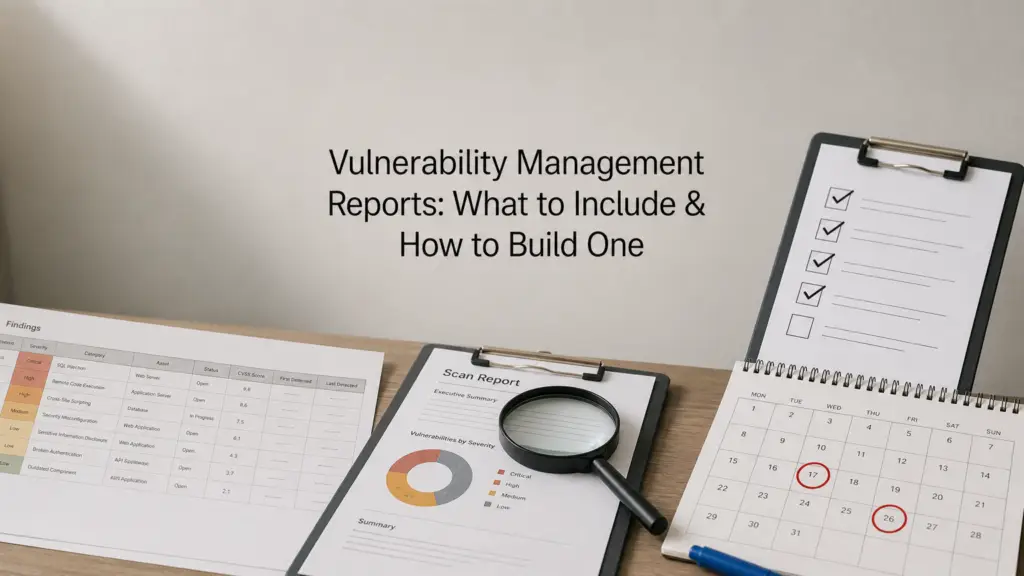
You’ve just run a scan and now you’re staring at a spreadsheet with hundreds of findings, no clear priority order, and a board meeting in two days. This is where most IT managers get stuck: turning raw scanner output into something a non-technical director will actually understand and act on. Vulnerability management reports exist to solve exactly that problem, and getting the format right matters as much as running the scan itself.
A proper vulnerability assessment report does three things: it lists what’s exposed, ranks it by real business risk, and tells someone what to fix first. Skip any of those and you end up with a document nobody reads, which defeats the purpose of scanning at all.
In this article, we’ll break down exactly what belongs in a security vulnerability report, from executive summaries through to remediation timelines, and walk through how to build one step by step. We’ll also point you towards practical templates so you’re not starting from a blank page, drawing on what we’ve seen work across audits for SMBs and enterprises pursuing ISO 27001 compliance.
Why vulnerability management reports matter
Without a written report, a vulnerability scan is just noise. You run the tool, generate a list of CVEs, and then what? Vulnerability management reports turn that raw data into a decision-making tool that justifies budget, proves due diligence, and gives your team a clear to-do list instead of a wall of red flags. Businesses that skip this step tend to fix whatever looks scariest that week, not what actually threatens the business most.
The cost of ignoring findings
Unpatched vulnerabilities are how most breaches happen. IBM’s Cost of a Data Breach research consistently shows that breaches exploiting known, unpatched flaws take longer to contain and cost more than those caught early. A clear report closes that gap by forcing someone to sign off on risk acceptance or remediation, rather than letting a finding sit unread in a dashboard view of your vulnerabilities for six months.
A vulnerability nobody reads about is a vulnerability nobody fixes.
Compliance and audit evidence
Auditors and insurers don’t just want to hear that you scan your network. They want to see the paper trail. If you’re working towards ISO 27001, your certification body will expect the documented evidence ISO 27001 requires you to keep on risk assessment, ranking, and remediation tracking, which is exactly what a proper report provides. We build this evidence trail into every engagement where we help businesses implement ISO 27001, because auditors reject vague assurances but accept structured reports every time.
Getting buy-in from people who don’t read CVE numbers
Secondly, reports matter because they’re your main tool for getting non-technical stakeholders to act. A finance director won’t approve a patching budget based on a CVSS score alone, but they’ll approve it when a report shows the finding sits on an internet-facing server holding customer data. Good reporting translates technical severity into business consequence, which is the language decision-makers actually respond to.
Building institutional memory
Finally, a consistent reporting cadence gives you a record over time. You can compare this quarter’s findings against last quarter’s, spot recurring weak points such as the same unpatched software version reappearing, and demonstrate improvement (or flag stagnation) to the board. Without that history, every scan is a one-off event with no context, and you lose the ability to show whether your security posture is genuinely getting stronger or simply generating more paperwork.
What to include in a vulnerability management report

Every vulnerability management report needs the same core skeleton, whether you’re a five-person startup or a 500-seat enterprise. Miss one of these sections and someone downstream will ask for it anyway, so build the habit of including all of them from the start.
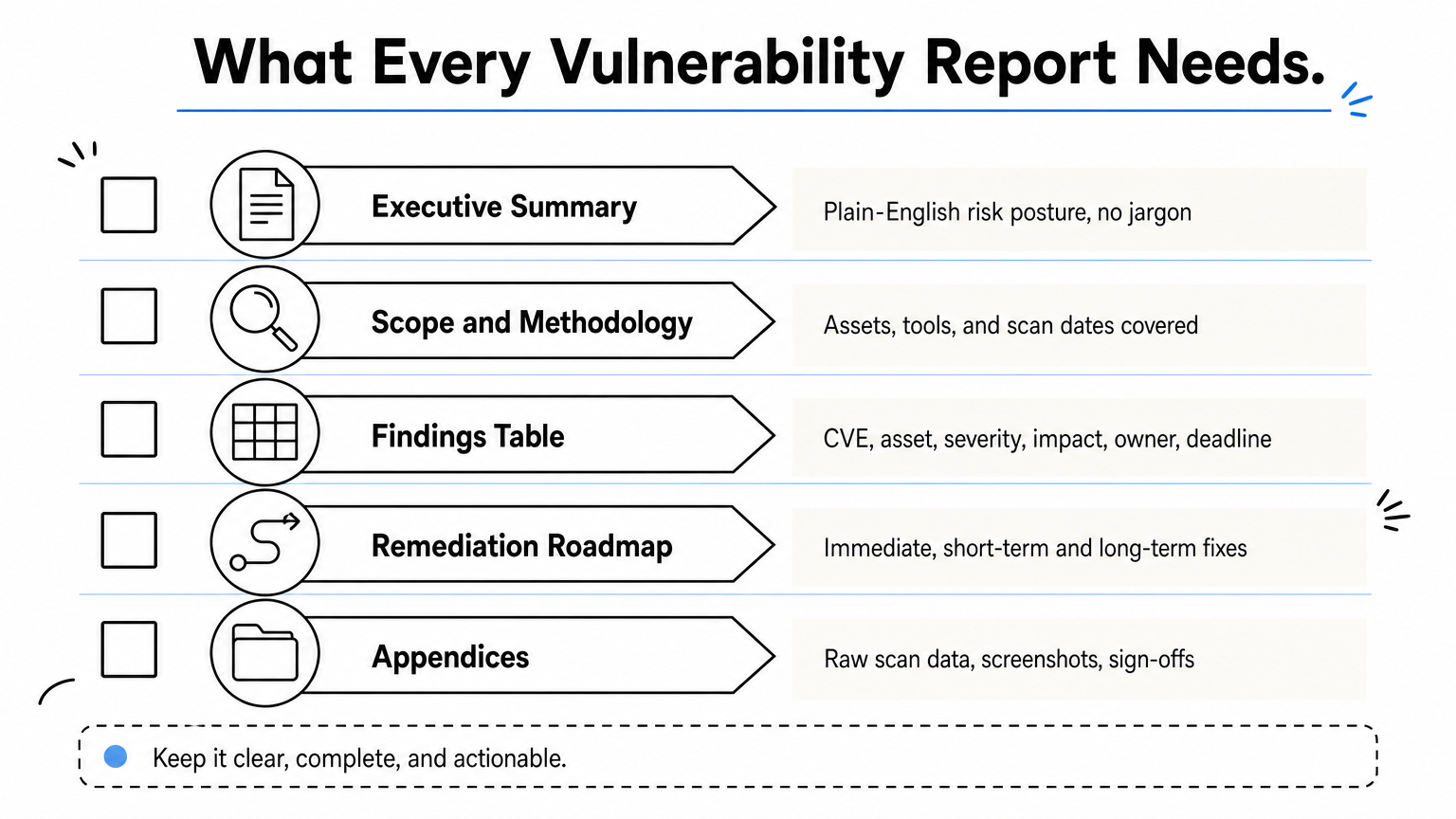
Start with an executive summary that states the overall risk posture in plain English, no CVE numbers, no jargon. Follow that with the scope and methodology, covering which assets, IP ranges, or applications were tested, what tools you used, and when the scan ran. Then comes the meat of the document: the findings themselves.
A report without a fix-first list is just a longer spreadsheet.
Each finding should carry the same fields so your team can scan the table rather than reread paragraphs:
| Field | Why it matters |
|---|---|
| Vulnerability name/CVE ID | Lets teams cross-reference vendor advisories |
| Affected asset | Pinpoints exactly what needs patching |
| Severity (CVSS score) | Gives a consistent, comparable ranking |
| Business impact | Translates severity into real consequence |
| Remediation steps | Tells the fixer exactly what to do |
| Owner and deadline | Creates accountability |
Beyond the findings table, include a remediation roadmap that groups fixes into immediate, short-term, and long-term buckets, since not everything can be patched by Friday. Add trend data comparing this report against the previous cycle wherever you have history to draw on. Finally, close with appendices: raw scanner output, evidence screenshots, and any risk acceptance sign-offs, so auditors have something concrete to check against your narrative claims.
How to build a vulnerability management report step by step
Building a vulnerability management report isn’t a one-person job you finish in an afternoon. It’s a repeatable process that turns scanner output into a document people trust, and skipping steps is exactly how reports end up ignored.
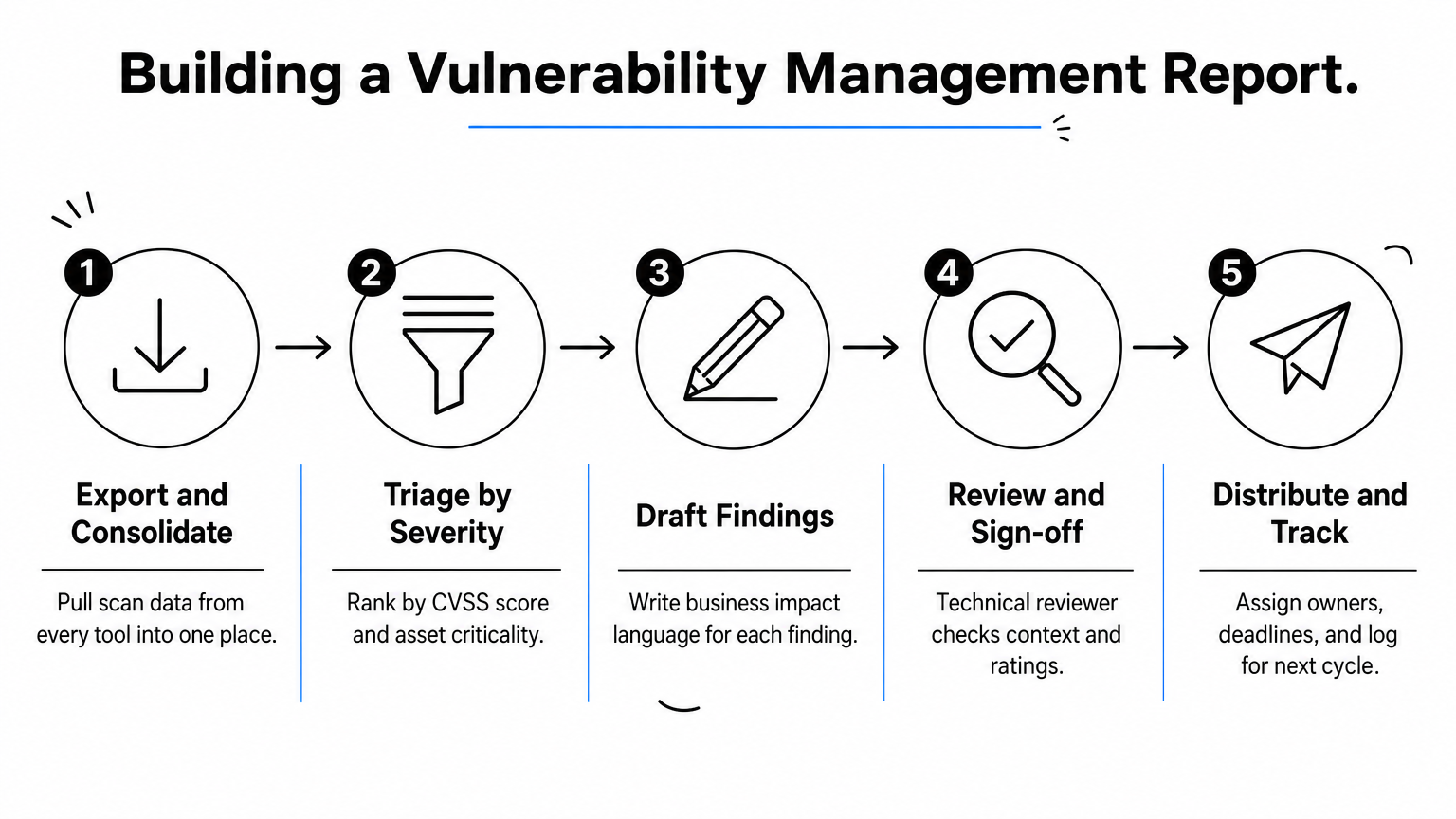
Gather and triage findings
First, pull raw results from every scanning tool you run, network scanners, endpoint agents, and any output from your penetration testing phases, into one place. Consolidate duplicate entries across tools before anyone starts prioritising, because the same vulnerability flagged by three scanners looks like three problems if you don’t merge them. Next, triage by combining CVSS severity with asset criticality, a risk-based approach to prioritising vulnerabilities: a medium-severity flaw on your customer database outranks a critical one on a test server nobody uses.
The scan finds problems; the report decides which ones matter first.
Draft, review and publish
Once triage is done, draft the report using the structure covered above, filling in business impact language rather than just technical descriptions. Then send it to a technical reviewer who can catch missing context or wrong severity ratings before it reaches a wider audience. Assign owners and deadlines against each finding at this stage, not after publishing, or accountability slips through the cracks.
- Export and consolidate scan data
- Triage by severity and asset criticality
- Draft findings with business impact language
- Technical review and sign-off
- Assign owners and deadlines
- Distribute and track remediation
Finally, distribute the finished report and log it somewhere searchable, since next quarter’s version needs to reference this one. Teams running this process manually every quarter often outsource it instead, and it helps to understand how vulnerability assessment services work before deciding where our own assessments fit into a client’s routine.
Tailoring reports for executives, technical teams and auditors
One document rarely satisfies three very different readers, so smart teams build a single vulnerability management report and then repackage it for each audience rather than writing three separate reports from scratch. The underlying data stays the same; only the framing and depth change.
For executives
Boards want a one-page view: overall risk trend, top three exposures, and the budget or resource ask tied to fixing them, which is exactly what board-level cyber security governance depends on. Skip CVE numbers entirely here and lead with business consequence, such as "a supplier-facing system holding payment data is exposed to a known exploit", because that sentence gets a signature on a spending request faster than any severity score.
For technical teams
A CISO reads outcomes; an engineer reads instructions.

Engineers and sysadmins need the opposite: full CVE detail, affected asset lists, patch versions, and exact remediation steps they can action without asking follow-up questions. Give this group the raw findings table in full, sorted by severity and asset criticality, plus links to vendor advisories so they’re not hunting for patch notes separately.
For auditors
Auditors, particularly those running the stages of an ISO 27001 certification audit, want proof of process rather than proof of urgency. They’ll check that risk was formally assessed, that owners were assigned, and that remediation was tracked to closure or formally accepted as residual risk. Include:
- Timestamped scan history
- Sign-off records for accepted risks
- Evidence that findings map to your risk register
Getting this tailoring right saves you from writing three reports every quarter. It also stops the common failure mode where a technical report lands on an executive’s desk, gets glanced at, and never generates the budget decision it was written to secure.
How often you should produce a vulnerability management report
Frequency depends on how much your environment changes, not on a calendar habit you picked once and never revisited. Most SMBs need a vulnerability management report at least quarterly, but that’s a floor, not a target to aim for. Businesses handling card payments, where PCI DSS testing requirements set the scope and cadence, health records, or anything covered by strict regulatory scope should be reporting monthly, and internet-facing infrastructure often justifies continuous scanning with weekly summary reports pulled from it.
Report as often as your environment changes, not as often as your calendar says.
Match cadence to risk profile
Different parts of your estate genuinely need different rhythms, so don’t force one cadence across everything you own:
| Environment type | Recommended reporting frequency |
|---|---|
| Internet-facing servers and applications | Weekly to monthly |
| Internal corporate network | Monthly to quarterly |
| Low-risk test or dev environments | Quarterly |
| ISO 27001 certified scope | At minimum quarterly, per your risk assessment schedule |
Organisations pursuing or maintaining ISO 27001 certification should set this cadence formally in their risk treatment plan rather than leaving it to whoever remembers to run the scanner.
Trigger-based reporting
Schedules only cover routine change. Anything that materially alters your attack surface, a new server going live, an acquisition bringing unfamiliar systems into scope, or a fresh CVE affecting software you run, should trigger an off-cycle report immediately. Waiting for the next quarterly cycle after a critical CVE drops is how businesses end up breached through a gap they already knew about. Teams without spare capacity to run this cadence themselves often hand it to a 24/7 SOC service that reports continuously rather than in scheduled bursts.
Turning your report into stronger security
A report only earns its keep once it changes what happens next. Get the structure right, executive summary, scope, findings table, remediation roadmap, and you’ve built something a board will actually read and an auditor will actually accept. Get the cadence right, matching frequency to how fast your environment changes rather than a fixed calendar date, and you close the gap where breaches usually happen: the known flaw nobody got round to fixing.
None of this needs to sit on your own plate. Scanning, triaging, drafting, and tailoring reports for three different audiences every quarter is a full-time job most IT teams don’t have capacity for alongside everything else on their list. If you’d rather hand that process to people who build vulnerability management reports for a living, from initial scan through to ISO 27001-ready evidence, get a vulnerability assessment with a prioritised remediation plan and take your next report off your desk and onto ours.