Most business continuity plans fail for a dull reason. They live in a Word document nobody has opened since the last audit. When a ransomware attack or a power outage hits, you are left hunting for contact lists and recovery steps while the clock runs.
The best tools for business continuity planning fix that. They turn static documents into living plans, with business impact analysis, risk assessment and automated incident notifications in one place. For most UK organisations, the strongest options are Fusion Framework, Archer, Veeam, Zerto, Assurance and Everbridge, and the right pick depends on your size, your sector and whether you need ISO 22301 or ISO 27001 alignment.
This article reviews seven business continuity planning software tools, covering features, strengths, limitations and who each suits. We have spent over 30 years helping businesses plan for, and recover from, disruption, so we judge these tools on what works under pressure. By the end, you will have a clear shortlist you can take to a demo.

1. TrustedIA managed business continuity service
What it covers
TrustedIA is the odd one out in this list. It is a managed service rather than a software licence, so a team builds and maintains your plan with you instead of handing you a platform to configure. That matters because many organisations buy software and never populate it. The continuity work sits within a wider managed security stack:
- Business continuity and disaster recovery planning
- CyberSOS incident response for recovery after an attack
- Security Operations Centre monitoring, endpoint detection and antivirus
- Dark web surveillance, vulnerability assessments and penetration testing
- Phishing simulation and cyber training
- Posture assessment using CRAFT, our in-house tooling
Best for
Small and mid-sized businesses with no dedicated continuity manager get the most from it. So do organisations working towards ISO 27001, because our subject matter experts handle implementation and certification support. Insurers and loss adjusters also use CyberSOS to get clients back on their feet.
If you want to work through business continuity planning software reviews and pick a platform your own team will run, the later entries on this list suit you better.
Key strengths and limitations
Among the best tools for business continuity planning, the one that stays current beats the one with the longest feature list. A managed service keeps plans, contacts and recovery steps maintained by people whose job is to maintain them. We are also solution agnostic, so we recommend what fits your problem, not a brand we resell.
A plan someone else keeps current beats a platform nobody opens.
Strengths
- Over 30 years in IT services and managed solutions
- Continuity, cyber response and ISO 27001 support from one provider
- Recommendations based on your risks, not vendor targets
Limitations
- Not a standalone product you license and run yourself
- You depend on a provider, which some in-house teams will not want
- Large enterprises wanting one configurable governance platform may prefer the software below
Pricing and deployment model
Pricing is scoped to your organisation, not published as a price list. Cost tends to follow the number of sites and systems in scope and how deeply you want recovery plans tested. We quote after a discovery conversation.
Delivery needs no software installation. Work starts with an assessment of your critical processes and dependencies, then moves to plan writing, testing and ongoing review. You can take it as a one-off project or as a continuing managed arrangement.
2. Fusion Framework System
What it covers

The Fusion Framework System is a cloud-based resilience platform that links business continuity with risk, IT recovery and supplier management. It maps how your services depend on people, sites, systems and suppliers, so you can see what else breaks when one thing fails. Core areas include:
- Business impact analysis and plan building
- Incident and crisis management workflows
- IT disaster recovery alignment
- Third-party and operational risk dashboards
Best for
Large or regulated organisations suit it best, particularly banks, insurers and multi-site enterprises that must evidence operational resilience to a regulator. It also fits businesses with a dedicated continuity or risk team able to own the platform.
Smaller firms should think twice. Without spare administrator time, you may find lighter tools easier to adopt.
Key strengths and limitations
In most business continuity planning software reviews, Fusion earns praise for flexibility and dependency mapping. You shape workflows around your own structure instead of a fixed template.
Configurable software only pays off if someone has time to configure it.
Strengths
- Highly configurable, with strong service mapping
- Continuity, risk and resilience in one system
Limitations
- Needs skilled administrators and setup time
- More platform than a small business usually needs
Pricing and deployment model
Fusion is delivered as software as a service, so there is nothing to install. Pricing is not published. You request a quote based on modules and users, and should expect an annual subscription.
Ask early about implementation costs. Configuration and training can add noticeably to the licence fee.
3. Premier Continuum ParaSolution
What it covers
ParaSolution is a dedicated business continuity management application from Premier Continuum, a US consultancy that built the software around its own planning method. It walks you through a structured, ISO 22301-style lifecycle, from analysis to plan upkeep. Modules include:
- Business impact analysis and risk assessment
- Plan development from templates
- Notification and incident management
- Exercise tracking and reporting
Best for
Mid-sized and large organisations that want a methodical, template-led approach will get the most from it. Teams new to the discipline benefit too, because the structure prompts you on what to document and when.
Consultancy backing is the real draw. If you want software with expert guidance behind it, that pairing sets ParaSolution apart from pure self-service platforms.
Key strengths and limitations
If you are building a shortlist of the best tools for business continuity planning, ParaSolution earns a place for its guided structure. It favours process over polish.
Structure helps most when your team is new to continuity planning.
Strengths
- Clear, repeatable planning method
- Consultancy expertise available alongside the software
Limitations
- US-centred vendor, so check UK support hours and references
- Less visible in UK buyer comparisons than some rivals
Pricing and deployment model
Pricing is quoted on request and typically reflects the modules and users you need. Expect a subscription, and ask whether consultancy hours are bundled or billed separately.
Because the vendor is American, confirm where your data is hosted and how the contract covers UK GDPR. Check the current deployment options directly, as these can change between versions.
4. Quantivate Business Continuity
What it covers
Quantivate Business Continuity is a module within a wider governance, risk and compliance suite, so your continuity data sits beside risk registers, policies and vendor records. You reuse information instead of re-keying it. Typical capabilities include:
- Business impact analysis and recovery priorities
- Plan templates with version control
- Risk assessment linked to the wider risk register
- Exercise tracking, incident logging and reporting
Best for
Mid-sized financial institutions, credit unions and public bodies will recognise themselves here. It suits teams that already run risk and compliance in one place and want continuity to follow the same process.
Standalone buyers should look closely. If continuity is your only need, you may pay for a suite you will not fully use.
Key strengths and limitations
Its appeal is the joined-up approach. One audit trail covers continuity, risk and compliance, which helps when examiners ask how your plans connect to your risk appetite. Among the best tools for business continuity planning, that integration is the reason to shortlist it.
Continuity planning works better when it shares data with your risk register.
Strengths
- One platform across risk, compliance and continuity
- Good fit for audit-heavy sectors
Limitations
- US-centred customer base, so ask for UK references
- Check how far its incident notification goes before assuming it replaces a dedicated alerting tool
Pricing and deployment model
Pricing is quoted on request, usually as an annual subscription based on the modules and users you choose. Ask whether continuity can be bought on its own, and what the suite adds to the bill.
Delivery is cloud-based, so you install nothing. Confirm where your data is hosted and how the contract covers UK GDPR, and get onboarding costs in writing before you sign.
5. Archer Business Resiliency
What it covers
Archer Business Resiliency sits within the Archer governance, risk and compliance platform, so continuity data lives next to risk, audit and third-party records. You can move from impact analysis to maintained recovery plans without switching systems. Typical areas include:
- Business impact analysis and dependency mapping
- Continuity and recovery plan management
- Resilience reporting for boards and regulators
- Links to enterprise risk and vendor records
Best for
Large enterprises and regulated firms that already use Archer for risk or compliance get the most from it. It also suits teams that need one evidence trail for auditors across several frameworks, ISO 22301 included. Smaller businesses rarely need this much platform.
Key strengths and limitations
Depth is the draw. Among the best tools for business continuity planning, Archer is the heavyweight, because it ties continuity to the wider risk picture and scales across many business units and regions. That breadth has a price in effort.
A platform this broad rewards only the firms with people to run it.
Strengths
- Strong integration with enterprise risk and compliance
- Scales across large, complex organisations
Limitations
- Heavy to configure and administer
- Poor value if continuity is your only need
Pricing and deployment model
Pricing is not published. Archer quotes by licence scope, so expect the cost to reflect modules, users and any wider suite you take alongside it.
Archer has offered both cloud-hosted and self-managed options, so check what is current. Confirm UK data hosting, and ask for implementation and specialist configuration costs in writing before you sign.
6. Castellan Platform
What it covers
Castellan is a cloud-based continuity and incident management platform that keeps planning and response in one place. You build plans from impact analysis, then use the same data when something goes wrong. Core areas include:
- Business impact analysis and recovery priorities
- Plan building and maintenance
- Incident and crisis management with team notifications
- Exercise planning and reporting
Best for
Mid-sized organisations that want planning and incident response tied together are the natural fit. It suits a small continuity team that needs plans to be usable during a live incident, not just ready for an audit.
Larger enterprises that need deep risk and compliance integration may find it narrower than Archer or Fusion.
Key strengths and limitations
Among the best tools for business continuity planning, Castellan stands out for keeping response close to the plan. Your people open one system to find the steps, the contacts and the log of what has been done.
A plan is only useful if the person on call can find it in a minute.
Strengths
- Planning and incident handling in one tool
- Practical focus on exercises and live response
Limitations
- Narrower governance and risk features than the suites above
- Customer base leans towards North America, so check UK references
Pricing and deployment model
Pricing is not published. You request a quote, which usually reflects the modules and users you need, and you should expect an annual subscription.
Delivery is software as a service, so you install nothing. Confirm where your data is hosted and how the contract covers UK GDPR. Ask too whether notification features cost extra, because those charges can surprise you after signing.
7. Cohesity SiteContinuity
What it covers
Cohesity SiteContinuity is an IT disaster recovery orchestration tool, not a full continuity planning suite. It automates failover and failback for workloads protected by Cohesity backup, so recovery follows a tested runbook instead of manual steps under pressure. Core capabilities include:
- Automated failover and failback workflows
- Recovery testing without disrupting production
- Recovery to a secondary site or cloud
- Reporting on recovery readiness
Best for
Organisations with a large estate of virtual servers and databases already backed up on Cohesity get the most from it. Add it once your impact analysis is done and you need fast, repeatable technical recovery. It does not replace the impact analysis or crisis communication tools above, so most buyers pair it with one of them.
Key strengths and limitations
In business continuity planning software reviews, Cohesity is judged on recovery speed, not planning depth. Automation lets you show auditors that recovery has been tested, and it suits ransomware scenarios where you must restore to a clean point in time.
Recovery you have tested beats recovery you have only documented.
Strengths
- Automated, repeatable recovery testing
- Strong fit for ransomware recovery plans
Limitations
- No business impact analysis or people-focused plan management
- Value depends on already using Cohesity backup
- Needs technical staff to design and run recovery workflows
Pricing and deployment model
Pricing is not published. You buy through Cohesity or a partner, usually as a subscription that reflects the data and workloads you protect. Ask whether SiteContinuity sits in your licence tier or is an add-on.
Deployment can span on-premises, cloud and managed options, so check what is current. Confirm UK data hosting before you sign.
8. How to choose the right planning tool
Start with the problem, not the feature list. The best tools for business continuity planning solve different problems, so decide first whether you need plan management, technical recovery or a team to do the work for you.
Match the tool to your situation
Size, sector and in-house capacity narrow the field fast. Adoption matters more than features, because a platform nobody maintains is just an expensive filing cabinet.
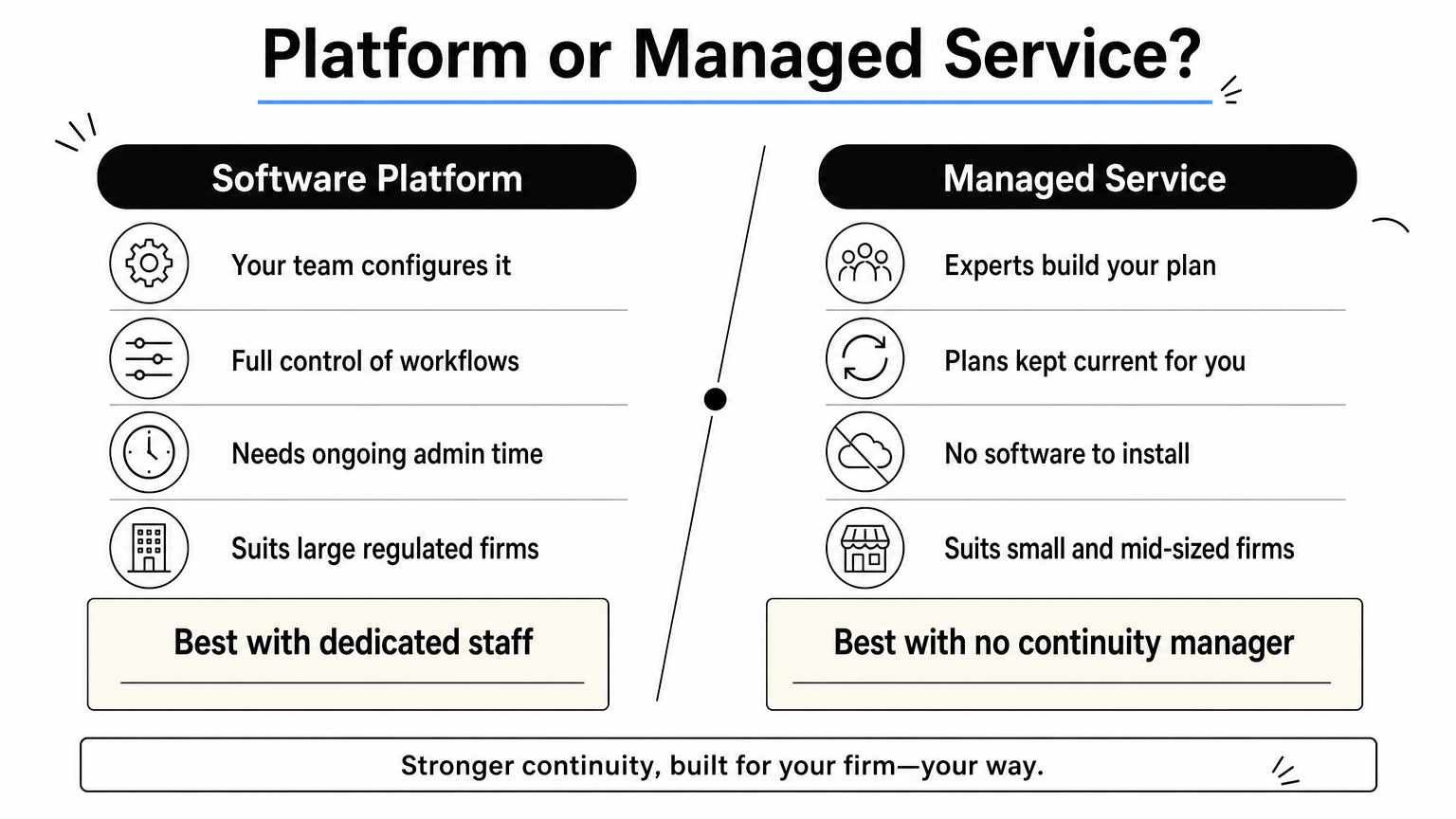
Pick the tool your team will still be updating in twelve months.
| Your situation | Best fit |
|---|---|
| No continuity manager, ISO 27001 goal | TrustedIA managed service |
| Large, regulated, dedicated risk team | Fusion or Archer |
| Mid-sized team wanting a guided method | ParaSolution |
| Already running a risk and compliance suite | Quantivate or Archer |
| Planning tied to live incident response | Castellan |
| Large virtual estate on Cohesity backup | Cohesity SiteContinuity |
Questions to ask before a demo
Ask every vendor the same questions, so your business continuity planning software reviews are comparable. Insist on a trial or a test exercise with your own processes, and get costs in writing before you sign.
- Who owns the plan after go-live, and how much admin time does that take?
- Where is data hosted, and how does the contract cover UK GDPR?
- Does it support ISO 22301 or ISO 27001 evidence?
- What do onboarding, training and notifications cost on top of the licence?
Choosing a tool you will actually use
The best tools for business continuity planning share one trait: your team keeps using them. A platform nobody updates fails the same way as the Word document it replaced. Fusion, Archer and Quantivate suit firms with dedicated risk staff, ParaSolution and Castellan suit mid-sized teams, and Cohesity covers technical recovery.
Before you book demos, write down who will own the plan, how much admin time they have and which standard you must evidence. Those three answers cut seven options to two or three. Then test each one with your own critical processes and get costs in writing.
If you would rather not run a platform at all, speak to TrustedIA about a managed business continuity service. We will assess your critical processes, build plans your team can follow, and keep them current after go-live.