Every business faces disruptions, from cyberattacks and supply chain failures to power outages and natural disasters. The difference between organisations that recover quickly and those that struggle for weeks often comes down to preparation. So, what is ISO 22301, and why should it be on your radar? It’s the internationally recognised standard that provides a structured framework for business continuity management.
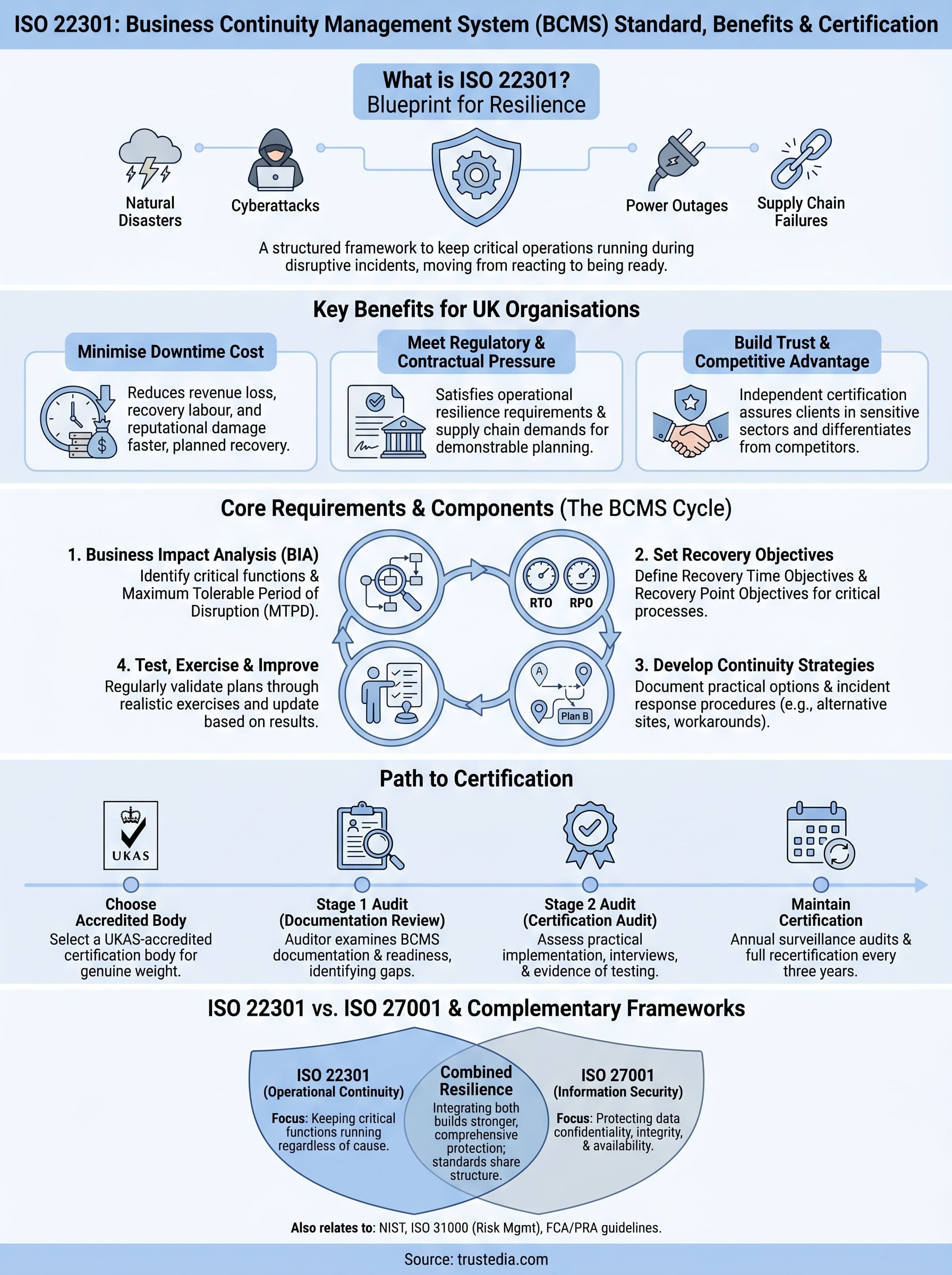
ISO 22301 sets out the requirements for building, implementing, and maintaining a Business Continuity Management System (BCMS). It helps organisations identify potential threats, assess their impact, and put plans in place to keep critical operations running when things go wrong. Think of it as a blueprint for resilience, not just reacting to incidents, but being ready for them before they happen.
At TrustedIA, we work with organisations on business continuity and disaster recovery as part of our managed security services, and we bring over 30 years of experience helping businesses meet standards like ISO 27001. This guide breaks down everything you need to know about ISO 22301, its core requirements, the benefits of certification, and the path to achieving it.
Why ISO 22301 matters for UK organisations
Business disruptions are not rare edge cases. In the UK, organisations face a steady stream of threats, from ransomware attacks and IT outages to flooding, supplier failures, and utility disruptions. Without a formal framework in place, many businesses discover their recovery plans are either incomplete or entirely untested. Understanding what ISO 22301 is and why it exists gives you a clearer picture of how seriously structured resilience planning should be taken and what the lack of it can actually cost.
The cost of unplanned downtime
Downtime is expensive, and the numbers are consistently sobering. Research across industries regularly shows that even a few hours of operational disruption can cost businesses tens of thousands of pounds in lost revenue, recovery labour, and reputational damage. For sectors like financial services, healthcare, and logistics, those figures climb sharply, and the damage to customer trust often outlasts the incident itself.
Critical systems that go offline without a recovery plan leave your team scrambling without clear roles, documented procedures, or tested workarounds. ISO 22301 forces you to work through those scenarios before they happen, so when a disruption hits, your people know exactly what to do and in what order. That clarity alone can significantly reduce recovery time compared to organisations improvising under pressure.
The businesses that recover fastest from disruptions are almost always the ones that planned for them well in advance, not the ones that reacted and hoped for the best.
Regulatory and contractual pressure in the UK
UK regulators are placing far greater emphasis on operational resilience across multiple sectors. The Financial Conduct Authority (FCA) and Prudential Regulation Authority (PRA) have set clear expectations for financial services firms to identify, protect, and recover important business services within defined tolerances. Similar requirements are taking shape across critical national infrastructure, healthcare, and the public sector. ISO 22301 provides a structured, independently audited way to demonstrate that your organisation meets those expectations, rather than simply claiming it does.
Beyond regulation, supply chain and procurement requirements increasingly demand proof of resilience. Larger organisations and public sector bodies often ask suppliers to demonstrate that they have tested and documented continuity plans before awarding contracts. Achieving ISO 22301 certification gives you a credible, verifiable answer to that question without having to produce bespoke evidence for every tender process you enter.
Building trust with clients and partners
Certification carries real weight because it is independently verified. When you achieve ISO 22301 certification, a third-party certification body has assessed your BCMS against the standard’s full requirements and confirmed that your approach is sound. Clients in sensitive sectors such as legal, financial services, and healthcare increasingly expect this level of assurance before sharing data or entering long-term service agreements.
Your competitive position also benefits in practical terms. Many businesses still operate without a formal continuity framework, which means certification sets you apart when potential clients weigh up their options. It shows that your organisation has invested in the processes, trained the right people, and tested its plans under realistic conditions, not just written a document and filed it away. For businesses looking to grow into larger contracts or more regulated markets, that credibility becomes a genuine commercial advantage.
What ISO 22301 covers and what it does not
When you start exploring ISO 22301, it helps to draw a clear boundary around what the standard addresses and where it stops. ISO 22301 focuses on your organisation’s ability to continue operating during disruptive incidents and recover within defined timeframes. It is not a general IT security standard, a quality management framework, or a risk management tool on its own. Knowing the scope upfront saves you from building a BCMS that misses the point or duplicates work you have already done elsewhere.
What the standard covers
ISO 22301 covers the full lifecycle of business continuity planning, from identifying which operations are most critical to your organisation, through to testing whether your recovery plans actually work under realistic conditions. The standard addresses leadership commitment, resource allocation, risk and impact analysis, communication procedures, and the processes your people follow when an incident occurs.
Specifically, the standard expects you to address:
- Business impact analysis (BIA): identifying your critical functions and the maximum tolerable period of disruption for each
- Recovery objectives: defining your recovery time objectives (RTO) and recovery point objectives (RPO) for critical processes
- Continuity strategies: documenting the practical options for maintaining or recovering operations
- Exercise and testing programmes: regularly validating that your plans perform as intended
- Incident response procedures: clear, actionable steps your teams follow during a disruption
A BCMS only delivers value if it reflects how your organisation actually operates, not how you wish it operated on paper.
What the standard does not cover
ISO 22301 does not prescribe specific technologies, tools, or vendor solutions. It sets requirements for outcomes, not for how you achieve them. The standard also does not replace cybersecurity frameworks such as ISO 27001, which address information security controls in detail. Business continuity and information security overlap, but they serve different purposes, and you will typically need both to address your full risk exposure.
Day-to-day IT service management, compliance with specific data protection legislation, and financial risk management all fall outside the scope of the standard. ISO 22301 focuses squarely on keeping your organisation operational during disruptions, which means it works best as part of a broader governance and resilience strategy rather than as a standalone solution.
Key ISO 22301 concepts and core terms
Before you can work toward certification, you need to understand the terminology the standard uses and why each concept carries weight in practice. Many of the core terms in ISO 22301 recur throughout the requirements, so misunderstanding them early can create real gaps in your BCMS. Getting comfortable with this language also helps when you need to explain your continuity posture to auditors, board-level stakeholders, or clients who want to know what your certification actually means for them.
Business Continuity Management System (BCMS)
A Business Continuity Management System is the structured framework ISO 22301 asks you to build, implement, maintain, and continuously improve. It is not a folder of documents or a plan written once and filed away. A BCMS is a living system of policies, processes, roles, and controls that your organisation actively manages, regularly reviews, and updates as your operating environment changes. A well-functioning BCMS typically brings together several interconnected components:
- Leadership and governance: clear ownership at the senior level
- Risk and impact assessments: structured analysis of threats and their business consequences
- Documented continuity plans: practical procedures your teams follow during a disruption
- Testing and exercising: regular validation that your plans work as intended
Business Impact Analysis
The business impact analysis (BIA) is one of the most fundamental exercises in the standard. It identifies which activities are truly essential to your organisation. It establishes the maximum tolerable period of disruption (MTPD) for each, which is the longest time your business can operate without that function before the consequences become unacceptable. Your BIA findings form the foundation for every recovery strategy you develop, so the quality of your analysis directly determines the quality of your entire BCMS.
Getting your BIA wrong undermines everything else, because your recovery priorities will not reflect how your business actually operates.
Recovery Time and Recovery Point Objectives
Once your BIA is complete, you set two measurable targets for each critical process. The Recovery Time Objective (RTO) is the maximum time allowed to restore a function after a disruption occurs. The Recovery Point Objective (RPO) defines the acceptable data loss, expressed as the maximum time your systems must be restored to. Understanding what ISO 22301 means in practice means recognising that RTO and RPO are not aspirational figures; they are commitments your plans must demonstrably meet through regular testing.

ISO 22301 requirements by clause
ISO 22301 is structured around ten clauses, with the actual requirements sitting in clauses 4 through 10. Clauses 1 to 3 cover scope, normative references, and terms. Understanding what ISO 22301 is at the clause level helps you see exactly what auditors will examine during certification, and it gives you a logical sequence to follow when building your BCMS.
Clauses 4 to 6: Foundation and planning
Clause 4 asks you to understand your organisation’s context, covering both internal and external factors that affect your ability to achieve business continuity outcomes. You need to identify your interested parties, such as clients, regulators, and supply chain partners, and define the scope of your BCMS with clear boundaries.
Leadership obligations then take centre stage in clause 5. Your senior management must demonstrate active commitment, assign accountability for the BCMS, and ensure the system has the resources it needs to function. Clause 6 then requires you to identify risks and opportunities that could affect your BCMS and to set measurable continuity objectives tied to real business outcomes.
Clauses 7 to 8: Support and operation
Clause 7 covers the support your BCMS depends on: trained staff, adequate infrastructure, controlled documentation, and clear communication processes. You need to demonstrate that the people working within your BCMS understand their responsibilities and hold the competence required to carry them out.
Operationally, clause 8 is the most significant section of the standard. It requires you to carry out your business impact analysis, define recovery strategies, and produce documented continuity plans that your teams can actually follow during a disruption. This clause is where your BCMS becomes practical and testable, rather than theoretical.
The quality of your clause 8 outputs determines whether your BCMS will hold up under real conditions or fail when it matters most.
Clauses 9 to 10: Performance and improvement
Clause 9 requires you to monitor and measure your BCMS performance through internal audits and formal management reviews at planned intervals. You also need to exercise your plans regularly and document the results, so you have verifiable evidence that the system functions as intended.
Continual improvement sits at the heart of clause 10. When audits or exercises reveal gaps, you are expected to investigate the root cause, take corrective action, and update your BCMS accordingly. ISO 22301 treats improvement as an ongoing obligation, not something you address once and move on from.
How ISO 22301 certification works
Understanding what ISO 22301 means in practical terms means knowing how the certification process unfolds, not just what the standard requires on paper. Certification is carried out by an accredited third-party certification body, which assesses your BCMS against the full requirements of the standard. It is a structured, staged process, and knowing what to expect at each stage helps you prepare effectively rather than treating the audit as an unknown quantity.
Choosing a certification body
Your first step is to select a United Kingdom Accreditation Service (UKAS)- accredited certification body to conduct your audit. Choosing an accredited body matters because only accreditation ensures the certification carries genuine weight with clients, regulators, and supply chain partners. Different bodies bring different levels of sector experience, so it is worth speaking to a few before committing. Your auditor’s familiarity with your industry can make the assessment more relevant and the feedback more actionable.
The certification audit process
The certification audit itself runs in two stages. Stage 1 is a documentation review in which the auditor examines your BCMS documentation, scope, policies, and risk analysis outputs to confirm that you are ready for a full assessment. Any significant gaps identified here give you the opportunity to address them before stage 2 begins.

Stage 2 is the main certification audit, where the auditor assesses whether your BCMS is genuinely implemented and functioning across your organisation. This involves interviews with staff, review of records, and evidence that your plans have been tested and reviewed. Auditors will look for real evidence of how your BCMS operates day-to-day, not just polished documentation.
Certification auditors are looking for a BCMS that works in practice, which means tested plans, trained people, and documented evidence of improvement over time.
Key outputs from the stage 2 audit include:
- Nonconformities: findings where your BCMS does not meet a specific requirement, which you must address before certification is granted
- Observations: areas where improvement is recommended but not mandatory
Maintaining your certification
Certification is not a one-time achievement. Once certified, you undergo annual surveillance audits to confirm your BCMS remains effective and continues to meet the standard’s requirements. Every three years, a full recertification audit is conducted to reassess your entire BCMS.
How to implement ISO 22301 step by step
Knowing what ISO 22301 is and actually building a BCMS that meets the standard are two different things. A practical implementation follows a logical sequence, and working through each phase in order prevents you from wasting time building recovery plans before you understand what you are actually trying to recover.
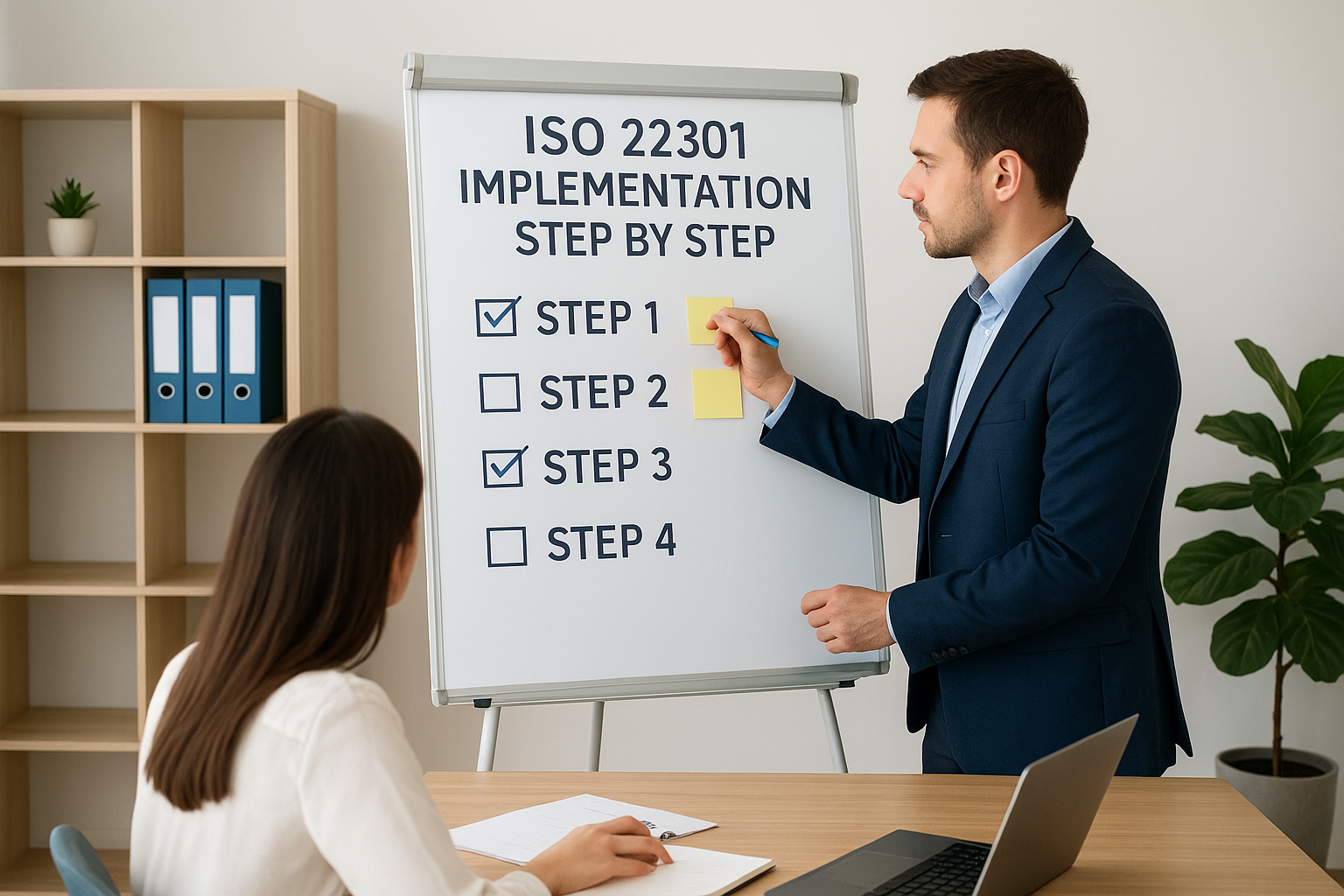
Step 1: Define your scope and context
Your first task is to establish the boundaries of your BCMS, deciding which parts of your organisation, locations, and services fall within scope. You also need to map your internal and external context, including factors that influence your continuity risks, such as your regulatory environment, supply chain dependencies, and the expectations of your key stakeholders. Getting this right at the start keeps everything that follows grounded in your actual operating environment rather than a version of it that looks tidy on paper.
Step 2: Conduct your business impact analysis
Your business impact analysis is where implementation becomes concrete. You identify your critical processes, assess the consequences of losing each one, and set your recovery time and recovery point objectives based on what your organisation can genuinely tolerate. This step shapes every recovery strategy you build, so invest time in gathering input from people who actually run those processes, not just senior management.
Your BIA outputs are only as reliable as the operational knowledge that feeds into them, so involve the right people from the start.
Step 3: Develop continuity strategies and plans
Once your BIA is complete, you can develop documented continuity strategies for each critical function. These describe practical options for maintaining or restoring operations, which typically include:
- Alternative operating sites or remote working arrangements
- Manual workarounds for technology-dependent processes
- Backup supplier or service provider agreements
- Pre-agreed communication procedures for staff and clients
Your incident response procedures must be clear enough for someone to follow under pressure without needing to improvise the critical decisions.
Step 4: Train, test, and improve
Writing plans is not the end of implementation. Your staff need training to understand their roles and execute procedures confidently when a real incident occurs. Regular exercises, ranging from tabletop walkthroughs to full live tests, verify that your plans perform as expected. When gaps appear, you update your BCMS and repeat the cycle, because ISO 22301 treats this loop of testing and improvement as a core requirement, not an optional extra.
ISO 22301 vs ISO 27001 and other frameworks
Once you understand what ISO 22301 is, the next question that naturally arises is how it fits alongside other standards and frameworks your organisation may already be working with. ISO 22301 does not operate in isolation, and placing it in context helps you avoid duplication, identify gaps, and build a more coherent governance structure across your organisation.
How ISO 22301 and ISO 27001 relate
ISO 22301 and ISO 27001 are often discussed together because they address overlapping concerns, but they serve distinct purposes. ISO 27001 focuses on protecting the confidentiality, integrity, and availability of information, establishing controls around data security, access management, and risk treatment. ISO 22301 focuses on keeping your organisation operational during a disruption, regardless of the cause. A cyberattack might trigger both frameworks at once: ISO 27001 governs how you protect and respond to the security breach, while ISO 22301 governs how you keep critical business functions running during and after it.
Organisations that implement both standards together tend to build significantly stronger resilience because each standard fills the gaps the other leaves open.
Both standards share the same high-level structure, which makes them straightforward to integrate into a combined management system. Policies, internal audits, management reviews, and document control requirements align across both, so you can run them in parallel without building entirely separate systems for each.
ISO 22301 alongside other frameworks
Several other frameworks address related but distinct areas of resilience. The NIST Cybersecurity Framework covers risk identification and security programme structure, but does not set certification requirements. ISO 31000 provides guidance on risk management principles and can complement your business impact analysis process, though it does not certify a management system. BS 65000, the UK standard for organisational resilience, takes a broader strategic view that sits above operational continuity planning.
Within a regulated UK environment, frameworks such as the FCA and PRA Operational Resilience guidelines share objectives with ISO 22301 but entail sector-specific obligations and supervisory scrutiny. Using ISO 22301 as your structural foundation typically makes it easier to map across to those regulatory requirements, because the standard already asks you to define critical services, set impact tolerances, and test your recovery arrangements, which directly supports the evidence regulators expect to see.
Next steps
Understanding what is ISO 22301 is the starting point, but the real value comes from putting that knowledge into practice. A well-built BCMS protects your revenue, satisfies client and regulatory expectations, and gives your organisation a genuine advantage over competitors that still treat continuity planning as an afterthought. The path from awareness to certification is straightforward when you follow the right sequence and involve the right expertise from the beginning.
Building a BCMS that passes independent audit scrutiny requires practical experience with the standard’s requirements, not just a familiarity with the documentation. Working with specialists who have delivered ISO 22301 implementations across different sectors accelerates the process and reduces the risk of gaps appearing late in your certification journey. If you want expert support to get your business continuity management right, speak to the team at TrustedIA and find out how we can help you build and certify a BCMS that holds up when it matters.