
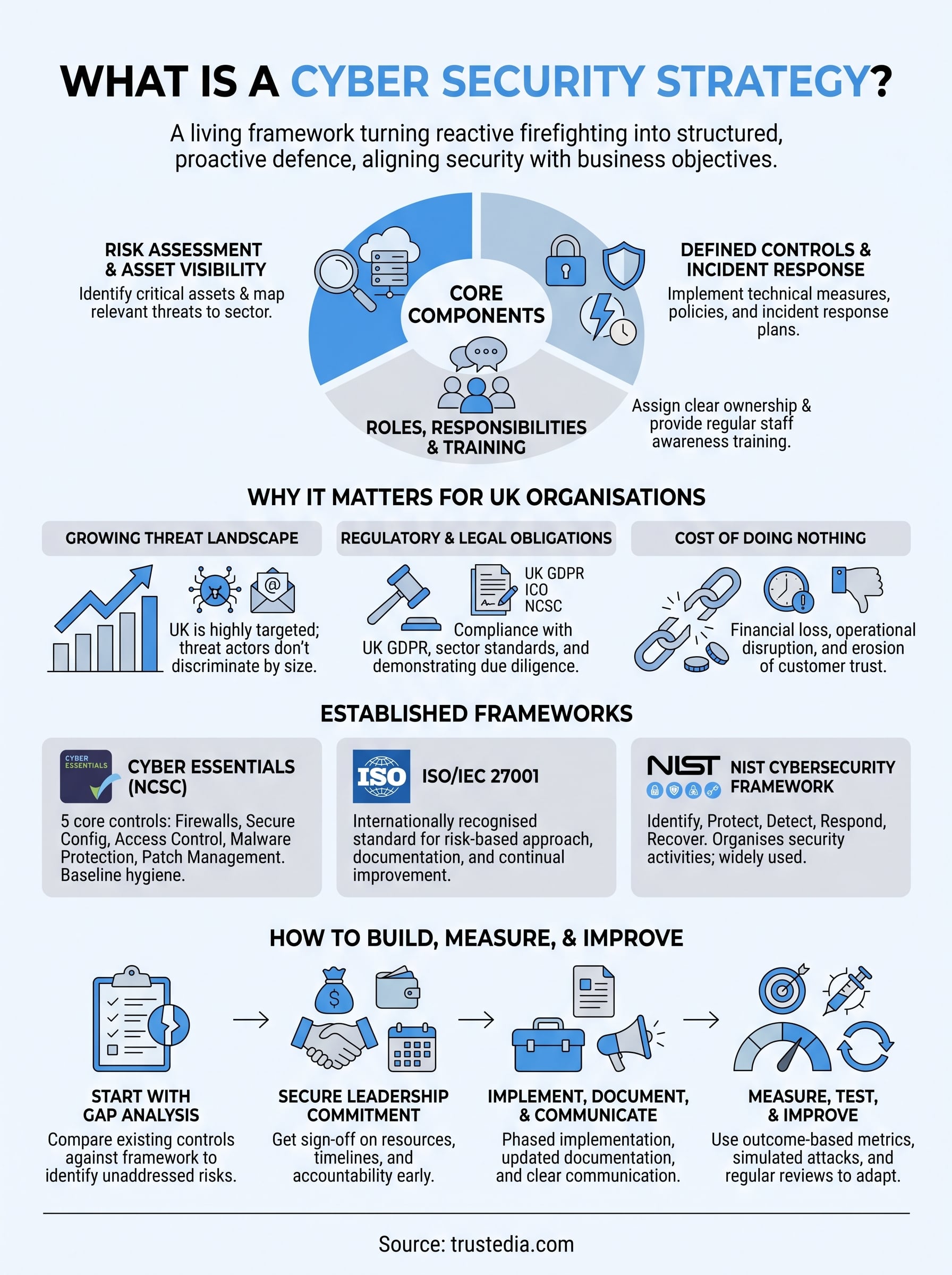
Every organisation faces cyber threats, from ransomware attacks that halt operations to data breaches that erode customer trust. The difference between those who recover quickly and those who don’t often comes down to one thing: whether they had a plan in place before the incident. Understanding what a cybersecurity strategy is matters because it’s the foundation that turns reactive firefighting into structured, proactive defence.
A cybersecurity strategy is more than a document sitting in a shared drive. It’s a living framework that defines how your organisation identifies risks, protects critical assets, and responds when something goes wrong. Done well, it aligns security efforts with business objectives and gives every stakeholder, from the board to the IT team, a clear picture of priorities and responsibilities.
This article breaks down the core components of an effective cybersecurity strategy, walks through real-world examples from government and organisational frameworks, and offers practical steps to build your own. At TrustedIA, we’ve spent over 30 years helping businesses develop and implement security strategies grounded in standards such as ISO 27001, so the guidance here reflects what works in practice.
Why a cybersecurity strategy matters for UK organisations
Many businesses assume they’re too small to be targeted, or that their existing security tools cover enough ground. Both assumptions carry real risk, and for UK organisations specifically, the environment has changed significantly over the past decade. Understanding what a cybersecurity strategy is is useful, but understanding why you can’t afford to operate without one is what drives action.
The UK threat landscape is growing
The UK is one of the most targeted countries in the world for cyber attacks. The National Cyber Security Centre (NCSC) handles hundreds of significant incidents every year, with ransomware, phishing, and supply chain attacks making up the bulk of cases affecting businesses across every sector. Threat actors don’t discriminate by company size. Small and medium-sized businesses often make easier targets precisely because their defences are thinner and their recovery resources are limited.

Cyber attacks on UK organisations increased year on year through the early 2020s, and the trend has not reversed. Without a strategy, your organisation responds to each threat as if encountering it for the first time, with no prepared playbook, no clear chain of responsibility, and no tested process for getting back online. That reactive position costs far more in time and money than building a structured plan in advance.
Regulatory and legal obligations in the UK
Operating in the UK carries specific compliance requirements that make a documented cybersecurity strategy not just good practice but a direct legal obligation. The UK General Data Protection Regulation (UK GDPR) requires organisations to implement appropriate technical and organisational measures to protect personal data. If a breach occurs and you cannot demonstrate that those measures were in place, the Information Commissioner’s Office (ICO) has grounds to levy significant financial penalties.
A documented, implemented cyber security strategy is one of the strongest pieces of evidence you can present to a regulator showing you took your obligations seriously before an incident occurred.
Sector-specific requirements add further pressure. Financial services firms are subject to oversight by the Financial Conduct Authority, healthcare organisations must meet NHS data security standards, and any business handling critical national infrastructure faces additional scrutiny. A strategy ties your security controls directly to these obligations, so you can demonstrate compliance rather than scramble to explain gaps after an attack has already happened.
The operational and financial cost of doing nothing
The most direct argument for building a strategy is the evidence of what happens without one. Cyber incidents cost UK businesses billions of pounds each year in operational downtime, recovery work, legal costs, and reputational damage. Research consistently shows that organisations with mature, documented security programmes detect and contain breaches more quickly, thereby directly reducing the total cost of each incident.
Without a strategy, your security spend tends to be reactive and uncoordinated rather than prioritised against actual risk. You buy tools after incidents rather than put controls in place that reduce the likelihood of those incidents. A strategy gives you a clear view of where your most critical assets sit, which threats are most relevant to your sector, and where your budget will have the greatest measurable impact. That structured clarity is what separates organisations that recover quickly from those that don’t fully recover.
What a good cybersecurity strategy includes
Knowing what a cybersecurity strategy in theory is is one thing; knowing what it should contain is what lets you actually build one. A strong strategy is structured around your specific environment rather than copied from a generic template. The components below appear across nearly every effective strategy, regardless of organisation size or sector.
Risk assessment and asset visibility
You cannot protect what you don’t know you have. A solid strategy starts with a clear inventory of your critical assets, including systems, data, applications, and third-party connections, then maps the threats most relevant to your sector. This risk assessment gives the other parts of your strategy direction. Without it, you’re allocating budget and controls based on guesswork rather than evidence of where your actual exposure sits.

Key areas your risk assessment should cover include:
- Data classification: What information you hold, where it lives, and who can access it
- Threat identification: Which attack types are most relevant to your industry
- Vulnerability mapping: Where your current controls fall short against identified risks
Defined controls, policies, and incident response
Once you understand your risks, you need controls to address them. This means technical measures such as multi-factor authentication, endpoint protection, and network segmentation, alongside organisational policies covering access management, data handling, and acceptable use. Your controls should map directly to identified risks rather than exist as a disconnected collection of tools you’ve accumulated over time.
A strategy that links controls to specific risks is far easier to defend to the ICO or a cyber insurer than one that simply lists the software you use.
Every strategy also needs to account for the scenario where something goes wrong. An incident response plan defines who does what when a breach occurs, from initial detection through containment and recovery. Alongside that, business continuity planning ensures your organisation can maintain critical operations under significant disruption. Organisations that test these plans before an incident hits recover measurably faster than those encountering the process for the first time mid-crisis.
Roles, responsibilities, and training
Security is not solely an IT problem. Your strategy should assign clear ownership for each security area, with named individuals or teams accountable for specific controls. Regular training ensures your staff understand their responsibilities, because human error remains one of the most exploited entry points for attackers across every sector.
Frameworks and standards to base your strategy on
Building a strategy from scratch without reference points wastes time and leaves gaps. Established frameworks give you a tested structure to work from, so you spend less time debating what your strategy should cover and more time actually implementing controls. The right framework depends on your size, sector, and regulatory environment, but several are widely recognised across UK organisations.
Cyber Essentials and the NCSC guidance
The UK National Cyber Security Centre (NCSC) offers one of the most practical starting points for UK businesses. Its Cyber Essentials scheme covers five core control areas: firewalls, secure configuration, access control, malware protection, and patch management. Achieving Cyber Essentials certification demonstrates a baseline level of security hygiene and is a requirement for certain government contracts. For smaller organisations, asking what a cyber security strategy is and where to begin, Cyber Essentials provides a structured, affordable entry point that addresses the most common attack vectors.
ISO/IEC 27001
ISO 27001 is the internationally recognised standard for information security management systems. Rather than prescribing specific tools, it defines a risk-based approach to identifying, treating, and monitoring security risks across your organisation. Achieving certification requires documented policies, defined controls, and regular audits, which means the process of pursuing it effectively forces you to build a comprehensive strategy.
ISO 27001 certification signals to clients, partners, and regulators that your security programme meets a verified international standard, which carries real commercial weight.
Organisations that implement ISO 27001 properly end up with a living management system rather than a static document. The standard requires continual improvement, so your strategy stays current as your business and the threat landscape evolve.
NIST Cybersecurity Framework
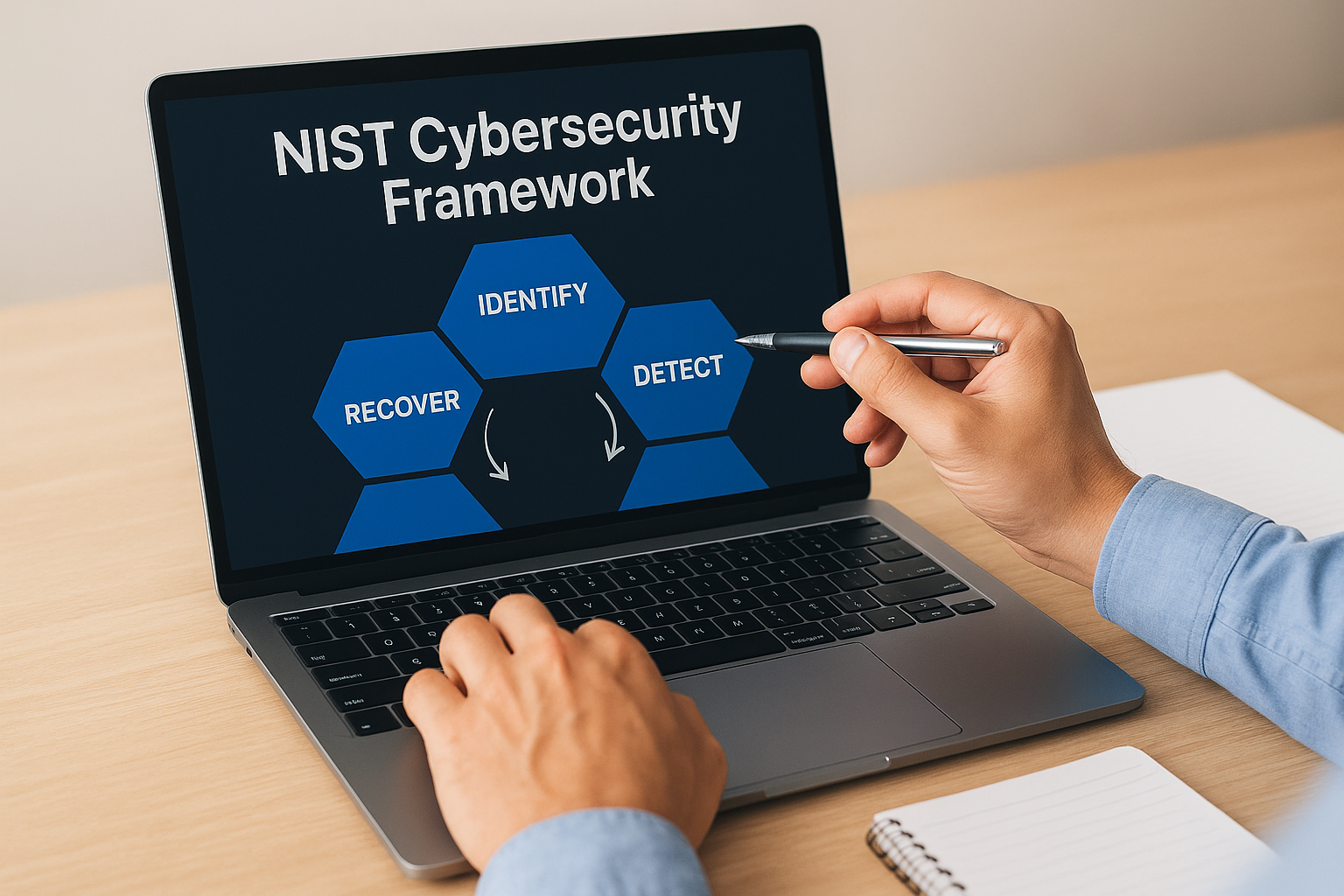
The NIST Cybersecurity Framework, developed by the US National Institute of Standards and Technology, organises security activities into five functions: Identify, Protect, Detect, Respond, and Recover. While it originates in the US, many UK organisations use it alongside other standards or in place of them because its structure maps clearly onto the practical stages of managing cyber risk. It works particularly well as a communication tool with senior leadership, because the five functions translate complex security concepts into language that non-technical stakeholders can follow and engage with.
How to build and implement a cybersecurity strategy
Understanding what a cybersecurity strategy is is the starting point, but building one requires a structured approach rather than trying to address every risk at once. Most organisations that attempt to overhaul their entire security posture stall due to resource constraints or competing priorities. A phased, prioritised plan keeps the work manageable and ensures your most critical gaps close first.
Start with a gap analysis
Before you build, you need to know where you currently stand. A gap analysis compares your existing controls against your chosen framework, whether that’s Cyber Essentials, ISO 27001, or NIST, and identifies which risks remain unaddressed. Treat the output as a prioritised list rather than an overwhelming catalogue of problems, and use it to set your implementation sequence.
The gap analysis is arguably the most valuable step in the entire process because it turns vague security concerns into a specific, documented action plan.
Organise your findings into three categories to focus effort:
- Critical gaps: controls that leave high-risk assets exposed, tackle these first
- Significant gaps: controls that increase exposure but don’t represent immediate threats
- Minor gaps: lower-priority improvements that reduce residual risk over time
Secure leadership commitment early
Security strategies fail most often not because of technical complexity but because leadership hasn’t committed the necessary resources. Before implementation begins, you need a clear sign-off from senior stakeholders on budget, timelines, and accountability. Present your gap analysis findings in terms of business risk rather than technical detail, and link the investment directly to regulatory obligations and the proven cost of incidents.
Without that commitment upfront, security work competes with every other business priority and rarely wins. Getting leadership engaged early means your strategy carries the authority and funding to progress rather than stall at the first obstacle.
Implement, document, and communicate
Once priorities are set and resources confirmed, move into phased implementation, starting with your highest-risk areas. As each control goes live, update your documentation to reflect the current state of your security posture.
Documentation is not administrative overhead. It’s the evidence you present to auditors, insurers, and regulators when they ask how your organisation manages cyber risk. Communicate each change to the relevant teams so responsibilities are clearly understood from the start.
Cyber security strategy examples by organisation type
Knowing what a cyber security strategy in abstract terms is is helpful, but seeing how it takes shape across different types of organisations makes it practical. Strategy looks different depending on your size, sector, and risk profile, so the examples below are meant to ground the concepts in recognisable situations rather than offer one-size-fits-all prescriptions.
Small and medium-sized businesses
For most SMBs, the starting point is Cyber Essentials. A small professional services firm, for example, might build its entire initial strategy around achieving Cyber Essentials certification: patching systems regularly, enforcing multi-factor authentication, restricting admin privileges, and deploying endpoint protection across all devices. That covers the most common attack vectors without requiring a large in-house security team.
Cyber Essentials certification is a strong foundation, but it represents a floor rather than a ceiling. As your organisation grows, your strategy should grow with it.
Once the basics are in place, an SMB strategy typically adds phishing simulation to test staff awareness, introduces a documented incident response plan, and schedules annual vulnerability assessments to identify gaps before attackers find them. These additions don’t require enterprise-level budgets, but they meaningfully raise the cost and effort required to compromise your organisation.
Regulated sectors and enterprises
Larger organisations and those operating in regulated sectors face more complex requirements that demand a more comprehensive approach. A financial services firm, for instance, needs its strategy to align with FCA guidance and its own risk appetite, covering third-party supplier risk, data loss prevention, and continuous monitoring through a Security Operations Centre (SOC). The strategy must demonstrate not just that controls exist, but that they are actively managed and tested.
Healthcare organisations face a similar picture, in which protecting patient data carries both ethical and regulatory weight under NHS data security standards and the UK GDPR. An effective enterprise strategy in this sector typically includes formal ISO 27001 certification, regular penetration testing, documented business continuity and disaster recovery plans, and a structured programme of staff training that runs throughout the year rather than as a single annual event. The common thread across all these examples is that strategy precedes tools: the plan defines what you need, rather than collecting tools and calling it a strategy.
How to measure, test, and improve your strategy
Understanding what a cybersecurity strategy is is only useful if you can also tell whether it’s actually working. A strategy without measurement is largely guesswork, and guesswork leaves you confident right up until an incident exposes the gaps your reporting should have flagged. Building in regular measurement and testing from the start turns your strategy into a genuinely active programme rather than a document that collects dust between reviews.
Define metrics that reflect real risk
Most security metrics focus on activity rather than outcomes: patches applied, alerts generated, training sessions completed. Activity metrics have their place, but they don’t confirm whether your risk exposure is actually reducing. Choose metrics that connect to business outcomes, including mean time to detect and contain incidents, the percentage of critical vulnerabilities remediated within a target timeframe, and phishing simulation failure rates tracked across your teams over time.
Metrics only drive improvement when leadership reviews them regularly and ties the results directly to strategy decisions rather than treating them as an annual compliance exercise.
Test your controls through simulated attacks
Reading your documentation tells you what your controls are supposed to do. Penetration testing and red team exercises tell you what they actually do under realistic attack conditions. Schedule penetration tests at least annually and after any significant change to your infrastructure. Phishing simulations provide a direct measure of staff awareness and indicate which teams need targeted follow-up rather than another generic session.
Run tabletop exercises with your incident response team to test whether your documented processes hold up under pressure. These sessions surface gaps in communication, unclear ownership, and steps your response plan assumes will happen automatically but don’t.
Review and update your strategy on a fixed cycle
Your threat environment, technology stack, and regulatory obligations evolve over time, so your strategy must adapt accordingly. Set a fixed annual review cycle as a minimum, and schedule unscheduled reviews after significant incidents, major business changes, or updates to the frameworks your organisation must comply with.
Each review should serve as a structured gap analysis of your current controls rather than a cursory read of existing documentation. Document what changed, what improved, and what still needs attention, then update your strategy so the version in use always reflects your actual security posture.
Next steps
What is a cybersecurity strategy, at its core? It is a structured plan that connects your risk profile to practical controls, keeps your business compliant, and ensures you recover faster when an incident hits. The sections above have walked you through the components, frameworks, implementation steps, and measurement practices that distinguish a working strategy from one that looks good on paper but fails under pressure.
Your next move is to assess where you currently stand. If you have no formal strategy in place, start with a gap analysis against Cyber Essentials or ISO 27001. If you have one but haven’t reviewed it recently, schedule that review now rather than waiting for an incident to force your hand.
If you want expert support building or strengthening your programme, TrustedIA’s managed cybersecurity services give you access to over 30 years of experience helping UK organisations turn strategy into measurable, lasting protection.