Getting GDPR right isn’t optional, and the fines prove it. The UK Information Commissioner’s Office (ICO) continues to hold organisations accountable, with penalties reaching into the millions for mishandling personal data. Whether you’re processing customer records, employee information, or supplier details, having a solid GDPR compliance checklist is the difference between confidence and costly mistakes. Yet many UK businesses still operate with gaps they haven’t identified, relying on outdated processes or assumptions that no longer hold up under scrutiny.
At TrustedIA, we work with businesses across the UK to strengthen their cybersecurity and compliance posture, including alignment with ISO 27001, a framework that shares significant overlap with GDPR’s requirements around data protection, risk management, and incident response. Through our audit services and professional consultancy, we’ve seen first-hand where organisations stumble and what separates those who tick boxes from those who are genuinely protected.
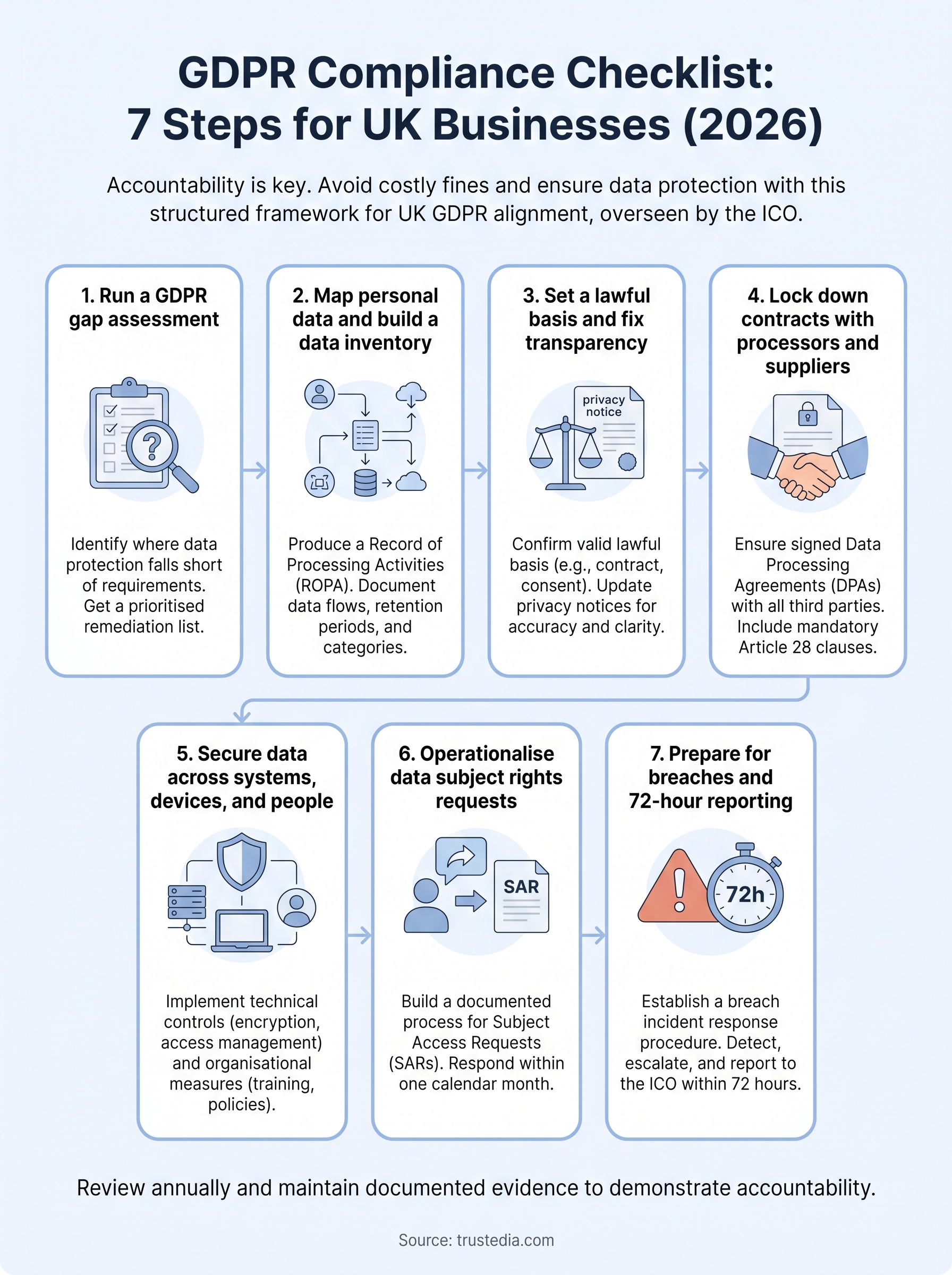
This guide breaks down GDPR compliance into 7 practical steps tailored for UK businesses in 2026. Each step gives you a clear action to take, so by the end, you’ll have a working framework to assess and tighten your own data protection practices.
1. Run a GDPR gap assessment with TrustedIA
A gap assessment is where your GDPR compliance checklist work should begin. Without one, you’re guessing at your risk exposure rather than measuring it. TrustedIA’s audit services use a structured methodology to identify exactly where your current data protection practices fall short of UK GDPR requirements, giving you a prioritised list of remediation actions rather than a vague sense of concern.
What this step covers
This step maps your existing data protection practices against the full scope of UK GDPR obligations. That means reviewing policies, procedures, technical controls, and third-party arrangements to surface where gaps exist and how significant each one is. You need this baseline before any other remediation work makes sense.
Without a baseline assessment, any compliance work you do risks addressing symptoms rather than root causes.
Actions checklist
Use this list as your starting point for the assessment. Each item needs a named owner and a target completion date before you move to the next step.
- Review existing data protection policies against UK GDPR requirements
- Interview key departments (HR, marketing, IT, finance) to document actual practices, not assumed ones
- Identify all data processing activities and confirm each has a lawful basis
- Assess technical controls including access management, encryption, and audit logging
- Score each finding by risk level to prioritise remediation work
Proof and documentation to keep
Retain evidence that a gap assessment took place and that findings were acted on. Store the full assessment report, including the methodology used and the date it was completed. Keep a remediation log that tracks each finding, the specific action taken, and sign-off from the responsible owner so you can demonstrate progress over time.
Tools and owners
Assign ownership to your Data Protection Officer (DPO), or if you do not have one, a senior IT or compliance lead. TrustedIA’s CRAFT assessment framework provides structured coverage of the data protection controls that matter most for GDPR alignment, removing the guesswork from scoping your assessment.
UK 2026 considerations
ICO enforcement in 2026 focuses heavily on accountability and documented evidence of compliance activity. Running a gap assessment and retaining the output directly supports your position if the ICO investigates your organisation. Your assessment must also reflect the UK GDPR specifically, which has diverged from EU GDPR since Brexit and continues to be updated independently by the UK government.
2. Map personal data and build a data inventory
You cannot protect data you don’t know you hold. Mapping every category of personal data your organisation collects, stores, and shares is a foundational step in any credible GDPR compliance checklist, and it directly feeds every other step that follows.

What this step covers
This step produces a Record of Processing Activities (ROPA), which UK GDPR Article 30 requires most organisations to maintain. Your ROPA documents what personal data you hold, where it came from, where it goes, how long you keep it, and who is responsible for it.
A ROPA is not a one-off exercise; it needs updating every time a new processing activity starts or an existing one changes.
Actions checklist
Work through each item and assign a named owner before signing it off.
- Identify all systems, databases, and paper records that hold personal data
- Categorise data by type (e.g. employee, customer, supplier, special category)
- Document the data flow for each category, including third-party recipients
- Record retention periods and confirm they align with your retention policy
Proof and documentation to keep
Retain your completed ROPA as a living document with version history showing when it was last reviewed and who approved each update. Keep supporting evidence such as data flow diagrams and system inventories alongside it.
Tools and owners
Your DPO or compliance lead should own the ROPA. Spreadsheet templates work for smaller organisations, but purpose-built data mapping tools improve accuracy at scale.
UK 2026 considerations
The ICO expects granular, accurate ROPA records and will request them during investigations. Ensure your inventory distinguishes clearly between UK and international data transfers, particularly post-Brexit transfers to EU processors.
3. Set a lawful basis and fix transparency
Every processing activity needs a valid lawful basis under UK GDPR Article 6. This is one of the most misapplied areas in any GDPR compliance checklist, particularly where businesses default to consent when legitimate interests or contractual necessity is more appropriate and more defensible.
What this step covers
This step ensures each activity has a documented lawful basis and that your privacy notices accurately reflect what you collect, why you collect it, and who receives it.
Relying on the wrong lawful basis is not a minor error; the ICO treats it as a substantive compliance failure.
Actions checklist
Assign a named owner to each item and set a target completion date before signing off.
- Confirm the lawful basis for every processing activity in your ROPA
- Review privacy notices and cookie policies for accuracy and plain language
- Update consent mechanisms where consent is the chosen basis
- Remove blanket consent clauses that bundle unrelated processing activities
Proof and documentation to keep
Keep updated privacy notices with version history and publication dates. Maintain a basis register that maps each processing activity to its lawful basis and documents the rationale behind that choice.
Tools and owners
Your DPO or legal lead should own this step, supported by your compliance team for notice updates and consent flow reviews.
UK 2026 considerations
The ICO actively scrutinises consent practices and privacy notice quality. Confirm your notices reflect any new processing activities, and ensure your legitimate interests assessments are fully documented where that basis applies.
4. Lock down contracts with processors and suppliers
When you share personal data with a third party that processes it on your behalf, UK GDPR requires a Data Processing Agreement (DPA) to be in place. Without one, you carry legal exposure for how that third party handles your data, and missing DPAs are a common gap in any GDPR compliance checklist review.
What this step covers
This step ensures every processor relationship is governed by a compliant written contract under UK GDPR Article 28. That covers cloud providers, payroll bureaus, marketing agencies, IT support firms, and any other supplier that touches personal data on your behalf.
A verbal assurance from a supplier is not a substitute for a signed, compliant DPA.
Actions checklist
Work through each item and assign a named owner with a target completion date.
- Identify all third parties that process personal data on your behalf
- Confirm a signed DPA is in place for each one
- Check that existing DPAs include all Article 28 mandatory clauses
- Review sub-processor arrangements and confirm they are disclosed and authorised
Proof and documentation to keep
Retain signed copies of every DPA alongside your supplier register. Log each review date and note any contract renewals or amendments so your records stay current.
Tools and owners
Your legal or compliance lead should own this step, with procurement involved wherever new supplier contracts are being signed or renewed.
UK 2026 considerations
International data transfers remain a key ICO focus in 2026. Confirm that any processors outside the UK operate under an approved transfer mechanism such as an adequacy decision or the UK International Data Transfer Agreement (IDTA).
5. Secure data across systems, devices, and people
Technical and organisational security sits at the heart of UK GDPR Article 5(1)(f), which requires you to protect personal data against unauthorised access, loss, and destruction. This step in your GDPR compliance checklist covers the controls that reduce those risks in practice, not just on paper.
What this step covers
This step addresses technical controls such as encryption and access management, alongside the organisational measures that govern how your staff handle personal data day to day.
Actions checklist
Each item below needs a named owner and a target completion date.
- Enforce role-based access controls so staff only access data they need
- Apply encryption at rest and in transit across all systems storing personal data
- Enable multi-factor authentication on email, cloud platforms, and remote access tools
- Run phishing simulations and data protection training for all staff annually
- Conduct regular vulnerability assessments across your network and endpoints
Proof and documentation to keep
Retain access control logs, training completion records, and the results of any vulnerability assessments or penetration tests. Document each control with a review date and a named owner.
Security documentation is only credible if it reflects what you actually do, not what your policy says you should do.
Tools and owners
Your IT lead or CISO should own technical controls, with HR responsible for training completion records.
UK 2026 considerations
The ICO expects proportionate, documented security measures matched to the sensitivity of the data you process. Higher-risk processing, such as special category data, demands stronger controls and more frequent review cycles.
6. Operationalise data subject rights requests
Under UK GDPR, individuals hold eight distinct rights over their personal data, including access, erasure, and rectification. Your organisation must respond to Subject Access Requests (SARs) and other rights requests within one calendar month, regardless of how many arrive at once.

What this step covers
This step builds a documented, repeatable process for receiving, verifying, and responding to data subject rights requests on time. Without a defined workflow, requests get missed or handled inconsistently, both of which create direct compliance risk.
A missed SAR deadline is one of the most common grounds for ICO complaints from individuals.
Actions checklist
Running a structured intake process removes ambiguity and protects you when response timelines run short.
- Set up a dedicated rights request channel (email or web form) and reference it in your privacy notice
- Create a verification step to confirm the identity of each requestor before releasing any data
- Document a response workflow with clear ownership and escalation steps
- Review each request type and confirm your response template addresses it correctly
Proof and documentation to keep
Retain a log of every rights request received, including the type of request, the date it arrived, and the date you responded. Keep copies of responses sent alongside any identity verification evidence for each entry.
Tools and owners
Your DPO or compliance lead should own this process, with IT and HR supporting data retrieval where needed.
UK 2026 considerations
The ICO continues to see high volumes of SAR-related complaints in 2026. Every item on your GDPR compliance checklist relating to subject rights must include a tested, documented response process rather than an informal one.
7. Prepare for breaches and 72-hour reporting
Under UK GDPR Article 33, you must report a personal data breach to the ICO within 72 hours of becoming aware of it, if it poses a risk to individuals’ rights and freedoms. Most organisations fail this test not because they lack intent, but because they have no documented process ready when a breach actually occurs.
What this step covers
This step builds your incident response procedure for data breaches, covering detection, internal escalation, ICO notification, and communication with affected individuals where Article 34 applies.
Actions checklist
Treat each item as a firm requirement to complete your GDPR compliance checklist, and assign a named owner to each one.
- Define what constitutes a reportable breach and train staff to recognise the signs
- Document an escalation path from initial detection to your DPO or senior lead
- Prepare an ICO notification template aligned to ICO reporting requirements
- Identify when you must notify affected individuals directly under Article 34
A 72-hour window closes faster than most businesses expect; your response procedure must be ready before a breach happens, not during one.
Proof and documentation to keep
Maintain a breach register that logs every incident, including near-misses, with dates, severity ratings, and actions taken. Keep copies of any ICO notifications submitted and any correspondence received in response.
Tools and owners
Your DPO or incident response lead should own this process, with your IT team on call to support containment and forensic activity.
UK 2026 considerations
The ICO scrutinises breach response timelines closely in 2026 and treats late or incomplete notifications as aggravating factors when calculating enforcement penalties.
Next steps
Working through this GDPR compliance checklist gives you a clear picture of where your organisation stands and what still needs attention. The seven steps in this guide cover the areas the ICO focuses on most, from your initial gap assessment through to breach response readiness, and each one builds on the last. If you complete every action, assign ownership, and retain the right documentation, you will have a credible, defensible compliance programme rather than a set of policies that nobody reads.
Keeping that programme current takes ongoing effort. Data processing activities change, suppliers move in and out, and the UK regulatory landscape continues to shift in 2026. Reviewing your compliance posture at least annually is the minimum standard you should hold yourself to.
If you want expert support to assess and strengthen your data protection controls, speak to the TrustedIA team about how our audit and managed security services can help your business stay compliant and protected.