
A single misdirected email or an unpatched server can put your organisation on the wrong side of the law. Breaching the Data Protection Act happens more often through carelessness than malice, yet the ICO doesn’t distinguish much between the two when it comes to enforcement. If you’ve had a near miss, a reported incident, or you’re simply trying to understand your obligations before something goes wrong, you need clear answers, not legal jargon.
This article sets out exactly what counts as a data protection act breach under UK GDPR, from unauthorised access and data loss to failures in how personal data is stored, shared, or deleted. We explain the legal thresholds regulators use, so you can judge whether an incident meets the bar for reporting.
You’ll also find the practical consequences: fines, reputational damage, and the operational disruption that follows a breach. We cover your reporting duties, including the 72-hour notification window, and what a solid incident response looks like in practice, the kind of preparation that separates businesses that recover quickly from those that don’t.
Why breaching the Data Protection Act carries such heavy risk
Regulators built the UK GDPR around a simple principle, and the Data Protection Act explained in plain terms follows the same logic: personal data belongs to the person it describes, not the organisation holding it. When you lose control of that data, whether through a hack, human error, or poor system design, the law treats it as a serious failure regardless of your intentions. That’s why breaching the Data Protection Act carries risk far beyond a slap on the wrist. The penalties are designed to hurt, and the reputational fallout often outlasts the fine itself.
What actually counts as a breach
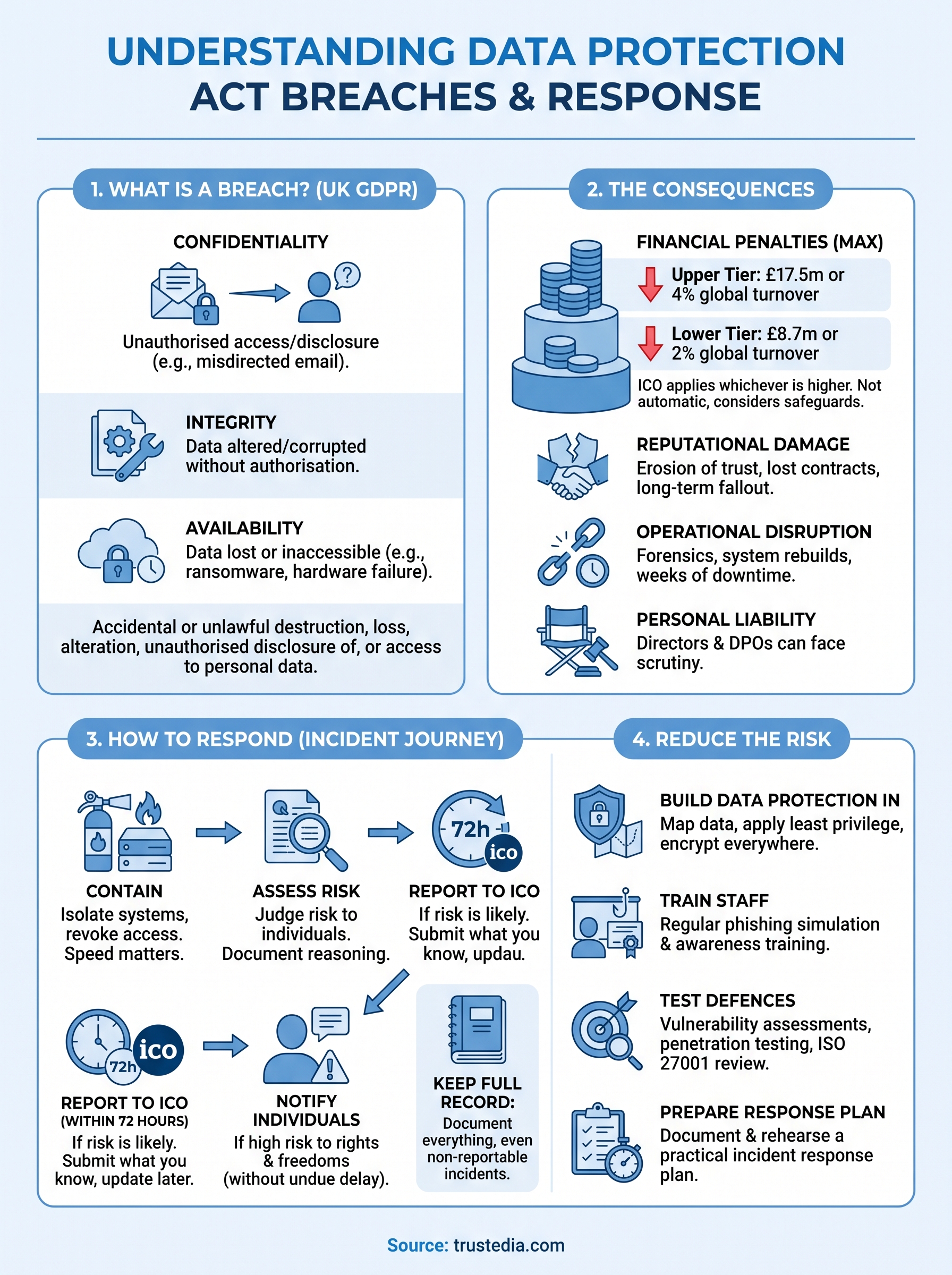
Under UK GDPR, a personal data breach is any security incident that leads to the accidental or unlawful destruction, loss, alteration, unauthorised disclosure of, or access to personal data. That definition is broader than most people assume. It covers three distinct categories: confidentiality breaches (data seen by the wrong people), integrity breaches (data altered without authorisation), and availability breaches (data lost or made inaccessible, including through ransomware). A data protection act breach doesn’t require malicious intent or even an external attacker. Sending a spreadsheet to the wrong recipient, leaving a laptop on a train, or failing to apply a critical patch all qualify.
The financial penalties are tiered but substantial
The ICO, the UK’s data protection regulator and the powers it wields, can issue fines in two tiers, and the ceiling is high enough to threaten the survival of a smaller business. The table below shows the maximum exposure.
| Breach severity | Maximum fine | Alternative threshold |
|---|---|---|
| Lower tier infringements | £8.7 million | 2% of global annual turnover |
| Upper tier infringements | £17.5 million | 4% of global annual turnover |
A single unreported breach can cost more than years of security investment would have.
The regulator applies whichever figure is higher, so turnover-based calculations tend to hit larger organisations hardest, while smaller businesses often face the flat sums instead. Fines aren’t automatic, though. The ICO weighs factors like the nature of the breach, whether you cooperated, and whether reasonable safeguards were already in place. Organisations that can demonstrate a mature security posture, evidenced through things like ISO 27001 certification, tend to receive more lenient treatment.
Reputational and operational fallout beyond the fine
Money is rarely the biggest cost. Customers and partners lose confidence fast when their data ends up compromised, and that erosion of trust translates directly into lost contracts, especially in sectors where data handling forms part of procurement due diligence. Operationally, expect weeks of disruption: forensic investigation, system rebuilds, staff time diverted from normal duties, and potentially restricted access to your own systems while you contain the incident. Insurers and loss adjusters increasingly ask for evidence of a tested incident response plan before they’ll even discuss cover, which is one reason services like TrustedIA’s CyberSOS incident response exist, to get businesses back on their feet quickly rather than leaving them to manage recovery alone.
Personal liability for directors and DPOs
Liability doesn’t stop at the company level either. Directors can face personal scrutiny if an investigation finds a pattern of ignoring known risks, and data protection officers, and whether you need one, carry specific accountability for how breaches are handled and reported. This shared exposure is exactly why proactive compliance work, such as achieving and maintaining ISO 27001 certification, matters so much. It creates a documented, auditable trail showing your organisation took reasonable steps, which counts heavily in your favour if the ICO ever comes knocking. Getting that structure right from the start, with support from genuine subject matter experts, is far cheaper than trying to prove good intentions after the fact.
How to respond when a data protection breach occurs
The moment you suspect a breach, speed matters more than perfection, and a seven-step guide for UK SMEs is worth having open in front of you. Every hour spent arguing about whose fault it is compounds the damage and eats into your reporting deadline. Treat breaching the Data Protection Act as a live incident from the first sign of trouble, because the ICO judges your response almost as harshly as the original failure.
Contain the problem before you investigate it
Isolate whatever is exposed first: disable compromised accounts, pull affected systems offline, or revoke access tokens before you start to investigate a data breach step by step. Containment always comes before root-cause analysis, because every extra minute of exposure increases the number of records affected and the fine that follows. Once the immediate risk is under control, pull together the people who actually know what happened, IT, your data protection officer, and legal, so you’re working from facts rather than guesswork.
Assess the risk and the reporting threshold
Not every security incident is reportable. You need to judge the likely risk to the people whose data is involved: a lost laptop with full disk encryption and no key compromised is a very different case to an unencrypted customer database exposed online. Get this assessment wrong and you either report noise to the ICO unnecessarily or, worse, miss a genuine data protection act breach that needed disclosure. If you’re unsure, document your reasoning either way, because that record protects you later.
A breach handled well in the first 72 hours often costs a fraction of one left to drift.
Report to the ICO within 72 hours
Where the breach is likely to result in risk to individuals, the clock starts the moment you become aware of it, not when the investigation concludes, so it pays to know how ICO breach reporting works in practice. Your notification should cover:
- What happened and when you became aware of it
- The categories and approximate number of individuals and records affected
- The likely consequences for those individuals
- The measures you’ve taken or plan to take to address it
Missing the window because you wanted a complete picture first is a common and avoidable mistake. Submit what you know within 72 hours and update the ICO as the picture develops.
Notify affected individuals when the risk is high
Separately from the regulator, you must tell affected individuals directly and without undue delay if the breach is likely to result in a high risk to their rights and freedoms, think financial fraud, identity theft, or exposure of sensitive categories of data. Clear, honest communication here does more for your reputation than silence ever will.
Keep a full record regardless
Even incidents you decide not to report still need documenting. The ICO can ask to see your internal breach log at any time, and a well-kept record, alongside a tested plan you can build from a data breach response plan template, shows regulators and insurers alike that you take this seriously.
Common examples of data protection act breaches
Abstract definitions only take you so far. Seeing how a data protection act breach actually happens in practice makes it far easier to spot risk in your own organisation before the ICO does it for you. Most incidents fall into a handful of recurring patterns, and none of them require a sophisticated attacker.
Human error and misdirected data
Genuine mistakes cause more breaches than hackers do. Emailing a client list to the wrong recipient, attaching the wrong file to a mass mailing, or leaving a printed report on a train are all textbook examples of breaching the Data Protection Act through carelessness rather than malice. Postal errors count too, sending a letter containing medical or financial details to the wrong address is still a reportable incident if the risk to the individual is high enough. Training reduces this category more than any technical control ever will, because the failure sits with a person, not a system.
Cyberattacks and unauthorised access
Ransomware, phishing, and credential theft sit at the sharper end of the scale. An attacker who gains access to a customer database through a phished password, or who encrypts your systems and demands payment, has triggered a confidentiality and availability breach in one move. Weak or reused passwords, missing multi-factor authentication, and unpatched software are the usual entry points, which is exactly why vulnerability assessments and endpoint detection matter as much as any policy document.
The most damaging breaches rarely start with a sophisticated hacker, they start with an unpatched system nobody got round to fixing.
System and process failures
Not every breach involves a human clicking the wrong button or an attacker forcing their way in. A data protection act breach can also come from poor system design: a misconfigured cloud storage bucket left publicly accessible, one of several cloud data security challenges and how to overcome them, a database backup stored without encryption, or access permissions that were never revoked after an employee left. These failures often sit undetected for months, which widens the scope of exposure and increases the eventual fine.
Retention and disposal failures
Holding personal data longer than necessary, or disposing of it improperly, breaches the law even without any external trigger. Old customer records left on a decommissioned server, paper files thrown out without shredding, or hard drives sold on without secure wiping all count.
| Breach type | Typical cause | Example |
|---|---|---|
| Human error | Misdirected email or post | Client data sent to the wrong address |
| Cyberattack | Phishing, weak credentials | Ransomware encrypting customer records |
| System failure | Misconfiguration | Publicly exposed cloud storage bucket |
| Retention failure | Poor disposal practice | Unwiped hard drives resold with data intact |
Third-party and supply chain exposure
Finally, you remain responsible for personal data even when a supplier or processor handles it on your behalf. A breach at your payroll provider or IT support partner is still your compliance problem, which is why due diligence on any third party touching personal data deserves the same scrutiny as your own systems.
How to reduce the risk of breaching the Data Protection Act
Prevention costs far less than recovery, yet many organisations only invest in cyber risk management after an incident forces their hand. Reducing the risk of breaching the Data Protection Act means treating data protection as an ongoing discipline rather than a box-ticking exercise you revisit once a year. The businesses that avoid enforcement action tend to share the same habits: they know where their data lives, who can access it, and what happens if something goes wrong before it actually does.
Build data protection into everyday processes
Mapping your data is the unglamorous first step that most organisations skip, and one of many quick ways to protect business data. You can’t protect what you can’t locate, so know which systems hold personal data, who has access, and why. Apply the principle of least privilege so staff only see what their role requires, and review access permissions whenever someone changes role or leaves. Encrypt sensitive data at rest and in transit, and make sure backups follow the same standard, because an unencrypted backup is just as reportable as an unencrypted live database.
Train staff to spot and avoid mistakes
Employees cause more breaches through carelessness than any hacker does, which makes training your single highest-value investment. Regular phishing simulation exercises, run according to nine steps UK SMEs should follow when simulating phishing, teach staff to pause before clicking a suspicious link rather than learning the hard way. Cover the basics repeatedly: verifying recipients before sending sensitive attachments, locking devices when unattended, and reporting near misses without fear of blame.
A well-trained employee stops more breaches than any single piece of security software.
Test your defences before attackers do
Regular testing exposes the gaps that policy documents alone never catch. Vulnerability assessments, run to a repeatable eight-step process, and penetration testing identify unpatched systems, misconfigured cloud storage, and weak credentials before someone outside your organisation finds them first. Pair technical testing with a periodic review against the ISO 27001 framework, which gives you a structured, auditable way to prove you took reasonable precautions if the ICO ever investigates.
Prepare a response plan you can actually use
Documented plans that nobody has practised tend to fall apart under pressure. Build and rehearse an incident response plan, working from an incident response checklist covering these steps:
- Who is notified first, internally and externally
- How containment decisions get made and by whom
- The template and channel for reporting to the ICO
- How and when affected individuals are told
- Who reviews the incident afterwards to close the gap that caused it
Lean on external expertise where it counts
Partnering with a managed security provider fills the gaps most in-house teams simply don’t have time to cover. A Security Operations Centre monitors continuously rather than reactively, catching the early signs of compromise before they become a reportable breach. Combined with dark web surveillance and endpoint detection, this kind of ongoing oversight turns data protection from a reactive scramble into a routine part of how the business runs.
Staying ahead of data protection risks
Every example in this article shares the same root cause: a gap between what an organisation assumed was secure and what actually was. Breaching the Data Protection Act rarely starts with malice. It starts with an unpatched server, an untrained employee, or a supplier nobody vetted properly. The good news is that every one of those gaps is fixable before the ICO ever gets involved.
Treat data protection as an ongoing habit rather than a one-off project, and a data protection act breach becomes far less likely to happen on your watch. Map your data, train your people, test your defences, and rehearse your response plan until it’s second nature rather than theory. And if the worst does happen, TrustedIA’s 24/7 CyberSOS incident response team can contain and remediate a breach before it becomes a headline, get in touch to talk it through.