
Every business handling customer or employee data faces the same question sooner or later: are we actually compliant, and would we know if we weren’t? UK GDPR and the Data Protection Act 2018 don’t go easy on organisations that guess rather than check, and the fines and reputational damage from a breach can outlast the incident itself by years. This is exactly where data protection services come in, and why so many IT managers and compliance officers are searching for a provider they can trust rather than another checklist to fill in.
This article explains what these services actually cover, from outsourced DPO support to policy audits and staff training, and who genuinely needs them versus who can manage in-house. We look at personal data protection services in practical terms, not legal theory, so you can see where the gaps in your current setup are.
We’ll also cover how these services connect to wider cyber security work, since data protection rarely sits in isolation from your broader security posture. At TrustedIA, we see this link daily through our ISO 27001 and audit work, and it shapes how we explain what a good provider should deliver for your organisation.
Why data protection services matter for your business
Most directors assume a breach means a fine from the Information Commissioner’s Office and what it actually enforces and nothing more. That’s the smallest part of the problem. Regulatory penalties for breaching data protection law under UK GDPR can reach £17.5 million or 4% of global turnover, whichever is higher, but the real damage tends to show up months later: lost contracts, cancelled tenders, and clients quietly moving to a competitor who can prove they take personal data protection services seriously. Data protection isn’t a legal box to tick once a year. It’s an operational discipline that touches every department handling customer records, employee files, or supplier contracts.

The real cost of getting it wrong
Numbers help make this concrete. The ICO’s own enforcement action shows a clear pattern: organisations that had no documented policies, no data processing agreements, and no evidence of staff training get penalised far more heavily than those who can show they tried and failed at one specific control. According to the ICO’s enforcement action page, fines regularly follow breaches where basic safeguards, like encryption or access controls, simply weren’t in place. That’s the gap data protection and privacy services are built to close before a regulator ever gets involved.
| Consequence | Typical trigger | Who feels it first |
|---|---|---|
| ICO fine or reprimand | Missing lawful basis, weak security controls | Finance and leadership |
| Contract loss | Client due diligence reveals no DPO or policy gaps | Sales and account management |
| Insurance premium rise | Breach history or no incident response plan | Whole organisation |
| Reputational damage | Public breach disclosure, media coverage | Brand and customer retention |
| Operational downtime | No recovery plan for a data incident | IT and operations teams |
A single unpatched gap in your data handling can cost more in lost contracts than any fine the ICO ever issues.
Beyond fines: trust, contracts, and reputation
Business customers now ask for evidence, not promises. Procurement teams routinely request a copy of your data protection policy, your last risk assessment, or proof of an appointed Data Protection Officer before signing anything. Without that paperwork ready, deals stall or disappear entirely. Contracts in sectors like healthcare, finance, and public services almost always include data processing clauses that assume you already have privacy and data protection services embedded in how you operate, not bolted on after a client asks. Getting caught without answers in a due diligence call is one of the fastest ways to lose a deal you thought was already won.
Why most in-house teams can’t keep up
Compliance officers and IT managers rarely have the bandwidth to track every change to UK data protection law, run staff training, manage subject access requests, and respond to an incident, all while doing their main job. Guidance shifts, case law develops, and the ICO updates its expectations more often than most internal teams can absorb. Smaller organisations especially tend to appoint a DPO on paper without giving them the time or authority to actually do the role properly, which leaves a gap that only surfaces during an audit or, worse, a breach investigation.
Outsourcing solves this without the overhead of a full-time hire. A dedicated provider brings:
- Continuous monitoring of regulatory changes and enforcement trends, so your policies stay current without someone chasing updates manually.
- Independent audits that catch blind spots an internal team, close to its own processes, is likely to miss.
- Incident response readiness, meaning a documented plan and a point of contact the moment something goes wrong, rather than a scramble to figure out who’s in charge.
- Staff training delivered on a schedule, not as a one-off induction session nobody remembers six months later.
- Evidence and documentation ready to hand over the moment a client, auditor, or regulator asks for it.
Organisations that treat data protection as an ongoing service, rather than an annual scramble before an audit, consistently show fewer breaches and faster recovery when something does go wrong. That’s the practical argument for bringing in specialists: not because the law demands it, but because the cost of getting it wrong, in fines, lost business, and operational chaos, is almost always higher than the cost of doing it properly from the start.
How to choose the right data protection service provider
Picking a data protection consulting partner isn’t just about price. Most businesses shopping for data protection services UK wide make the mistake of comparing quotes before checking whether the provider actually understands their sector, their data flows, and the size of the risk they’re carrying. A generic policy template dressed up as a service won’t hold up under ICO scrutiny or a client’s due diligence check. The right partner should ask more questions than you do in the first meeting, because they need to understand your data before they can protect it.
If a provider can quote you a price before asking what data you actually hold, walk away.
Questions to ask before signing
Start any conversation with a provider by testing how they actually work, not just what they promise. A firm offering genuine privacy and data protection services should be able to answer these without hesitation:
- Do you hold ISO 27001 certification yourselves, or work to that framework as standard?
- Can you name the qualifications of the person who’d act as our outsourced DPO?
- What does your incident response process look like in the first 24 hours of a breach?
- How often do you review and update our policies once the initial engagement is done?
- Can you provide references from clients in our sector, not just a generic case study?
- What happens if we need to scale the service up quickly during an audit or investigation?
A provider who can’t answer the last two questions clearly probably hasn’t run this service under real pressure before.
Local presence versus national coverage
Geography still matters more than people expect. Businesses searching for data protection services London often assume they need a local firm for site visits, staff training sessions, or in-person audits, and that’s a fair instinct for larger organisations with multiple offices. But remote delivery has closed most of that gap. What actually matters is response time when something goes wrong, not the provider’s postcode. Ask directly how quickly they can get someone on a call, or on site if needed, once an incident is reported.
Red flags that should end the conversation
Some warning signs are consistent enough across the industry that they’re worth listing outright:
| Red flag | Why it matters |
|---|---|
| No named DPO or contact person | Accountability disappears when something goes wrong |
| Vendor-locked recommendations | Suggests commercial bias over genuine risk assessment |
| No documented incident response plan | Response time in a breach becomes guesswork |
| Reluctant to share client references | Track record may not hold up to scrutiny |
| One-off engagement with no review cycle | Compliance drifts within months of sign-off |
A solution-agnostic approach is worth prioritising here. Providers tied to a single software vendor or platform tend to fit your organisation into their product rather than the other way round. Look instead for a provider who assesses your risk first and recommends tools and controls afterwards, based on what actually suits your setup rather than what earns them a commission.
Types of data protection services explained
Not every provider offers the same package under the label data protection services, and that’s where a lot of confusion starts. Some firms sell a single audit and call it a day. Others build an ongoing relationship covering everything from policy drafting to incident response. Knowing the difference before you sign a contract saves you from paying for a report that sits unread in a folder while your actual risk stays exactly where it was.
Outsourced DPO services
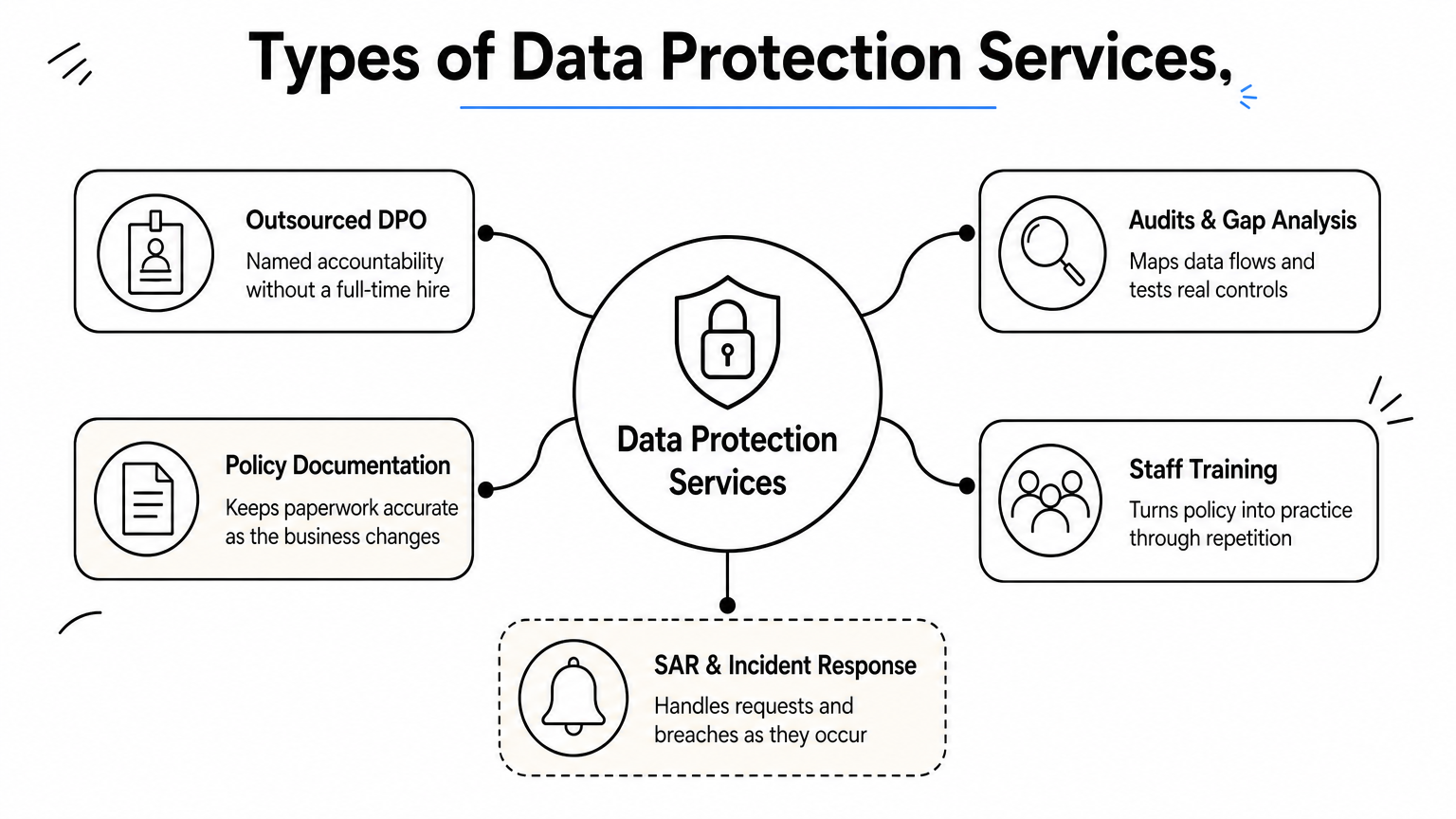
Under UK GDPR, certain organisations are legally required to appoint a Data Protection Officer, and many more appoint one voluntarily because it demonstrates good governance to clients and regulators alike, so it pays to know when a DPO appointment is mandatory. An outsourced DPO gives you that accountability without the cost of a full-time salary, and crucially, without the conflict of interest that comes from making an internal employee responsible for policing their own department. Typical DPO services handle regulatory correspondence, advise on high-risk processing, and act as the named point of contact the ICO expects to see.
Data protection audits and gap analysis
An audit tells you where you actually stand, rather than where you assume you stand. A proper GDPR gap analysis maps your data flows, checks your lawful basis for processing, and tests your technical controls against what UK GDPR actually requires, not a generic checklist. TrustedIA’s own data protection audit and cyber assurance work feeds directly into this, because data protection gaps rarely exist in isolation from wider security weaknesses.
An audit that only checks paperwork misses the technical gaps that actually cause breaches.
Policy and documentation support
Policies need to reflect how your organisation genuinely operates, not a template downloaded from a search result. This includes privacy notices, retention schedules, data processing agreements with suppliers, and breach response procedures. Quality personal data protection services rewrite these documents around your actual data flows and keep them current as your business changes, rather than leaving them to gather dust after the first sign-off.
Staff training and awareness
Regulators and courts alike routinely find that human error, not a technical failure, caused the breach in question. Incident response training for staff turns policy into practice, covering phishing awareness, correct handling of subject access requests, and what to do in the first hour after a suspected incident. Refresher sessions matter more than the initial induction, since awareness fades fast without repetition.
Subject access requests and incident response
Under well-designed data protection and privacy services, providers also manage the operational side: responding to subject access requests within statutory deadlines, and coordinating what to do once a data breach is discovered. This table summarises how the main service types differ in scope:
| Service type | Core focus | Typical frequency |
|---|---|---|
| Outsourced DPO | Regulatory accountability and advice | Ongoing |
| Audit and gap analysis | Identifying weaknesses in policy and controls | Annual or biannual |
| Policy and documentation | Keeping paperwork accurate and current | Reviewed on change |
| Staff training | Reducing human error | Quarterly or biannual |
| Subject access and incident support | Handling requests and breaches as they occur | As needed |
Very few in-house teams can cover all five well, which is exactly why most organisations end up combining internal ownership with outsourced specialists for the parts that need constant attention.
Who needs data protection services
The honest answer is almost every organisation that holds personal data on customers, employees, or suppliers, but the urgency varies sharply by sector and size. Businesses processing special category data, financial records, or health information sit at the sharp end of regulatory attention, while a five-person consultancy with a client list and a payroll system still has legal obligations under UK GDPR, just with less at stake per incident. Working out where your organisation falls on that spectrum is the first step before you even start comparing data protection services UK providers.
Regulated and high-risk sectors
Healthcare providers, financial services firms, and public sector bodies face the heaviest scrutiny, and for good reason. These organisations routinely process special category data or high volumes of financial information, which means a breach carries statutory reporting duties and reputational consequences that spread fast through patients, clients, or constituents. Legal and insurance firms fall into this bracket too, since client confidentiality is the product they’re selling, not a side consideration. Any organisation in this group should treat privacy and data protection services as core infrastructure, not an optional extra bolted on before an audit.
If a breach in your sector would make the news, you need this covered properly, not partially.
SMBs without in-house expertise
Smaller businesses often assume data protection law only applies at scale, but GDPR compliance for small UK businesses has no headcount threshold. A 20-person e-commerce business holding customer payment details and order histories carries real exposure, and rarely has the budget for a dedicated compliance hire. This is where outsourced personal data protection services genuinely level the playing field, giving smaller organisations access to the same DPO expertise, audit rigour, and incident response planning that a much larger competitor would have in-house.
Insurers, loss adjusters, and their clients
Insurers and loss adjusters have a slightly different need. They’re not just managing their own data protection obligations, they’re also responsible for getting policyholders back on their feet quickly after a cyber incident, which means they need a reliable partner to call on. TrustedIA’s CyberSOS incident response service exists specifically for this relationship, giving insurers and adjusters a dependable route to fast, well-documented recovery for the businesses they cover.
Organisations chasing contracts or certification
Finally, plenty of businesses come looking for data protection support not because of a breach or a legal deadline, but because a contract depends on it. Public sector tenders, supply chain agreements with larger corporates, and embedding the ISO 27001 standard all demand documented evidence of proper data handling before the ink dries. A quick breakdown of who typically falls into each category:
| Organisation type | Main driver | Typical service need |
|---|---|---|
| Healthcare, finance, legal | Regulatory exposure | Outsourced DPO, ongoing audits |
| SMBs and retailers | Limited in-house resource | Full-service outsourced package |
| Insurers and loss adjusters | Client recovery obligations | Incident response partnership |
| Public sector and supply chain firms | Contract and certification requirements | Documentation and gap analysis |
Whichever category you fall into, the underlying question stays the same: could you prove your compliance today, without weeks of scrambling first?
Data protection services vs cyber security services
Confusing these two is common, and it’s an expensive mistake. Cyber security services protect your systems, networks, and data from attack. Data protection services govern how you collect, use, store, and delete personal data lawfully, regardless of whether a hacker ever gets near it. You can run a technically secure network with encrypted endpoints and a monitored SOC, and still breach UK GDPR by keeping customer records for years past their retention period or processing data without a documented lawful basis. The two disciplines overlap heavily in practice, but they answer different questions, and a provider who only understands one half of the equation will leave you exposed on the other.

A firewall won’t stop a GDPR fine for keeping data you had no right to hold in the first place.
Where the two disciplines overlap
Security failures and data protection failures often trigger each other. A phishing attack that compromises an employee’s inbox is a cyber security incident, but it also becomes a data protection incident the moment personal data in that inbox is exposed, which triggers the 72-hour reporting clock under UK GDPR. This is exactly why TrustedIA treats the two as connected rather than separate services: our managed security services feed directly into the evidence a DPO needs when assessing breach severity, and our audit work regularly surfaces data protection gaps that started as a technical control failure nobody flagged.
Where they genuinely diverge
Despite the overlap, the day-to-day focus is different enough that one team rarely does both well. The table below sets out the practical split:
| Aspect | Cyber security services | Data protection services |
|---|---|---|
| Primary question | Can attackers get in? | Do we handle data lawfully? |
| Typical output | Penetration test, SOC monitoring, patching | Policies, DPO advice, training, audits |
| Governing framework | NIST, Cyber Essentials, ISO 27001 | UK GDPR, Data Protection Act 2018 |
| Who owns it internally | IT manager, security lead | Compliance officer, appointed DPO |
| Failure looks like | Breach, ransomware, downtime | ICO fine, unlawful processing, lost contract |
Why most organisations need both, not either
Treating data protection and privacy services as a legal add-on to a security contract, or treating security as an IT problem separate from compliance, both lead to the same gap: nobody owns the full picture. Insurers assessing a claim after an incident will ask about both your technical controls and your data handling practices, and a weak answer on either side affects the payout. Organisations that get this right tend to buy from a provider who genuinely covers both under one roof, or who at minimum coordinates closely with whoever handles the other half, so the DPO isn’t the last person to hear about a breach and the security team isn’t guessing at reporting deadlines. That coordination, more than any single tool or certificate, is what actually keeps an organisation out of trouble when something goes wrong.
UK data protection laws your provider should know
Anyone offering data protection services UK wide should be fluent in more than just the headline legislation. UK GDPR and the obligations it creates plus the Data Protection Act 2018 form the backbone, but a genuinely capable provider also tracks how the ICO interprets these laws in practice, which shifts more often than the statute text itself. Ask a prospective provider to explain a recent enforcement decision off the top of their head. If they can’t, they’re working from theory rather than current practice, and that gap will show up eventually in your policies.
The core legal framework
Beyond UK GDPR itself, several related instruments shape day-to-day compliance work, and a competent provider should reference all of them without prompting:
- UK GDPR and the Data Protection Act 2018 in practice, covering lawful basis, individual rights, and the accountability principle.
- The Privacy and Electronic Communications Regulations (PECR), governing marketing emails, cookies, and electronic communications.
- The Freedom of Information Act 2000, relevant for public sector clients handling both personal and non-personal data requests.
- Sector-specific guidance published by the ICO, including detailed codes on children’s data, employment practices, and international transfers.
The ICO’s guide to UK GDPR remains the single most reliable reference point, and any provider worth hiring should be checking it regularly rather than relying on knowledge from a training course completed years ago.
A provider who quotes outdated ICO guidance will draft you a policy that fails the next audit.
Sector-specific rules to watch
Data protection law doesn’t apply uniformly across every industry, and a provider offering genuine privacy and data protection services needs to know where the extra obligations sit. Financial services firms answer to the FCA as well as the ICO. Healthcare organisations must layer NHS-specific data protection duties on top of UK GDPR. Public sector bodies carry statutory transparency duties that private companies don’t. A provider treating every client with the same generic policy template hasn’t understood this, and it will show the first time a regulator or auditor asks a sector-specific question.
International transfers and post-Brexit complexity
Moving data outside the UK adds another layer that catches out organisations working with overseas suppliers, cloud platforms, or remote teams. Since Brexit, UK GDPR runs alongside its EU counterpart as a separate but closely aligned regime, and transfers to countries without an adequacy decision require additional safeguards such as Standard Contractual Clauses. Suppliers using US-based cloud infrastructure, for example, need contractual protections such as European Commission Standard Contractual Clauses checked carefully rather than assumed. A provider unfamiliar with this distinction risks leaving a genuine compliance gap in any organisation using international vendors, which covers most businesses running on major cloud platforms today.
Keeping pace with change
Staying current isn’t optional in this field. The ICO updates guidance, issues new codes of practice, and publishes enforcement decisions throughout the year, and a static policy written once and never revisited will drift out of alignment within months. Vet any provider on how they track these changes internally, not just how they describe their service in a sales pitch. That ongoing discipline, more than any single certification, separates a provider who genuinely keeps you compliant from one who simply sold you a document.
What to expect: cost and process
Cost is the question every prospect asks first and the one providers answer least clearly. That’s partly because data protection services genuinely vary by scope, not just by provider markup. A five-person consultancy needing a basic policy review pays a fraction of what a healthcare group with multiple sites and special category data pays for full outsourced DPO cover. Anyone quoting a fixed price before understanding your data flows is guessing, and you’ll pay for that guesswork later when gaps surface mid-contract.
How pricing typically breaks down
Expect three broad pricing models across the market, each suited to a different stage of maturity. A one-off audit or gap analysis carries a fixed price, usually settled after an initial scoping call. Ongoing outsourced DPO support runs as a monthly retainer, scaled to headcount, data volume, and sector risk. Incident response tends to sit on a separate retainer or an on-demand rate, since nobody can predict when it’ll be needed.
| Service | Typical pricing model | What drives the cost |
|---|---|---|
| Gap analysis or audit | Fixed one-off fee | Number of systems, data volume, sector complexity |
| Outsourced DPO | Monthly retainer | Headcount, processing volume, regulatory exposure |
| Staff training | Per session or annual package | Number of staff, refresher frequency |
| Incident response | Retainer plus incident rate | Response time guarantees, severity of incidents covered |
Cheap data protection services almost always mean a smaller scope, not a better deal.
Getting a genuinely comparable quote means giving every provider the same information: staff numbers, data types held, current policies (if any), and any known compliance gaps. Without that, you’re comparing prices attached to entirely different scopes of work.
What a typical onboarding process looks like
Providers worth hiring follow a broadly consistent sequence, even if the language differs between firms:
- Scoping call to map your data flows, current documentation, and existing risk exposure.
- Gap analysis against UK GDPR and sector-specific requirements, producing a prioritised list of fixes.
- Policy and process work, drafting or updating documentation to match how you actually operate.
- Staff training rollout, scheduled around your business rather than delivered as a single generic session.
- Ongoing review cycle, agreed upfront so compliance doesn’t drift once the initial project ends.
Skipping straight from a sales call to a signed contract without that scoping stage is a warning sign, whatever the price on offer.
Timescales and what changes over time
Setting up personal data protection services properly, from first scoping call to a working set of policies and a trained team, usually takes between four and twelve weeks depending on organisational size and how much documentation already exists. That initial project is the heaviest lift. After that, the relationship shifts to lighter, scheduled touchpoints: quarterly training refreshers, annual audits, and ad hoc support when a subject access request or incident arrives. Budgeting for that ongoing cadence matters more than fixating on the initial setup fee, since compliance maintained badly for a year costs far more to fix than it would have cost to run properly from day one.
Finding the right data protection partner
Data protection services aren’t a compliance formality you tick off once a year. They’re the difference between spotting a gap before an auditor does and explaining it after a breach has already cost you a contract. Whether you need an outsourced DPO, a proper gap analysis, or a partner who understands how data protection and cyber security overlap in practice, the provider you choose matters more than the price on their quote.
Getting this right means working with people who ask before they answer, who can show their incident response track record, and who treat your policies as living documents rather than paperwork filed once and forgotten. That’s the standard worth holding any provider to.
If you’re ready to see where your own organisation stands, talk to TrustedIA about UK GDPR and DPA 2018 compliance help and get a straight answer, not a sales pitch.



