
GDPR fines don’t discriminate by company size. A single reported breach can trigger an ICO investigation, and if you can’t show you took data protection seriously, the penalties and reputational damage follow fast. That’s why so many UK businesses are now looking at data protection consulting services rather than trying to interpret regulation guidance alone at 11pm before an audit deadline.
In plain terms, these services give you access to specialists who assess your current data handling practices, close the gaps, and keep you compliant as rules and risks evolve. Whether you need a one-off review or an outsourced DPO to manage compliance long-term, the right consultancy translates dense regulatory requirements into practical steps your team can actually follow.
This article breaks down what data protection advisory services typically include, how they differ from general IT support, and why they matter for businesses that can’t justify a full-time compliance department. We’ll also look at what to expect when working with a data protection consultancy, so you know exactly what good support looks like before you commit to one.
Why data protection consulting services matter
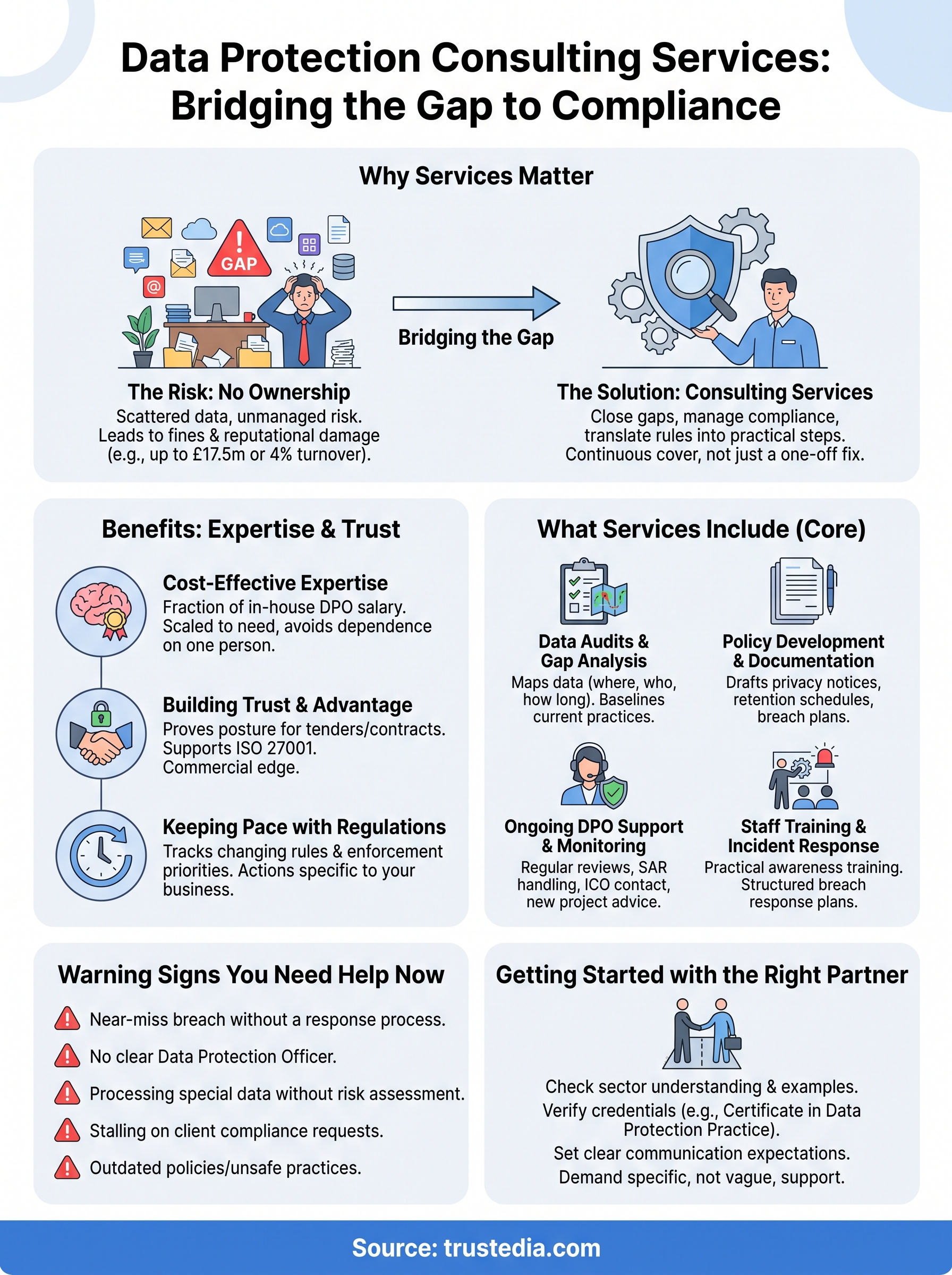
Most businesses don’t get into trouble because they ignored data protection deliberately. They get into trouble because nobody owned the problem. Data sits scattered across email, cloud storage, and third-party apps, and without someone actively managing that risk, gaps appear that no one notices until a breach forces the issue. Data protection consulting services exist to close that gap before it becomes a headline.
The real cost of getting it wrong
Under UK GDPR, the ICO can issue fines of up to £17.5 million or 4% of annual global turnover, whichever is higher, for the most serious infringements (ico.org.uk). Fines are only part of the damage. Customers walk away, insurers raise premiums, and partners start asking questions before renewing contracts. Reputational fallout often outlasts the financial penalty by years.
A breach doesn’t just cost you money, it costs you the trust you spent years building.
Regulations don’t sit still
Rules change, guidance gets updated, and enforcement priorities shift depending on what’s making headlines that quarter. Keeping pace with all of it while running day-to-day operations is unrealistic for most teams. Data protection advisory services give you someone whose entire job is tracking those changes and translating them into actions specific to your business, rather than generic checklists pulled from a government website.
Expertise most businesses can’t justify hiring full-time
Hiring a qualified in-house Data Protection Officer is expensive, and for many SMBs, there simply isn’t enough work to keep one busy full time. Bringing in a data protection consultancy or an outsourced DPO solves that problem without the overhead.
| Approach | Typical cost | Coverage | Best suited for |
|---|---|---|---|
| Full-time in-house DPO | £45,000-£70,000+ salary | Continuous, single organisation | Large enterprises with heavy data processing |
| Outsourced DPO / consultancy | Fraction of salary cost, scaled to need | Continuous, flexible scope | SMBs and mid-sized firms |
| Ad-hoc internal responsibility | Low direct cost, high hidden risk | Inconsistent, reactive | Businesses gambling on not being audited |
Spreading the load across a specialist team also means you’re never dependent on one person’s knowledge or availability when a regulator comes knocking.
Beyond compliance: building trust that wins business
Understanding this matters even more once you factor in procurement. Larger clients and public sector buyers increasingly ask suppliers to prove their data protection posture before signing contracts. Vendor questionnaires, security audits, and ISO 27001 certification requests are now standard in tender processes. Working with a consultancy that also supports certification, like the ISO 27001 professional services offered through TrustedIA, means compliance stops being a defensive exercise and starts becoming a commercial advantage.
How to choose and work with a data protection consultant
Finding the right partner starts with checking whether they actually understand your sector, not just data protection law in general. A consultancy that’s worked with healthcare providers understands special category data risks that a generalist might miss entirely. Ask for examples of similar clients, and don’t accept vague reassurances instead of specifics.
Verify credentials before you sign anything
Qualifications matter, but so does practical delivery. Look for consultants holding recognised certifications such as the Certificate in Data Protection Practice, alongside a demonstrable history of handling real incidents, not just policy writing. A genuine data protection consultancy services provider will happily share case studies or references without you having to press for them.
If a consultant can’t explain how they’d handle your worst-case breach scenario, they’re not ready to be your DPO.
Questions worth asking before you commit
Use a short checklist during initial conversations to separate serious providers from box-tickers:
- Do they offer a named point of contact, or will you be passed between juniors?
- Can they support both one-off audits and ongoing outsourced DPO cover?
- Do they understand your industry’s specific regulatory pressures?
- Will they document decisions in a way that stands up to an ICO investigation?
- Do they have experience supporting ISO 27001 certification alongside GDPR compliance?
Set expectations on communication and reporting
Ongoing value depends on how the relationship actually runs day to day, not just what’s promised in the pitch. Good data protection advisory services include scheduled reviews, clear escalation paths when something goes wrong, and reporting that your board can actually understand without a legal dictionary. Vague promises of "support when needed" tend to translate into silence until something breaks, so push for specifics on response times and communication cadence in writing before you sign a contract.
What data protection consulting services typically include
Scope varies between providers, but most data protection consulting services cover a recognisable core: assessing where you stand today, fixing what’s broken, and putting structures in place so problems don’t repeat. Knowing this list before you speak to a consultancy helps you spot providers who cut corners.
Data audits and gap analysis
Every engagement should start here. A proper data protection audit maps what personal data you hold, where it lives, who can access it, and how long you keep it. Without this baseline, any advice that follows is guesswork. Good data protection advisory services document this mapping clearly enough that you could hand it straight to an ICO investigator if you ever had to.
You can’t protect data you haven’t mapped.
Policy development and documentation
Consultants typically draft or rewrite your privacy notices, data retention schedules, subject access request procedures, and breach response plans. These aren’t generic templates, they should reflect how your organisation actually processes data.
Ongoing DPO support and monitoring
Many businesses opt for continuous cover rather than a single project. This usually includes:
- Monthly or quarterly compliance reviews
- Handling subject access requests as they arrive
- Acting as the registered contact point for the ICO
- Advising on new projects before data protection issues get baked in
- Reporting compliance status to your board or leadership team
Staff training and awareness
Policies mean nothing if staff don’t follow them. Reputable data protection consultancy services include practical staff security awareness training sessions, not just a slide deck emailed once a year, covering phishing awareness, handling personal data securely, and recognising a breach when it happens.
Incident response and breach management
Finally, most consultancies build a breach response plan into their offering, so if the worst happens, you’re not scrambling to work out reporting deadlines while the clock to the ICO’s 72-hour window is already running.
Signs your organisation needs advisory support now
Some businesses know exactly when they need help, usually because something has already gone wrong. Others drift along assuming their current setup is fine until a client’s procurement team asks a question nobody can answer. Recognising the warning signs early means you’re calling a data protection consultancy on your own terms, not scrambling after an incident.
Warning signs you can’t ignore
A handful of situations should prompt an immediate conversation with a specialist rather than a wait-and-see approach:

- You’ve had a near-miss breach, even a minor one, and don’t have a documented breach response process
- Nobody in your organisation can name who your Data Protection Officer actually is
- You’re processing special category data (health records, financial details, biometric data) without a formal risk assessment
- A client or partner has asked for evidence of your compliance posture and you’ve had to stall for time
- Your last policy review predates major changes to how you store or share data
- Staff routinely email personal data without encryption because "it’s always been done that way"
If you can’t answer basic questions about your own data in under a minute, that’s the answer.
When growth outpaces your compliance capacity
Expansion changes your risk profile faster than most teams notice. New markets, new suppliers, new software tools, each one adds a fresh data flow that nobody’s mapped. Data protection advisory services become essential exactly at this point, when the informal arrangements that worked for ten staff start failing at fifty.
If you’ve already had a scare
Finally, if you’ve experienced anything resembling a breach, even one that didn’t escalate, treat it as a warning rather than a lucky escape. TrustedIA’s Cyber Incident Response (CyberSOS) service exists precisely for organisations that need rapid recovery support and a clear-headed assessment of what went wrong before it happens again.
Getting started with the right partner
Data protection isn’t a box you tick once and forget. It’s an ongoing relationship between your business, your data, and the regulations that keep shifting around both. The organisations that handle this well aren’t necessarily the ones with the biggest budgets, they’re the ones who brought in data protection consulting services before a breach forced their hand, not after.
Whatever stage you’re at, whether you’re mapping data for the first time or replacing a DPO who’s left, the goal stays the same: clear ownership, documented decisions, and a partner who explains things in plain English rather than legal jargon. That clarity is what separates businesses that survive an ICO enquiry from those that don’t.
If you’re ready to stop guessing and get a proper handle on your compliance posture, see how TrustedIA’s UK GDPR and DPA 2018 compliance support could work for your organisation.



