
A single misconfigured cloud folder or a phishing email that slips past your filters can put years of customer records, contracts, and intellectual property on the open market within hours. That’s the reality data leakage protection exists to stop. If you’re trying to work out where your sensitive data actually lives, who can touch it, and how it might walk out the door, you’re not alone: most businesses discover gaps only after an incident forces the question.
This article gives you a straightforward answer: what data leak protection actually means, how leaks typically happen (think unencrypted laptops, careless file sharing, insider mistakes, and third-party breaches), and the practical controls that reduce your exposure, from endpoint monitoring to access restrictions and staff training.
We’ll also walk through the technologies and processes that make prevention realistic rather than aspirational, drawing on the same approach we use when assessing cyber posture for clients through our CRAFT framework. By the end, you’ll know exactly where to start tightening your defences.
Why data leakage protection matters for your business
Businesses tend to treat data leakage protection as an IT problem until the day it becomes a board-level crisis. The UK government’s own Cyber Security Breaches Survey shows that a large share of organisations experiencing a breach or attack in the past year point to phishing, unauthorised access, or third-party failures as the root cause (see gov.uk’s Cyber Security Breaches Survey). Once sensitive data leaves your control, whether through a stolen laptop, a careless email attachment, or an exposed database, you can’t simply undo it. That’s why data leak protection needs to sit alongside firewalls and antivirus as a core part of your security stack, not an afterthought bolted on after something goes wrong.
The financial fallout of a data leak
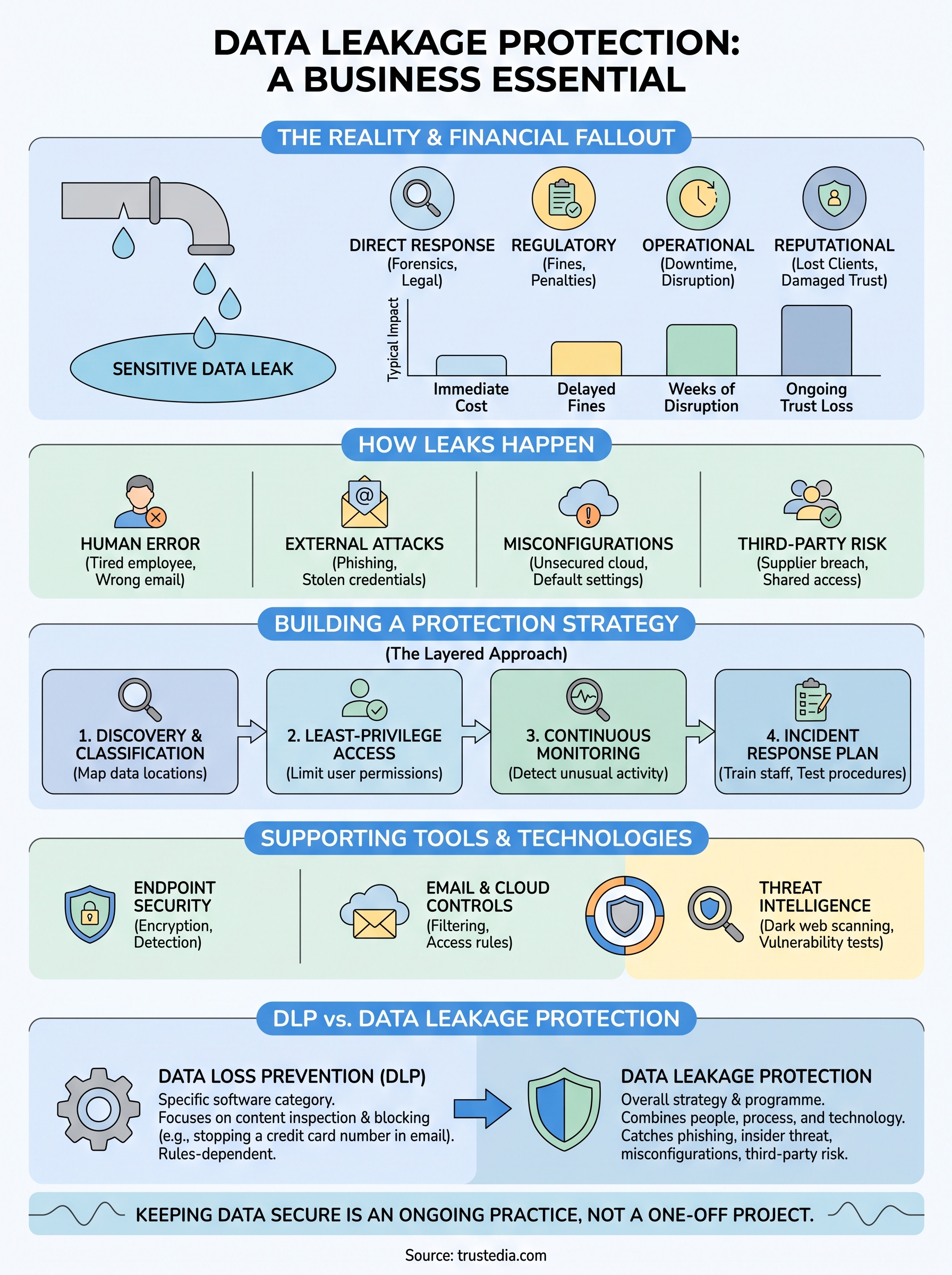
Direct costs stack up fast: forensic investigation, legal advice, customer notification, credit monitoring for affected individuals, and the staff hours spent on containment instead of running the business. Indirect costs often run higher over time, including lost contracts, cancelled tenders, and the sales cycles that stall because a prospect googled your company name and found a breach headline.

| Cost type | Example | Typical impact |
|---|---|---|
| Direct response | Forensics, legal fees, notification letters | Immediate, one-off spend |
| Regulatory | ICO fines, contractual penalties | Can arrive months after the incident |
| Operational | Downtime, lost productivity | Days to weeks of disruption |
| Reputational | Lost clients, damaged trust | Ongoing, hardest to quantify |
A single unprotected data leak can cost far more in lost trust than it ever does in fines.
Regulatory obligations you can’t ignore
Compliance frameworks exist precisely because unmanaged data leakage causes real harm to real people. Under UK GDPR, the Information Commissioner’s Office expects organisations to demonstrate appropriate technical and organisational measures to protect personal data, and failure to do so can trigger enforcement action alongside the reputational damage (see ICO guidance on data security). Frameworks like ISO 27001 go further, requiring documented risk assessments, access controls, and incident response procedures that directly address data leakage scenarios. Getting ISO 27001 certified isn’t just a box-ticking exercise for winning contracts, it forces the kind of disciplined thinking about where sensitive data lives and who can reach it that genuinely reduces leak risk. If you’re working towards certification, our ISO 27001 professional services team can help you build controls that satisfy auditors and actually hold up in practice.
Trust, once lost, is hard to win back
Customers and partners rarely give a second chance after their data turns up somewhere it shouldn’t. Insurers, loss adjusters, and B2B clients increasingly ask for evidence of your security posture before signing contracts, and a visible history of leaks makes that conversation much harder. Prevention isn’t just about avoiding fines, it’s about protecting the relationships that keep revenue flowing. Word travels fast when a leak hits the press or a regulator’s public register, and rebuilding a damaged reputation typically takes far longer than the breach itself.
Why smaller businesses can’t afford to wait
Smaller organisations often assume attackers only target large enterprises, but the opposite is usually true. Attackers favour smaller businesses precisely because they expect weaker defences and less monitoring, making them easier targets with a similar payout in stolen data or ransom. Without a dedicated security team, gaps in access controls, unpatched software, or unencrypted file shares can sit unnoticed for months. Building even basic data leakage protection, starting with visibility over where sensitive data sits and who can access it, closes the easiest entry points attackers rely on and puts you ahead of most competitors who haven’t bothered yet.
How data leaks happen: common causes and threats
Most data leaks don’t start with a sophisticated hacking operation. They start with a tired employee clicking the wrong link, a laptop left on a train, or a cloud storage bucket set to "public" by mistake. Understanding these patterns is the first step in any data leak protection effort, because you can’t defend against a threat you haven’t mapped. The causes fall into a handful of recurring categories, and most businesses are exposed to more than one of these data security threats and examples at once.
Human error and insider mistakes
People remain the weakest link in almost every breach investigation. Employees email spreadsheets to the wrong recipient, save customer files to personal devices, or reuse weak passwords across work and personal accounts. Some insider incidents are malicious, such as a departing employee copying client lists before their notice period ends, but the vast majority are simple carelessness rather than intent. Either way, the outcome is the same: sensitive data ends up somewhere it shouldn’t.
Most data leaks start with a mistake, not a hack.
External attacks and phishing
Attackers rarely need to break down the front door when they can trick someone into opening it. Phishing emails remain the most common entry point into corporate networks, often used to harvest credentials that give attackers legitimate-looking access to email accounts, file shares, or cloud platforms. Once inside, attackers move quietly, searching for financial records, credentials, or intellectual property before exfiltrating it, sometimes weeks after the initial compromise. Ransomware groups increasingly combine encryption with data theft, threatening to publish stolen files if a ransom isn’t paid, which turns a single attack into both an operational and a data leakage crisis.
Misconfigured systems and unsecured devices
Technical oversights cause leaks just as often as deliberate attacks. A cloud storage bucket left open to the internet, a database with default credentials, or an unencrypted laptop stolen from a car all expose data without any attacker needing to breach a firewall, and cloud data security challenges like these are among the easiest to overlook. These gaps often go unnoticed for months because nobody is actively monitoring configuration changes or device compliance.
| Common cause | How it typically leads to a leak |
|---|---|
| Phishing emails | Stolen credentials give attackers access to email or cloud accounts |
| Misconfigured cloud storage | Sensitive files become publicly accessible without any breach |
| Lost or stolen devices | Unencrypted laptops or phones expose stored data directly |
| Insider mistakes | Files sent to the wrong recipient or shared too broadly |
| Third-party breaches | A supplier’s weak security exposes data you shared with them |
Third-party and supply chain risk
Your own defences can be solid and you can still suffer a leak because a supplier, contractor, or software vendor wasn’t as careful. Shared access to systems, outsourced payroll processing, or integrated software platforms all create pathways for data to leave your control through someone else’s mistake. Vetting third-party security practices before sharing data, and limiting what each supplier can actually access, closes off a threat vector that’s easy to overlook until it’s the reason behind an incident.
How to build a data leakage protection strategy
Building a proper data leakage protection strategy isn’t about buying a single tool and calling it done. It’s a layered approach that starts with knowing what you’re protecting and ends with a plan for when something slips through anyway. Businesses that treat this as an ongoing programme rather than a one-off project tend to catch problems while they’re still small, before a misconfigured folder turns into a headline.
Start with data discovery and classification
You can’t protect what you can’t find. The first step is mapping where sensitive data actually lives, across servers, cloud storage, email archives, and the laptops your staff carry home. Once you know where it sits, classification lets you apply different rules to different data types, so a customer database gets tighter controls than a marketing brochure, which is where a proper data governance roadmap pays off.
You can’t protect data you don’t know exists.
Restrict access on a least-privilege basis
Once data is classified, the next question is who actually needs to touch it. Least-privilege access, a core principle of the zero trust security model, means giving employees the minimum permissions required for their role, nothing more, and reviewing those permissions regularly as people change jobs or leave the business. This single control closes off a huge chunk of insider risk and limits the damage if an account is compromised, since an attacker with stolen credentials can only reach what that account was allowed to see in the first place.
Put monitoring and detection in place
Prevention alone isn’t enough because determined attackers and careless employees will occasionally get past your defences. Continuous monitoring of network traffic, file access, and unusual login patterns gives you a chance to spot a leak in progress rather than discovering it months later from a customer complaint or a regulator’s letter. Pairing this with regular vulnerability assessments and penetration testing, delivered through a managed Security Operations Centre service, turns detection from a hopeful afterthought into an active defence.
Train staff and test their responses
Technology only gets you so far when most leaks start with a person clicking a link or misdirecting an email, which is why security awareness training for staff earns its place in the plan. Regular phishing simulation exercises and short, practical training sessions build the instinct to pause before sharing sensitive files, and they give you real data on who needs extra support rather than a guess based on job title.
Plan for the leak you can’t prevent
A strategy without a response plan is only half finished. Build a documented incident response process that covers who gets notified, how systems get isolated, and what evidence gets preserved for investigation:
- Identify and classify sensitive data across all systems
- Apply least-privilege access controls and review them quarterly
- Deploy continuous monitoring and endpoint detection
- Run phishing simulations and staff training on a recurring schedule
- Document and rehearse an incident response plan, including third-party notification steps
Getting this right before an incident happens is far cheaper than scrambling afterwards, which is exactly why services like our CyberSOS 24/7 incident response exist for businesses that need rapid, structured recovery when prevention wasn’t enough.
Tools and technologies that support data leak protection
No single product stops every leak, which is why a proper stack layers several technologies together, each covering a gap the others miss. Data leak protection works best when discovery, detection, and response tools talk to each other rather than sitting as isolated purchases nobody reviews after installation. Below are the categories that matter most, along with what each one actually catches.
Endpoint detection and encryption
Every laptop, phone, and USB drive is a potential exit point for sensitive data, so endpoint detection software that flags unusual file transfers, unauthorised software, or suspicious process behaviour earns its place first. Full-disk encryption on every device means a stolen laptop exposes nothing readable, turning what would be a reportable breach into a non-event. Our own managed endpoint detection and response service combines both, watching for compromise in real time rather than relying on signature-based antivirus alone.
A stolen laptop only becomes a data breach if the disk wasn’t encrypted.
Email, cloud, and network controls
Gateway filtering catches phishing attempts before they reach an inbox, while cloud access security tools flag storage buckets or shared folders left open to the public. Network monitoring adds visibility over large or unusual data transfers, the kind that often signal exfiltration in progress rather than routine business activity. Together these controls close the three channels attackers and careless staff use most often to move data out.
Dark web surveillance and threat intelligence
Sometimes the first sign of a leak isn’t inside your network at all, it’s stolen credentials or customer records showing up for sale elsewhere. Dark web threat intelligence scans criminal marketplaces and forums for your domain, email addresses, or leaked credentials, giving you a chance to force password resets and investigate before the data gets used against you. Pairing this with internal and external vulnerability scanning and penetration testing means you’re finding your own weak points before someone else does.
| Technology | What it catches | Best paired with |
|---|---|---|
| Endpoint detection & encryption | Stolen or compromised devices | Least-privilege access controls |
| Email and cloud security filters | Phishing, misconfigured storage | Staff training and phishing simulations |
| Network monitoring | Unusual data transfers, exfiltration | A Security Operations Centre |
| Dark web surveillance | Leaked credentials, stolen records | Incident response planning |
Solution-agnostic advice matters here because vendors will always push their own platform as the answer, when the right combination genuinely depends on your data, your industry, and your existing infrastructure. Tools bought without that context tend to duplicate coverage in one area while leaving another completely exposed. Choosing technology based on a proper assessment of your actual risk, rather than a sales pitch, is what separates a stack that works from one that just looks impressive on paper.
Data leakage protection vs data loss prevention
Confusion between these two terms is common, and it’s worth clearing up before you start budgeting for either. Data leakage protection is the broader goal: stopping sensitive information from ending up somewhere it shouldn’t, whether that’s an attacker’s server, a public cloud bucket, or an employee’s personal email. Data loss prevention (DLP) is the name of a specific technology category built to support that goal, typically software that scans outgoing emails, file transfers, and endpoints for content matching predefined rules, then blocks or flags anything that looks like it’s leaving in a way it shouldn’t. In practice, DLP is one tool inside a wider data leak protection strategy, not a replacement for it.
What DLP tools actually do
DLP software works by inspecting content against policies you define, such as blocking any email containing a credit card number pattern, or preventing a USB drive from copying files tagged as confidential. Deployment usually happens at three points: the network, where traffic is inspected as it moves; the endpoint, where the software watches what a device tries to send or copy; and cloud applications, where it monitors uploads and sharing permissions. That granularity makes DLP genuinely useful for catching accidental leaks, the misdirected email or the well-meaning employee trying to work from a personal laptop, but it depends entirely on rules being configured correctly and kept current as your data and workflows change.
DLP software enforces rules; data leakage protection is the whole discipline of keeping data safe.
Where the two overlap and where they diverge
Overlap exists because both aim at the same outcome: sensitive data staying inside your control. Divergence shows up in scope. DLP software won’t stop a phishing attack from harvesting credentials, won’t encrypt a stolen laptop, and won’t tell you if your employees’ passwords are already for sale on a criminal forum. Those gaps get covered by the wider data leakage protection approach, layering DLP alongside endpoint encryption, access controls, dark web surveillance, and staff training.
| Aspect | Data loss prevention (DLP) | Data leakage protection |
|---|---|---|
| Scope | Specific software category | Overall strategy and programme |
| Focus | Content inspection and blocking | People, process, and technology combined |
| Catches | Policy-violating transfers, accidental sharing | Phishing, insider threat, misconfiguration, third-party risk |
| Deployment | Network, endpoint, cloud apps | Across the entire security stack |
| Limitation | Rules-dependent, needs regular tuning | Requires ongoing coordination across teams |
Why the distinction matters for budgeting
Businesses often buy a DLP product expecting it to solve leak risk entirely, then discover it never touches half the incidents that actually happen, like a supplier’s breach or a stolen unencrypted phone. Treating DLP as one line item within a broader data leak protection plan, rather than the whole plan itself, keeps expectations realistic and spending focused on the gaps that genuinely need closing.
Keeping your data secure for the long term
Data leakage protection isn’t a project you finish and file away. It’s a discipline you maintain as your systems, staff, and suppliers change. Data leak protection works when discovery, access controls, monitoring, and staff training operate together, not when they sit as separate purchases nobody revisits. The businesses that avoid becoming a headline are the ones that treat this as ongoing practice, reviewing access permissions, testing incident response plans, and checking that DLP rules still match how the business actually works today.
Start small if you have to, but start with visibility over where your sensitive data actually lives. From there, build outwards: access controls, monitoring, training, and a tested response plan. If you’d rather have that groundwork assessed properly rather than guessed at, book a cybersecurity posture assessment with TrustedIA and we’ll show you exactly where your gaps sit.



