
If a customer files a complaint about how you handle their data, or you suffer a breach that needs reporting within 72 hours, you need to know exactly who you’re dealing with. That’s where data protection authorities come in, and confusion about which one applies to your business or your complaint causes real delays at the worst possible moment.
A data protection authority (DPA) is the independent public body responsible for enforcing GDPR and national data protection law in a given country. In the UK, that’s the Information Commissioner’s Office (ICO), but every EU member state has its own equivalent, and knowing which authority holds jurisdiction over your organisation, or the one you need to complain to, matters more than most businesses realise.
This article explains what DPAs actually do, from investigating breaches to issuing fines and guidance, and walks you through how to identify the right authority for your country or cross-border situation. If you’re running a business that handles personal data and want to stay on the right side of GDPR compliance principles and requirements, this is the grounding you need before things go wrong.
Why data protection authorities matter for your business
The powers a DPA actually holds over you
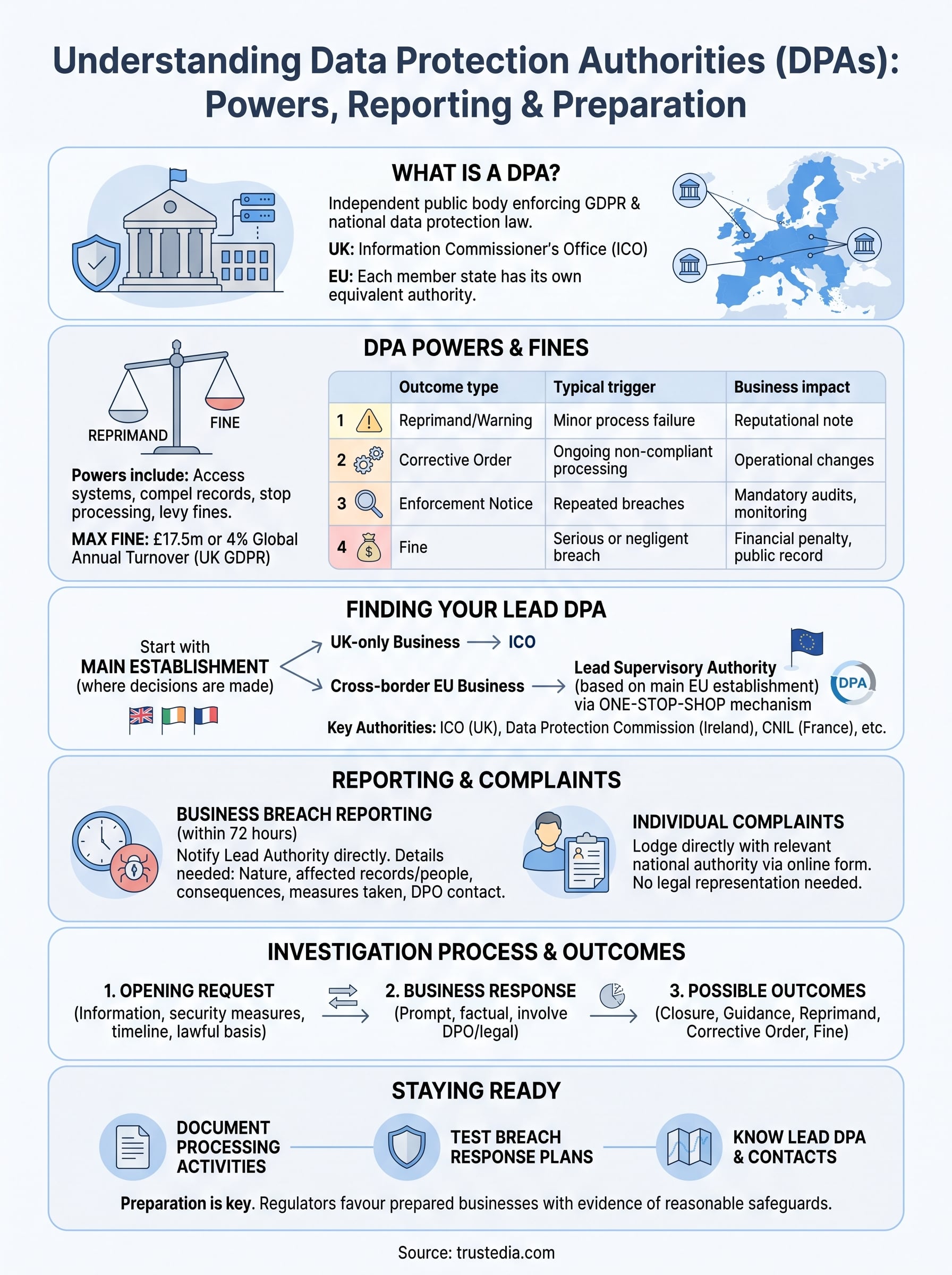
Every data protection authority carries statutory teeth under the Data Protection Act and what it means for businesses, not just advisory influence. The ICO, like its EU counterparts, can demand access to your systems, compel you to hand over records, issue formal reprimands, order you to stop processing data altogether, and levy fines that reach into the millions. Under UK GDPR, the maximum penalty sits at £17.5 million or 4% of global annual turnover, whichever is higher, and the EU version mirrors that figure in euros. Few businesses ever hit that ceiling, but the authority’s willingness to investigate at all can freeze operations while you scramble to respond.
A data protection authority doesn’t just fine businesses after the fact, it can order you to stop processing data while the investigation runs.
Fines that make headlines and the smaller ones that don’t
Big penalties against household names dominate the news, but most enforcement action never reaches that scale. Smaller businesses face reprimands, corrective orders, and mandatory audits far more often than eye-watering fines, and those outcomes still cost time, legal fees, and client trust. The table below shows the range you’re realistically looking at:
| Outcome type | Typical trigger | Business impact |
|---|---|---|
| Reprimand or warning | Minor process failure, late breach report | Reputational note, no direct cost |
| Corrective order | Ongoing non-compliant processing | Operational changes, legal review |
| Enforcement notice | Repeated or unresolved breaches | Mandatory audits, monitoring |
| Fine | Serious or negligent breach | Financial penalty, public record |
Understanding where your business sits on that scale before an incident happens gives you a far better chance of staying in the first two rows rather than the last.
Why this matters beyond the fine itself
Regulatory attention rarely stays contained to a single penalty. Once a data protection authority opens a file on your organisation, that record can influence future insurance premiums, client due diligence checks, and even public procurement bids that require evidence of a clean compliance history. Losing a contract because a prospective client’s legal team found an ICO enforcement notice against your company is a real, if less visible, cost that doesn’t show up in the headline fine figure.
Handling a DPA investigation well, or better still, avoiding one through solid preparation, depends on having documented processes, tested breach response plans, and evidence that you took reasonable steps to protect the data in question. That’s precisely the gap our CyberSOS incident response service is built to close, giving you a structured recovery and reporting process the moment an incident hits, rather than improvising while a regulator’s clock is already running. Businesses that treat DPA readiness as an ongoing discipline, not a reaction, consistently come out of investigations faster and with less damage to show for it.
How to find the data protection authority for your country
Start with where your business is established
Your starting point is always the country where your organisation has its main establishment, meaning the place where decisions about data processing are actually made, not just where you happen to have a server. If you’re a UK-only business, that’s the ICO, and it’s worth understanding what the Information Commissioner does day to day. If you operate across the EU, GDPR’s one-stop-shop mechanism designates a single lead supervisory authority based on your main EU establishment, so you’re not fielding separate investigations from every country your customers happen to live in, though the differences between UK GDPR and EU GDPR after Brexit still shape which rules you follow.
Find your lead supervisory authority before an incident happens, not while you’re drafting a breach notification at 2am.
When more than one authority can get involved
Cross-border processing complicates things fast. If complaints come from residents in several member states, or your processing significantly affects people outside your lead authority’s country, other national DPAs can act as concerned authorities and weigh in on the investigation. This is common for businesses with subsidiaries, call centres, or cloud infrastructure spread across multiple EU countries, so don’t assume one DPA covers you just because your headquarters sits in a single jurisdiction.
Where to look it up
Every national authority publishes clear contact and jurisdiction details, and the European Data Protection Board maintains a full directory. Useful starting points include:
- UK: Information Commissioner’s Office
- Ireland: Data Protection Commission (lead authority for many US tech firms with EU headquarters in Dublin)
- Germany: split across federal and state-level authorities depending on the sector
- France: Commission Nationale de l’Informatique et des Libertés (CNIL)
- EU-wide directory: European Data Protection Board members list
Checking this before you need it saves precious hours when a breach clock is already running.
How to contact your DPA or file a complaint
Reporting a breach to your data protection authority works differently depending on whether you’re the business notifying a regulator or a customer lodging a complaint against one. Most DPAs, including the ICO, run dedicated online portals for both purposes, and knowing the ICO’s breach reporting steps and thresholds from the start avoids your report sitting in a general enquiries queue while the 72-hour breach notification clock keeps running.
Reporting a breach as a business
When you discover a breach that risks people’s rights and freedoms, you notify your lead authority directly, not wait for a customer to complain first. The ICO’s online reporting tool asks for specifics: what happened, how many records are affected, what containment steps you’ve already taken, and who your data protection officer is. Have this ready before you start:
- Nature of the breach and the data categories involved
- Approximate number of people and records affected
- Likely consequences for those individuals
- Measures already taken or proposed to address the breach
- Contact details for follow-up
The businesses that report breaches fastest are the ones that already have a template filled out before the incident happens.
Keeping a pre-drafted notification template on hand, reviewed and updated as part of your breach response plan template, turns a panicked scramble into a fifteen-minute task.
Filing a complaint as an individual
Someone who believes their data has been mishandled complains directly to the relevant national authority, usually via a simple web form asking for the organisation’s name, what happened, and any evidence such as emails or screenshots. Ireland’s Data Protection Commission, the ICO, and CNIL all publish these forms in plain language, and none require legal representation to submit.
What to expect after you submit
Acknowledgement typically arrives within a few weeks, though investigation timelines vary widely depending on complexity and the authority’s current caseload. Businesses on the receiving end of a complaint should expect a formal request for information as the next step, which is exactly where the investigation process, covered next, begins in earnest.
What happens when a DPA investigates your business
Getting a letter or email from a data protection authority rarely means the worst has already happened. Most investigations start as a fact-finding exercise, not a punishment, and how you respond in the first few weeks shapes everything that follows.
The opening request
Investigations usually begin with a formal request for information: what data you hold, how it’s processed, what security measures were in place, and why the incident (or complaint) occurred. The ICO and its EU counterparts typically set a deadline of two to four weeks for a first response, and missing that deadline without explanation counts against you. Expect questions covering:
- Your lawful basis for the processing in question
- Technical and organisational security measures at the time
- Timeline of events, including when you first became aware
- Communications with affected individuals
- Evidence of staff training and internal policies
Regulators judge you as much on how you respond during an investigation as on what caused it in the first place.
Cooperation without overexposure
Answering promptly and factually matters more than answering perfectly. Authorities look unfavourably on evasive or incomplete responses, but that doesn’t mean volunteering information beyond what’s asked. Involve your data protection officer or legal counsel early, keep a single point of contact for all correspondence, and document every exchange so nothing gets lost between departments during a stressful few weeks.
Possible outcomes
Once the DPA has enough information, it closes the file, issues guidance, or escalates to formal enforcement. Outcomes range from a quiet no-further-action letter to a public reprimand, corrective order, or fine, depending on severity and your evidence of reasonable safeguards. Businesses that can show a tested incident response plan, prompt breach reporting, and documented remediation consistently land toward the lighter end of that scale. That’s the practical value of preparation: it doesn’t stop a DPA from asking questions, but it gives you a strong, evidence-backed answer the moment they do.
Staying ready for regulatory scrutiny
Knowing which data protection authority covers your business, and having a clear plan for what happens when they come knocking, separates businesses that recover quickly from those that spend months untangling a preventable mess. The ICO or your relevant national authority won’t wait for you to get organised once an investigation starts, so the groundwork has to happen now, while things are calm.
Build the habit of documenting your processing activities, testing your breach response, and knowing your lead data protection authority before you ever need to contact them. Regulators consistently treat prepared businesses more favourably than those scrambling to explain gaps after the fact.
If you want that preparation handled properly rather than pieced together under pressure, TrustedIA’s UK GDPR and DPA 2018 compliance service builds the data mapping, breach readiness, and audit processes that keep you ready long before a DPA ever asks a question.



