
If you’ve ever handed over your NHS number, medical history, or home address to a GP receptionist, you’ve trusted the NHS with some of the most sensitive data that exists about you. The data protection act nhs relationship isn’t just a legal formality tucked away in a privacy notice. It’s the rulebook that decides who can see your records, how long they’re kept, and what happens if something goes wrong.
Most patients want a straight answer to a simple question: what actually happens to my medical data once it leaves the consultation room? The Data Protection Act 2018 and the duties it creates, working alongside UK GDPR, sets out exactly that. It gives NHS trusts, GP surgeries, and third-party contractors clear duties around lawful data handling, patient consent, and breach reporting, and it gives you enforceable rights over your own records.
This article breaks down what the legislation actually covers, how NHS organisations are expected to apply it in practice, and where patient rights commonly get misunderstood. We’ll also look at what happens when things go wrong, because from a cyber security standpoint, healthcare data breaches carry consequences that go well beyond a fine.
Why the Data Protection Act matters to NHS patients
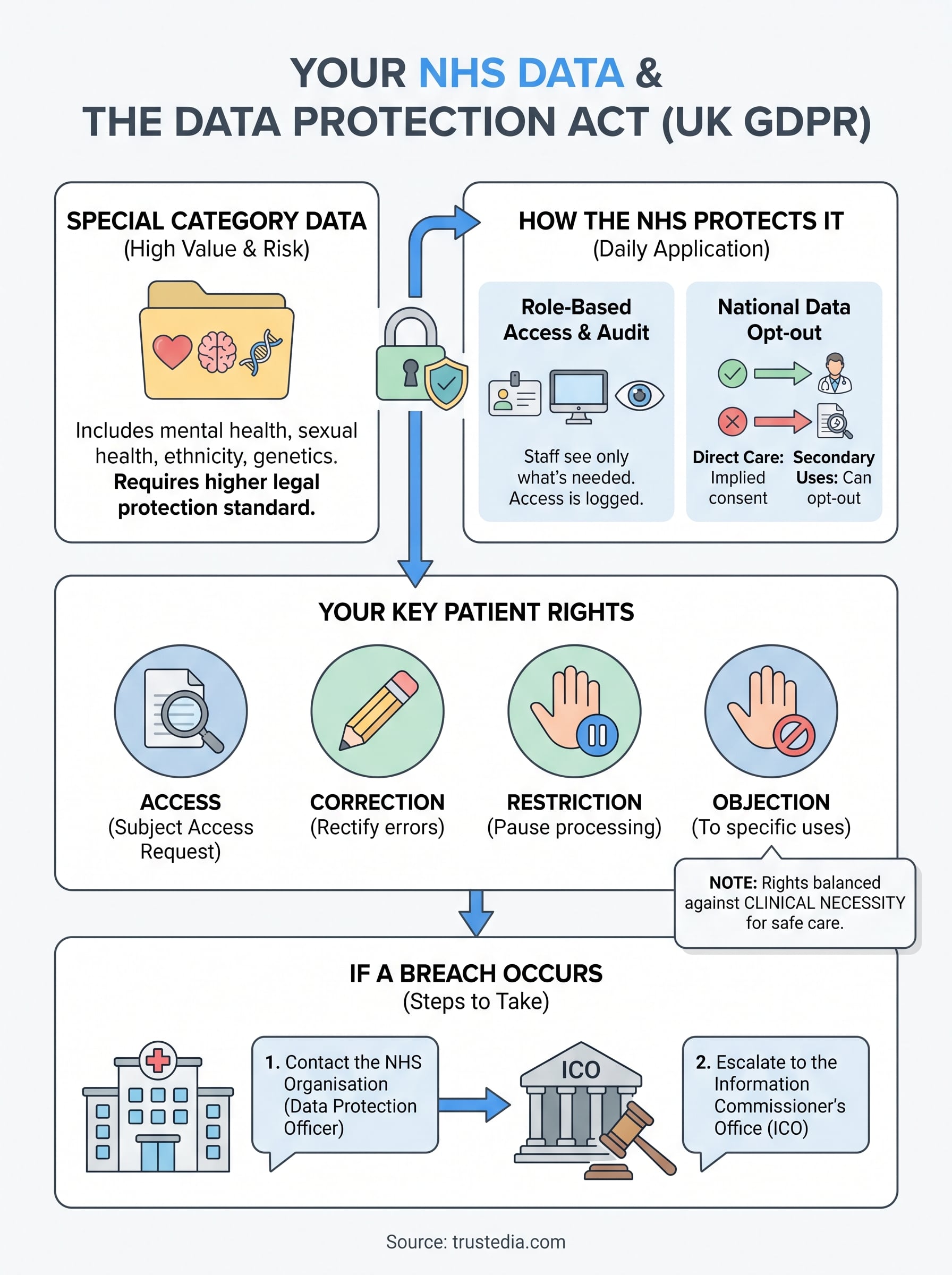
Your medical record is not ordinary paperwork. It contains details about your mental health, sexual health, ethnicity, and any conditions you’ve ever been treated for, information that could be used against you if it fell into the wrong hands. Under UK GDPR, this is classed as special category data, which means the NHS must meet a higher legal bar before collecting, storing, or sharing it. That’s why nhs data protection rules go further than the general data handling standards applied to, say, a retailer holding your delivery address.
Medical records carry extra legal weight
Special category data needs both a lawful basis under Article 6 of UK GDPR and a specific condition under Article 9 before it can be processed at all. For most NHS care, that condition is usually tied to providing health or social care, or public health duties, rather than your explicit consent for every single use. This distinction confuses a lot of patients who assume nothing happens to their data without them signing something first. In practice, treatment-related sharing between your GP, hospital consultant, and pharmacist doesn’t require fresh consent each time, because it falls under direct care.
What counts as special category data in an NHS context
- Physical and mental health diagnoses, including historic conditions
- Genetic and biometric data used for identification
- Sexual orientation and sexual health records
- Ethnicity, religion, and information linked to safeguarding concerns
- Details shared during mental health assessments or counselling sessions

Why breaches hit harder in healthcare than almost anywhere else
A leaked email address is annoying. A leaked HIV status, fertility treatment record, or mental health history can affect someone’s relationships, employment, or safety. That’s the practical reason regulators treat healthcare data breaches as a distinct, higher-risk category, and it’s why NHS organisations face particular scrutiny from the Information Commissioner’s Office (ICO) when things go wrong. You can see the ICO’s GDPR guidance and the practical steps behind it on its website, which sets out exactly how tightly this category of information is meant to be controlled.
When medical data leaks, patients can’t just change their password and move on, the damage is personal and often permanent.
The trust equation behind every NHS interaction
Every time you disclose something to a clinician, you’re relying on a legal and operational structure holding firm behind the scenes. GPs, hospital trusts, NHS 111, and even third-party IT contractors processing appointment bookings are all bound by the same underlying duty of confidentiality and lawful processing. Businesses working alongside the NHS, including IT suppliers and managed service providers, are contractually and legally obligated to meet the same standard, which is one reason organisations handling any part of the health data chain need fast, practical ways to protect business data, not just a privacy policy. Failing to secure that chain is how a single vulnerable supplier ends up causing a trust-wide data incident.
How the NHS applies the Data Protection Act to your data
NHS organisations translate the Data Protection Act into day-to-day rules that decide exactly who can open your file and why. Every trust runs on role-based access control, meaning a receptionist, a nurse, and a consultant each see a different slice of your record depending on what their job actually requires. This isn’t optional good practice, it’s a direct requirement of the data protection act nhs framework, and it’s checked annually through the Data Security and Protection Toolkit (DSPT), a self-assessment every NHS organisation and supplier must complete against national standards.
Consent, direct care, and the National Data Opt-out
Sharing your data for direct care, between your GP and a hospital consultant treating the same condition, doesn’t need fresh consent each time, as covered earlier. Secondary uses are different. Research, planning, and commissioning purposes generally require either explicit consent or reliance on the National Data Opt-out, a national scheme letting patients block their confidential data from being used beyond their own care. You can set or check this preference directly through NHS England’s own opt-out service, which applies across GP practices, hospitals, and most NHS-commissioned services.
If a data use goes beyond treating you personally, you almost always have the right to say no.
The technical safeguards behind every record
Behind the policy layer sits the technical one: encrypted storage, audit logging of every record access, staff training refreshed annually, and incident response plans tested rather than just filed away. These controls matter because a policy document doesn’t stop a phishing email or a misconfigured server. This is exactly where managed detection and response, vulnerability assessments, and a properly resourced SOC as a service earn their keep, whether run in-house or through a specialist partner.

| Safeguard | Purpose |
|---|---|
| Role-based access | Limits staff to data relevant to their role |
| DSPT assessment | Annual compliance check against national standards |
| Audit logging | Tracks every access to a patient record |
| National Data Opt-out | Lets patients block secondary data use |
| Incident response plan | Contains and reports breaches quickly |
Organisations supporting the NHS supply chain that want their own compliance posture reviewed can look at what managed security actually covers as a starting point.
Your rights under the Data Protection Act in the NHS
As a patient, you hold a specific set of legal rights over your own medical record, and the NHS has to honour them regardless of how the data was collected or where it’s stored. These rights sit at the heart of the data protection act nhs framework, and knowing them turns you from a passive data subject into someone who can actually question what’s happening to their information.
The right to see what’s held about you
Under a subject access request, you can ask any NHS organisation for a copy of everything they hold on you, including GP notes, hospital letters, and test results. Trusts must respond within one calendar month, free of charge in most cases, and the request doesn’t need to be formal or in writing to a specific department. Delays happen, particularly with older paper records, but the legal deadline still applies.
The right to correction, restriction, and objection
Beyond simply viewing your file, you can challenge what’s in it:
- Rectification: ask for factual errors, such as a wrong diagnosis code or outdated address, to be corrected
- Erasure: request deletion in limited circumstances, though this rarely applies to core clinical records needed for ongoing care
- Restriction: ask the NHS to pause processing while a dispute over accuracy is resolved
- Objection: refuse specific secondary uses of your data, such as research, through the National Data Opt-out mentioned earlier
Your medical record isn’t fixed the moment it’s written, you have a legal say in keeping it accurate.
Why these rights rarely override direct care
Erasure requests, in particular, get refused more often than patients expect, because clinicians need a complete history to treat you safely. A missing allergy note or an incomplete medication list can be genuinely dangerous, so patient rights around deletion are balanced against clinical necessity rather than treated as absolute. This isn’t the NHS being obstructive, it’s the same logic that keeps your record useful in an emergency, and it’s worth understanding before you submit a request expecting automatic removal.
What to do if you think your data rights have been breached
Finding out your medical data has been mishandled, whether through a lost letter, an unauthorised staff access, or a full-scale ransomware attack on a trust’s systems, leaves most patients unsure where to even start. Fortunately, the data protection act nhs framework builds in a clear complaints route, and you don’t need a solicitor to use it.
Start with the organisation itself
Raise the issue directly with the NHS organisation involved first, whether that’s your GP practice, a hospital trust, or a third-party contractor handling appointment data. Every NHS body has a designated Data Protection Officer, and what they do includes investigating exactly this kind of complaint, and they’re legally required to respond. Keep a simple record as you go:
- Date and details of the suspected breach
- Who you spoke to and when
- Any written responses you received
- Copies of correspondence, not just summaries
Escalate to the Information Commissioner’s Office
Unsatisfied with the response, or getting no response at all within a reasonable timeframe, you can escalate directly to the Information Commissioner’s Office and the powers it holds. The ICO investigates complaints against NHS bodies and can issue enforcement action, including fines, where organisations fail to meet their legal duties under UK GDPR. You’ll find the complaint form and guidance on the ICO’s own website, and there’s no cost to submit one.
A breach isn’t the end of the story, it’s the point where you have the legal standing to demand answers.
For NHS suppliers and contractors facing a breach
Very differently placed are the organisations sitting inside the NHS supply chain rather than the patients affected by it. If your business processes NHS data and suspects a breach, incident response speed determines whether the situation stays contained or spirals into a reportable, trust-wide event. TrustedIA’s CyberSOS incident response service exists for exactly this scenario, helping organisations investigate, contain, and report breaches within the tight ICO breach reporting timelines UK GDPR demands, rather than scrambling to work it out under pressure.
What this means for you and your NHS records
Understanding the data protection act nhs framework doesn’t require a law degree, just a clear grasp of the basics: your records are protected as special category data, access is controlled by role, secondary uses need your consent or opt-out, and you have real rights to see and correct what’s held about you. Knowing this turns you from someone who just hands over information into someone who can question how it’s used and push back when something looks wrong.
Organisations sitting behind the scenes carry the harder job. Keeping patient data secure across GP systems, hospital trusts, and third-party suppliers takes proper technical controls, not just a policy document nobody reads. If your business handles any part of that chain and wants its defences properly tested, a data protection audit from TrustedIA will show you where the gaps sit before a regulator, or a patient, finds them for you.



