
Ask three people what DPA stands for in a data protection conversation and you might get three different answers. That is the problem with DPA data protection as a topic: the acronym covers the UK Data Protection Act 2018, a Data Processing Agreement between two organisations, and sometimes the old Data Protection Directive. Mix these up in a contract or a compliance audit and you risk gaps that regulators or clients will spot fast.
This article sorts out exactly which DPA you are dealing with, what each one requires, and how they sit alongside the UK GDPR. You will see how the Data Protection Act works as the UK’s domestic law, why a Data Processing Agreement matters whenever a third party handles personal data on your behalf, and where GDPR and Data Protection Act obligations overlap or diverge.
We work with businesses every day who confuse these terms during ISO 27001 and cyber assurance projects, so we have set out the practical distinctions here. By the end, you will know which DPA applies to your situation and what compliance steps you need to take next.
We also cover common contract clauses, breach notification duties, and how strong data protection practice feeds directly into broader cyber security resilience.
Why DPA compliance matters for your business
Getting your DPA data protection obligations wrong is not a paperwork slip. It is a business risk with a real price tag, and the regulator that enforces it has significant powers. The Information Commissioner’s Office can fine UK organisations up to £17.5 million or 4% of global annual turnover, whichever is higher, for serious breaches under the UK GDPR. A mishandled personal data incident also damages client trust faster than almost anything else you do as a business, and rebuilding that trust takes years, not months.
A missing Data Processing Agreement isn’t just a compliance gap, it’s a liability you’re carrying without knowing it.
The regulatory and financial stakes
Regulators rarely accept "we didn’t know" as a defence. If your business shares personal data with a supplier, cloud provider, or payroll firm without a proper Data Processing Agreement in place, you are exposed the moment anything goes wrong, and so is that supplier. The table below shows how quickly a missing contract turns into a bigger problem.
| Failure | Typical consequence |
|---|---|
| No DPA with a processor | Joint liability exposure, ICO enforcement action |
| Missing breach notification clause | Delayed reporting, larger fines |
| Poor data retention terms | Unnecessary data held, bigger attack surface |
| No audit rights over the processor | No way to verify their security controls |
Each of these gaps compounds the others. A supplier holding data longer than agreed, with no audit rights and no notification clause, is a breach waiting to be discovered by a regulator rather than reported by you.
Why clients and insurers ask for proof
Procurement teams, insurers, and enterprise clients increasingly ask to see your data protection contracts before they sign anything themselves. Winning new business can hinge on producing a compliant Data Processing Agreement on request, particularly in finance, healthcare, and public sector supply chains where due diligence is standard practice. Insurers writing cyber cover also scrutinise your contractual controls when calculating premiums; weak or absent agreements can mean higher premiums, added exclusions, or a declined claim after an incident, exactly when you need the payout most, so it pays to know what cyber insurers expect before they offer cover.
Where this connects to your wider cyber resilience
Treat DPA compliance as part of operational resilience, not a box-ticking legal exercise sitting apart from your security work. Businesses we support through ISO 27001 implementation find that tightening data processing agreements exposes the same gaps that show up in vulnerability assessments and audits, things like unclear supplier responsibilities or unmonitored third-party access. Sorting the contract side properly makes the technical side easier to defend, and vice versa. Skip this groundwork and you risk building strong technical controls on top of a legal structure that won’t hold up under scrutiny.
How the UK Data Protection Act relates to GDPR
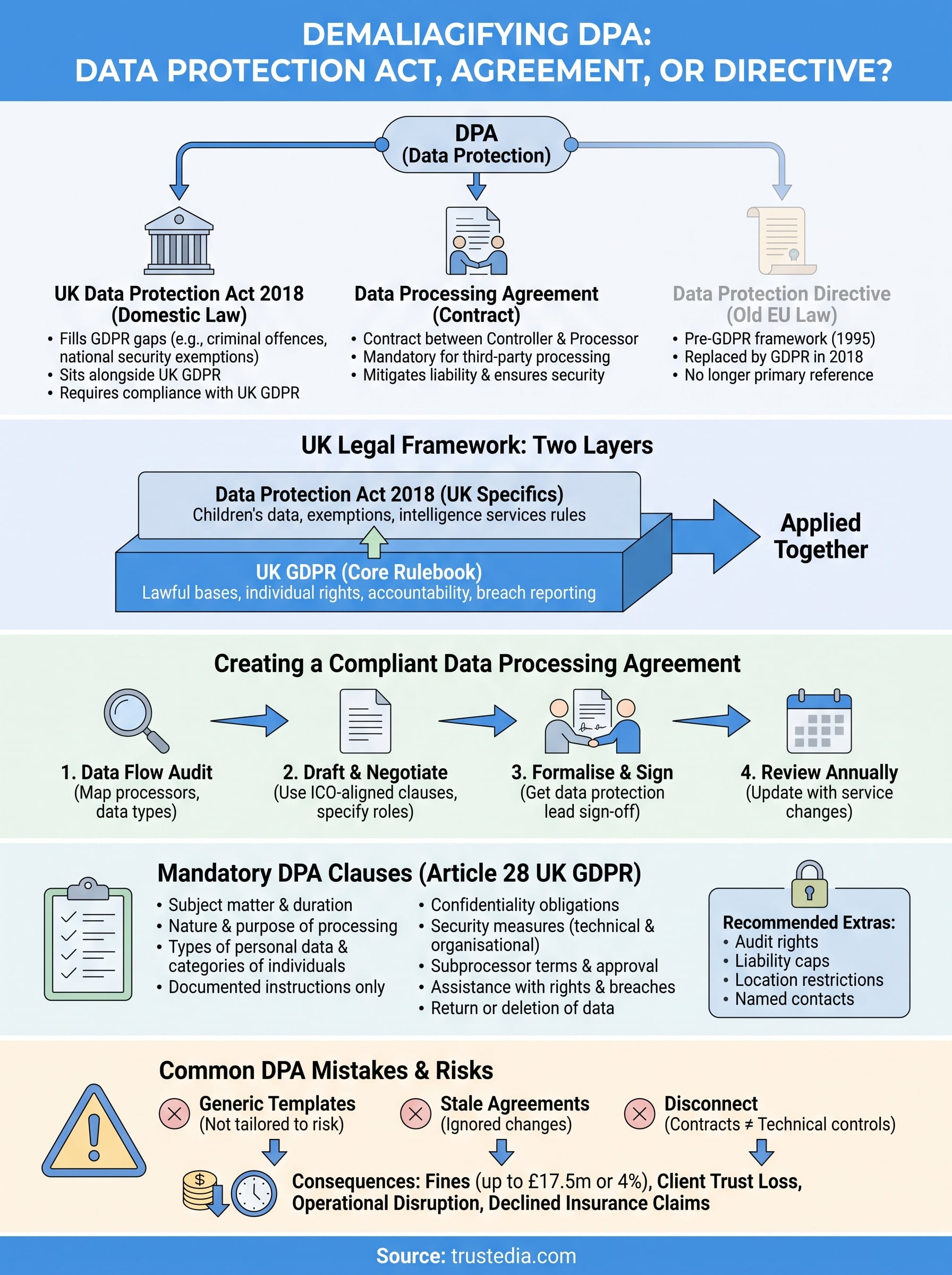
Many business owners treat GDPR and Data Protection Act as interchangeable terms, but they work as two layers of the same law. The EU General Data Protection Regulation set the original framework in 2018, and the Data Protection Act 2018 and why it matters arrived alongside it to fill in the gaps GDPR left for member states to decide themselves, things like criminal offences for data misuse, exemptions for journalism, and rules around law enforcement processing. After Brexit, the EU regulation was copied into domestic law as the UK GDPR, and the Data Protection Act 2018 now sits next to it, amended to keep both documents working together.
The Data Protection Act doesn’t replace GDPR, it fills in the parts GDPR left open for the UK to decide.
What each law actually covers
Think of UK GDPR as the core rulebook: lawful bases for processing, individual rights, breach reporting timelines, and the accountability principle that puts the burden of proof on you, all of which shape the steps GDPR compliance actually involves. The Data Protection Act 2018 then adds UK-specific detail on top:
- Special provisions for children’s data and consent ages
- Exemptions for immigration control, national security, and journalism
- Criminal offences for knowingly obtaining or disclosing personal data unlawfully
- Rules for how law enforcement and intelligence services handle personal data
Read only one of these documents and you get half the picture. Regulators expect you to apply both together, not pick whichever is more convenient.
Why the distinction matters for your compliance work
Since leaving the EU, the UK government has kept its own version of GDPR rather than automatically following EU updates, so the two frameworks can drift apart post-Brexit through separate amendments and case law. Organisations trading with EU customers or processors need to track adequacy decisions and check whether UK GDPR and EU GDPR still align closely enough for cross-border transfers, a point the ICO covers in its international transfer guidance. Practically, this means your contracts, privacy notices, and internal policies should reference the correct law for your jurisdiction rather than treating
How to create a data processing agreement
Building a Data Processing Agreement does not need a law firm on retainer, but it does need a methodical approach. You start by mapping every third party that touches personal data on your behalf, from your payroll provider to the marketing platform sending your newsletters. Skip this mapping step and you will miss a supplier, and that gap becomes the same liability we flagged earlier in this article.

Start with a data flow audit
Before drafting anything, list what data each processor handles, where it is stored, and how long they keep it, the same groundwork that underpins a practical data governance roadmap. Cross-reference this against your existing contracts to see which relationships already have a DPA and which do not. Many businesses discover during ISO 27001 preparation that half their suppliers have never signed one, which is exactly the kind of finding an independent data protection audit is designed to surface.
If you can’t list every processor touching your data right now, you don’t have a DPA problem, you have a visibility problem.
Draft, negotiate, and formalise
Once you know who needs an agreement, work through these steps in order:
- Identify the controller and processor roles for each relationship, since this determines who carries legal responsibility for what.
- Draft the agreement using ICO-aligned clauses, covering purpose, duration, data types, and security obligations.
- Negotiate terms with the processor, particularly around breach notification timelines and audit rights.
- Get sign-off from both parties’ data protection leads, not just procurement or legal teams working in isolation.
- Store the signed agreement somewhere accessible for audits, not buried in an inbox.
- Review it annually, or whenever the processing activity or subprocessor list changes.
Repeat this process for every processor, and resist the temptation to use a single generic template across wildly different suppliers. A cloud hosting provider and a one-person bookkeeping contractor carry very different risk profiles, and your GDPR and Data Protection Act obligations expect proportionate, not identical, controls for each. Treat the agreement as a living document that gets reviewed alongside your wider risk assessments, not something you sign once and forget.
What to include in a data processing agreement
A compliant Data Processing Agreement is not a vague promise to "look after data properly". Article 28 of the UK GDPR sets out specific content the agreement must contain, and missing any of it leaves your contract legally incomplete even if both parties signed it in good faith. Treat this list as the floor, not the ceiling, of what your DPA data protection documentation should cover.

The mandatory clauses
Every agreement needs to spell out the practical detail of the processing relationship, not just general commitments to security.
| Required element | What it must specify |
|---|---|
| Subject matter and duration | What the processing is for and how long it runs |
| Nature and purpose | The specific activities the processor will carry out |
| Types of personal data and categories of individuals | Exactly what data and whose it is |
| Controller’s instructions | Confirmation the processor acts only on documented instruction |
| Confidentiality | Staff obligations to keep data confidential |
| Security measures | Technical and organisational controls in place |
| Subprocessor terms | How subprocessors are appointed and controlled |
| Assistance with data subject rights | How the processor helps you respond to access or erasure requests |
| Breach notification | Timescales and method for informing you of an incident |
| Return or deletion of data | What happens to the data once the contract ends |
Leave out any one of these ten elements and you don’t have a Data Processing Agreement, you have a service contract with a data clause bolted on.
Clauses that go beyond the minimum
Once the mandatory content is in place, stronger agreements add protections that Article 28 does not force you to include but that reduce your exposure considerably. Consider building in:
- Audit rights, letting you inspect or request evidence of the processor’s controls rather than taking their word for it
- Liability caps and indemnities, clarifying who pays if the processor’s failure causes you a fine or loss
- Location restrictions on data storage, particularly relevant if any subprocessor sits outside the UK or EEA
- Named contact points, so breach reporting does not stall while someone hunts for the right email address
Finally, cross-reference these clauses against your own ISO 27001 documentation requirements so the contractual commitments match the controls you have actually implemented, rather than describing an aspiration.
Common DPA mistakes and how to avoid them
Most DPA data protection failures we see are not dramatic. They are small oversights that sit quietly until a breach or an audit forces them into the open. Recognising the pattern early saves you from discovering it during an ICO investigation instead.
Signing without reading the detail
Busy procurement teams often accept a supplier’s standard template without checking it against Article 28 requirements, assuming the vendor has already covered the legal detail. That assumption is where most gaps start. Watch out for these recurring errors:
- Accepting vague security wording like "industry standard measures" instead of specific technical and organisational controls
- Skipping subprocessor visibility, so you have no idea who else touches your data further down the chain
- Ignoring breach notification timescales, leaving you unable to meet your own 72-hour reporting duty to the ICO under the UK GDPR
- Treating the DPA as a one-off task rather than a document tied to an active supplier relationship
A Data Processing Agreement you signed and forgot is barely different from having no agreement at all.
Letting agreements go stale
Organisations change suppliers, add new subprocessors, and expand what data they collect, but the paperwork rarely keeps pace. A DPA drafted three years ago for a basic email marketing tool will not reflect the analytics integration or new storage location added since. Review your agreements whenever a processor’s service scope changes, not just when someone happens to notice the contract during a renewal cycle.
Missing the connection between contracts and controls
Finally, many businesses treat the legal agreement and the technical security review as separate exercises run by different teams. That split creates the exact confusion we described at the start of this article: a contract promising controls that nobody has verified, or a security assessment that never checks whether the underlying agreement is even in place. Bringing these together, ideally through the same audit or ISO 27001 audit process, closes that gap for good and gives you one consistent picture of where your GDPR and Data Protection Act obligations actually stand, rather than two conflicting versions maintained by two teams who rarely talk to each other.
Staying on top of your data protection obligations
Getting DPA data protection right means knowing which DPA you’re dealing with, whether it’s the Data Protection Act 2018, a Data Processing Agreement with a supplier, or both working together. You now know how the UK Data Protection Act sits alongside GDPR, what a compliant agreement needs to contain, and where most businesses trip up when contracts and technical controls drift apart.
Treat this as ongoing work, not a project with an end date. Suppliers change, subprocessors get added, and regulators keep raising expectations, so your agreements and audits need to move with them. Waiting for a breach or a client’s due diligence request to expose the gaps is the expensive way to learn this lesson.
If you’d rather find those gaps before an incident does, talk to TrustedIA about UK GDPR and DPA 2018 compliance support, from data mapping and RoPA to breach readiness, and get a clear picture of where your data protection obligations actually stand.



