A ransomware attack, a flooded server room, a key supplier going bust overnight. None of these wait for a convenient time, and the businesses that recover fastest are the ones where someone actually knew what to do. That’s the gap business continuity planning training closes: it turns a dusty policy document into skills your team can use under pressure.
If you’re searching for this, you’re probably weighing up a business continuity planning course against a formal business continuity planning certification, or trying to work out which one actually builds capability rather than just a certificate on the wall. The honest answer is that it depends on your role, your industry’s compliance demands, and whether you need to design a plan from scratch or simply execute one when things go wrong.
In this article, we’ll break down what business continuity planning training actually covers, how it differs from generic disaster recovery courses, what qualifications carry real weight with auditors and insurers, and why organisations without this training in-house often lean on external specialists to fill the gap. We’ll also point you towards business continuity planning training courses worth considering.
Why business continuity planning training matters

Most businesses have been through the motions of creating a business continuity plan, and it’s sitting in a folder somewhere. Far fewer have staff who could execute it at 2am when a data centre goes dark. That gap between having a document and having trained people is exactly why business continuity planning training exists, and why it matters more than the plan itself. A plan tells you what should happen. Training builds the muscle memory to make it happen when nobody has time to read a manual.

The real cost of an untrained response
Consider what actually happens during a serious incident. Systems are down, customers are calling, and the person who wrote the continuity plan three years ago has since left the company. Without training, the response is improvised, slow, and often makes things worse: staff duplicate effort, skip critical steps like preserving evidence for insurers, or simply freeze because nobody assigned them a clear role. Every hour of confused response adds directly to downtime costs, and downtime is rarely cheap. Industry estimates from bodies like the UK’s National Cyber Security Centre consistently show that organisations with rehearsed response plans recover in a fraction of the time of those improvising on the day.
An untested continuity plan is just a hope, not a strategy.
Training changes the equation because it forces people to walk through the plan before a real crisis forces them to. Tabletop exercises, simulated outages, and structured drills are how to test a business continuity plan properly, exposing the gaps that look fine on paper but fall apart in practice, like an escalation contact who’s on holiday, or a backup system nobody has actually tested restoring from.
Building capability, not just paperwork
Secondly, training builds capability that survives staff turnover. A continuity plan authored by one departed IT manager is a liability. A team where multiple people have been through business continuity planning training courses means the knowledge lives in the organisation, not in one person’s head. This matters especially for smaller businesses that can’t afford a dedicated business continuity officer and instead need several people cross-trained, or outsourced continuity management, to step in when needed.
Here’s what tends to separate organisations that recover well from those that don’t:
- Defined roles under pressure: everyone knows whether they’re making decisions, communicating with customers, or restoring systems, rather than working it out live.
- Rehearsed communication chains: staff, suppliers, and customers get consistent, timely updates instead of silence or contradictory messages.
- Familiarity with recovery tools: backups, failover systems, and alternative sites have actually been tested by the people who’ll use them.
- Confidence to make calls fast: trained staff make faster decisions because they’ve practised the scenario, even in a simplified form, before.
Compliance and stakeholder pressure
Thirdly, external pressure is pushing training up the priority list. Insurers increasingly ask about tested continuity arrangements before agreeing cyber cover, and a documented, exercised plan can materially affect premiums and claims outcomes. Auditors assessing against ISO 27001 expect evidence that continuity arrangements have been tested, not just written, and untrained staff are an obvious weak point in that evidence trail, which is why the ISO 27001 staff training requirements matter here too. Regulators in sectors like finance and healthcare go further still, often mandating demonstrable competence rather than a policy on file.
Organisations that lack the internal resource to run this training properly often bring in business continuity and disaster recovery specialists rather than let the requirement slip. That’s a sensible move: a specialist partner can design exercises tailored to your actual risk profile, run realistic simulations, and help you build the kind of evidence auditors and insurers want to see. TrustedIA’s Business Continuity and Disaster Recovery services exist for exactly this reason, pairing structured planning with the practical exercises that turn a document into a rehearsed capability.
Ultimately, the businesses that bounce back fastest from a serious incident aren’t the ones with the thickest binder of policies. They’re the ones where staff have actually practised the response, know their roles, and trust the plan because they’ve tested it. That’s the outcome training is meant to deliver, and it’s why skipping it is a false economy.
How to choose the right business continuity planning course
Not every business continuity planning course suits every reader, and picking the wrong one wastes both time and budget. Before you book anything, work out whether you need a broad awareness course for general staff, a role-specific qualification for someone who’ll own the plan, or a recognised business continuity planning certification that carries weight with auditors and clients. Getting this match right is the single biggest factor in whether the training actually changes how your organisation behaves during a crisis.

Match the course to your role and responsibility
Start by being honest about what the person taking the course actually needs to do afterwards. A receptionist who needs to know the evacuation and communication protocol has completely different requirements from a compliance officer building an ISO 27001-aligned continuity programme from scratch. Courses aimed at practitioners, such as those aligned with the Business Continuity Institute (BCI) framework, go deep into risk assessment, business impact analysis, and plan design. Awareness-level courses, by contrast, focus on what to do in the first hour of an incident, much like introductory incident response courses. Buying the wrong level either bores people with detail they’ll never use or leaves the plan-owner without the depth they need.
The right course fits the job someone actually has to do, not the job title on their badge.
Check accreditation and how it’s assessed
Secondly, look closely at how a course is assessed and who accredits it. A certificate earned from a multiple-choice quiz at the end of a video course won’t carry the same weight with an auditor or insurer as one that requires a written business impact analysis or a scenario-based exam. Ask providers these questions before enrolling:
- Is the qualification recognised by a body auditors reference, such as the BCI or ISO?
- Does assessment involve applied work, like drafting part of a real plan, or just a knowledge test?
- How current is the syllabus, and does it reflect recent incident types like ransomware and supply chain failure?
- Is there a renewal or continuing education requirement, or is the certificate permanent regardless of skills decay?
Prioritise practical exercises over theory
Thirdly, favour courses that include simulation or tabletop exercises over ones that are purely lecture-based. Theory teaches the vocabulary of business continuity; practice teaches people how to behave when systems are down and customers are angry. Courses built around live scenarios force participants to make the same imperfect, time-pressured decisions they’d face in a real incident, which is where the actual learning happens.
Finally, weigh up whether an off-the-shelf course actually reflects your organisation’s risk profile, or whether you’d get more value from tailored training built around your own systems, suppliers, and past incidents. Generic business continuity planning training courses are a solid starting point for individual credentials, but organisations with specific compliance obligations, like ISO 27001 certification, often need exercises designed around their actual environment. That’s precisely the gap TrustedIA’s Business Continuity and Disaster Recovery services fill, building tested plans and training around the risks your business genuinely faces rather than a generic template.
Types of business continuity planning courses and certifications
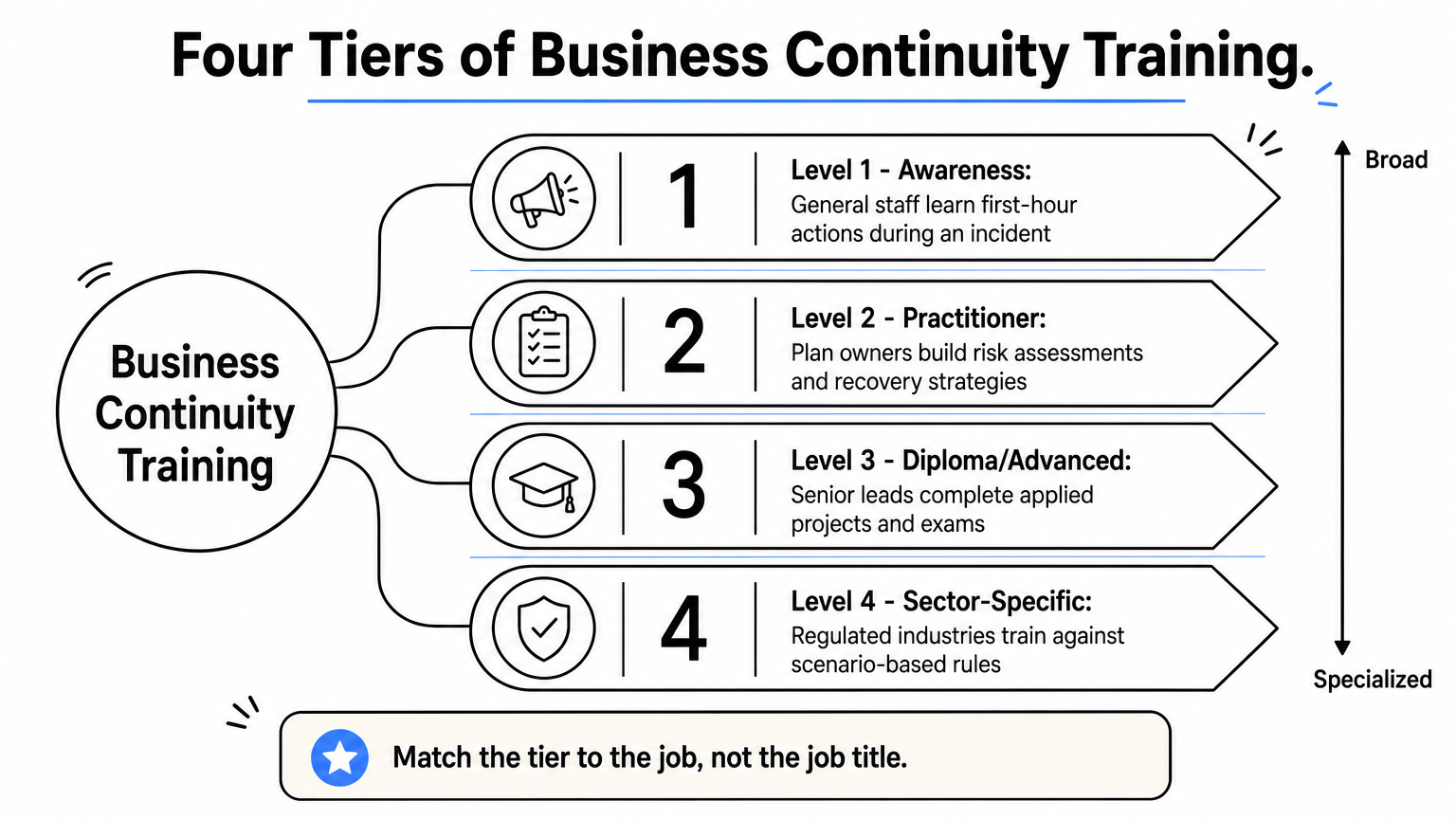
Search for business continuity planning certification and you’ll find dozens of options, ranging from a two-hour online awareness module to a multi-year professional qualification. They aren’t interchangeable, and treating them as if they were is how organisations end up with a certificate that impresses nobody. Understanding the tiers helps you match spend and time to the actual outcome you need.
Awareness and foundation level courses
Foundation courses give general staff a working understanding of what a continuity plan is, what their role would be during an incident, and where to find instructions when normal channels are down. Typically delivered in a day or less, often online, these are aimed at everyone from receptionists to line managers rather than the person who’ll design the plan itself. Value here comes from breadth: getting the whole workforce to a baseline understanding costs far less than training a handful of specialists and hoping the message trickles down. Most business continuity planning training courses at this level end with a short assessment rather than a formal certification, which is fine, since the goal is awareness, not credentials.
Practitioner and diploma-level qualifications
Beyond awareness sits practitioner training, aimed at whoever actually owns the plan: business impact analysis, risk assessment methodology, recovery strategy design, and exercise facilitation. Qualifications from bodies like the Business Continuity Institute and the Disaster Recovery Institute sit here, usually requiring written coursework or a proctored exam rather than a quiz.
A certificate that didn’t require you to build a real plan won’t hold up when an auditor asks how you got it.
| Level | Typical duration | Assessment style | Best suited to |
|---|---|---|---|
| Awareness | Half-day to 1 day | Short quiz | General staff, first responders |
| Practitioner | 3-5 days | Written coursework, exam | Plan owners, BC managers |
| Diploma / advanced | Weeks to months, part-time | Applied project, exam | Senior BC leads, consultants |
| Sector-specific | Varies | Scenario-based assessment | Regulated industries (finance, health) |
Diploma-level programmes go further still, often requiring a real-world project such as drafting a business impact analysis for the candidate’s own organisation. These take longer and cost more, but they produce someone genuinely capable of running a continuity programme rather than just describing one.
Sector-specific and specialist certifications
Finally, some industries need certifications built around their specific regulatory context. Financial services firms often train against frameworks tied to FCA operational resilience and continuity obligations, healthcare providers train around patient safety continuity, and organisations pursuing ISO 27001 need staff who understand how business continuity clauses fit into the wider information security management system. These specialist routes tend to blend generic BCP theory with sector rules, such as the ISO 22301 continuity standard, and skipping them in favour of a generic course can leave gaps an auditor will spot immediately.
Given this range, many organisations find that no single off-the-shelf certification covers everyone who needs training. Combining a foundation course for general staff with practitioner training for plan owners, supported by tailored exercises from a specialist partner, tends to produce far more resilience than chasing one certificate for the whole business.
How to put your training into practice
Completing a business continuity planning course is only the starting point. Certificates gather dust just as easily as unread policy documents if nobody schedules the follow-through. The organisations that actually benefit from training treat it as the first exercise in an ongoing programme, one of several continuity planning habits worth building, not a box ticked once and forgotten. What follows is how to make sure the skills learned on a course actually show up during a real incident.
Schedule regular exercises, not one-off events
Book your first tabletop exercise within weeks of finishing training, while the material is still fresh, and then set a recurring cadence, quarterly for high-risk teams, at least annually for everyone else. Skills decay fast when they aren’t used. A member of staff who confidently ran through an incident scenario in March can struggle to remember the escalation contact by November if nothing has reinforced it since. Treat exercises the way you’d treat fire drills: routine, scheduled, and non-negotiable, rather than something that gets bumped whenever a quieter week finally arrives.
A skill practised once and never repeated is a skill you can’t rely on.
Test the plan against real scenarios
Generic drills teach generic lessons. Far more value comes from running exercises against the specific incidents your business is likely to face: a ransomware attack on your actual finance system, a supplier your logistics genuinely depends on going under, or the office building becoming inaccessible for a week. Vary the scenario each time so different parts of the plan get exercised, and rotate who leads the response so the organisation isn’t dependent on one person’s memory of the training. This is where a documented plan starts becoming a rehearsed capability rather than a theoretical one.
After each exercise, work through a short debrief covering:
- What went to plan, and what didn’t
- Which roles were unclear or contested
- Whether communication reached everyone who needed it, in time
- What would have happened if the incident had lasted twice as long
Capture lessons and update the plan
Every exercise, and every real incident, should feed back into the written plan. If a phone number was wrong, a backup didn’t restore cleanly, or a decision took longer than it should have because nobody had authority to make the call, fix it immediately rather than noting it and moving on. Plans that never change after an exercise are a sign the exercise wasn’t taken seriously, or that the lessons went nowhere.
Bring in outside support where it counts
Finally, recognise where internal resource runs out. Designing realistic scenarios, facilitating exercises objectively, and producing the audit-ready evidence that ISO 27001 assessors and insurers expect takes time most internal teams don’t have spare. TrustedIA’s Business Continuity and Disaster Recovery services step in at exactly this point, running the exercises, capturing the evidence, and helping you turn a trained team into a genuinely resilient business rather than one with a folder of certificates and an untested plan.
Turning knowledge into resilience
Getting business continuity planning training right isn’t about collecting a certificate for the wall. It’s about making sure the people in your business know exactly what to do when a server fails, a supplier collapses, or an attacker locks up your systems. Choose the right course for each role, favour practical exercises over theory, and keep testing the plan long after the training ends. That’s the difference between a document nobody trusts and a capability your team has actually rehearsed.
No course, however well chosen, replaces exercises built around your real risks and evidence auditors and insurers will actually accept. If you’d rather not build that capability from scratch, or you need help turning trained staff into a tested, audit-ready programme, TrustedIA’s business continuity and disaster recovery services can design the exercises, capture the evidence, and help your business recover faster when it matters most.