A single ransomware attack, a server failure, or even a prolonged power outage can bring operations to a halt, sometimes permanently. Research consistently shows that businesses without a recovery plan are far less likely to survive a major disruption. That’s where business continuity and disaster recovery services come in: they give organisations the structure, tools, and expertise to keep running when things go wrong and recover quickly when they do.
But BC/DR terminology can be confusing. What exactly do these services cover? How do business continuity and disaster recovery differ from each other? And what should you actually expect from a provider? These are fair questions, especially if you’re an IT manager, business owner, or compliance officer trying to make informed decisions about protecting your organisation’s operations and data.
At TrustedIA, we deliver managed business continuity and disaster recovery services built on over 30 years of experience in IT services and cybersecurity. We work with businesses across the UK to design, implement, and manage BC/DR strategies that are practical, tested, and aligned with standards like ISO 27001. This article breaks down what business continuity and disaster recovery services actually involve, how they work together, and what to look for when choosing a provider, so you can move forward with clarity rather than guesswork.
What business continuity and disaster recovery services include
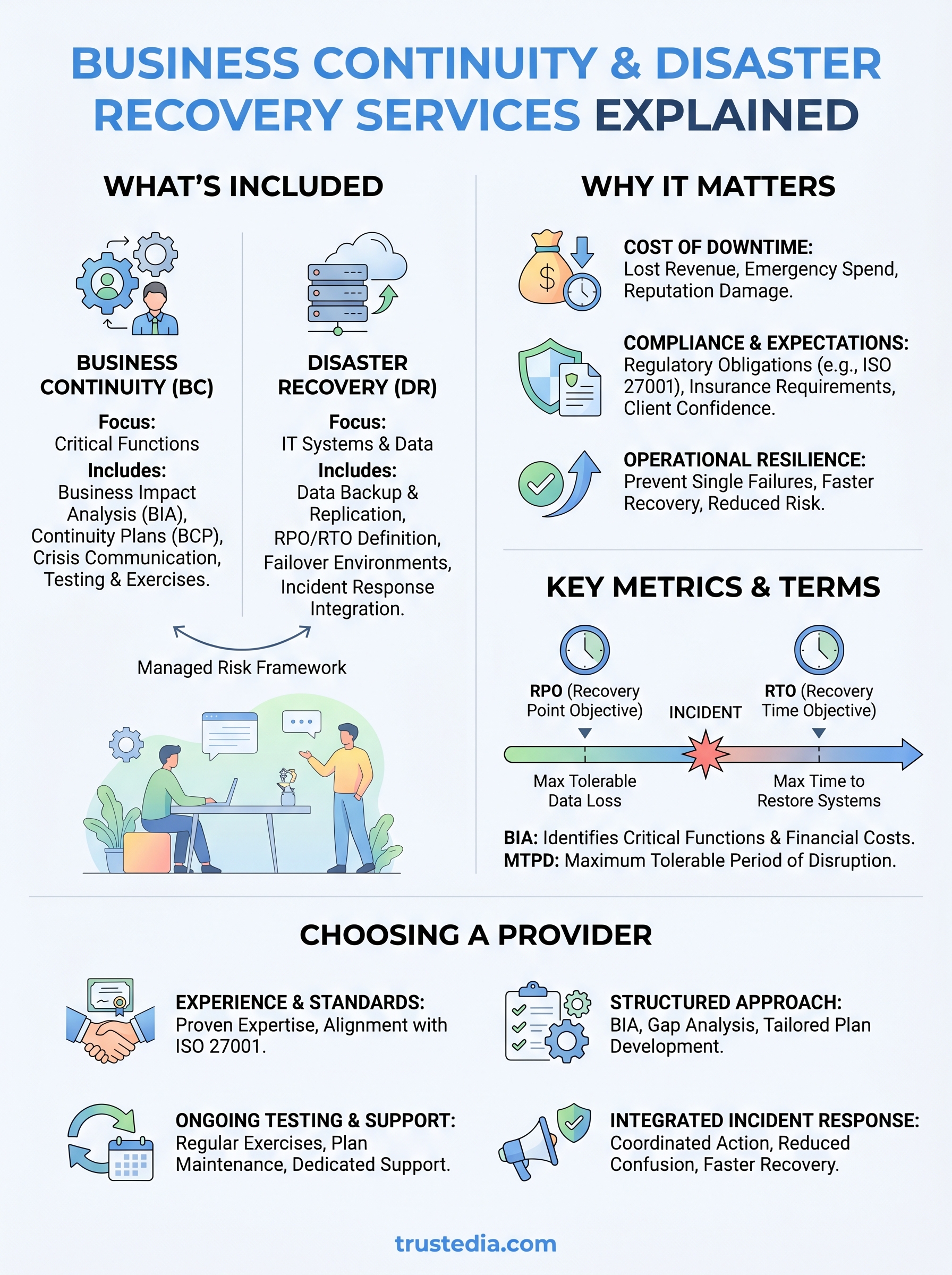
Business continuity and disaster recovery are related but distinct disciplines. Business continuity (BC) focuses on keeping critical business functions running during a disruption, while disaster recovery (DR) focuses on restoring IT systems, data, and infrastructure after a disruption. Together, business continuity and disaster recovery services give your organisation a complete framework for managing risk before, during, and after an incident.

Business continuity services
Business continuity services help you identify which functions are critical to your organisation and build processes that keep them operational when something goes wrong. A managed BC service typically starts with a Business Impact Analysis (BIA), which maps out what would happen if specific systems, people, or processes became unavailable. From there, your provider helps you design continuity plans that are realistic, documented, and regularly tested.
Common components of a business continuity service include:
- Business Impact Analysis (BIA): Identifies your most critical operations and quantifies the cost of downtime
- Business Continuity Plan (BCP) development: A documented playbook for maintaining operations during disruptions
- Crisis communication planning: Defines how your team communicates internally and externally during an incident
- Testing and exercises: Simulations and tabletop exercises to validate your plans before a real event occurs
A plan that has never been tested is little more than a document. Regular exercises are what turn a BCP into a genuine operational asset.
Disaster recovery services
Disaster recovery services focus on restoring your IT infrastructure and data after a failure, whether caused by ransomware, hardware collapse, accidental deletion, or a natural event. A managed DR service takes responsibility for designing and maintaining the technical recovery mechanisms your organisation needs, without requiring you to build it all in-house.
Your DR service provider will typically cover:
- Data backup and replication: Ensuring your data is backed up regularly and stored securely, often across multiple locations
- Recovery point objectives (RPO) and recovery time objectives (RTO): Defining how much data loss is acceptable and how fast systems must be restored
- Failover environments: Setting up secondary systems that can take over if primary infrastructure fails
- Incident response integration: Connecting DR processes with your broader incident response procedures to reduce recovery time
Managed DR services remove the guesswork from technical recovery by giving you predefined procedures, tested infrastructure, and a clear chain of responsibility. For organisations without dedicated IT security teams, this external expertise is especially valuable for reducing recovery time and the risk of compounding damage during an incident.
Why business continuity and disaster recovery services matter
Most organisations underestimate how quickly a disruption turns into a business-threatening event. Whether it’s a cyberattack, a flooded server room, or a critical supplier failure, the consequences compound fast. Business continuity and disaster recovery services exist precisely to prevent a single bad day from becoming a permanent problem. Without a structured plan, your team is left making decisions under pressure, with no clear procedures and no tested recovery path.
The real cost of unplanned downtime
Downtime costs more than the obvious. Direct costs include lost revenue, emergency IT spend, and staff productivity losses, but indirect costs often hit harder. Customers lose confidence, contracts are at risk, and your reputation takes a hit that can take years to rebuild. According to IBM’s Cost of a Data Breach Report, the average cost of a data breach continues to rise year on year, with downtime being one of the primary cost drivers.
Organisations that test and maintain a recovery plan consistently recover faster and at significantly lower cost than those that don’t.
Your industry and size do not determine your exposure. Small businesses are frequently targeted precisely because attackers assume they lack the defences and recovery capabilities that larger organisations have in place.
Compliance and stakeholder expectations
Beyond operational risk, regulatory and contractual obligations increasingly require you to demonstrate that you have continuity and recovery plans in place. Standards such as ISO 27001 include specific controls around business continuity management, and many insurers now ask for evidence of a documented, tested plan before issuing or renewing a cyber insurance policy. Investors, enterprise clients, and partners are also asking the same questions during due diligence. A managed BC/DR service helps you meet these expectations with documented evidence, not just good intentions.
Key terms and metrics you need to know
When you start evaluating business continuity and disaster recovery services, you’ll encounter a consistent set of terms that providers and standards use throughout their documentation. Understanding what these terms actually mean in practice helps you ask the right questions, set realistic expectations, and verify whether a proposed solution genuinely fits your organisation’s needs.
Recovery objectives: RTO and RPO
Two metrics sit at the heart of every disaster recovery plan. Recovery Time Objective (RTO) defines the maximum amount of time your systems or processes can be unavailable before the impact becomes unacceptable to the business. Recovery Point Objective (RPO) defines how much data loss is tolerable, measured in time: if your RPO is four hours, you’re accepting that up to four hours of data could be lost in a recovery scenario.
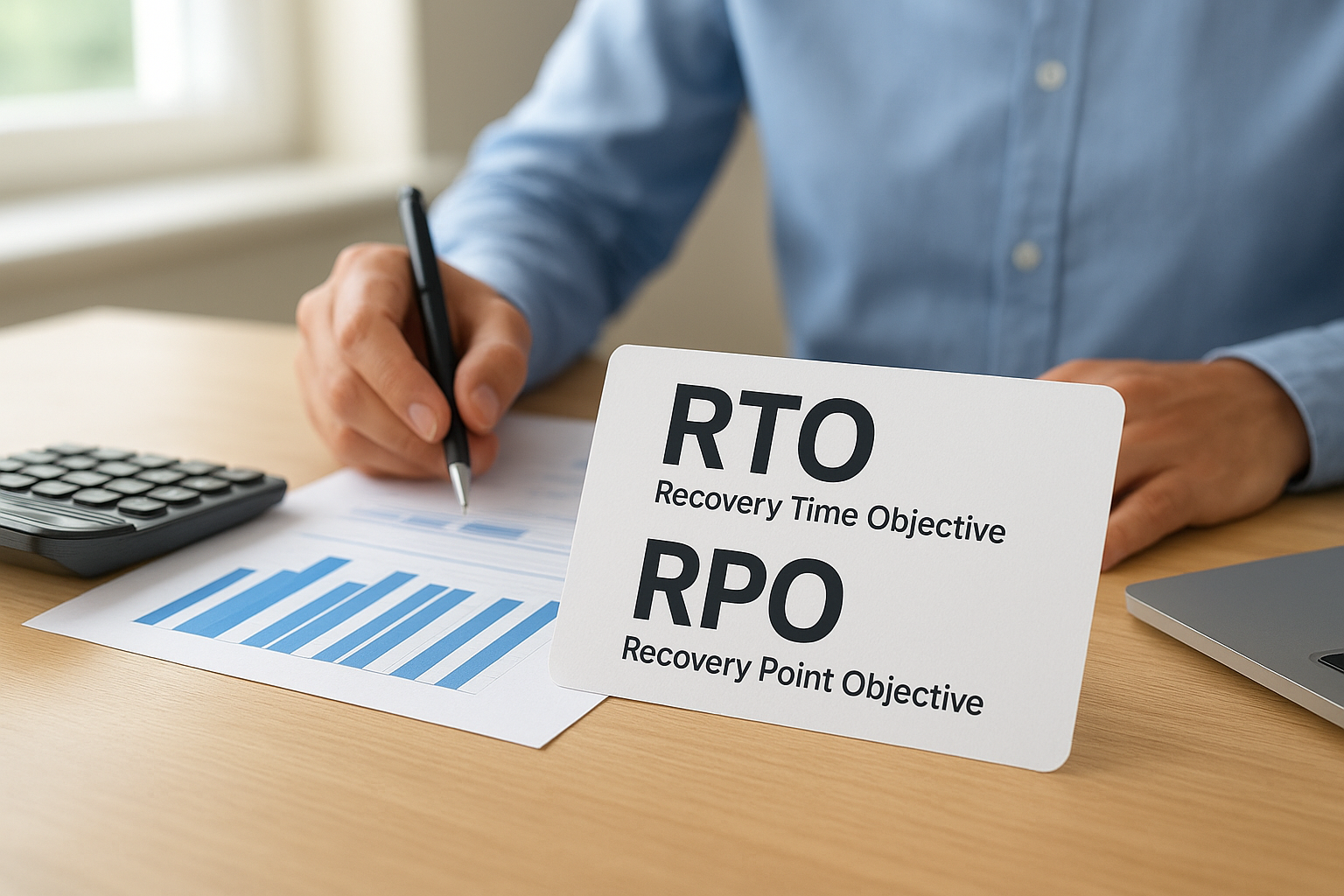
Setting RTO and RPO without input from your business stakeholders is one of the most common mistakes organisations make when designing a DR plan.
These two metrics directly shape the technical design and cost of your recovery infrastructure. A tighter RTO demands faster failover capabilities, which typically increases the investment required. Your provider should help you align these figures with your actual business risk tolerance, not just default technical thresholds.
Other key terms you should know
Beyond RTO and RPO, several other terms come up regularly in BC/DR work. Maximum Tolerable Period of Disruption (MTPD) is the absolute ceiling for how long a critical function can be unavailable before recovery becomes impossible or the business damage becomes irreversible. Work Recovery Time (WRT) covers the time needed to verify and restore normal operations after systems are technically back online, a phase that planning exercises frequently underestimate.
A Business Impact Analysis (BIA) ties all of these together by identifying which processes are critical and what the financial and operational cost of disruption to each one actually is. Your provider will use the BIA to set sensible RTO and RPO targets and prioritise recovery efforts accordingly.
How to implement BC and DR with a managed provider
Working with a managed provider to implement business continuity and disaster recovery services follows a structured process across several defined stages. Understanding what to expect at each stage helps you engage more productively with your provider and ensures your organisation’s specific risks and requirements actually shape the final outcome, rather than a generic template that may not reflect how your business operates.
Start with an assessment
Your provider will begin with a Business Impact Analysis (BIA) and a gap analysis of your current capabilities. These two exercises establish a clear picture of which processes are critical, what your existing recovery mechanisms look like, and where the shortfalls are. Without this foundation, any plan your provider builds risks being either under-resourced or misaligned with what your business actually needs to survive a disruption.
The BIA stage is where most of the strategic decisions get made, so investing time in it upfront pays dividends throughout the entire implementation.
From the assessment, your provider will define your RTO and RPO targets, design the technical architecture to meet them, and document the response procedures your teams will follow when an incident occurs.
Build, test, and maintain
Once the plan is documented, your provider implements the required technical infrastructure: backup systems, failover environments, and monitoring tools. Implementation alone is not enough. Your provider should schedule regular testing exercises, including tabletop simulations and, where appropriate, live failover tests, to confirm the plan holds up under realistic conditions.
Maintenance is what separates a functional BC/DR programme from one that becomes outdated. As your business changes, your systems, suppliers, and risk profile change with it. Your provider should conduct scheduled reviews at least annually and update your plans accordingly to keep them accurate and ready to use.
How to choose the right BC and DR service provider
Not every provider offering business continuity and disaster recovery services delivers the same depth of capability. The difference between a provider that helps you recover in hours and one that leaves you scrambling for days often comes down to how thoroughly you assess them before committing. Choosing the right partner requires asking specific questions and looking for evidence, not just reassurances.
Look for proven experience and standards alignment
A provider’s credentials tell you a lot about whether they can deliver. Look for providers with demonstrable experience in your sector and a track record of working to recognised standards such as ISO 27001. Experience with compliance frameworks matters because it signals that your provider understands how recovery planning connects to your broader risk and governance obligations, not just the technical mechanics of restoring a server.
Providers who understand ISO 27001 controls bring a level of structure and rigour to BC/DR planning that purely technical vendors often lack.
You should also ask whether your provider uses internally developed tooling or assessment frameworks. This can indicate a more mature, consistent approach to evaluating your security posture and continuity gaps, rather than relying on generic checklists that may not reflect your actual risk profile.
Evaluate their testing and ongoing support model
Your provider’s value does not end at implementation. Ask directly how they handle plan testing and maintenance once your BC/DR programme is in place. Providers who schedule regular exercises, update your documentation as your business evolves, and offer clear incident response support during an actual disruption are worth significantly more than those who hand you a plan and step back.
Check whether the provider offers a dedicated incident response capability alongside their continuity and recovery services. When an actual event occurs, having a single provider who understands both your recovery architecture and your response procedures reduces confusion and cuts recovery time substantially.
Conclusion
Business continuity and disaster recovery services are not a luxury reserved for large enterprises. Any organisation that depends on its systems, data, and people to operate needs a structured approach to managing disruption, and most businesses are far less prepared than they think. This article has covered what these services include, why they matter, the key metrics and terminology you need to understand, how implementation works with a managed provider, and what to look for when choosing the right partner.
The right provider brings experience, tested tooling, and a rigorous process that keeps your plans current as your business evolves. Instead of waiting for an incident to expose gaps in your current approach, you can act now to build real resilience. If you want to understand your current continuity and recovery posture and what it would take to improve it, speak to the TrustedIA team and get started with a proper assessment.