
Most business continuity plans sit in a folder gathering dust until the day a server room floods or ransomware locks every workstation, and that’s exactly when businesses discover the plan doesn’t work. A business continuity plan test is how you find those gaps before an attacker or a fire does it for you. Skipping this step is one of the most common mistakes we see across the SMBs and enterprises we work with at TrustedIA.
If you’re searching for how to actually run testing a business continuity plan, the answer isn’t a single tabletop chat once a year. It means running structured exercises, from walkthroughs to full simulations, against realistic scenarios such as ransomware attacks, supplier failure, or site loss, then documenting what broke and fixing it. Done properly, business continuity plan testing turns a static document into something your team can actually execute under pressure.
This guide walks through the practical steps for business continuity plan testing, the scenarios worth rehearsing, and how often you should be testing given today’s threat landscape. We draw on what we’ve learned running incident response and disaster recovery work for organisations across the UK, so you get an approach grounded in real recoveries, not theory.
Why you need to test your business continuity plan
An untested plan is a guess, not a plan
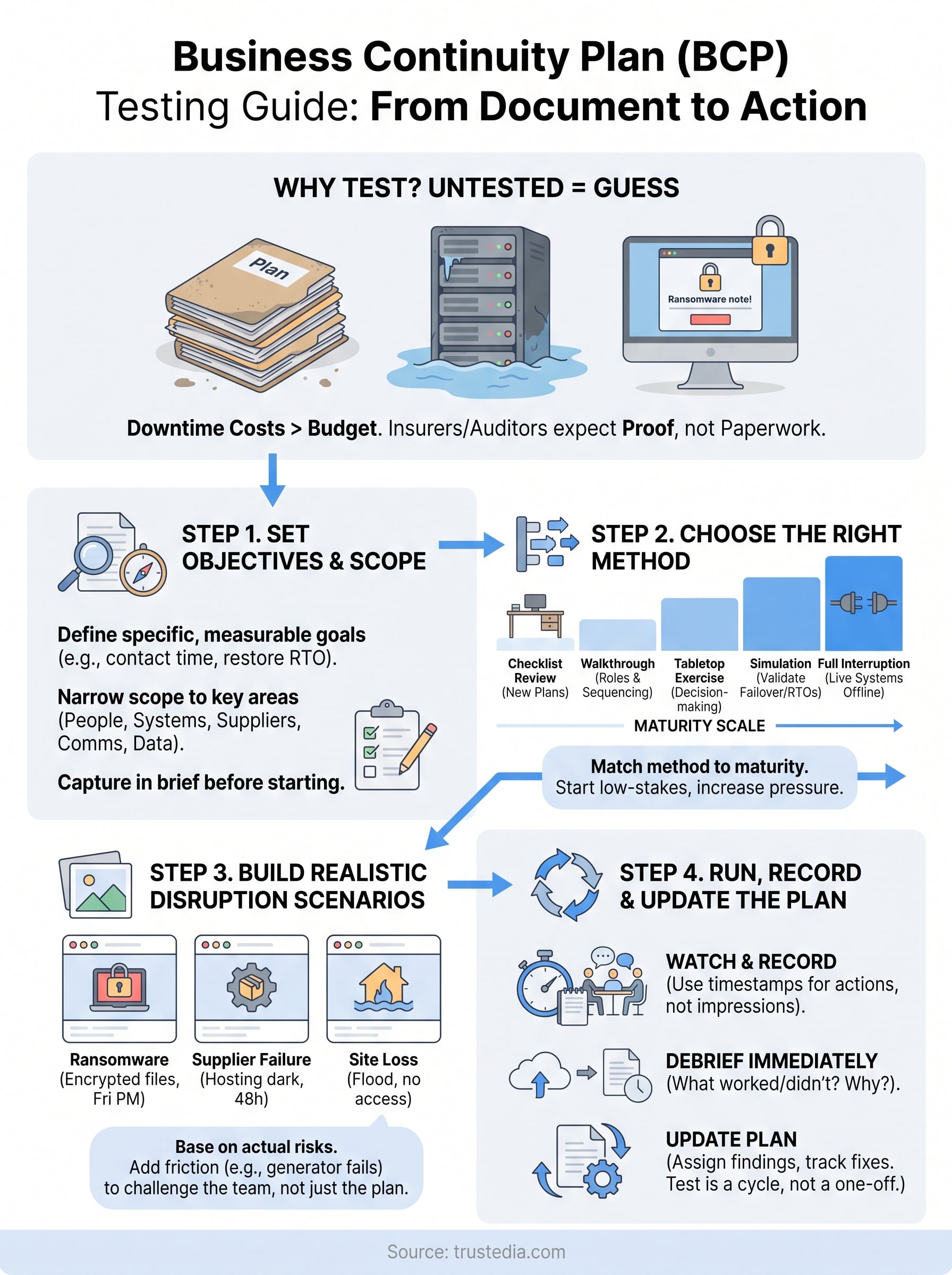
Writing a business continuity plan feels like progress, but a document sitting in SharePoint has never actually recovered anything. Untested assumptions creep into every plan: the backup generator that hasn’t run in two years, the supplier contact who left the company, the failover server that was decommissioned last quarter. You only find these gaps by trying to execute the plan, which is the entire point of a business continuity plan test.
A plan you’ve never tested is a guess dressed up as a strategy.
Downtime costs more than most businesses budget for
Downtime hits harder than most finance teams expect, and the gap between what a plan promises and what actually happens during an incident is where the real damage sits. Ransomware recovery without a rehearsed plan routinely stretches into weeks rather than the hours a plan document might claim. According to the UK government’s Cyber Security Breaches Survey, a large share of businesses that suffer breaches report material disruption to operations, and the ones without practised response procedures take noticeably longer to get back online. Every extra hour offline means lost revenue, missed SLAs, and customers quietly moving to a competitor who stayed available.
Insurers and auditors now expect proof, not paperwork
Insurers have caught up with this reality, and cyber insurance policies increasingly ask for evidence of tested continuity arrangements before they’ll pay out on a claim, not just a copy of the plan itself. ISO 27001 goes further still, requiring organisations to demonstrate that continuity arrangements are validated through exercises, not merely documented on paper, as part of maintaining certification. If you’re pursuing or maintaining that certification, testing isn’t optional, it’s an audit requirement your assessor will ask to see evidence of. Loss adjusters and cyber insurers we work with through our CyberSOS incident response service consistently tell us the same thing: the businesses that recover fastest are the ones who’d rehearsed the incident before it happened, not the ones with the thickest binder.
What a real test actually uncovers
Running an actual exercise, rather than just reading through the document, tends to surface the same categories of problems again and again. Testing a business continuity plan properly, with people actually working through the steps under time pressure, reveals issues that a desk review never will:
- Outdated contact details for staff, suppliers, and emergency services
- Unclear ownership of decisions, so nobody knows who authorises a failover or a ransom conversation
- Missing dependencies, such as a critical supplier or cloud service the plan never accounted for
- Unrealistic recovery time estimates that assume backups restore faster than they actually do
- Communication breakdowns when the usual channels, like email or Slack, are the systems that are down
Uncovering these issues in a controlled exercise costs you an afternoon. Discovering them mid-incident costs you days of downtime, reputational damage, and possibly a failed insurance claim. That difference alone is why business continuity plan testing deserves a proper slot on your calendar rather than a box-ticking exercise once a year. The next four steps show you exactly how to build and run that testing programme so it produces real, actionable findings instead of another document nobody reads.
Step 1. Set clear testing objectives and scope
Before you book a room or draft a scenario, decide what the test is actually meant to prove. A business continuity plan test without clear objectives turns into a vague conversation that feels productive but produces nothing you can measure or improve. Are you testing whether staff can be contacted within an hour? Whether backups restore within your stated recovery time objective? Whether the incident response team knows who has authority to declare a major incident? Pick two or three specific objectives per test rather than trying to validate the entire plan in one sitting.
If you can’t state what the test is meant to prove, you’re not testing, you’re rehearsing theatre.
Decide which parts of the plan you’re testing
Scope matters just as much as objectives. Testing your entire organisation’s continuity arrangements in one exercise is unrealistic and usually results in a shallow test that skips important detail. Narrow the scope to a specific department, system, or scenario type, and go deep rather than wide. A finance team testing payment processing failover learns far more from a focused two-hour exercise than the whole business does from a token, hour-long walkthrough that touches everything and tests nothing properly.
| Scope element | Example question to answer |
|---|---|
| People | Can the incident response team be assembled within 30 minutes, out of hours? |
| Systems | Does the failover server actually take the production workload? |
| Suppliers | Does the backup ISP contract still exist and work as documented? |
| Communications | Can the team coordinate if email and Slack are both down? |
| Data | Do backups restore within the stated recovery point objective? |
Put it in writing before the exercise starts
Capture the objectives, scope, and success criteria in a short brief before the exercise, not after. This single document is what separates disciplined business continuity plan testing from an unstructured chat that happens to touch on relevant topics. Distribute it to everyone involved so participants know what they’re being asked to demonstrate, and keep a copy for your ISO 27001 audit trail if certification is part of your compliance obligations. When you’re testing a business continuity plan as part of a formal management system, auditors will specifically ask to see this kind of planning evidence alongside the results, so building the habit now saves you scrambling before your next assessment.
Step 2. Choose the right testing method
Not every part of your plan needs a full-scale simulation, and picking the wrong method wastes time or, worse, gives you false confidence. Testing methods for a business continuity plan sit on a scale from a quiet desk review through to pulling the plug on live systems, and the right choice depends on what you’re trying to prove, how mature your plan already is, and how much disruption the business can tolerate on the day. Start light if this is your first attempt at business continuity plan testing, then increase intensity as your team gets comfortable executing under pressure.
Match the method to your maturity
Organisations new to testing should start with a checklist review or walkthrough before attempting anything live. Jumping straight to a full interruption test without ever having walked through the plan on paper almost guarantees confusion and wasted effort, because nobody yet knows their role. Build confidence with lower-stakes exercises first, then graduate to methods that put real pressure on people and systems.
Test like you fly: start on the ground before you take the controls in the air.
Compare the main testing formats
Each format below tells you something different, so most mature continuity programmes run a mix across the year rather than relying on one method alone.
| Method | What it involves | Best for |
|---|---|---|
| Checklist review | Team reads through the plan and confirms details are current | New plans, quick annual health checks |
| Walkthrough | Team talks through each step in sequence, no systems touched | Confirming roles and sequencing before a bigger test |
| Tabletop exercise | Facilitated scenario discussion, team decides actions verbally | Testing decision-making and communication under a hypothetical scenario |
| Simulation | Team performs actual recovery actions in a test environment | Validating technical failover, backup restores, RTOs |
| Full interruption test | Live systems or a site are taken offline for real | Mature programmes validating true production failover |
Pick based on risk, not preference
High-risk, high-impact scenarios such as ransomware or total site loss deserve a simulation or full interruption test eventually, because a tabletop discussion won’t tell you whether your backups actually restore inside your recovery time objective. Lower-risk scenarios, like a single supplier outage, are often well served by a tabletop exercise that’s quicker to run and easier to schedule. Whichever method you choose, the UK’s National Cyber Security Centre recommends exercising your response regularly rather than treating a single test as sufficient (https://www.ncsc.gov.uk), and mixing methods across the year gets you closer to genuine confidence than repeating the same format on repeat.
Step 3. Build realistic disruption scenarios
Generic scenarios produce generic results. Telling a team "imagine a cyber attack happens" gives them nothing concrete to react to, so build scenarios with enough specific detail that people have to make real decisions, not just nod along. Realistic disruption scenarios should draw directly from your own risk register and past incidents, not a template downloaded from somewhere else, because the ransomware strain that hits a manufacturer’s OT network behaves nothing like the one that hits a professional services firm’s file servers.

Base scenarios on what’s actually likely to hit you
Start by pulling the top risks from your last risk assessment or penetration test findings, then translate each one into a narrative with a timeline. A strong scenario for business continuity plan testing answers who discovered the problem, what time it happened, what systems are affected, and what constraints the team is working under, such as a director being unreachable or the primary office being inaccessible.
A scenario without specific detail tests nothing, because there’s nothing forcing anyone to actually decide.
Scenario examples worth rehearsing
Rotate through different categories across your testing calendar rather than repeating the same event every time:
- Ransomware encryption discovered on a Friday evening, with backups showing signs of tampering
- Key supplier failure, such as your hosting provider or payment processor going dark for 48 hours
- Site loss, where flooding or fire makes the primary office unusable for a week
- Data breach involving customer records, triggering ICO notification obligations within 72 hours
- Key person unavailability, where the one person who knows the failover process is on holiday abroad
Add friction deliberately
Inject a complication partway through the exercise instead of letting the scenario run cleanly from start to finish, because real incidents never behave and rarely stay contained to the plan you wrote. Introducing a curveball, like the backup generator failing to start or a second system going down mid-recovery, is what separates useful business continuity test plan exercises from a scripted read-through where everyone already knows the ending. Keep the twist plausible and tied to something in your actual environment, not a Hollywood-style disaster, so the lessons transfer directly to how your team would actually respond.
Step 4. Run the test, record findings and update your plan
Running the exercise is where all the planning either pays off or falls apart, so treat the day itself with the same discipline as a real incident. Brief participants on their roles beforehand, appoint someone as an independent observer who isn’t actively solving the scenario, and stick to the timeline you set in Step 1. Testing a business continuity plan only works if people engage with it as though the disruption were genuine, hesitation, wrong guesses and all, rather than performing a version of events they know will look good in the write-up.
Watch and record as it happens
Your observer’s job is to capture what actually occurred, not what the plan says should have occurred, and the gap between those two things is usually the most useful output of the whole exercise. Note timestamps for key actions: when the incident was declared, when the response team assembled, when backups started restoring, when customers or regulators would have been notified. Vague notes like "communication was a bit slow" are useless. Write down that the on-call manager wasn’t reached until 47 minutes in because the emergency contact number was three years out of date.
If your notes don’t include timestamps, you’re recording impressions, not evidence.
Debrief immediately, while memory is sharp
Hold the debrief within the hour, not the following week, because details fade fast and people start reconstructing events more favourably than they happened. Ask three questions of the group: what worked, what didn’t, and what would have happened if this had been real. A short structured debrief captures more than an open-ended chat, so work through a fixed list:
- Did the team hit the recovery time objective for each system in scope?
- Where did communication break down, and why?
- Which documented steps were wrong, missing, or outdated?
- What single change would have the biggest impact on the next test?
Close the loop with an updated plan
A test that doesn’t change the plan wasn’t worth running. Assign each finding an owner and a deadline, log it against the plan version it affects, and schedule a follow-up review to confirm the fix actually landed rather than just being marked complete. This is also the evidence your ISO 27001 auditor or cyber insurer will want to see: proof that a business continuity plan test produced real, tracked corrective action, not just a report that sits alongside the plan it was meant to challenge.
Making testing part of business as usual
Treat your next business continuity plan test as the start of a cycle, not a one-off project you tick off before an audit. Schedule the follow-up review, book the next scenario, and set a recurring date on the calendar before you close out this year’s exercise, because the moment testing stops being routine, gaps quietly creep back in. Quarterly tabletop exercises paired with an annual simulation or interruption test give most organisations a realistic rhythm without overwhelming the team or the business.
Few SMBs have the spare capacity to run this properly alongside day-to-day operations, and that’s exactly where an outside pair of hands earns its keep. TrustedIA has spent over 30 years helping businesses across the UK build, test, and refine continuity arrangements that hold up under real pressure, backed by our CyberSOS incident response experience and ISO 27001 expertise. Get in touch with TrustedIA to plan your next test before you need it.



