When your organisation transfers personal data to a processor or another controller, especially one based outside the European Economic Area, you need a lawful mechanism to protect that data. European Commission Standard Contractual Clauses (SCCs) are one of the most widely used tools for exactly this purpose, providing pre-approved contractual safeguards that align with GDPR requirements without needing additional authorisation from a supervisory authority.
Yet many businesses still treat SCCs as a box-ticking exercise, copying template language into contracts without understanding the obligations they’re actually signing up to. That approach creates real risk. Getting SCCs wrong can expose your organisation to regulatory enforcement, financial penalties, and reputational damage, outcomes that undermine the very data protection posture you’re trying to build. At TrustedIA, we work with organisations across the UK to strengthen their compliance frameworks, including ISO 27001 certification and broader cyber security assurance, where understanding data transfer mechanisms like SCCs is essential.
This article breaks down what the European Commission’s Standard Contractual Clauses are, how the current modular structure works, who needs to use them, and what proper implementation actually looks like. Whether you’re a business owner, IT manager, or compliance officer, you’ll come away with a clear understanding of your obligations and the steps required to get this right.
What the European Commission SCCs are
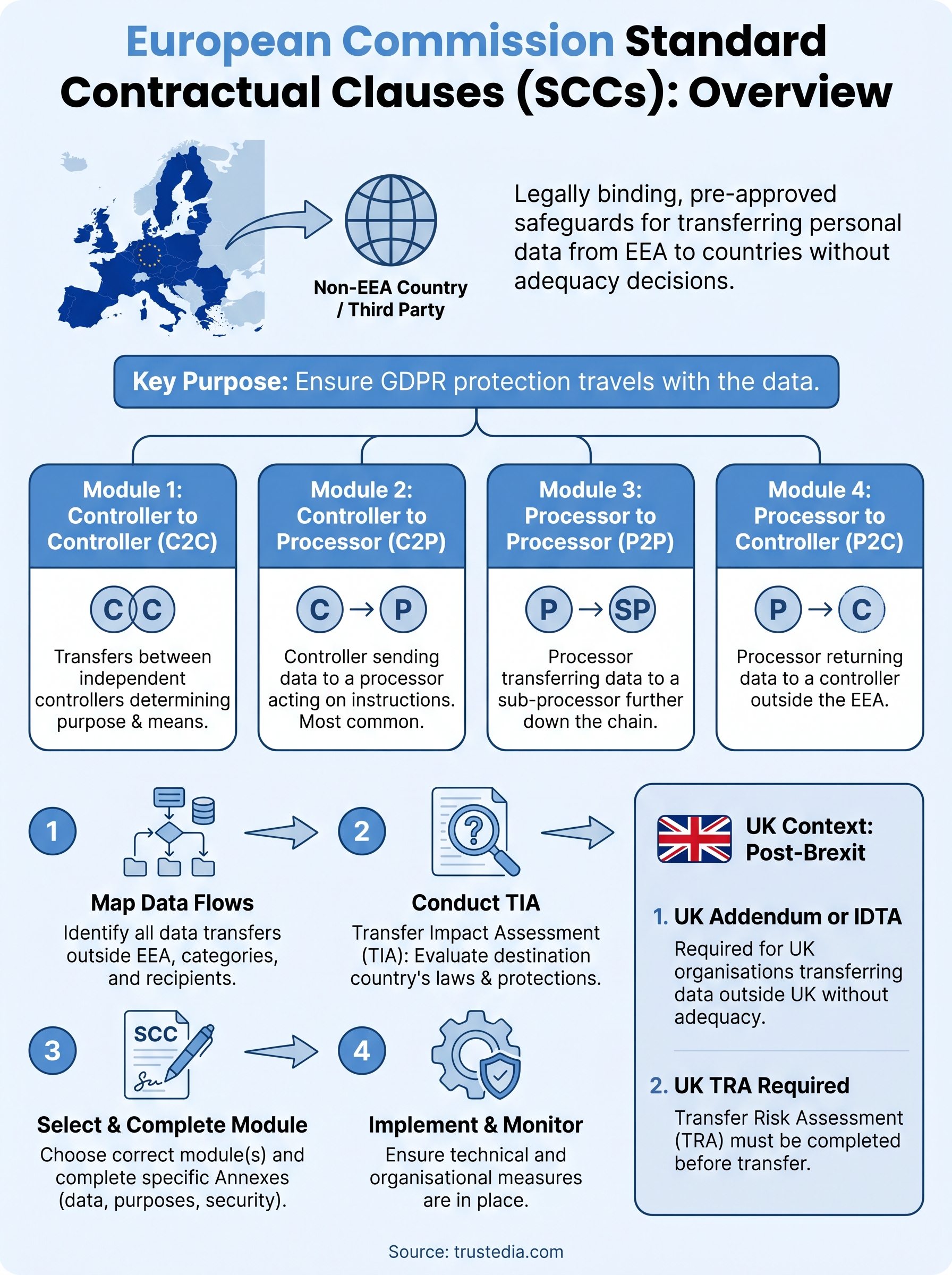
Standard Contractual Clauses are legally binding contractual provisions adopted by the European Commission under Article 46(2)(c) of the GDPR. They set out specific data protection obligations for both the party transferring personal data and the party receiving it, creating a framework that supervisory authorities across the EU have already reviewed and approved. Because the European Commission publishes them as fixed, standardised templates, you don’t need to seek separate authorisation from your national data protection authority before using them.
Where the current SCCs come from
The European Commission first introduced SCCs in the early 2000s, but most organisations rely on the versions adopted in June 2021. Those 2021 SCCs responded directly to the Court of Justice of the European Union’s Schrems II ruling, which invalidated the EU-US Privacy Shield and raised serious concerns about whether the older clause sets provided adequate real-world protection. Under the updated framework, you must carry out a Transfer Impact Assessment (TIA) before relying on SCCs, evaluating whether the destination country’s legal framework would allow the contractual commitments to be honoured.
Signing SCCs alone is not enough: you must assess whether the protections they promise can realistically be enforced where your data is going.
What the clauses actually contain
European Commission standard contractual clauses are built around four core elements: definitions and interpretations, obligations on the data exporter, obligations on the data importer, and provisions covering enforcement, liability, and remedies. Each clause is mandatory and cannot be modified, though you can add supplementary provisions alongside them, provided those additions don’t contradict or weaken the standard terms.
Beyond the fixed text, the SCCs include Annexes where you document the specifics of your particular transfer: the categories of personal data involved, the purposes of processing, the technical and organisational security measures you have in place, and any sub-processors the importer intends to use. These Annexes are not an afterthought. A supervisory authority reviewing your compliance will examine whether they reflect the actual processing activity in detail, rather than a vague summary that simply exists to satisfy a formality. Getting those Annexes right is just as important as signing the clauses themselves.
When you need SCCs for data transfers
You need SCCs whenever you transfer personal data from within the EEA to a country the European Commission has not recognised as providing an adequate level of data protection. Without either an adequacy decision or another Article 46 safeguard in place, that transfer is unlawful under GDPR, regardless of whether the recipient is a trusted business partner or a group company within your own organisation. This applies to cloud service providers, payroll processors, CRM platforms, and any other third party that accesses or stores personal data on your behalf.
An intra-group transfer carries exactly the same legal requirements as a transfer to a third-party vendor, so internal corporate structures offer no automatic exemption.
Transfers to third countries without adequacy decisions
When you send data to processors or controllers in countries such as the United States, India, or China, first check whether an adequacy decision covers that destination. The EU-US Data Privacy Framework covers certain certified organisations in the US, but many US-based vendors fall outside its scope, which means you still need European Commission standard contractual clauses to lawfully transfer data to them. For all other destinations without an adequacy decision, SCCs remain the most practical and widely accepted transfer mechanism for most organisations operating within GDPR’s reach.
When SCCs are not required
SCCs are not required if you transfer data entirely within the EEA, since GDPR applies uniformly across all member states. They are also unnecessary where a valid adequacy decision fully covers the destination country. However, you should never assume adequacy applies without verifying it, because the list changes and existing decisions can be revoked, as the original Privacy Shield demonstrated. Always confirm the current status before relying on it.
How the SCC modules work
The 2021 SCCs introduced a modular structure that replaced the older, separate clause sets with a single, flexible framework. Instead of choosing between entirely different documents, you now select the module that matches your specific transfer relationship, then complete the Annexes to reflect your actual processing activities. This makes the framework more adaptable without compromising the legal certainty of using pre-approved language.
The four modules explained
The European Commission standard contractual clauses are divided into four modules, each covering a different type of transfer relationship:
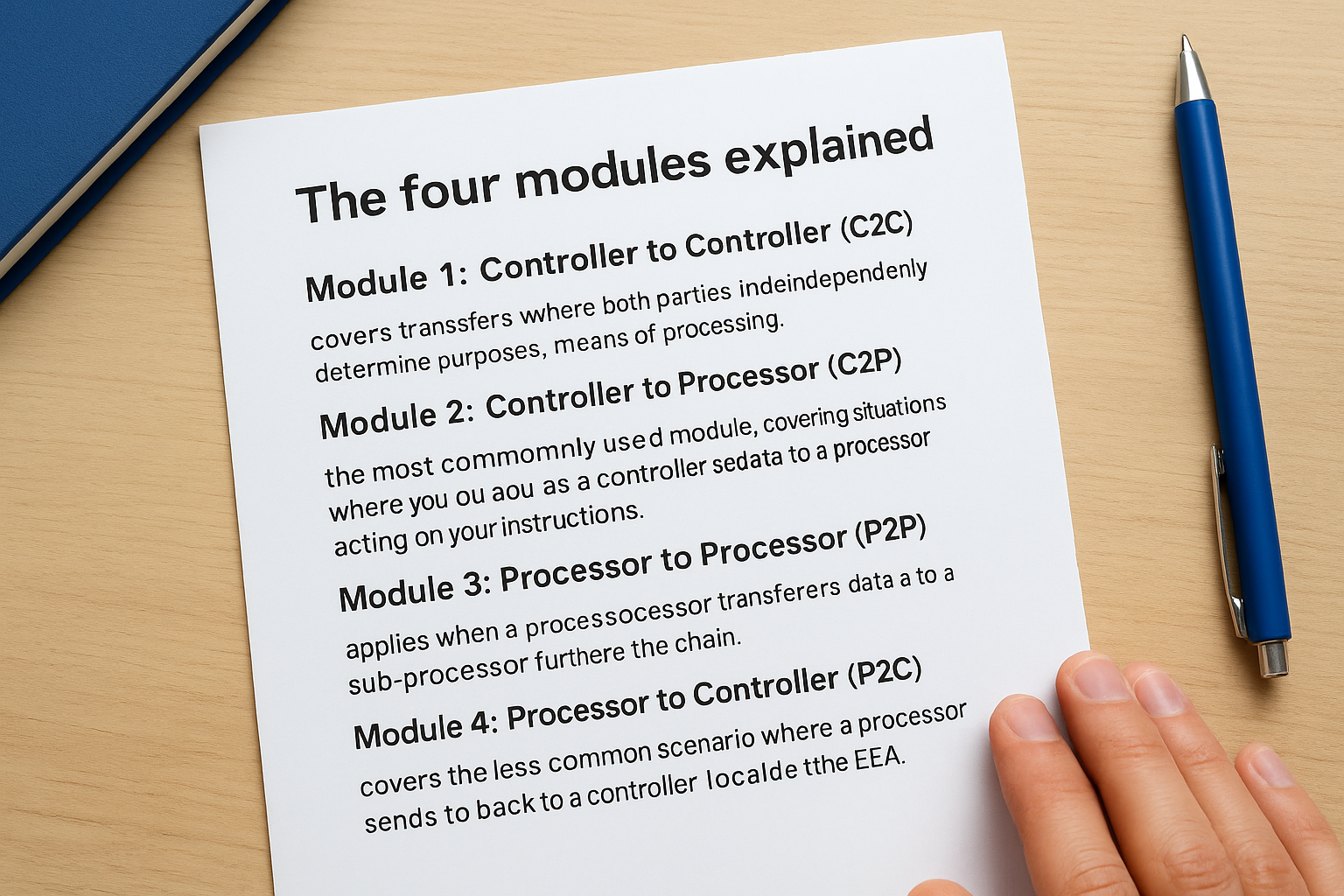
- Module 1: Controller to Controller (C2C) – covers transfers where both parties independently determine the purposes and means of processing.
- Module 2: Controller to Processor (C2P) – the most commonly used module, covering situations where you, as a controller, send data to a processor acting on your instructions.
- Module 3: Processor to Processor (P2P) – applies when a processor transfers data to a sub-processor further down the chain.
- Module 4: Processor to Controller (P2C) – covers the less common scenario where a processor sends data back to a controller located outside the EEA.
Choosing the wrong module invalidates your legal basis for the transfer, so you must identify the correct relationship before signing anything.
Selecting and combining modules
You can include more than one module in a single set of SCCs if your relationship with a third party involves multiple transfer types. However, each module selection must accurately reflect the actual legal relationship between the parties involved. Mischaracterising a controller as a processor, or vice versa, creates both contractual and regulatory exposure that a supervisory authority will not overlook.
How to implement SCCs in real life
Implementing european commission standard contractual clauses correctly involves more than downloading a template and inserting a signature. You need to follow a structured process that links your contractual obligations to your actual data flows and security measures. Skipping steps in that process is where most organisations create gaps that regulators will identify during an audit.
Map your data flows first
Before you touch the SCC templates, you need to map every transfer of personal data that crosses an EEA border. This means identifying which processors or controllers receive data, what categories of data they handle, and what legal basis currently covers each transfer. Your data flow map becomes the foundation for selecting the correct module and completing the Annexes accurately.
Capturing this information at a granular level also makes it easier to detect transfers you may have overlooked, such as cloud storage services or analytics platforms that quietly send data to servers outside the EEA.
Conduct a Transfer Impact Assessment
Once you know where your data is going, you must complete a Transfer Impact Assessment (TIA) for each destination country. A TIA evaluates whether that country’s legal and regulatory framework allows the protections in the SCCs to function in practice. If the assessment shows that local laws could undermine those protections, you must identify supplementary technical or contractual measures before the transfer can proceed.
Signing SCCs without completing a TIA first leaves you exposed, because the Schrems II ruling made assessments a mandatory step, not an optional one.
Complete the Annexes with precision
The Annexes contain your specific processing details. You must document the data categories, purposes, retention periods, and security measures that apply to each transfer with enough detail to reflect the actual activity. Supervisory authorities treat vague Annex descriptions as a compliance failure in their own right, so approach them as operational records rather than administrative formalities.
UK organisations: SCCs, IDTA and UK addendum
Since the UK left the European Union, European Commission standard contractual clauses no longer apply directly to UK organisations. The UK operates under the UK GDPR and the Data Protection Act 2018, which means you need UK-specific transfer mechanisms when sending personal data to countries that the ICO has not recognised as adequate. Understanding which tools apply is critical if your organisation operates across both the EU and UK regimes, since using only EU SCCs leaves your UK transfers without a lawful basis.
The International Data Transfer Agreement (IDTA)
The International Data Transfer Agreement (IDTA) is the UK’s standalone replacement for EU SCCs, published by the ICO in March 2022. It serves the same fundamental purpose as the EU framework: creating enforceable obligations between a UK data exporter and an overseas data importer. The IDTA separates its mandatory clauses from a “Commercial Clauses” section where you record your specific processing details, but the underlying compliance obligations are comparable to those in the EU module structure.
If you sign EU SCCs without also executing the correct UK mechanism, your UK transfers remain unlawful regardless of how thorough the EU paperwork is.
The UK Addendum for existing EU SCCs
If your contract already incorporates the 2021 EU SCCs, you can use the UK Addendum instead of replacing the entire agreement. It sits alongside your existing EU SCCs and adapts them to satisfy UK GDPR requirements, making it a practical option when working with EU-based processors who already operate under EU SCC arrangements.

Both the IDTA and the UK Addendum also require you to complete a Transfer Risk Assessment (TRA), the UK equivalent of the EU’s Transfer Impact Assessment. The ICO provides a TRA tool to support this process, and completing it before any transfer proceeds is a regulatory requirement, not a recommendation.
Next steps
Understanding European Commission Standard Contractual Clauses is only the starting point. The real work lies in mapping your data flows, selecting the correct module, completing the Annexes accurately, and conducting a Transfer Impact Assessment before any transfer takes place. If you operate under UK GDPR, you also need to confirm whether the IDTA or the UK Addendum applies to your specific arrangements, since using the wrong mechanism leaves your transfers without a lawful basis.
Compliance gaps in data transfer mechanisms frequently surface during cyber security audits and ISO 27001 assessments, where reviewers examine not just your technical controls but your contractual and governance frameworks as well. Getting ahead of those gaps before an audit, a breach, or a regulatory inquiry is the approach that consistently produces better outcomes.
If you want to strengthen your compliance posture and address data transfer obligations across both EU and UK frameworks, speak to the TrustedIA team about how we can support your organisation.