
If someone at work has asked you to explain what the data protection act 2018 actually covers, you’re not alone. It’s one of those pieces of legislation that gets mentioned constantly in compliance meetings, yet most people have never read past the headlines. The short version: it’s the UK’s law governing how organisations collect, store, and use personal data, and it sits alongside the UK GDPR to form the backbone of data protection compliance here.
This article answers the question directly. You’ll get a plain-English explanation of what the Data Protection Act is, why it replaced the 1998 version, who it applies to, and what counts as personal data under its scope. We’ll also cover the key principles you need to know if you’re responsible for handling customer or employee information.
We work with businesses every day on ISO 27001 compliance and cyber risk management, so we’ve seen firsthand where organisations misunderstand their legal obligations. This guide clears that up, so you know exactly where your business stands.
Why the Data Protection Act 2018 matters
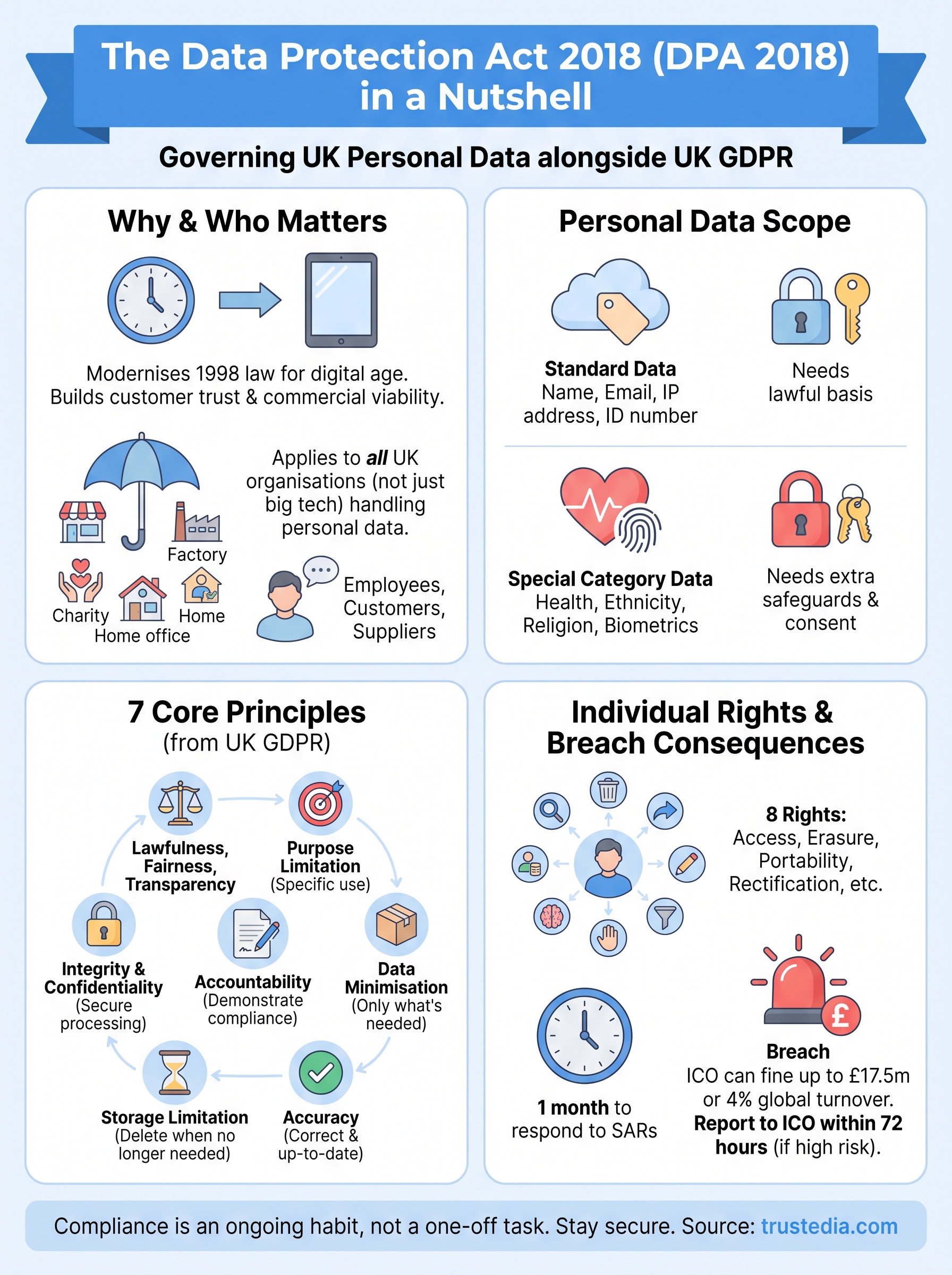
The Data Protection Act 2018 didn’t appear out of nowhere. It replaced a law written in 1998, back when the internet was mostly dial-up and nobody had heard of cloud storage, smartphones, or social media profiling. That older act simply couldn’t keep pace with how modern businesses collect and use information, so Parliament rewrote it to reflect the reality of data-driven organisations. Understanding this history matters because it explains why the data protection act 2018 and uk gdpr work together rather than as two competing rulebooks, and what changed for UK GDPR after Brexit. The Act fills in the gaps the UK GDPR leaves open, covering areas like law enforcement processing, national security, and how the Information Commissioner’s Office (ICO) enforces the rules.
Who the law actually applies to
Almost every organisation operating in the UK falls under this data protection legislation 2018, regardless of size or sector. If you hold employee records, customer contact details, or supplier information, you’re processing personal data and the law applies to you. This includes sole traders, charities, schools, and multinational enterprises. The Act draws a distinction between data controllers (who decide why and how data is processed) and data processors (who handle it on the controller’s behalf), and both carry legal responsibilities. Many businesses assume this legislation only affects big tech firms or companies handling sensitive records, but that’s a costly misunderstanding.
The Data Protection Act 2018 applies to any organisation that touches personal data, not just large corporations with dedicated legal teams.
What counts as personal data
People often ask what is protected by the data protection act, and the answer is broader than most expect. Personal data includes anything that identifies a living individual, either directly or indirectly. That covers obvious examples like names and email addresses, but also IP addresses, employee ID numbers, CCTV footage, and location data from mobile devices. The Act also introduces stricter rules for special category data, which includes health records, ethnicity, religious beliefs, sexual orientation, and biometric information. Handling this category incorrectly carries higher regulatory scrutiny, so it’s worth knowing exactly what your business collects.
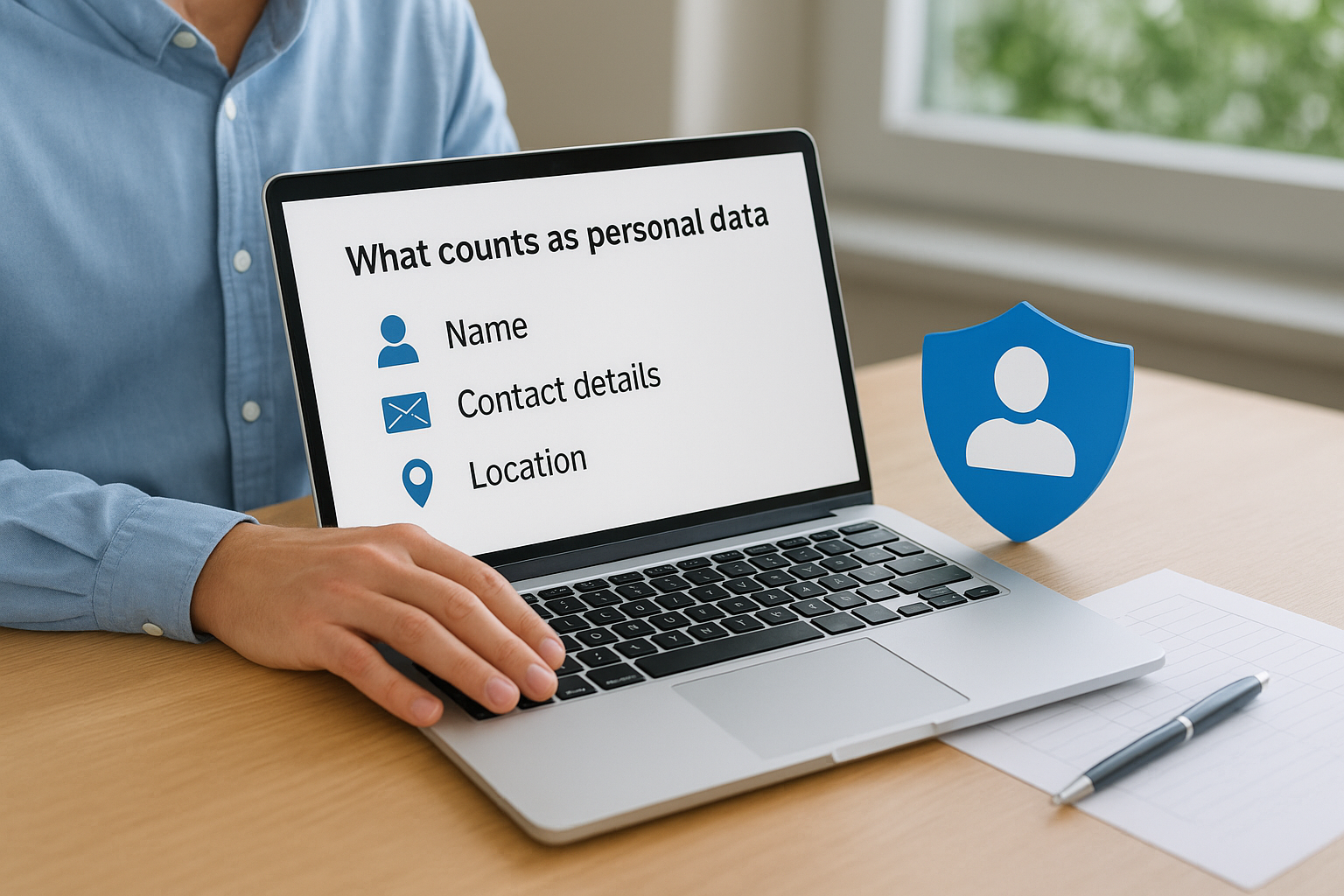
| Data type | Examples | Extra safeguards required |
|---|---|---|
| Standard personal data | Name, email, phone number, IP address | Lawful basis for processing |
| Special category data | Health records, ethnicity, religion, biometrics | Explicit consent or specific legal condition |
| Criminal offence data | Conviction records, allegations | Official authority or legal authorisation |
The business case for taking it seriously
Beyond the legal obligation, there’s a practical reason this matters: customer trust. People are increasingly aware of how their data gets used, and a business that mishandles it loses credibility fast. Clients, insurers, and partners now routinely ask about data protection act uk compliance before signing contracts, and many will check whether you appear on the data protection register, particularly in sectors handling financial or health information. Meeting these expectations isn’t just about avoiding fines, it’s about staying commercially viable. We see this constantly in our work supporting clients through ISO 27001 compliance, where data protection obligations sit at the core of the certification process.
Supply chains add another layer of pressure. Larger organisations increasingly demand proof that their suppliers meet UK data protection standards before awarding contracts, which means smaller businesses can lose opportunities simply by failing to demonstrate compliance. Regulators, too, expect organisations to show they understand their obligations under the protection of data act, not just tick a box once and forget about it. This is where structured cyber risk management becomes essential, giving you a framework to identify where personal data lives, how it flows through your systems, and where the gaps sit before they become breaches. Getting this right from the start saves far more time and money than reacting after an incident, which is exactly the territory the next sections cover in detail.
How to comply with the Data Protection Act 2018
Compliance with the data protection act 2018 isn’t a one-off checklist you complete and file away. It’s an ongoing discipline that touches every part of how your business collects, stores, and shares information. Getting there means combining practical processes with a genuine understanding of your obligations, not just paperwork that looks good during an audit. Most organisations we work with start in the same place: they don’t actually know where their personal data lives, let alone how it moves between systems and third parties.
Start with a data audit
Before you can protect anything, you need to know what you’re protecting. A data mapping exercise identifies every system, spreadsheet, and third-party tool that touches personal data, from your CRM to your payroll provider. Without this step, businesses often discover gaps only after a breach forces the issue. Our independent data protection audit exists precisely because so many organisations underestimate how scattered their data actually is across cloud platforms, email archives, and legacy systems nobody’s looked at in years.
You can’t comply with data protection law if you don’t know where your data actually sits.
Build lawful processing into daily operations
Once you know where the data lives, you need a lawful basis for processing it, whether that’s consent, contractual necessity, or legitimate interest, which sits at the heart of GDPR compliance requirements. This isn’t a legal technicality, it’s the foundation the rest of your compliance sits on. Practical steps include:
- Reviewing privacy notices so they clearly explain what you collect and why
- Checking that consent mechanisms are genuinely opt-in, not pre-ticked boxes
- Setting retention periods so old data gets deleted rather than piling up indefinitely, applying data protection by design from the outset
- Restricting access so only staff who need personal data can see it
- Encrypting sensitive records both in transit and at rest
Smaller businesses sometimes assume these steps only matter for large enterprises, but regulators expect proportionate measures from everyone, regardless of headcount.
Document, train, and review
Documentation proves compliance when regulators or clients come asking, so keep records of your processing activities, data protection impact assessments, and staff training logs. Training matters just as much as policy, since most breaches start with human error rather than sophisticated attacks. Regular phishing simulations and cyber security awareness training close that gap far more effectively than a policy document nobody reads twice.
Sustaining compliance long-term means building review cycles into your calendar rather than waiting for an incident to force the issue. Structured frameworks like ISO 27001 give you that discipline, aligning your information security management directly with data protection obligations. That’s exactly why we support clients through integrating ISO 27001 into the business, because certification forces the kind of rigour that ad hoc compliance efforts rarely achieve on their own. Treat compliance as infrastructure, not admin, and it stops being a burden and starts protecting the business it was designed for.
The seven principles of data protection in practice
Underneath the data protection act 2018 sit seven core principles, borrowed directly from the UK GDPR, that shape every decision about how personal data gets collected and used. These aren’t abstract legal ideas locked away in a statute. They’re the practical test regulators apply when they investigate a complaint, and the same test your business should apply before launching any new system, campaign, or supplier relationship. Get familiar with these seven, and most of the data protection act principles suddenly make a lot more sense.
The principles at a glance
Each principle covers a distinct stage of the data lifecycle, from the moment you collect information to the point you eventually delete it.
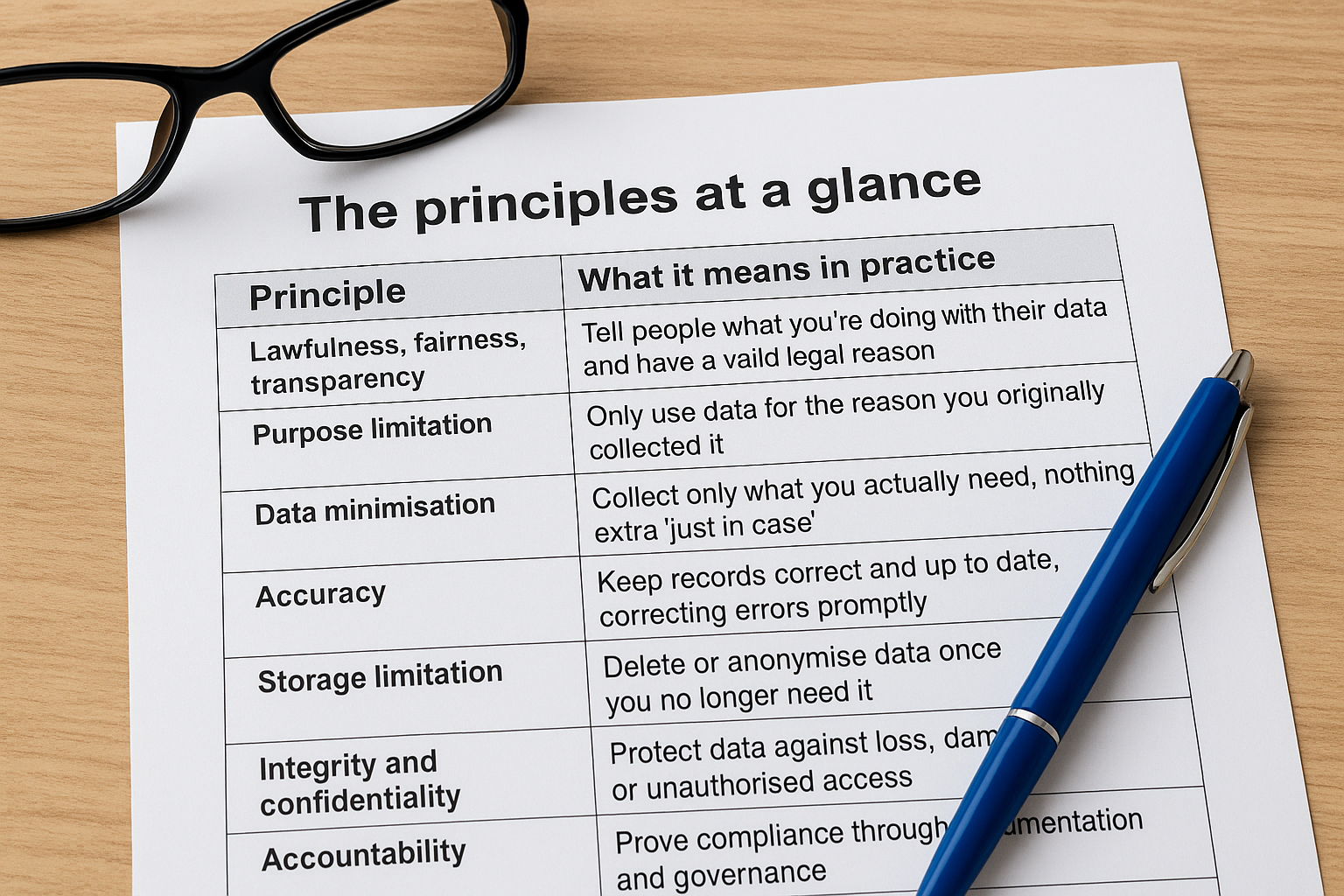
| Principle | What it means in practice |
|---|---|
| Lawfulness, fairness, transparency | Tell people what you’re doing with their data and have a valid legal reason |
| Purpose limitation | Only use data for the reason you originally collected it |
| Data minimisation | Collect only what you actually need, nothing extra "just in case" |
| Accuracy | Keep records correct and up to date, correcting errors promptly |
| Storage limitation | Delete or anonymise data once you no longer need it |
| Integrity and confidentiality | Protect data against loss, damage, or unauthorised access |
| Accountability | Prove compliance through documentation and governance |
Where businesses trip up
Most failures don’t come from ignoring the principles outright, they come from applying them loosely. Purpose limitation gets broken when marketing teams reuse customer contact lists for a new campaign nobody consented to. Storage limitation fails when HR systems still hold records for employees who left five years ago, simply because nobody assigned deletion responsibility. Retention creep like this is one of the most common issues we flag during audits, because it’s invisible until someone asks to see it.
Data protection principles only work when someone owns the responsibility for applying them day to day.
Regulators treat these lapses seriously because they signal weak governance, not just a single mistake. A business that can’t explain why it still holds outdated records, or why it collected far more data than a form required, struggles to demonstrate genuine compliance under this data protection legislation 2018, even if no breach has actually occurred yet.
Accountability ties it together
Sitting above the other six is accountability, arguably the principle that causes the most confusion. It requires you to actively demonstrate compliance, not just achieve it quietly in the background. That means keeping records of processing activities, running data protection impact assessments for higher-risk projects, and being able to show your working if the ICO ever asks. Businesses working through structured frameworks tend to handle this far more smoothly, because the documentation habit is already built into how they operate. This is exactly the discipline we build into our standards based cyber security audit, giving clients a clear paper trail that satisfies both regulators and commercial partners asking hard questions about data governance.
Your rights under the Data Protection Act 2018
Alongside the obligations placed on businesses, the data protection act 2018 hands individuals a set of enforceable rights over their own information. These aren’t goodwill gestures from a considerate organisation, they’re legal entitlements that customers, employees, and even job applicants can invoke at any time. Knowing what these rights are, and how quickly you’re expected to respond, is just as important as understanding your own compliance duties, because failing to honour them creates the same regulatory exposure as a data breach itself.
The eight rights individuals hold
Every person whose data you process, often called a data subject, holds a specific set of rights under this legislation. Businesses need a process ready to handle each one, not just a vague awareness that they exist.
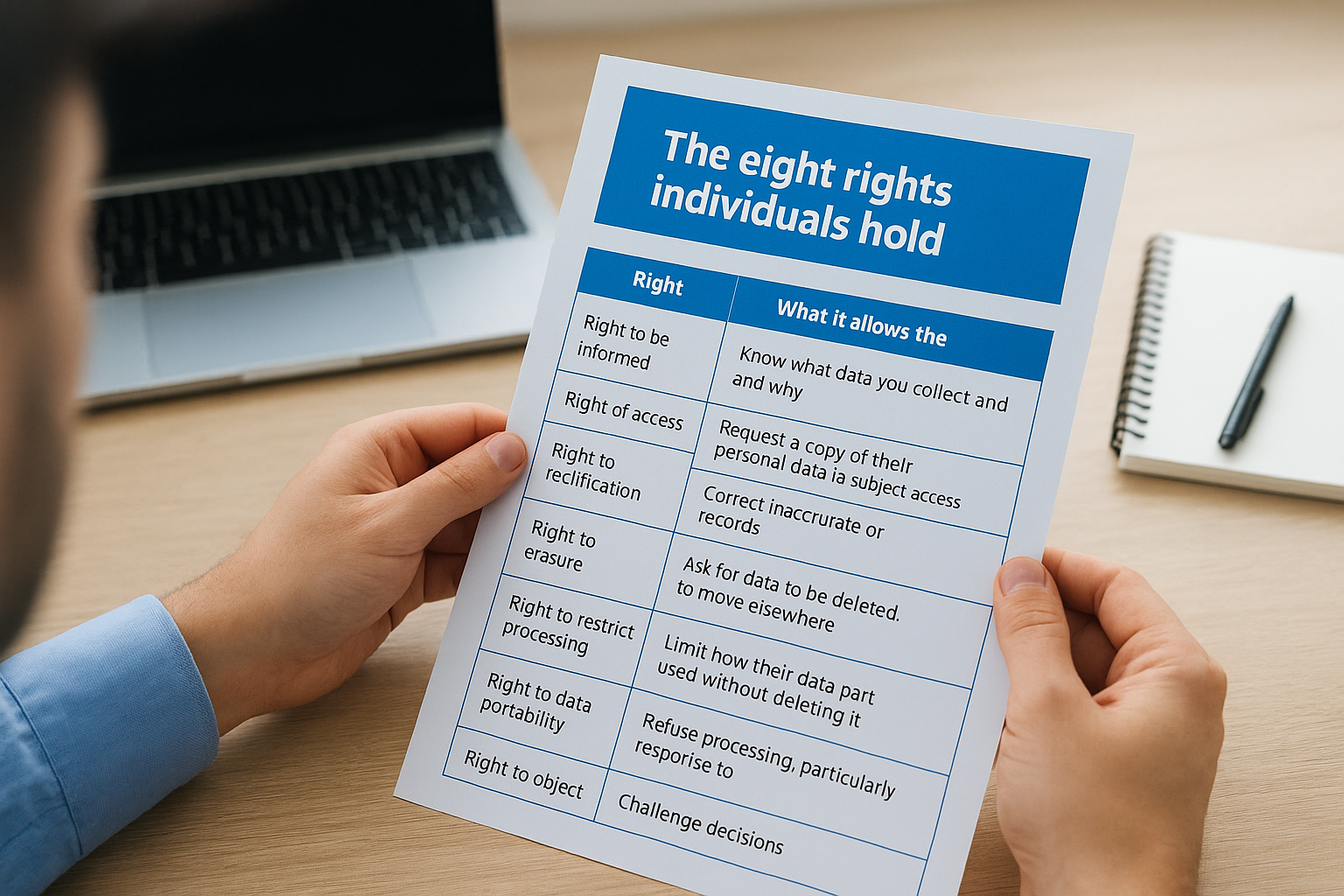
| Right | What it allows the individual to do |
|---|---|
| Right to be informed | Know what data you collect and why |
| Right of access | Request a copy of their personal data (a subject access request) |
| Right to rectification | Correct inaccurate or incomplete records |
| Right to erasure | Ask for data to be deleted, sometimes called the "right to be forgotten" |
| Right to restrict processing | Limit how their data is used without deleting it |
| Right to data portability | Receive their data in a usable format to move elsewhere |
| Right to object | Refuse processing, particularly for direct marketing |
| Rights related to automated decisions | Challenge decisions made without human involvement |
Responding to subject access requests
Subject access requests, or SARs, generate the most day-to-day friction for businesses. Once someone submits a request, you generally have one calendar month to respond, and that clock starts the moment the request lands, not when you get around to reading it. Organisations without a clear internal process often scramble to locate scattered records across email, spreadsheets, and legacy systems, which is exactly the kind of gap a proper data mapping exercise should have already closed.
A subject access request tests whether your data governance actually works, not just whether it exists on paper.
Having a documented SAR procedure, including who’s responsible for coordinating the response and how you verify the requester’s identity, turns a stressful scramble into a routine task, which is one reason implementing data governance pays off. Businesses that treat these requests as rare, one-off events tend to miss deadlines, and missed deadlines get reported to the ICO more often than most people assume.
Where businesses underestimate the risk
Companies frequently assume these rights only matter for customer-facing data, but employees hold identical rights over their HR records, appraisal notes, and internal communications. Disgruntled former staff exercising a right to access is one of the most common triggers for a data protection complaint we see referenced in incident work. Underestimating this exposes businesses to complaints that are entirely preventable with proper process.
Getting this right connects directly back to accountability. If you can’t produce a complete, accurate response within the legal timeframe, it signals the same governance weakness that shows up during an ICO investigation or a client’s due diligence check. Treating individual rights as a routine operational function, rather than an occasional legal headache, keeps your business on the right side of the data protection act uk requires.
What happens if the Act is breached
Breaching the data protection act 2018 isn’t just a compliance footnote, it triggers a formal enforcement process with real financial and operational consequences. The Information Commissioner’s Office and its regulatory role covers investigating complaints, auditing organisations, and issuing penalties where businesses fail to meet their obligations. Understanding what happens after a breach, rather than just how to prevent one, is essential because the way you respond in the first 72 hours often determines whether a bad situation becomes a catastrophic one.
The ICO’s enforcement powers
Organisations found in breach of the data protection act 2018 face a range of responses from the ICO, not all of which involve fines. The regulator can issue warnings, reprimands, enforcement notices demanding specific changes, or monetary penalties depending on severity and intent.
| Breach severity | Typical ICO response | Maximum penalty |
|---|---|---|
| Minor procedural failure | Warning or reprimand | No fine, corrective action required |
| Standard non-compliance | Enforcement notice | Up to £8.7 million or 2% of global turnover |
| Serious or repeated violation | Enforcement notice plus fine | Up to £17.5 million or 4% of global turnover |
These figures come directly from the ICO’s own guidance on penalties, and the higher tier applies to the most severe failures, including negligence around special category data or a total absence of basic security measures.
A fine is rarely the first consequence of a data breach, it’s usually the last one after reputational damage has already taken hold.
Reporting a breach within 72 hours
Under the Act, organisations must notify the ICO within 72 hours of becoming aware of a breach likely to risk people’s rights and freedoms, and notify affected individuals directly if the risk is high. Missing this window compounds the problem, since regulators view delayed reporting as an aggravating factor rather than a minor oversight. Businesses without a documented incident response plan almost always struggle to meet this deadline, because nobody has clearly assigned who investigates, who decides on notification, and who communicates with affected customers.
This is precisely where a structured response makes the difference between containment and chaos. Our 24/7 cyber incident response service exists for exactly this scenario, giving businesses a clear, tested process to follow the moment a breach is suspected, rather than improvising under pressure while the clock runs.
The cost beyond the fine itself
Financial penalties often represent the smallest part of the total damage. Legal fees, forensic investigation costs, customer notification exercises, and lost contracts from partners who reassess the relationship after a breach frequently dwarf the ICO’s fine. Reputational harm lingers longest, particularly for businesses in sectors where trust drives commercial decisions, such as healthcare, finance, or professional services. Treating breach response planning as an afterthought, rather than a core part of your data protection act uk obligations, leaves businesses exposed at precisely the moment they can least afford it.
Keeping personal data safe for the long term
The data protection act 2018 isn’t a hurdle to clear once and forget. It’s a standard your business either lives up to continuously or drifts away from quietly, until an audit, a subject access request, or a breach exposes the gap. Everything covered here, the seven principles, individual rights, and the ICO’s enforcement powers, points to the same conclusion: compliance works best as an ongoing habit built into daily operations, not a document pulled out when someone asks.
Getting there doesn’t require an in-house legal team. It requires knowing where your data sits, who’s accountable for it, and having a tested plan for when things go wrong. That’s where structured support pays for itself many times over. If you’d rather build that resilience properly than hope nothing goes wrong, talk to TrustedIA about accelerating your UK GDPR and DPA 2018 compliance and get your data protection obligations under control for good.



