

If you’ve searched for the principles of the Data Protection Act, you’re probably trying to work out exactly what your organisation is meant to comply with, and whether you’re already falling short. It’s a fair question. The older Data Protection Act 1998 had eight principles, but the current UK GDPR and Data Protection Act 2018 condensed these into seven. Mixing the two up is one of the most common compliance mistakes we see when auditing businesses.
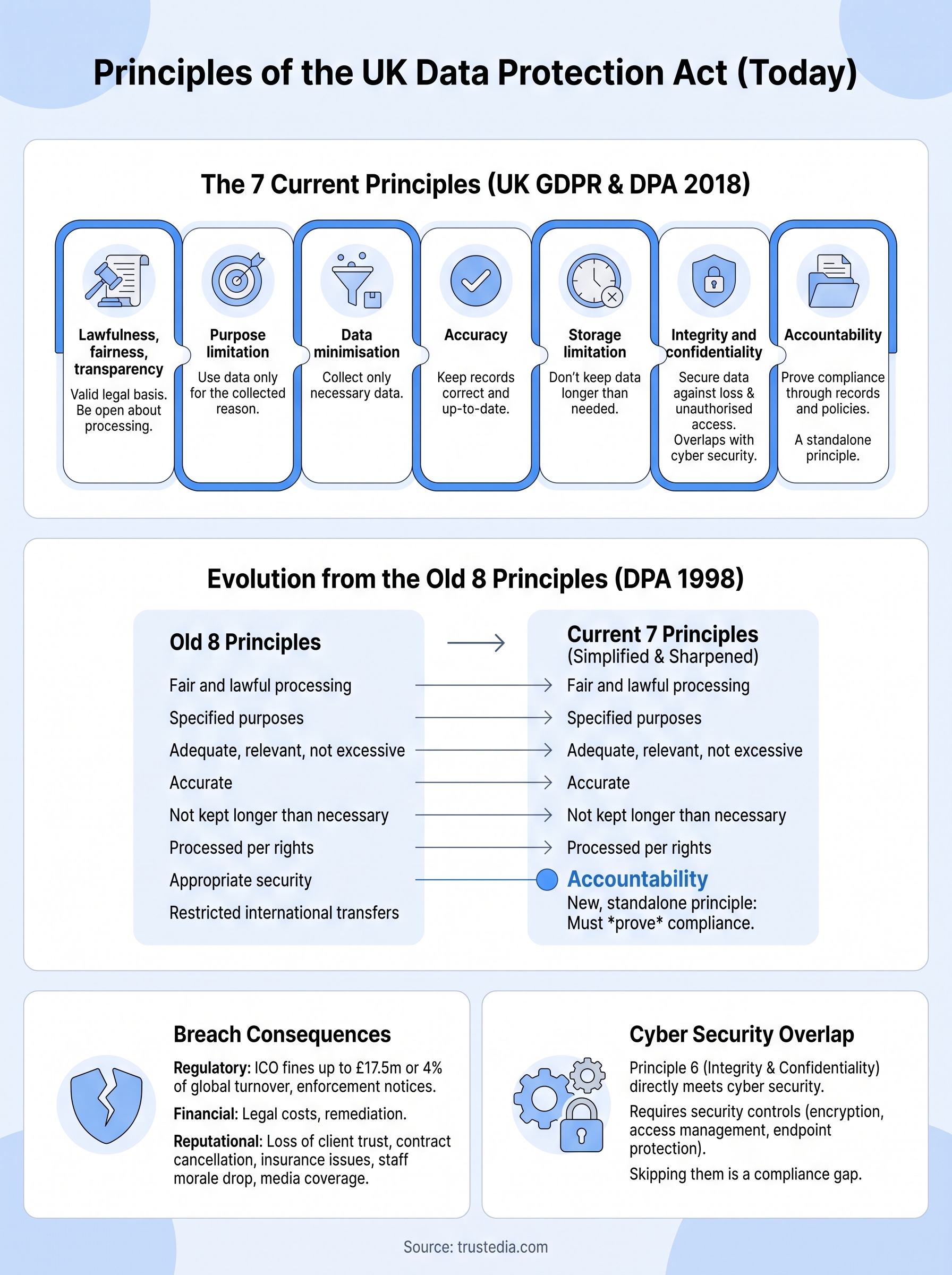
So, how many principles are there in the Data Protection Act today? Seven, under current UK law. Each one sets out a specific obligation, from lawfulness and transparency through to accountability, and together they form the backbone of how you must collect, store, and use personal data.
In this article, we’ll break down each of the seven principles in plain terms, show how they replaced the old eight-principle framework, and explain what they mean practically for your day-to-day operations. At TrustedIA, we help businesses turn these principles into working ISO 27001-aligned processes, so you’ll also see where compliance and real-world cyber security practice overlap.
Why the principles matter for your business
Every business that touches personal data, whether that’s customer records, employee files, or supplier contacts, is bound by these seven rules whether it likes it or not. Ignoring them isn’t a paperwork oversight, it’s a direct route to regulatory action, reputational damage, and lost contracts. Understanding the principles of the Data Protection Act properly means you can build data handling into how you already work, rather than bolting on compliance after something goes wrong.
The seven principles at a glance
Getting a clear view of all seven at once helps you spot where your current processes already comply, and where the gaps actually sit. Here’s a quick reference table showing what each principle covers and why it matters day to day:
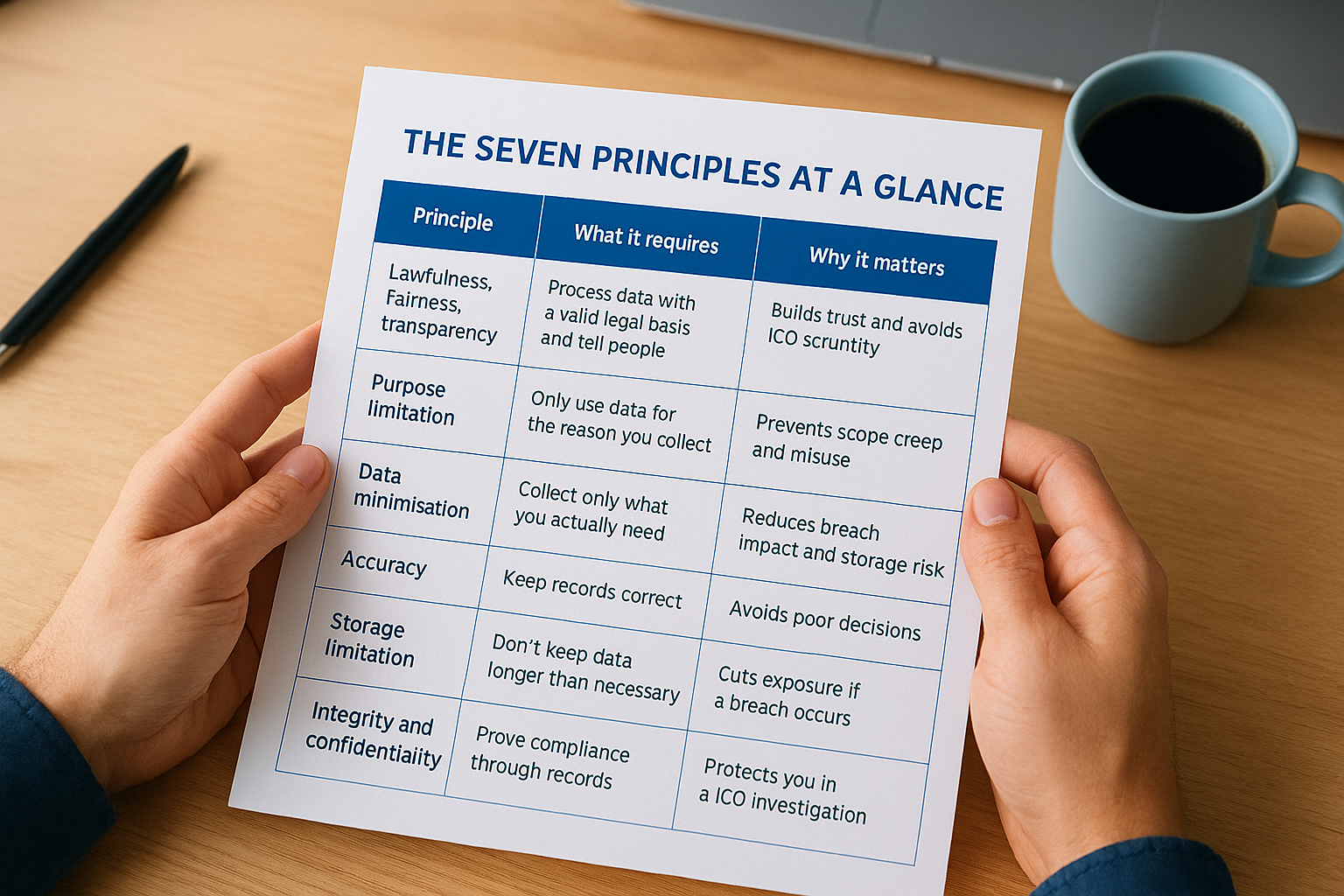
| Principle | What it requires | Why it matters |
|---|---|---|
| Lawfulness, fairness, transparency | Process data with a valid legal basis and tell people what you’re doing with it | Builds trust and avoids ICO scrutiny |
| Purpose limitation | Only use data for the reason you collected it | Prevents scope creep and misuse |
| Data minimisation | Collect only what you actually need | Reduces breach impact and storage risk |
| Accuracy | Keep records correct and up to date | Avoids poor decisions and complaints |
| Storage limitation | Don’t keep data longer than necessary | Cuts exposure if a breach occurs |
| Integrity and confidentiality | Secure data against loss, damage, or unauthorised access | Directly overlaps with your cyber security controls |
| Accountability | Prove compliance through records and policies | Protects you in an ICO investigation |
Trust, contracts, and market access
Clients and partners increasingly ask for evidence of data protection maturity before signing contracts, particularly in sectors handling sensitive information. Showing you take the data protection act and principles seriously, backed by documented policies, often opens doors that competitors without that evidence can’t access. Many procurement teams now treat data handling questions as standard due diligence, sitting alongside requests for ISO 27001 certification.
Get the seven principles right and data protection stops being a legal burden and becomes a genuine business advantage.
Where cyber security and compliance overlap
Naturally, the sixth principle, integrity and confidentiality, is where cyber security and legal compliance meet directly. Security controls like encryption, access management, and endpoint protection aren’t just good practice, they’re literally how you demonstrate compliance with this principle. Skipping proper security measures doesn’t just create a cyber risk, it creates a compliance gap that regulators will flag the moment something goes wrong.
How to apply the principles in daily operations
Knowing the principles of the Data Protection Act on paper is one thing. Actually running them through your daily operations is where most businesses stumble. You don’t need a compliance department to get this right, you need practical habits baked into how staff already work, from onboarding a new client to deleting an old spreadsheet.
Building principles into everyday processes
Start by mapping where personal data actually flows through your business, then attach a principle to each stage. Collecting a new customer’s details? That’s lawfulness and data minimisation in action. Storing old invoices? That’s storage limitation. Once staff see the connection between routine tasks and specific obligations, compliance stops feeling abstract.
Compliance sticks when it’s built into daily habits, not bolted on as an annual audit exercise.
A simple checklist helps embed this:
- Only collect data fields you genuinely need for the task
- Review retention periods every 12 months and delete what’s overdue
- Restrict access to personal data on a need-to-know basis
- Log any data-sharing agreements with third parties
- Train staff annually on handling personal data securely
Practical steps for smaller teams
Running this well doesn’t require enterprise-level resourcing. Smaller teams can assign one person as a data protection lead, even part-time, to own the checklist above and flag issues early. Reviewing access permissions quarterly, rather than leaving them unchanged for years, catches most integrity and confidentiality gaps before they become breaches. Automated retention reminders in your CRM or file storage system also take the guesswork out of storage limitation, so nobody’s relying on memory to delete old records. Ultimately, applying the principle of the Data Protection Act consistently across your operations is what separates businesses that pass an ICO enquiry comfortably from those that scramble to produce evidence after the fact.
How the old 8 principles compare to today’s 7
Businesses that have been operating since before 2018 often still think in terms of the 8 principles of the Data Protection Act, and it’s easy to see why. The original Data Protection Act 1998 set out eight distinct rules, and plenty of internal policies and training materials never got updated when the law changed. Knowing how the old framework maps onto the current one saves you from auditing against rules that no longer exist.
What the original eight covered
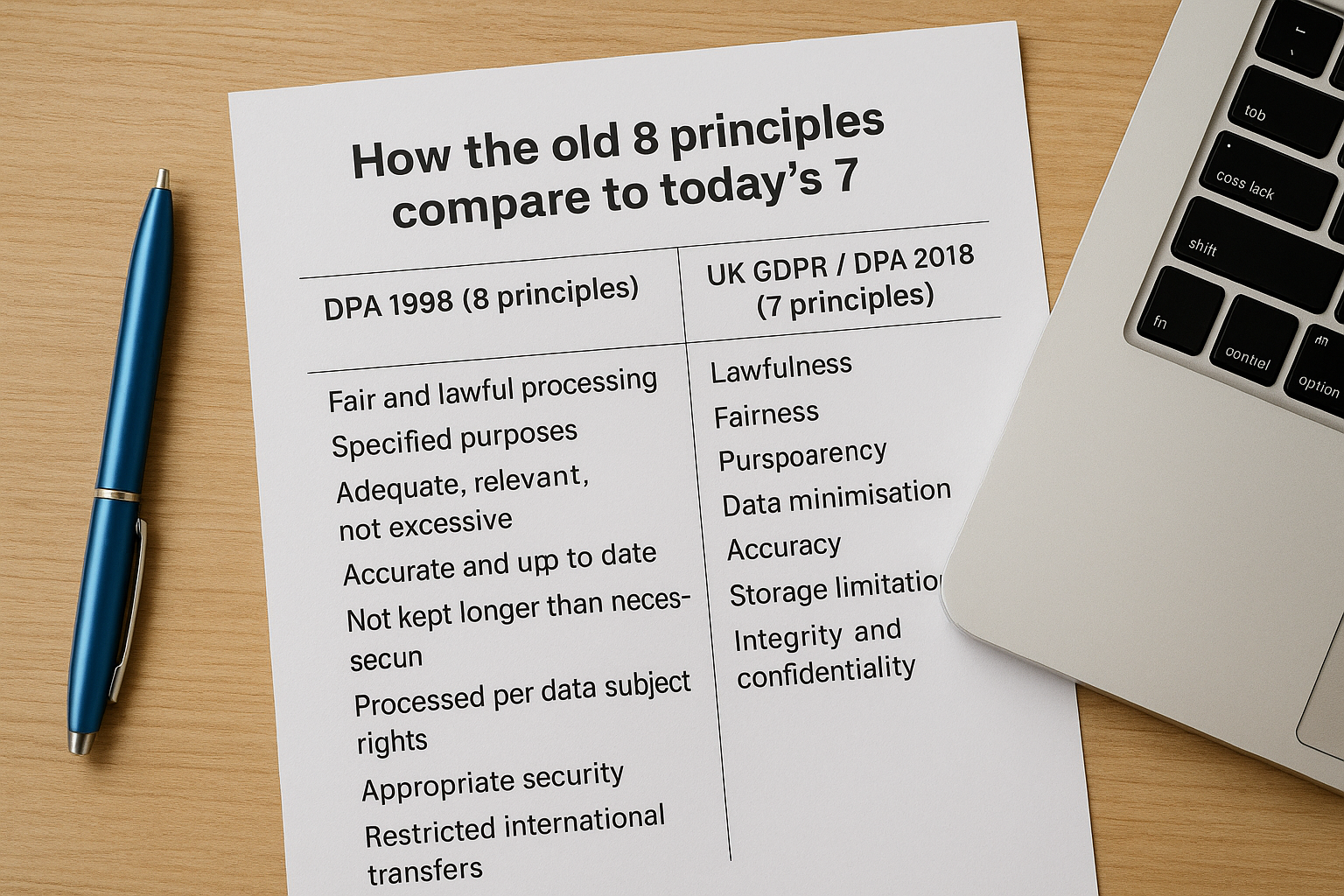
The 1998 Act required data to be processed fairly and lawfully, used only for specified purposes, adequate and not excessive, accurate, not kept longer than necessary, processed in line with individual rights, kept secure, and not transferred outside the European Economic Area without adequate protection. Reading that list next to today’s seven principles, you’ll notice most of the substance survived, just reorganised and sharpened.
| DPA 1998 (8 principles) | UK GDPR / DPA 2018 (7 principles) |
|---|---|
| Fair and lawful processing | Lawfulness, fairness, transparency |
| Specified purposes | Purpose limitation |
| Adequate, relevant, not excessive | Data minimisation |
| Accurate and up to date | Accuracy |
| Not kept longer than necessary | Storage limitation |
| Processed per data subject rights | Folded into accountability and transparency |
| Appropriate security | Integrity and confidentiality |
| Restricted international transfers | Governed separately under transfer rules |
The eight old principles didn’t disappear, they got sharper, merged, and given real teeth.
Why the update actually matters
Going from eight to seven wasn’t simplification for its own sake. Accountability emerged as a standalone principle, forcing you to prove compliance through documented policies, not just claim it. That single change explains why so many audits now focus on evidence, not intentions.
What happens if you breach the principles
Breaching the principles of the Data Protection Act rarely stays a quiet internal issue. The Information Commissioner’s Office (ICO) can investigate, issue enforcement notices, and impose fines that scale with the severity and negligence involved. Even a minor lapse, like failing to delete old customer records under storage limitation, can trigger a formal complaint if a data subject notices and reports it.
Regulatory and financial consequences
Fines under UK GDPR can reach £17.5 million or 4% of global annual turnover, whichever is higher, for the most serious breaches. Most enforcement action against SMBs sits well below that ceiling, but even a modest penalty combined with legal costs and remediation work adds up quickly. The ICO publishes enforcement action regularly, and it’s worth reviewing cases in your sector to see what actually triggers investigation.
A breach doesn’t just cost money, it costs the trust you spent years building with clients and partners.
Reputational and operational fallout
Beyond fines, breaching the 8 data protection act principles framework or its modern equivalent damages relationships that took years to build. Consider the knock-on effects:
- Clients pause or cancel contracts pending your remediation
- Insurers may increase premiums or refuse renewal
- Procurement teams flag you during future tender processes
- Staff morale drops when incidents stem from avoidable process gaps
- Media coverage, even local, sticks to search results for years
For businesses working with insurers or loss adjusters, this is exactly where a structured incident response plan earns its keep. Recovering quickly and demonstrating accountability afterwards, through documented actions and lessons learned, often determines whether a breach becomes a footnote or a lasting reputational problem.
Keeping your data protection practices on track
Seven principles, one clear obligation: know your data, protect it, and prove you’re doing so. Whether you’re mapping old habits from the 1998 Act or building fresh processes under UK GDPR, the principles of the Data Protection Act only work when they’re lived day to day, not filed away after an audit. Treat lawfulness, minimisation, and accountability as operational habits rather than legal checkboxes, and you’ll find compliance stops draining time and starts protecting the business you’ve actually built.
Getting this right consistently, especially where security and compliance overlap, is exactly where most in-house teams need outside expertise. TrustedIA has spent over 30 years helping businesses turn these principles into working, auditable practice, backed by ISO 27001 expertise and real incident response experience. If you’re ready to stop guessing and start proving compliance, talk to TrustedIA about your cyber security posture.



