
If you’ve stumbled across a reference to the Data Protection Act 1998 (DPA 1998) in an old contract, a compliance audit, or a legal case, you’re probably wondering why it still gets mentioned when GDPR has been the law for years. It’s a fair question, and understanding the answer matters if your organisation handles historical records or is trying to make sense of how UK data law got to where it is today.
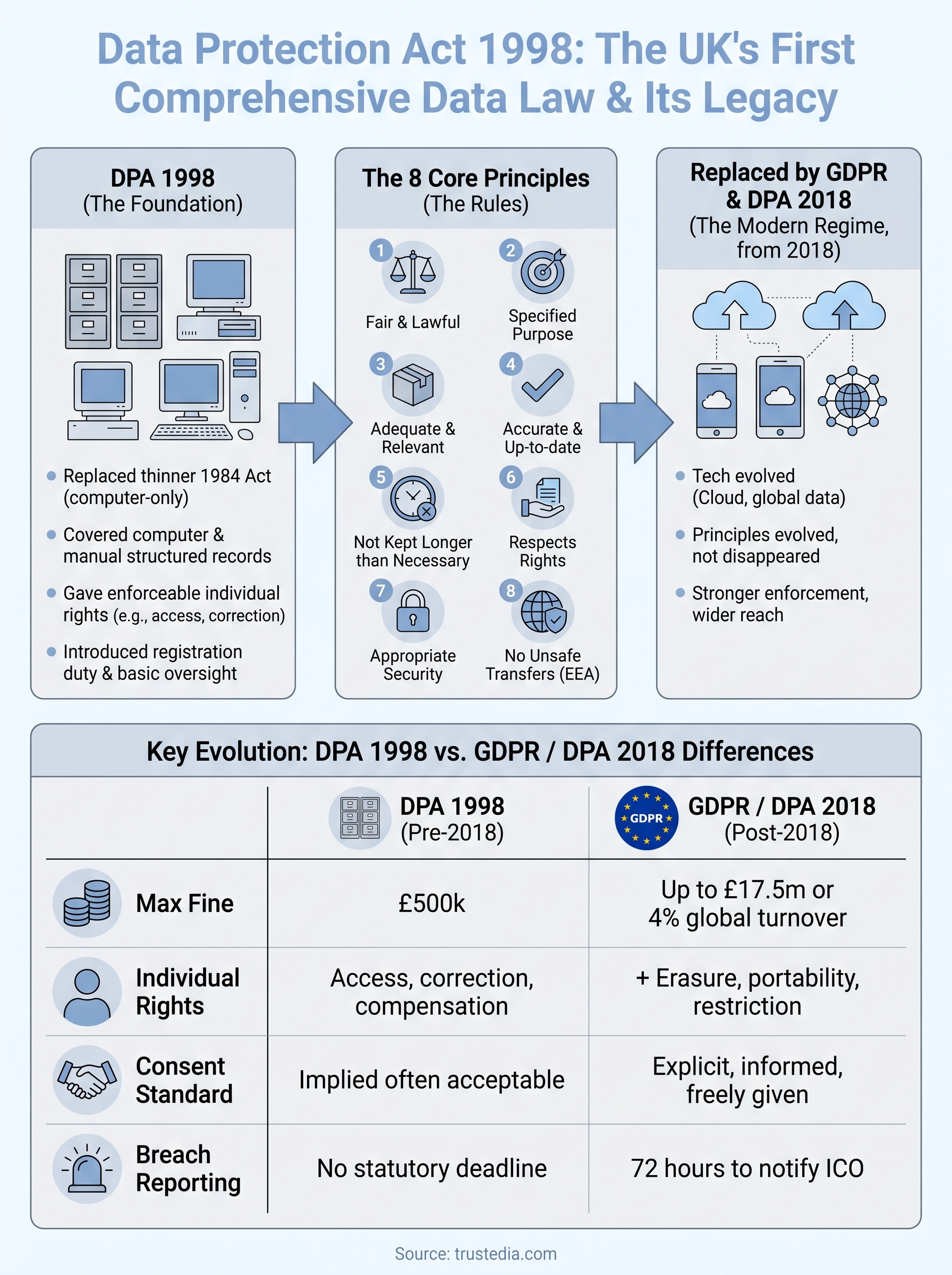
In short, the DPA 1998 was the first comprehensive UK law governing how personal data could be collected, stored, and used. It set out eight core data protection principles that shaped how businesses handled customer and employee information for nearly two decades, until it was replaced by the Data Protection Act 2018 alongside GDPR.
This article walks through what the Act actually covered, the eight principles that underpinned it, who it applied to, and why its legacy still shapes how we think about compliance today. At TrustedIA, we work with businesses every day to meet current standards like ISO 27001, so knowing where the rules came from helps put today’s obligations into proper context.
Why the Data Protection Act 1998 mattered
Before 1998, the UK’s approach to data protection was thin. The Data Protection Act 1984 existed, but it only covered information held on computers and gave people very few practical rights over what organisations did with their details. Businesses could hold personal records with little oversight, and individuals had almost no way to challenge inaccurate or misused information. When the EU Data Protection Directive (95/46/EC) arrived, the UK had to bring its domestic law up to a much higher standard, and that’s exactly what the data protection act 1998 was built to do.
Filling a legal gap left by the 1984 Act
Unlike its predecessor, the 1998 legislation covered both computerised and paper-based records held in structured filing systems. That single change was significant. HR files, customer correspondence, and handwritten client notes suddenly fell under the same rules as digital databases. Organisations that had never thought twice about a filing cabinet full of application forms now had a legal duty to manage that information responsibly.
| Feature | Data Protection Act 1984 | Data Protection Act 1998 |
|---|---|---|
| Scope | Computerised records only | Computerised and structured manual records |
| Individual rights | Very limited | Subject access, correction, compensation |
| Registration | Basic registration scheme | Formal notification to the Data Protection Registrar |
| Enforcement | Weak, few penalties | Enforcement notices, court action, damages |
| EU alignment | None | Implemented EU Directive 95/46/EC |
Handing individuals enforceable rights
For the first time, people in the UK had a genuine legal mechanism to find out what organisations knew about them. Under the Act, anyone could submit a subject access request and expect a response within statutory time limits, request corrections to inaccurate records, and in some cases claim compensation for damage caused by misuse of their data. This wasn’t a courtesy extended by well-meaning companies. It was a right backed by law, and it changed the balance of power between individuals and the organisations holding their information.
The Data Protection Act 1998 gave ordinary people, for the first time, an enforceable legal claim over how businesses used their personal information.
Government departments, banks, retailers, and employers all had to rethink how they collected and stored personal details. If you want to see how the legislation was actually worded, the original text is still available through legislation.gov.uk, and it’s worth a skim if you’re dealing with historical compliance questions or legacy contracts that still reference it.
Forcing organisations to take data seriously
What made the data protection act 1998 matter beyond individual rights was the cultural shift it forced inside organisations. Companies had to appoint people responsible for data compliance, register their processing activities, and think through the consequences of collecting information they didn’t strictly need. That discipline sounds basic now, but in the late 1990s it was new territory for most UK businesses.
Smaller companies especially struggled at first. Many hadn’t audited what personal data they held, let alone documented why they held it or how long they’d keep it. The Act pushed organisations toward practices that feel obvious today, like data minimisation and secure storage, but were genuinely novel at the time. Those habits didn’t disappear when the law was replaced. They became the foundation that GDPR and the current Data Protection Act 2018 built upon, which is one reason understanding the 1998 legislation still helps make sense of the compliance obligations businesses face now.
How the Data Protection Act 1998 worked in practice
Understanding what the data protection act 1998 actually asked of organisations means looking past the headline principles and into the daily mechanics of compliance. The law didn’t just set expectations, it created a structured system of registration, obligations, and enforcement that businesses had to build into their operations. If you ran a company handling customer records in the late 1990s or 2000s, this is the machinery you’d have been dealing with.
The eight data protection principles
At the heart of the legislation sat eight data protection principles that every data controller had to follow. These principles governed the entire lifecycle of personal data, from collection through to deletion:

- Personal data must be processed fairly and lawfully
- Data must be obtained only for specified, lawful purposes
- Information held must be adequate, relevant, and not excessive
- Data must be accurate and kept up to date
- Records should not be kept longer than necessary
- Processing must respect the rights of individuals
- Appropriate security measures must protect the data
- Personal data could not be transferred outside the European Economic Area without adequate protection
Every principle in the data protection act 1998 existed to answer one question: can this organisation justify what it’s doing with someone’s personal information?
Regulators expected organisations to be able to demonstrate compliance with each principle, not just claim it. That meant documented policies, defined retention periods, and clear justifications for why particular data was collected in the first place.
Registering with the Data Protection Registrar
Before processing personal data, most organisations had to formally notify the Data Protection Registrar, later renamed the Information Commissioner. This notification listed what kinds of data the organisation held, why it was collected, and who it might be shared with. Failing to register when required was itself a criminal offence, which gave the requirement real teeth rather than treating it as paperwork.
Enforcement, complaints, and penalties
Going further than the 1984 Act, this legislation gave the regulator genuine enforcement powers. The Information Commissioner could issue enforcement notices ordering an organisation to change its practices, and persistent breaches could end up in court. Individuals who suffered damage from misuse of their data could also claim compensation directly, which added a private route to accountability alongside regulatory action.
Daily compliance under the 1998 data protection act looked a lot like today’s obligations, just with fewer digital tools and less automated monitoring. Businesses tracked data manually, relied on paper audit trails, and often struggled to keep registration details current as their operations grew. That gap between legal expectation and practical capability is part of why later reform became necessary, a theme we’ll pick up next.
What replaced the Data Protection Act 1998
Growth in technology moved faster than the 1998 legislation ever anticipated. Cloud storage, smartphones, and global data flows meant a law written for filing cabinets and desktop databases couldn’t keep pace with how organisations actually collected and shared information by the mid-2010s. Regulators across Europe recognised the gap, and the result was a wholesale replacement rather than a patch job.
The arrival of GDPR and the Data Protection Act 2018
On 25 May 2018, the General Data Protection Regulation (GDPR) came into force across the EU, and the UK passed the Data Protection Act 2018 alongside it to fill in the domestic detail GDPR left to member states. Together, these two pieces of law replaced the data protection act 1998 in its entirety. The eight principles didn’t vanish, they evolved into GDPR’s data protection principles, but the new framework went considerably further. You can read the official government summary of the current regime on GOV.UK, which sets out how the 2018 Act and GDPR work together.
GDPR didn’t tear up the 1998 rulebook, it rewrote it with sharper teeth and a much wider reach.
Several changes stand out immediately when you compare the two regimes side by side:
| Feature | Data Protection Act 1998 | GDPR / Data Protection Act 2018 |
|---|---|---|
| Maximum fine | £500,000 | Up to £17.5m or 4% of global turnover |
| Consent standard | Implied consent often acceptable | Explicit, informed, freely given consent required |
| Breach reporting | No statutory deadline | 72 hours to notify the ICO |
| Territorial reach | UK-focused | Applies to any organisation processing UK/EU residents’ data |
| Individual rights | Access, correction, compensation | Adds erasure, portability, restriction, objection |
Brexit and the UK GDPR
After the UK left the EU, the government retained GDPR’s substance through UK GDPR, sitting alongside the Data Protection Act 2018. This meant businesses didn’t face a sudden regulatory vacuum post-Brexit, though it did create two parallel regimes (UK GDPR and EU GDPR) for organisations operating across both markets. Anyone still referencing data protection legislation 1998 in a contract today is almost certainly dealing with a document that predates this entire transition and needs updating.
Why the fines got so much bigger
Under the 1998 data protection act, financial penalties rarely reflected the real cost of a data breach to individuals or the wider economy. GDPR’s enforcement structure was designed deliberately to change that calculation, making non-compliance a board-level financial risk rather than a manageable operating cost. Fines against major organisations in the years since 2018 have shown regulators are willing to use that power, which is precisely the deterrent the old regime lacked.
What the DPA 1998’s legacy means for businesses today
Even though the data protection act 1998 has been off the books since 2018, its fingerprints are all over how UK businesses handle personal data now. The eight principles didn’t disappear, they became the DNA of GDPR’s data protection rules, so any team that already had solid 1998-era habits had a genuine head start when the new regime arrived. Recognising that continuity matters if you’re building a compliance programme today, because you’re not starting from zero, you’re building on a foundation that’s been tested for over two decades.
Legacy documents still need attention
Paperwork drafted under the old law hasn’t magically updated itself. Contracts, privacy notices, and internal policies written before 2018 that still reference data protection legislation 1998 are a genuine liability if left unreviewed, because they typically promise weaker rights and shorter retention rules than current law requires. Businesses that inherited older systems, whether through acquisition, legacy suppliers, or simply never getting round to it, should treat this as a practical audit task rather than a formality:
- Search contracts and supplier agreements for references to the 1984 or 1998 Acts and flag them for renewal
- Check retention schedules against current UK GDPR requirements, not the older standards
- Confirm privacy notices reflect current subject rights, including erasure and portability
- Review historical subject access request logs for consistency with today’s response timelines
A contract that still cites the data protection act 1998 is a warning sign, not a footnote.
Building on old habits rather than starting over
Organisations that took the 1998 principles seriously, appointing a data controller, documenting retention periods, running basic security reviews, already had most of the scaffolding GDPR expected. That’s the real legacy value here. The discipline of asking why you’re holding a piece of data, and for how long, predates GDPR by twenty years, and it’s exactly the mindset frameworks like ISO 27001 formalise into a certifiable management system today.
Regulatory memory works differently too. The Information Commissioner’s Office (ICO) still draws on enforcement precedent built under the 1998 regime when interpreting current cases, which means historical compliance failures can still carry weight in how a business is viewed today. Teams that understand where the eight principles came from tend to explain their current obligations more convincingly to staff, because the logic behind the rules makes sense rather than feeling like arbitrary red tape.
For businesses still untangling legacy contracts or unsure whether their current practices genuinely meet modern standards, TrustedIA’s cyber audit services can map exactly where the gaps sit, and how to close them without starting your compliance programme from scratch.
Where UK data protection stands now
UK GDPR and the Data Protection Act 2018 govern personal data today, but the data protection act 1998 laid the groundwork that made those rules workable. Its eight principles became the template regulators still build on, and its enforcement gaps taught the UK exactly what stronger data protection legislation needed to fix. Understanding that history isn’t just trivia, it explains why current obligations look the way they do and why regulators expect the discipline the 1998 Act first demanded.
Knowing where the rules came from is one thing. Knowing whether your organisation actually meets them is another. Legacy contracts, outdated retention schedules, and half-documented policies don’t fix themselves, and they’re exactly the kind of gaps that surface during a real audit or, worse, after a breach. If you’re not confident your current practices hold up, get in touch with TrustedIA and let our cyber audit team show you precisely where you stand.



