Most breaches today do not happen because a firewall failed. They happen because someone already inside the network, a user, a device, or an app, was trusted by default and abused that trust. The zero trust security model flips this old assumption on its head. Instead of granting access based on network location, it demands that every request proves itself, every single time.
If you are trying to understand what zero trust actually means beyond the marketing buzz, here is the short version: never trust, always verify. No user, device, or application gets a free pass just because it sits inside your perimeter. Every connection is authenticated, authorised, and continuously checked, whether it originates from your office, a home network, or a supplier’s laptop.
In this article, we break down how zero trust architecture actually works, the core principles behind it, and what implementing it looks like in practice. We draw on what we see daily managing security operations for UK businesses, so you get a grounded explanation rather than vendor theory.
Why the zero trust model matters for your business
UK businesses have spent decades building networks around a simple idea: things inside the perimeter are safe, things outside are not. That idea is now dangerously outdated. Employees work from home, contractors log in from personal devices, and critical data lives in SaaS platforms you don’t control. The zero trust security model matters because it accepts this reality instead of pretending your network still has clean edges.
The perimeter has quietly disappeared
Think about how many places your data actually touches in a normal week: a laptop at home, a phone on 4G, a supplier’s system, a cloud storage bucket. Traditional security assumed a single, defensible boundary. That boundary is gone. Remote and hybrid work turned every home router into part of your attack surface, and cloud adoption scattered your data across services that sit entirely outside your old firewall. Zero trust matters because it protects the data and the identity, not a network boundary that no longer reflects how people actually work.
One stolen password shouldn’t mean total access
Credential theft is still the leading way attackers get in. Once inside, many networks let that attacker move sideways with little resistance, because internal traffic was trusted by default. This is where zero trust earns its keep: it treats every request as suspicious until verified, so a compromised account doesn’t automatically become the keys to everything.
A single stolen password should never be enough to reach your entire network.
We see this pattern constantly through our CyberSOS incident response work: the initial breach is rarely the expensive part. The expensive part is what the attacker reaches afterwards.
The cost of getting this wrong
Breach costs in the UK keep climbing, and the figures from official UK government cyber security breaches survey data show that mid-sized organisations regularly lose tens of thousands of pounds per serious incident, before accounting for reputational damage or lost contracts. Zero trust reduces this exposure by limiting what any single compromised credential or device can actually touch.
| Impact area | Perimeter-only approach | Zero trust approach |
|---|---|---|
| Lateral movement after breach | Often unrestricted | Contained by segmentation |
| Remote worker risk | High, trust assumed by location | Low, verified per session |
| Third-party access | Broad, hard to audit | Scoped and monitored |
| Compliance readiness | Manual, patchy | Continuous, evidence-based |
Compliance is catching up to the model
Regulators and insurers increasingly expect the controls zero trust delivers as standard practice. ISO 27001 certification, cyber insurance renewals, and supply chain audits now regularly ask whether you enforce least-privilege access and continuous verification. Businesses that already operate this way sail through those assessments. Those that don’t often scramble to retrofit controls under deadline pressure, which is a far more expensive and stressful way to arrive at the same destination.
How zero trust security works in practice
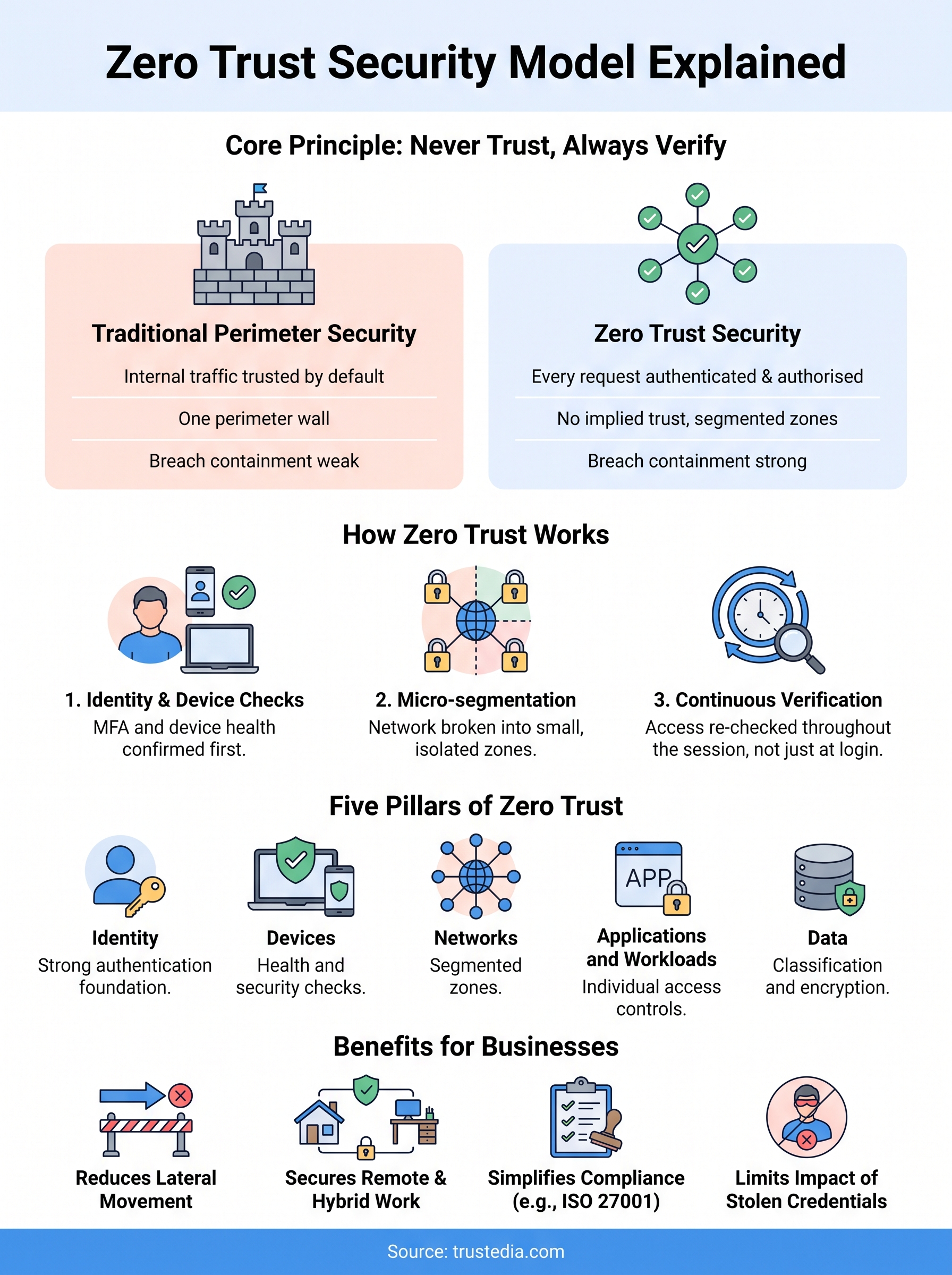
Zero trust isn’t a single product you switch on. It’s a set of policies enforced continuously across every access request, whether that request comes from a person, a device, or an application talking to another application. A policy engine sits at the centre of this, evaluating identity, device health, location, and behaviour before granting access, and it keeps checking after access is granted rather than trusting a session indefinitely.
Identity and device checks come first
Before anything else happens, the system confirms who is asking and what they’re asking from. Multi-factor authentication replaces the old single password gate, and device posture checks confirm the laptop or phone meets your security baseline before it touches anything sensitive.
- Is the user who they claim to be, confirmed through MFA?
- Is the device patched, encrypted, and free of known malware?
- Does the request match normal behaviour for this user and role?
- Is the location or network consistent with expected patterns?
Only when these checks pass does the system move to the next step.
Micro-segmentation contains any breach
Granting access doesn’t mean granting everywhere. Micro-segmentation breaks your network into small, isolated zones, so a compromised laptop in finance can’t quietly reach engineering servers or customer databases. Each segment enforces its own access rules, which shrinks the space an attacker can move through even after they get a foothold.
Continuous verification, not one-off logins
Here’s the part traditional security misses entirely: trust granted at login doesn’t automatically continue for the rest of the session. Continuous verification re-checks context throughout a session, flagging anything unusual, an odd file transfer at 2am, a sudden request to reach a system this user has never touched, a login attempt from an unexpected country.
Access earned five minutes ago doesn’t guarantee trust right now.
This ongoing scrutiny is what separates the zero trust security model from older approaches that verified once and then relaxed. Threat actors count on that relaxation. Zero trust removes it.
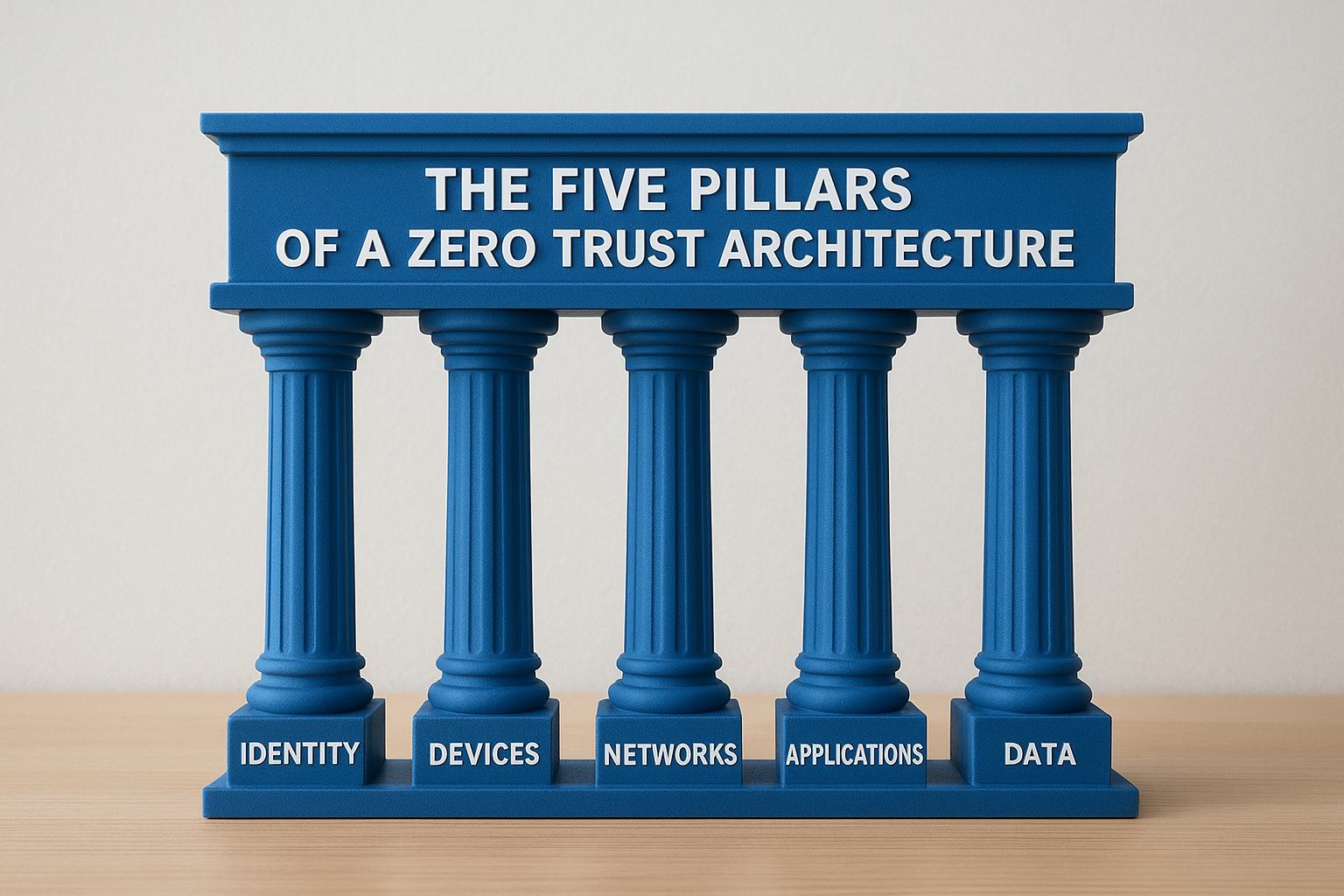
The five pillars of a zero trust architecture
Most zero trust frameworks, including the one from NIST’s zero trust architecture guidance, break the model into distinct pillars that together cover every place an attacker could try their luck. Rather than treating security as one big wall, you build controls around each of these areas separately, so a gap in one doesn’t leave the others exposed. Understanding these pillars gives you a practical checklist for auditing where your own defences stand today.
Identity
Identity is the foundation everything else depends on. Every user, service account, and device needs a verified identity before it gets near your systems, backed by strong authentication rather than a password alone. Weak identity controls undermine every other pillar, because an attacker who steals a valid identity inherits whatever trust that identity carries.
Devices
A verified user on a compromised laptop is still a risk. This pillar checks device health continuously, confirming patches are current, disk encryption is active, and no known malware is present before that device reaches sensitive systems.
Networks
Networks stop being flat, trusted spaces and become segmented zones with their own access rules. Network segmentation limits how far any single compromised account or device can travel, containing incidents that would otherwise spread unchecked.
Applications and workloads
Every application, whether on-premises or in the cloud, gets treated as its own protected surface with access controls that don’t assume internal traffic is automatically safe.
Data
Data sits at the centre of the model, because protecting it is the actual point. Data classification and encryption ensure that even if other controls fail, the information itself remains protected.
Protect the data directly, and every other control becomes a backup, not the only line of defence.
Strengthening all five pillars together, rather than picking one favourite, is what separates a genuine zero trust architecture from a partial rollout that still leaves obvious gaps for attackers to exploit.
Zero trust versus traditional perimeter security
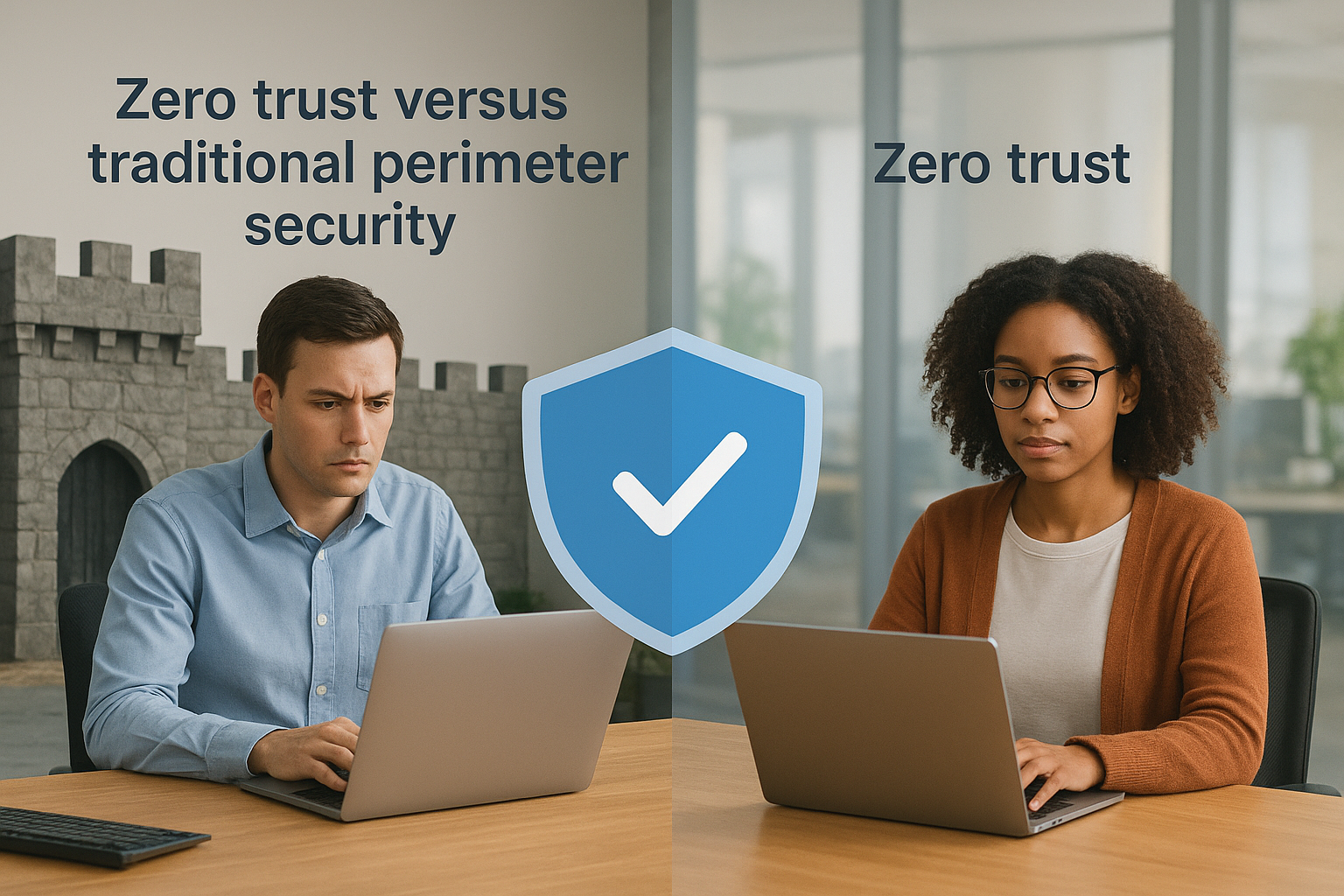
Traditional perimeter security works like a castle wall: build it thick enough, and everything inside is treated as safe. Zero trust security rejects that idea entirely, verifying every request regardless of where it comes from. The difference isn’t cosmetic. It changes what happens the moment something goes wrong inside your network, which is exactly when perimeter defences historically fall apart.
Trust assumptions flip completely
Perimeter models assume internal traffic is trustworthy and external traffic is not, so once a user or device gets past the firewall, they roam relatively freely. Zero trust architecture assumes nothing is trustworthy by default, inside or outside, and checks continuously rather than once at the door. This single shift explains most of the practical differences below.
| Factor | Traditional perimeter | Zero trust |
|---|---|---|
| Trust basis | Network location | Verified identity and context |
| Internal traffic | Trusted by default | Verified like any other request |
| Breach containment | Weak, attacker roams freely | Strong, segmented zones limit reach |
| Remote work fit | Poor, relies on VPN trust | Built for distributed access |
| Ongoing checks | Rare after login | Continuous throughout session |
Perimeter tools still have a role
Firewalls, VPNs, and network boundaries haven’t become useless overnight. They still filter obvious noise and provide a first layer of defence. What’s changed is their job description: they’re no longer the entire strategy, just one control among many. Relying on them alone leaves the exact gap attackers exploit once they’re past that single wall.
A wall around your network means nothing once someone’s already standing inside it.
Why the shift matters for UK businesses specifically
Businesses running hybrid teams, cloud platforms, and third-party suppliers simply don’t have a perimeter that maps to reality anymore. Legacy VPN setups grant broad network access the moment credentials check out, which is precisely the weakness attackers target through phishing and credential theft. Moving toward zero trust doesn’t mean ripping out your existing infrastructure overnight. It means layering identity, device, and continuous verification checks on top of what you already have, so a single compromised login stops being a total network compromise.
Getting started with zero trust adoption
Adopting the zero trust security model doesn’t mean tearing out your network and starting again. It means layering verification and segmentation onto what you already run, in a deliberate order that reduces risk at each step rather than creating chaos. Businesses that succeed treat this as a multi-year programme, not a weekend project.
Start with an honest audit
You can’t protect what you haven’t mapped. Asset visibility comes first: list every system, application, and data store, then note who and what currently has access to each one. Most organisations discover far more standing access than they expected, often left over from staff who changed roles or left entirely.
- Identify your most sensitive data and where it actually lives
- List every account with access to that data, human and machine
- Flag any access that’s broader than the role genuinely requires
- Check which systems still rely on passwords alone
Prioritise identity and access first
Once you know what you’re protecting, fix identity controls before anything else. Multi-factor authentication and least-privilege access deliver the biggest risk reduction for the least disruption, and they lay the groundwork every other pillar depends on. Trying to segment networks before identity is solid just moves the same weak trust into smaller boxes.
Fix identity first, because every other control depends on knowing who’s really asking.
Roll out in phases, not overnight
Pick one business-critical system, apply zero trust controls there, and learn from what breaks before expanding. This phased approach avoids the operational disruption that comes from flipping every switch at once, and it gives your team a working template to repeat elsewhere. A managed security partner who has done this before can shortcut a lot of the trial and error, particularly around policy tuning and staff communication, which is where most internal rollouts stall.
Building a zero trust mindset
Zero trust isn’t a product you buy once and forget. It’s a habit of questioning every request, every device, and every login, no matter how familiar it looks. The businesses that get this right treat continuous verification as normal practice, not an occasional audit exercise, and they keep refining their identity and segmentation controls as their systems and teams change.
Getting there takes planning, the right tooling, and a clear order of priorities, which is exactly why so many UK businesses bring in specialist support rather than guessing their way through a rollout. Our team at TrustedIA works with organisations daily on exactly this journey, from initial audits through to full zero trust architecture deployment, backed by ISO 27001 expertise and real incident response experience. If you’re ready to move beyond perimeter thinking and build defences that match how your business actually operates, get in touch with TrustedIA to start the conversation.