
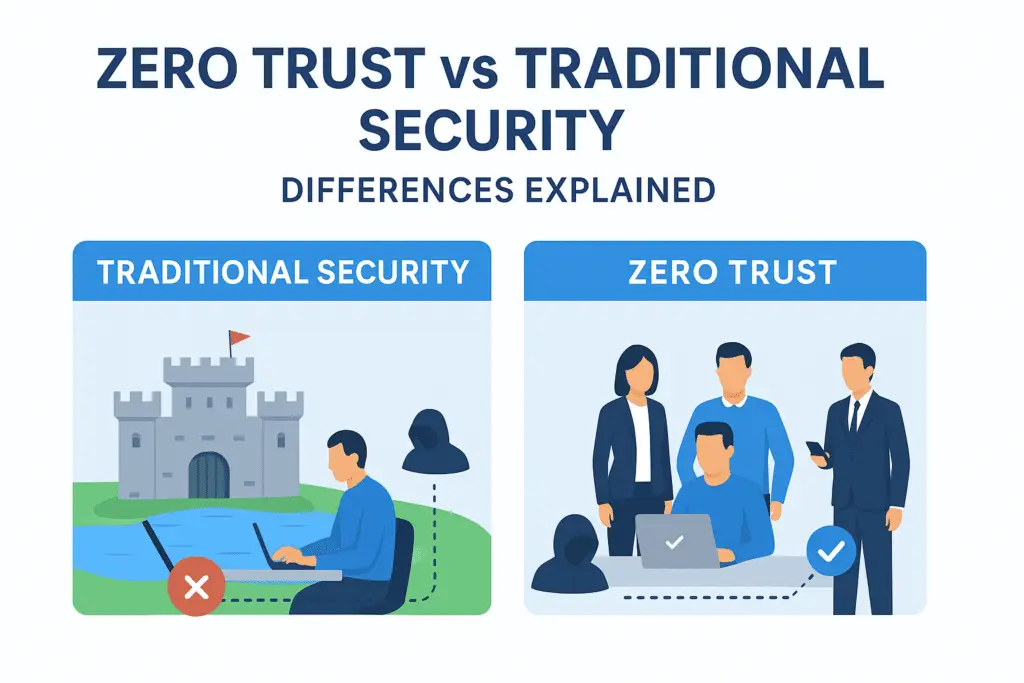
Most businesses still rely on a security model built around a simple idea: trust everything inside the network, block everything outside. That worked when employees sat at office desks and data lived on local servers. But remote work, cloud services, and increasingly sophisticated attacks have exposed serious cracks in that thinking. Understanding zero trust vs traditional security comes down to a fundamental shift in how organisations grant and verify access to their systems and data.
Traditional security draws a line around your network and assumes anything inside that perimeter is safe. Zero Trust flips that assumption entirely, no user, device, or application is trusted by default, regardless of where it connects from. Every access request must be verified. It’s a model designed for how businesses actually operate now, not how they operated twenty years ago.
At TrustedIA, we help organisations across the UK assess their security posture and implement the right controls through our managed security services, cyber audits, and ISO 27001 expertise. This article breaks down the core differences between these two models, explains where traditional perimeter security falls short, and helps you determine which approach best protects your business.
What zero trust and traditional security mean
Before comparing the two approaches, it helps to understand what each one actually does and why each was designed the way it was. Traditional perimeter security and Zero Trust represent two distinct philosophies about where risk sits in a network and how access should be controlled as a result.

Traditional perimeter security explained
Traditional security operates on a castle-and-moat model. The idea is straightforward: build a strong barrier around your network, and once someone is inside, they can move around with relatively few restrictions. Tools like firewalls, VPNs, and intrusion detection systems form that outer wall. Anything sitting inside the perimeter is considered trusted by default, while everything outside is treated as a potential threat.
This model made practical sense when most employees worked from a fixed office location, applications ran on local servers, and the network boundary was clearly defined. Access control decisions happened at the edge, not within the network itself. Once a user authenticated through the perimeter, they typically gained broad access to internal resources without repeated verification.
Zero Trust explained
Zero Trust starts from a completely different position: no user, device, or connection is trusted by default, regardless of whether it originates inside or outside the network. The term was coined by analyst John Kindervag at Forrester Research in 2010 and has since been adopted by major security frameworks, including the UK National Cyber Security Centre’s guidance on Zero Trust architecture.
Every access request is treated as potentially hostile until verified, which means your security controls work continuously rather than only at the entry point.
Under Zero Trust, access is granted based on continuous verification of identity, device health, and context. A user logging in from a known device on a corporate network still needs to prove who they are and confirm their device meets your security requirements. Least-privilege access is a core principle here, meaning users only receive the minimum permissions needed to complete a specific task, and nothing beyond that.
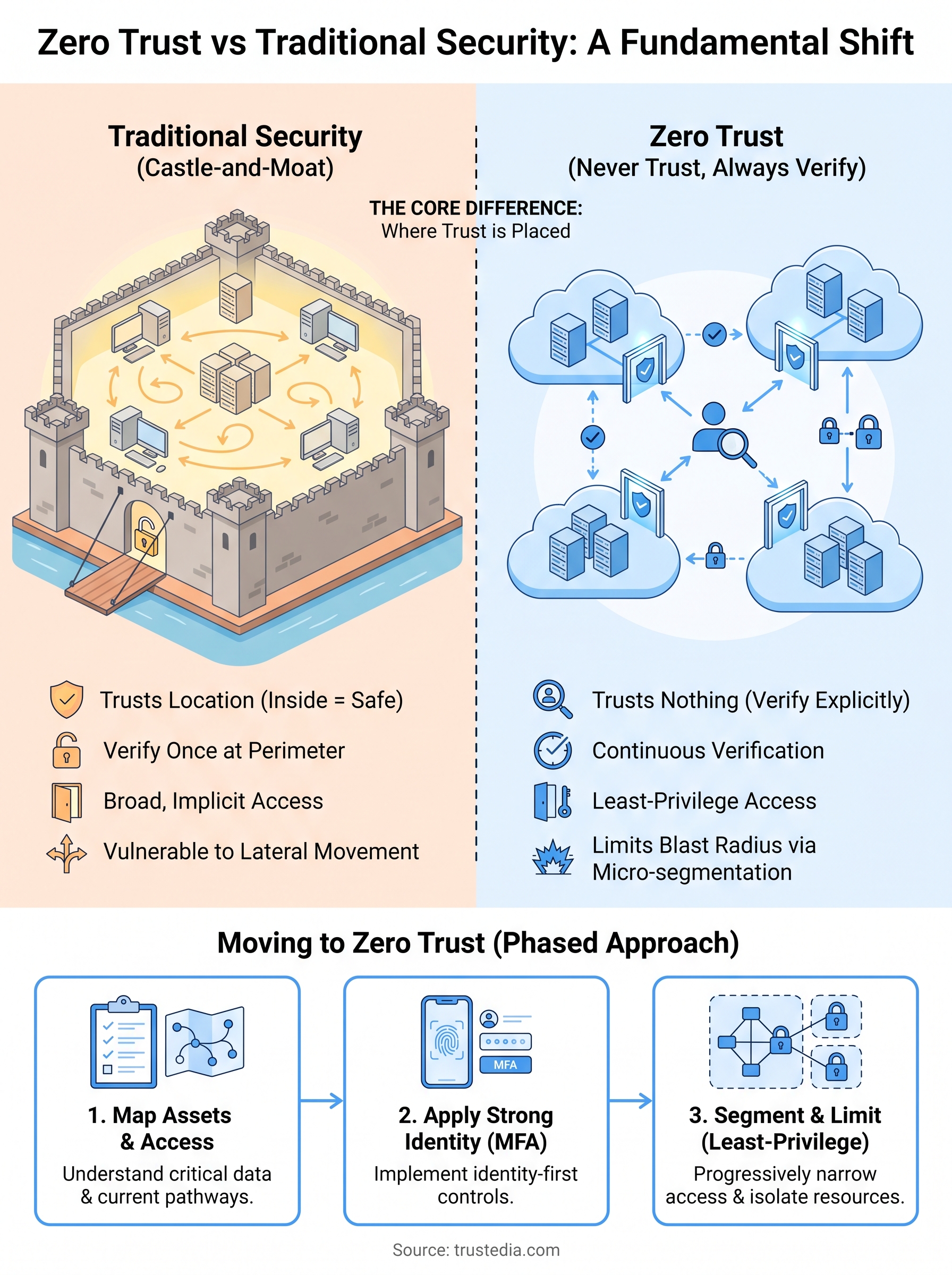
When you look at zero trust vs traditional security side by side, the fundamental difference is where trust is placed. Traditional security trusts location. Zero Trust trusts nothing and verifies everything. That shift in thinking changes how you design controls, respond to threats, and recover when something goes wrong. Both models aim to protect your organisation, but they do it in fundamentally different ways, and only one of them was built for the environment most UK businesses operate in today.
Why perimeter security struggles today
The perimeter security model was built around a stable, predictable network. That network no longer exists for most UK businesses. Remote working, cloud migration, and third-party integrations have stretched your network boundary to the point where it’s nearly impossible to define, let alone defend. When your data moves across dozens of services and your staff connect from home, coffee shops, and shared offices, a single outer wall stops being a meaningful control.
The dissolving network boundary
Traditional security assumes your most sensitive assets sit inside a clearly defined zone. Cloud platforms like Microsoft Azure and AWS have fundamentally changed that assumption by hosting critical workloads outside any perimeter you control. When your business runs on SaaS applications and remote access tools, the VPN tunnel that once felt like a secure drawbridge becomes a single point of failure.
When an attacker compromises one set of credentials, traditional perimeter security often gives them free movement across your entire internal network.
Lateral movement is one of the most damaging consequences of this model. Once a threat actor passes the outer boundary, whether through phishing, stolen credentials, or a compromised device, they can often access systems and data far beyond their original entry point. That’s a direct result of trusting location rather than identity.
The insider threat problem
Insider threats, both accidental and deliberate, expose another weakness in perimeter-based thinking. An employee with broad internal access can cause significant damage without ever triggering a perimeter alert, because the model has already decided they’re trusted by virtue of being inside the network. This is precisely why the zero trust vs traditional security debate matters so much for organisations handling sensitive customer or operational data. Continuous verification would catch unusual behaviour regardless of where the user sits.
Key differences that change security outcomes
When you compare zero trust vs traditional security in practice, the differences show up in outcomes rather than just architecture. Traditional security concentrates its controls at the network boundary, which means a single failure can have wide consequences. Zero Trust distributes verification throughout the entire environment, so a compromised credential or device doesn’t automatically hand an attacker unrestricted access to everything you’re protecting.
Access control and verification
Traditional security typically authenticates a user once at the entry point and extends broad, implicit trust for the rest of that session. Zero Trust replaces that with continuous, context-aware verification that checks identity, device compliance, and behaviour at every access request. If a user’s device suddenly fails a health check mid-session, access is revoked immediately rather than waiting for the next login.
Continuous verification means a stolen session token becomes far less useful to an attacker, because the system keeps re-checking whether the access still makes sense.
Network segmentation and blast radius
One of the most significant practical differences between the two models is how they limit damage when something does go wrong. Traditional perimeter security often leaves internal systems flat and largely open to each other, which gives attackers room to move laterally after breaching the outer wall. Zero Trust enforces micro-segmentation, dividing your network into small, isolated zones where access between them still requires explicit authorisation.

This directly reduces what security teams call the blast radius of any incident. If a threat actor compromises one account or endpoint, micro-segmentation contains them within a narrow segment rather than letting them reach your financial systems, client data, or operational infrastructure. Limiting the damage is just as important as preventing the initial breach, and Zero Trust architecture is specifically built with that goal in mind.
How to move to zero trust in a UK business
Moving to Zero Trust doesn’t require replacing your entire infrastructure overnight. Most UK businesses approach this as a phased transition, layering new controls on top of existing systems while gradually reducing reliance on perimeter-based thinking. Starting with a clear picture of what you’re protecting and who needs access to it is the most practical first step any organisation can take.
Map your assets and access requirements
Before you can build Zero Trust controls, you need to know what your critical assets are and which users, devices, and applications currently interact with them. An accurate asset inventory tells you where your most sensitive data sits and which access paths currently exist without proper verification. This is where a structured cyber audit adds real value, surfacing blind spots that traditional perimeter tools typically miss.
Understanding your current access landscape is the foundation of any successful Zero Trust implementation, without it you’re building controls on guesswork.
Once you have that map, you can identify which access relationships carry the most risk and prioritise those for tighter controls first.
Apply identity verification and least-privilege access
Multi-factor authentication (MFA) is the most immediate control you can deploy when moving away from perimeter trust. Microsoft’s own guidance on Zero Trust deployment recommends starting with strong identity verification as the entry point for any Zero Trust programme. Combining MFA with role-based access controls ensures users only reach the systems they genuinely need for their role, which directly narrows your attack surface compared to the broad access that traditional security permits.
When you compare zero trust vs traditional security at this stage, the practical difference becomes visible quickly. Identity-first controls stop a compromised credential from cascading into a full breach, because access is narrow and continuously checked rather than assumed.
Common challenges and how to handle them
Shifting away from perimeter-based controls brings practical friction, even when the case for Zero Trust is clear. Most organisations hit similar obstacles during implementation, and understanding them in advance helps you avoid the delays that slow down many programmes. The good news is that none of these challenges are unique to your business, and there are straightforward ways to address each one.
Resistance from staff and stakeholders
People who are used to broad network access will notice when that access gets narrower. Tighter controls and additional verification steps can feel like obstacles, especially when staff are already managing busy workloads. The key is framing the change clearly: explain that stricter access protects the organisation rather than penalises individuals.
Communicating the "why" behind Zero Trust controls significantly reduces friction during rollout, particularly when staff understand what a breach could mean for the business.
Phishing simulations and structured cyber awareness programmes help staff understand the real threat landscape, which makes tightened access policies easier to accept and follow.
Complexity of implementation
The zero trust vs traditional security comparison can make Zero Trust sound straightforward, but the implementation work requires careful planning. Legacy systems and older applications frequently lack the identity and access management capabilities that Zero Trust relies on, and replacing or wrapping those systems takes time and budget.
Breaking the transition into clearly defined phases makes it manageable. Start with your highest-risk access paths, apply MFA and least-privilege controls there first, then extend those controls progressively. Prioritising by risk rather than attempting a full transformation at once keeps the programme moving without overwhelming your IT team or your budget in the process.
Final takeaways
The zero trust vs traditional security debate isn’t really a debate anymore. Perimeter-based models were built for a network environment that no longer exists, and the gaps they leave are consistently exploited by attackers who know exactly how to move freely once they’re past the outer wall. Zero Trust replaces implicit trust with continuous verification, which directly limits the damage any single compromised account or device can cause.
Transitioning to Zero Trust works best as a phased programme, starting with your highest-risk access paths, applying strong identity controls, and extending micro-segmentation progressively. You don’t need to rebuild everything at once. What you do need is a clear picture of your current environment before you start.
If you’re unsure where your organisation stands, TrustedIA can help you assess your security posture and build the right controls for your business. Speak to our cybersecurity team to get started.



