Every organisation that processes personal data under the GDPR needs to understand the data protection officer’s role, even if it’s not legally required to appoint one. The DPO sits at the intersection of compliance, risk management, and operational decision-making, serving as an independent point of accountability for how your business handles personal data.
But the role is widely misunderstood. Some organisations treat it as a tick-box exercise. Others confuse it with general IT security responsibilities. Neither approach holds up under regulatory scrutiny, and getting it wrong can lead to enforcement action, fines, or reputational damage that’s hard to recover from.
This article breaks down exactly what a Data Protection Officer does, the specific legal obligations the GDPR places on the role, and how to determine whether your organisation must appoint one. At TrustedIA, we work with businesses across the UK to build compliance frameworks, including ISO 27001 implementation and certification, that support data protection requirements from the ground up. What follows is a practical, honest explanation to help you make informed decisions about DPO appointment and responsibilities within your organisation.
What the GDPR says a DPO must do
Articles 37 to 39 of the GDPR set out the specific legal tasks that every DPO must carry out. These are not flexible guidelines your organisation can adjust based on available resources or internal preference. The regulation defines a minimum set of binding duties that apply regardless of your sector, size, or how you choose to structure the appointment. Understanding them is the starting point for getting the role right.
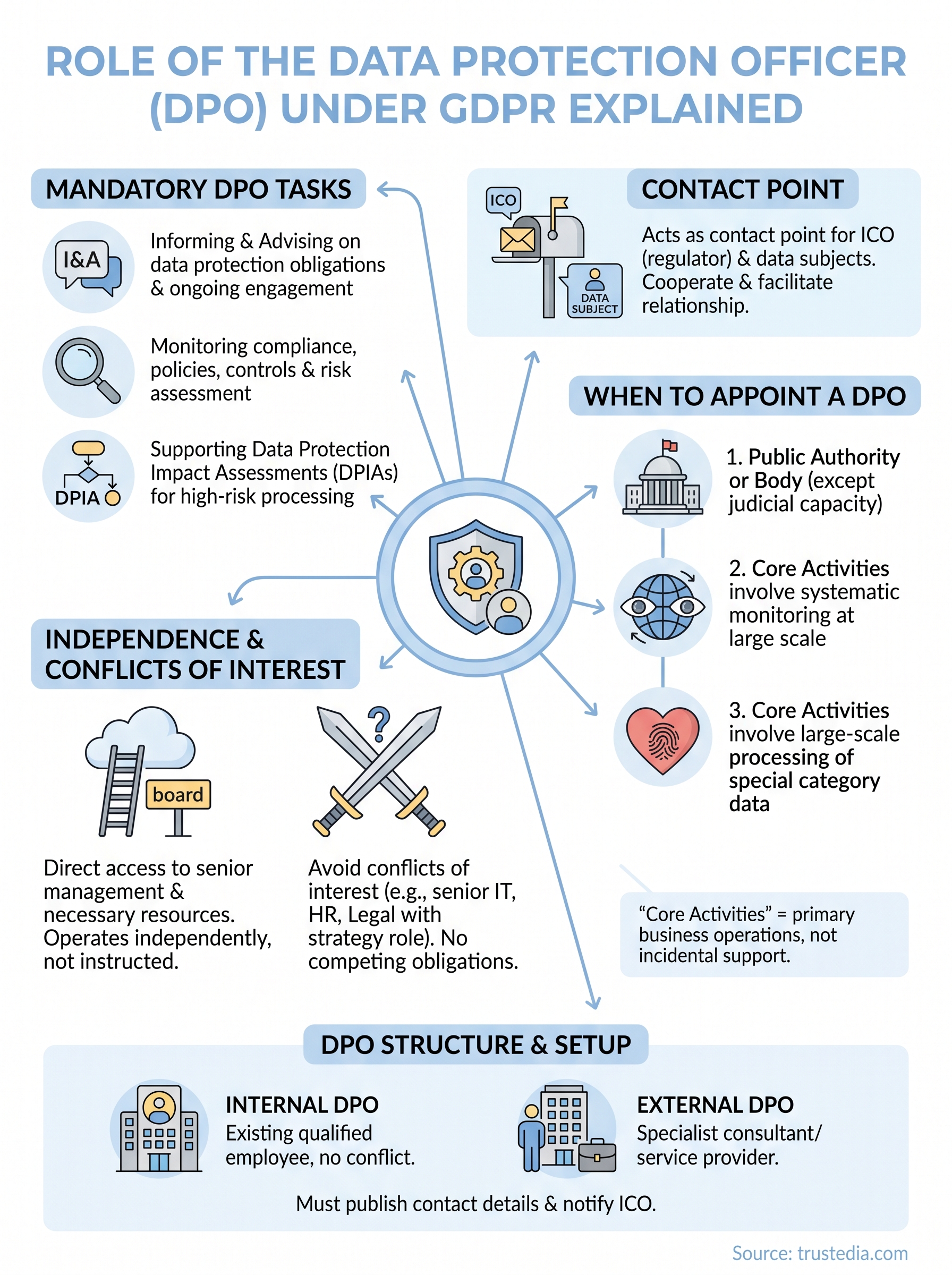
Informing and advising on data protection obligations
Your DPO’s first duty is to inform and advise your organisation and its staff about their obligations under the GDPR and any relevant national data protection law. This is not a one-time briefing delivered at onboarding. It means the DPO must maintain ongoing engagement with the business, flag legislative changes, identify gaps in internal practice, and ensure that the people making decisions about personal data understand what the rules require.
The DPO’s advisory role extends to every layer of the organisation, from senior leadership making strategic decisions about data use, down to the individuals processing data day-to-day.
Training is central to this obligation. Your DPO must ensure staff who handle personal data have the knowledge they need, and that training stays relevant as processing activities evolve over time.
Monitoring compliance across the organisation
The DPO must actively monitor your organisation’s compliance with the GDPR on a continuing basis, not just respond to incidents when they arise. This includes reviewing internal policies, overseeing how data processing responsibilities are assigned, and verifying that controls function as intended rather than existing only on paper.
Monitoring also requires the DPO to stay across your record of processing activities and assess whether any changes to the business, such as new systems or expanded data use, introduce compliance risks that need to be addressed before they become a problem.
Supporting data protection impact assessments
When your organisation plans high-risk processing activities, the GDPR requires a Data Protection Impact Assessment (DPIA) under Article 35. Your DPO must advise on how to conduct the DPIA and review its conclusions before processing begins. This applies particularly to large-scale profiling, systematic monitoring of individuals, and the introduction of new technologies that handle personal data at scale.
Recognising the full role of the data protection officer under GDPR means understanding that DPIAs are not administrative paperwork. They are a structured risk management process, and your DPO actively shapes how that process runs and what decisions come out of it.
Acting as a contact point for regulators and data subjects
Your DPO must cooperate with the ICO, the UK supervisory authority, and serve as the primary contact point for regulatory queries, audits, or investigations. This means the ICO can approach your DPO directly, and your organisation must facilitate that relationship without interference.
Data subjects also have the right to contact your DPO directly about how their personal data is processed. The DPO must handle those enquiries independently, which means management cannot instruct the DPO on how to respond or restrict access to information that data subjects are entitled to receive.
When you must appoint a DPO
UK GDPR sets out three specific conditions under which appointing a DPO is a legal requirement, not a choice. Many organisations assume the obligation only applies to large corporations or public bodies, but that assumption leaves some businesses exposed. Understanding where you fall is essential before you decide how to structure your data protection responsibilities.
The three mandatory triggers
Article 37 of the UK GDPR identifies the conditions that make appointing a DPO compulsory. Your organisation must appoint one if it falls into any of the following categories:

- You are a public authority or body, except courts acting in their judicial capacity
- Your core activities involve regular and systematic monitoring of individuals at large scale, such as behavioural advertising, location tracking, or CCTV monitoring
- Your core activities involve large-scale processing of special category data, such as health information, biometric data, or criminal conviction records
If you are uncertain whether your processing qualifies as “large scale,” the ICO recommends considering the number of individuals affected, the volume of data, the geographical reach, and the duration of the processing.
What “core activities” actually means
The phrase “core activities” is important here. It refers to the primary operations that define your business, not incidental tasks that support it. A hospital’s core activity is treating patients, which involves processing health data at scale, so it must appoint a DPO. An employer processing staff payroll data is unlikely to meet the threshold because that is an administrative function, not a core business purpose.
Even if you are not legally required to appoint one, the GDPR’s DPO role still offers a model worth following voluntarily to strengthen your compliance posture and demonstrate accountability to regulators and clients.
Independence and conflicts of interest
The GDPR gives the DPO a protected legal status that most internal roles simply do not have. Under Article 38, your organisation must ensure that the DPO operates independently and is not instructed on how to perform their tasks. This is not a soft guideline. You cannot direct your DPO to downplay a compliance issue, delay reporting to the ICO, or prioritise business convenience over data protection obligations.
What independence means in practice
Your DPO must have direct access to senior management and must be able to report at the highest level of your organisation. This means your DPO needs a clear reporting line to the board or an equivalent decision-making body, not a middle manager with competing priorities. You must also ensure the DPO receives the resources they need, including time, budget, and access to the information required to do the job properly.
If your DPO raises a compliance concern and management overrides it without documented justification, your organisation is in breach of Article 38, regardless of the outcome.
Avoiding conflicts of interest
Conflicts of interest represent one of the most common practical failures in DPO arrangements. The role of the data protection officer under GDPR requires your DPO to work without competing obligations that could compromise their judgement. A DPO who also holds a senior IT management position, determines the purpose and means of processing, or leads a department that handles significant volumes of personal data is likely conflicted. The ICO takes a clear position: a DPO cannot hold a role that requires them to set data processing objectives and simultaneously audit those same decisions.
Roles that typically create a conflict include:
- Chief Information Officer or IT Director
- Head of HR
- Legal Counsel with authority over data processing strategy
- Any position with power to determine the purpose or means of processing
How to set up the DPO role in practice
Deciding that you need a DPO is only the first step. How you structure and resource the role determines whether it functions effectively or simply satisfies a formal requirement on paper. The GDPR permits you to appoint an internal employee or an external service provider as your DPO, and both options carry distinct practical implications for your organisation.
Internal vs external DPO
An internal DPO is a member of your existing team who takes on the role, either as their sole responsibility or alongside other duties, provided no conflict of interest exists. This works well when you have a qualified individual with a strong understanding of both data protection law and your business operations. An external DPO, by contrast, is typically a specialist consultant or managed service provider engaged on a contract basis. External appointments are common among SMBs that lack the in-house expertise or cannot justify a full-time dedicated position.
External DPOs must still have reliable access to your staff, systems, and senior management to carry out the role of the data protection officer under GDPR effectively.
Documenting and communicating the appointment
Once you appoint a DPO, the GDPR requires you to publish their contact details and notify the ICO. You do not need to disclose the DPO’s personal identity, but data subjects and regulators must have a clear, accessible way to reach them. Internally, communicate the DPO’s role to all staff so they know who to contact for data protection queries and understand that the DPO operates independently of line management.
Put a written agreement or terms of reference in place that defines the DPO’s scope, access rights, reporting line, and available resources. This protects both the DPO and your organisation if questions arise about how the role has been carried out.
DPO checklist for UK organisations
Before you finalise your DPO arrangements, run through a practical checklist to confirm your setup meets the minimum legal requirements under UK GDPR. The role of the data protection officer under GDPR carries specific obligations for both the DPO and the organisation, and missing any one of them can undermine the validity of your entire compliance framework.
Completing this checklist is not a one-time exercise. Review it whenever your organisation undergoes significant changes to how it processes personal data.
What your organisation must have in place
Use the following checklist to assess whether your DPO arrangement is properly structured and legally sound:
- Appointment decision documented: You have assessed the three mandatory triggers under Article 37 and recorded your reasoning in writing, whether or not you are legally required to appoint a DPO.
- Conflicts of interest resolved: Your DPO does not hold a position that sets the purposes or means of processing personal data within your organisation.
- Contact details published: Data subjects and the ICO can reach your DPO through a clearly accessible contact point, such as a dedicated email address on your website.
- Direct access to senior management confirmed: Your DPO can escalate compliance concerns to board level without obstruction.
- Resources allocated: Your DPO has sufficient time, budget, and system access to carry out their duties effectively.
- Staff awareness communicated: All employees know who the DPO is and understand that the role operates independently from line management.
- DPIA process integrated: Your DPO is involved in assessing high-risk processing activities before they begin, not after problems emerge.
- Training programme active: Staff who handle personal data receive regular, relevant data protection training.
Treating this checklist as a living document, rather than a one-off sign-off, is what separates organisations that genuinely embed data protection from those that simply comply on paper.
Next steps for your organisation
Understanding the role of the data protection officer under GDPR is one thing. Acting on that understanding is another. If you have worked through this article and identified gaps in your current arrangements, the priority is to address them before a regulatory query or data incident forces your hand. Start by reviewing the mandatory appointment triggers against your actual processing activities and document your reasoning either way.
From there, assess whether your existing arrangements genuinely meet the independence and resource requirements that Article 38 demands. Many organisations discover that a nominal DPO appointment, made without proper authority or access, provides little real protection when it matters.
TrustedIA works with UK businesses to build robust compliance frameworks that hold up under scrutiny. Whether you need help structuring a DPO arrangement or want to strengthen your wider data protection posture, get in touch with TrustedIA to learn how we can help.