When a breach hits, the gap between a calm, controlled response and total chaos usually comes down to training. That’s why so many IT managers and analysts start searching for incident response courses the moment they realise their team is reacting on guesswork rather than a rehearsed plan. Whether you’re building a career in security or trying to get your whole team certified, the right course teaches you how to contain, eradicate and recover from an attack without making things worse.
This article answers the question directly: which incident response course actually delivers practical, job-ready skills, and which ones are just certificates for the wall. We’ve looked at cost, format, depth of hands-on labs, and how well each course maps to real-world scenarios like ransomware or data exfiltration.
Below, you’ll find seven courses covering everything from free introductory training to advanced, industry-recognised certifications. We’ve also flagged who each course suits best, so you can match your current skill level and budget to the right option. At TrustedIA, we work with incident response daily through our CyberSOS breach containment and recovery service, and that experience shapes exactly what we’ve prioritised in this list.
1. TrustedIA cyber incident response training
When you’re evaluating incident response courses, it makes sense to start with training built by people who handle live incidents every week, not just theory in a slide deck. TrustedIA runs its cyber incident response training off the back of our own CyberSOS service, which means the scenarios you work through are drawn from real cases we’ve handled for clients, insurers, and loss adjusters. You’re not learning generic frameworks; you’re learning what actually happens when ransomware hits a finance department or when an attacker sits undetected on a network for weeks.
What it covers
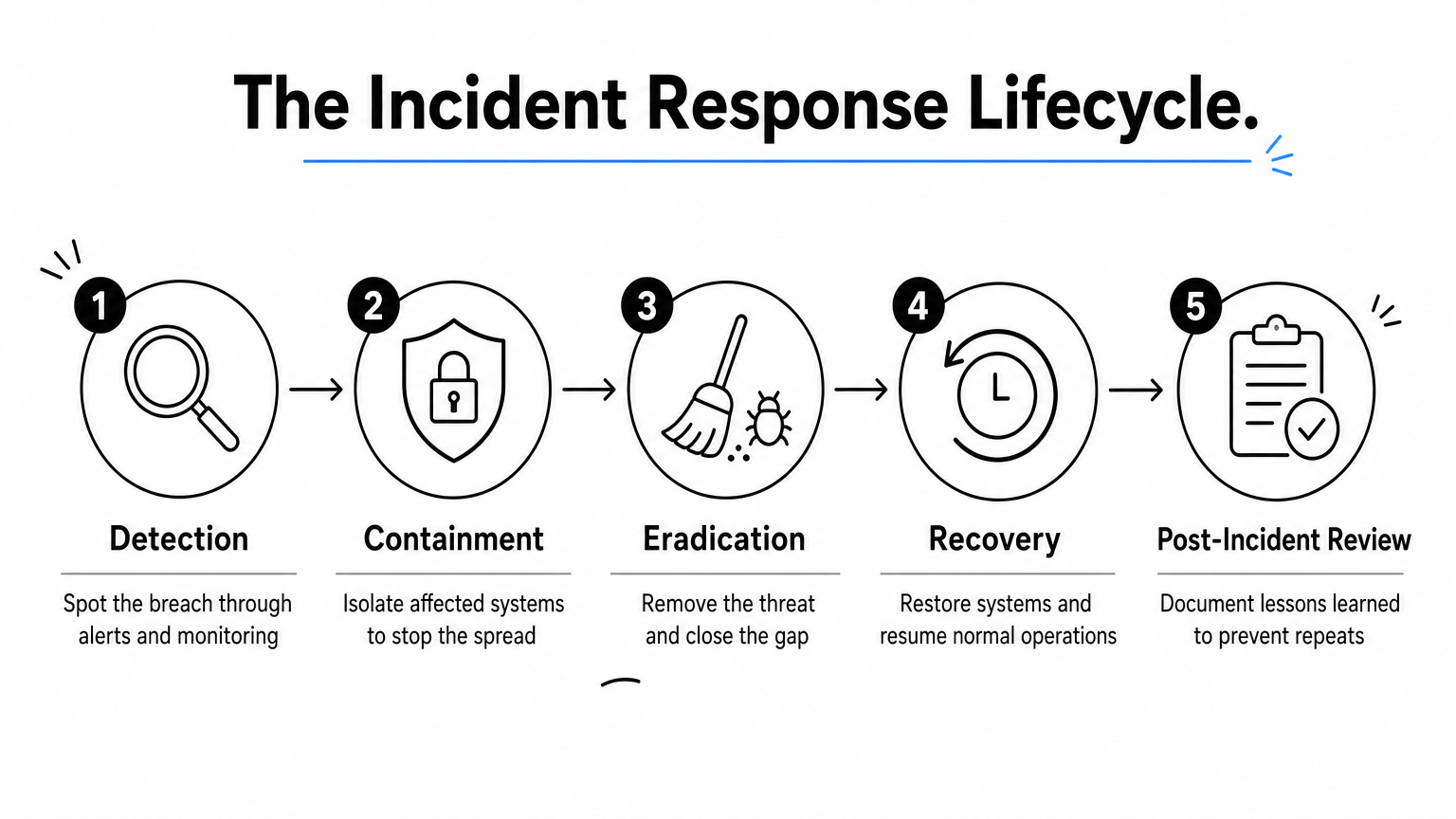
The course walks through the full incident response lifecycle: detection, containment, eradication, recovery, and the post-incident review that most training skips entirely. You’ll cover how to triage alerts under pressure, how to preserve evidence for potential legal or insurance purposes, and how to communicate with stakeholders during an active breach. We also build in modules on continuity and recovery planning, since a response that doesn’t get the business back online quickly isn’t much of a response at all.
A good incident response course doesn’t just teach you what to do; it trains you to think clearly when everything is on fire.
Who it’s for
This training suits IT managers, security analysts, and compliance officers at SMBs and enterprises who need practical skills fast, not a lengthy academic path. It’s particularly useful for organisations working towards ISO 27001 compliance, since incident response is a core control under the standard. If your team lacks in-house cyber expertise and you want a partner who can both train wider staff on incident response and step in during an actual breach, this is the more direct route.
Format and duration
Sessions run as instructor-led workshops, either on-site or remote, and are scoped around your organisation’s existing maturity level rather than a fixed curriculum. Most engagements run across one to three days, depending on team size and whether you’re bundling in tabletop exercises or a live simulation.
Cost
Pricing is tailored to your organisation’s size and the scope of training required, so there’s no flat per-seat fee published. Get in touch with TrustedIA directly for a quote based on your team and current incident response maturity.
2. ISC2 incident management: preparation and response
ISC2, the body behind the CISSP, offers a shorter certificate course aimed at professionals who want a recognised name on their CV without committing to a full certification path. It’s one of the more structured incident response courses available online, built around ISC2’s own body of knowledge rather than a single vendor’s tooling.
What it covers
The course focuses on the preparation phase most training glosses over: building an incident response plan, defining roles, and setting up detection capabilities before anything goes wrong. It then moves into identification, containment, and recovery, with case studies pulled from ISC2’s broader research into breach trends.
Preparation is the phase most teams skip, and it’s the one that decides whether your response actually works.
Who it’s for
This suits early-career analysts and IT staff who want a globally recognised certificate to support a CISSP or related credential later on. It’s less suited to teams needing hands-on incident response courses with live-fire labs, since the format stays largely conceptual.
Format and duration
Delivered entirely online and self-paced, most learners complete it in around 8 to 10 hours spread across a few weeks. There’s no live instructor component, so it works well alongside a full-time job.
Cost
ISC2 prices the course modestly compared to full certifications, typically under £100, with occasional discounts for ISC2 members. Check the ISC2 site directly for current pricing, since it shifts with promotions.
3. IT Governance cyber incident response management foundation
IT Governance built its reputation on ISO 27001 consultancy, so its foundation-level incident response course leans heavily on the compliance angle rather than pure technical response. Among the incident response courses aimed at compliance-focused staff, this one stands out for tying incident handling directly to regulatory obligations like GDPR breach notification deadlines.
What it covers
Expect a walkthrough of the incident response lifecycle mapped against ISO 27001’s Annex A controls, plus modules on breach reporting timelines, evidence handling, and how to structure an incident response policy that satisfies an auditor. Practical exercises focus on documentation and process rather than technical containment techniques.
Compliance without practical readiness just gets you a well-documented failure.
Who it’s for
This suits compliance officers, risk managers, and IT staff who need to understand incident response as part of a wider governance framework, particularly if your organisation is working towards or maintaining ISO 27001 certification. It’s a weaker fit for analysts who need hands-on technical labs, since the focus stays procedural.
Format and duration
The course runs as a one-day classroom or virtual session, with IT Governance offering scheduled dates throughout the year rather than fully self-paced access. You’ll typically walk away with a certificate of attendance rather than an examined credential.
Cost
Pricing sits in the low hundreds of pounds per delegate, with discounts available for group bookings. Contact IT Governance directly for current dates and rates, since these change with demand.
4. Cyber Management Alliance CIPR incident planning and response
Cyber Management Alliance built its CIPR (Certified Incident Planning and Response) course specifically around tabletop exercises, which makes it one of the more scenario-heavy incident response courses on this list. Rather than lecturing you through frameworks, the course puts you inside simulated breach scenarios, ransomware containment and recovery, insider threats, supply chain compromise, and asks you to make decisions as the incident unfolds in real time.

What it covers
The curriculum covers incident response planning, crisis communication, and the roles needed on a response team, then tests all of it through live simulations rather than multiple-choice quizzes. You’ll also work through legal and regulatory considerations, including when and how to notify regulators and affected customers.
A tabletop exercise that never goes wrong teaches you nothing about handling one that does.
Who it’s for
This course suits security managers and incident response team leads who already understand the basics and now need practice making decisions under pressure. It’s less useful as a first incident response course for absolute beginners, since it assumes some prior exposure to the terminology and process.
Format and duration
CIPR runs as an intensive two-day instructor-led course, delivered either in-person or via live online sessions with a fixed cohort. Certification follows a short exam at the end.
Cost
Expect to pay in the low thousands of pounds for the full CIPR certification, reflecting its intensive, exam-backed format. Group and corporate rates are typically negotiable for larger teams.
5. Coursera cyber incident response by IBM
IBM’s cyber incident response course on Coursera forms part of its broader Cybersecurity Analyst Professional Certificate, which makes it a natural fit if you’re already working through IBM’s wider curriculum. Given its price point and brand recognition, it’s become one of the most searched incident response courses for people starting a career in security rather than upgrading an existing one.
What it covers
Modules walk through the incident response lifecycle using IBM’s own frameworks, alongside practical labs on log analysis, malware identification, and using SIEM tools to detect suspicious activity. You’ll also get exposure to digital forensics and incident response basics, which most entry-level courses skip entirely.
A course built for beginners still needs real tools, not just slides describing them.
Who it’s for
This suits career-changers and junior analysts who want a recognised name alongside a structured, affordable path into security operations. Experienced practitioners looking for advanced technical depth or live-fire simulations should look elsewhere on this list.
Format and duration
Entirely self-paced online, the course typically takes 20 to 25 hours to complete, spread across roughly four weeks of part-time study. There’s no live cohort or instructor interaction, so support comes mainly through discussion forums.
Cost
Coursera runs this on a subscription model, usually around £35 to £45 per month, so total cost depends on how quickly you finish. Financial aid is available through Coursera for learners who qualify.
6. Cybrary incident response lifecycle course
Cybrary built its name on affordable, community-driven cybersecurity training, and its incident response lifecycle course fits that model well. It’s a solid option among incident response courses for anyone who wants structured content without committing to a paid subscription upfront, since much of Cybrary’s catalogue sits behind a free tier.

What it covers
The course maps directly onto the standard incident response lifecycle: preparation, detection, containment, eradication, recovery, and lessons learned. You’ll work through practical scenarios covering malware outbreaks and unauthorised access, plus guidance on writing incident reports that actually get read by management rather than filed away.
Free training only helps if it teaches the same discipline as paid courses, not a watered-down version of it.
Who it’s for
This suits self-taught learners, junior analysts, and anyone testing whether a career in incident response suits them before investing in paid certification. It’s less rigorous than instructor-led options, so experienced practitioners won’t find much new material here.
Format and duration
Delivered as self-paced video modules with short knowledge checks, most learners finish the core content in 6 to 8 hours. There’s no live component, and progress tracking happens through Cybrary’s own dashboard.
Cost
The base course is free with a Cybrary account, though some advanced labs sit behind its paid Insider Pro tier, priced monthly. Check Cybrary directly for current tier pricing, since it changes periodically.
7. LetsDefend incident responder path
LetsDefend takes a different approach from most incident response courses on this list by putting you inside a simulated security operations centre from day one. Instead of watching videos about SIEM dashboards, you log into a live-feeling SOC environment and work real alerts, which makes it one of the most hands-on options for anyone wanting to feel what the job actually involves before committing to it.
What it covers
The path walks you through alert triage, log analysis, and threat hunting using an actual SOC interface, then builds into full incident investigations covering phishing, malware, and network intrusions. You’ll practise writing incident reports and escalation notes exactly as you would in a real SOC, which few other courses replicate this closely.
Reading about a SOC alert and actually triaging one under a ticking clock are two completely different skills.
Who it’s for
This suits junior analysts, career-changers, and anyone preparing for a SOC analyst interview who wants practical exposure rather than theory. Experienced responders looking for advanced forensics or malware reverse-engineering will find the content too foundational.
Format and duration
Access is entirely self-paced through LetsDefend’s platform, with most learners spending 15 to 20 hours working through the labs and simulated investigations. There’s no fixed schedule or live instructor, so it fits around existing work commitments easily.
Cost
A free tier gives limited access to the platform, while full access to the incident responder path runs on a paid monthly or annual subscription. Check LetsDefend’s site directly for current pricing tiers.
Building your incident response skills further
No single course on this list will make you fully incident-ready on its own. Free platforms like Cybrary and LetsDefend build the foundations cheaply, self-paced options from Coursera and ISC2 add structure and credentials, and intensive programmes like CIPR sharpen your decision-making under pressure. Picking the right mix depends on where your team sits today and how quickly you need those skills operational.
Getting certificates on a wall is one thing. Handling a live ransomware attack at 2am with a board waiting for answers is another. That gap is exactly why we built our training around real incident scenarios rather than theory, drawing on cases our CyberSOS team has actually worked. If you want training that reflects what a breach really looks like, and a partner who can step in when one happens, talk to TrustedIA about cyber security education and training built around your organisation’s actual risk.