
When a breach hits, most businesses default to panic mode: pull the network cable, wipe the affected machine, hope the problem goes away. That instinct usually destroys the very evidence you need to understand what happened. This is where incident response digital forensics earns its place, combining rapid containment with careful evidence preservation so you can act fast without losing the ability to investigate properly.
Digital forensics and incident response, often shortened to DFIR, is the discipline of detecting a cyber incident, containing it, and then forensically examining systems, logs, and files to establish how attackers got in, what they touched, and how to stop it happening again. The forensics side answers the questions; the incident response side stops the bleeding. Neither works well alone.
In this article, we break down what DFIR actually involves, how the two disciplines fit together during a live incident, and why businesses without in-house security expertise struggle without it. We also cover what good cyber forensics and incident response looks like in practice, drawing on the kind of recovery work we handle through TrustedIA’s CyberSOS service.
Why digital forensics and incident response matters
Businesses lose more than money when they mishandle a breach. They lose the evidence trail that tells them whether the attacker is still inside, what data left the building, and whether they’re legally obliged to report it. Incident response and digital forensics exist precisely because those three questions decide everything that follows: your legal exposure, your insurance payout, and whether the same attacker walks back in through the same door next month.
The cost of acting too fast, or not fast enough
Speed matters, but so does sequence. Shutting down a server before imaging its memory destroys volatile evidence that could show exactly how ransomware spread. Leaving a compromised account active for another day gives an attacker more time to move laterally. Good digital forensic incident response balances both pressures: contain the threat quickly, but preserve enough forensic material to reconstruct the attack afterwards.
Rushing containment without preserving evidence often costs businesses more than the breach itself.
Organisations that skip this balance tend to repeat the same mistakes:
- Reformatting infected machines before capturing logs, losing the only record of the initial entry point
- Restoring from backups without checking whether the backup itself is compromised
- Assuming the visible malware is the whole problem, when it’s often just the payload dropped after a quieter, earlier compromise
Regulatory and insurance pressure is real
Compliance frameworks add another layer of urgency. Under UK GDPR, organisations generally have 72 hours to notify the Information Commissioner’s Office of a reportable personal data breach, and that clock starts the moment you become aware of it. You can read the ICO’s own guidance on personal data breaches for the exact reporting thresholds. Without a forensic timeline, you’re guessing at scope, and guessing badly in a regulatory submission is worse than saying nothing at all.
Insurers apply similar pressure from a different angle. Cyber insurance policies increasingly require a documented incident response process as a condition of cover, and claims get contested when a business can’t demonstrate what happened, when, and how it was contained. This is exactly why insurers and loss adjusters use services like TrustedIA’s CyberSOS: a defensible, evidence-backed account of the incident supports the claim rather than undermining it.
What businesses risk without it
Smaller organisations often assume DFIR is only for large enterprises with dedicated security teams. That assumption is backwards. A business without in-house expertise is the one most likely to destroy evidence by accident, most likely to miss a reportable breach deadline, and most likely to face the same attack twice because nobody established the root cause the first time.
Together, these pressures explain why digital forensics and incident response has moved from a specialist niche to a standard business continuity requirement. It’s not just about catching the attacker. It’s about proving what happened, meeting your legal obligations, and closing the door properly so the next incident doesn’t start the same way.
How digital forensics and incident response works together
A live incident doesn’t move in neat, separate stages. Forensics and response run in parallel, feeding each other information as the picture develops. Digital forensic incident response typically follows a recognisable sequence, but each stage relies on evidence gathered during the last one, which is why treating them as separate teams working in isolation almost always slows everything down.
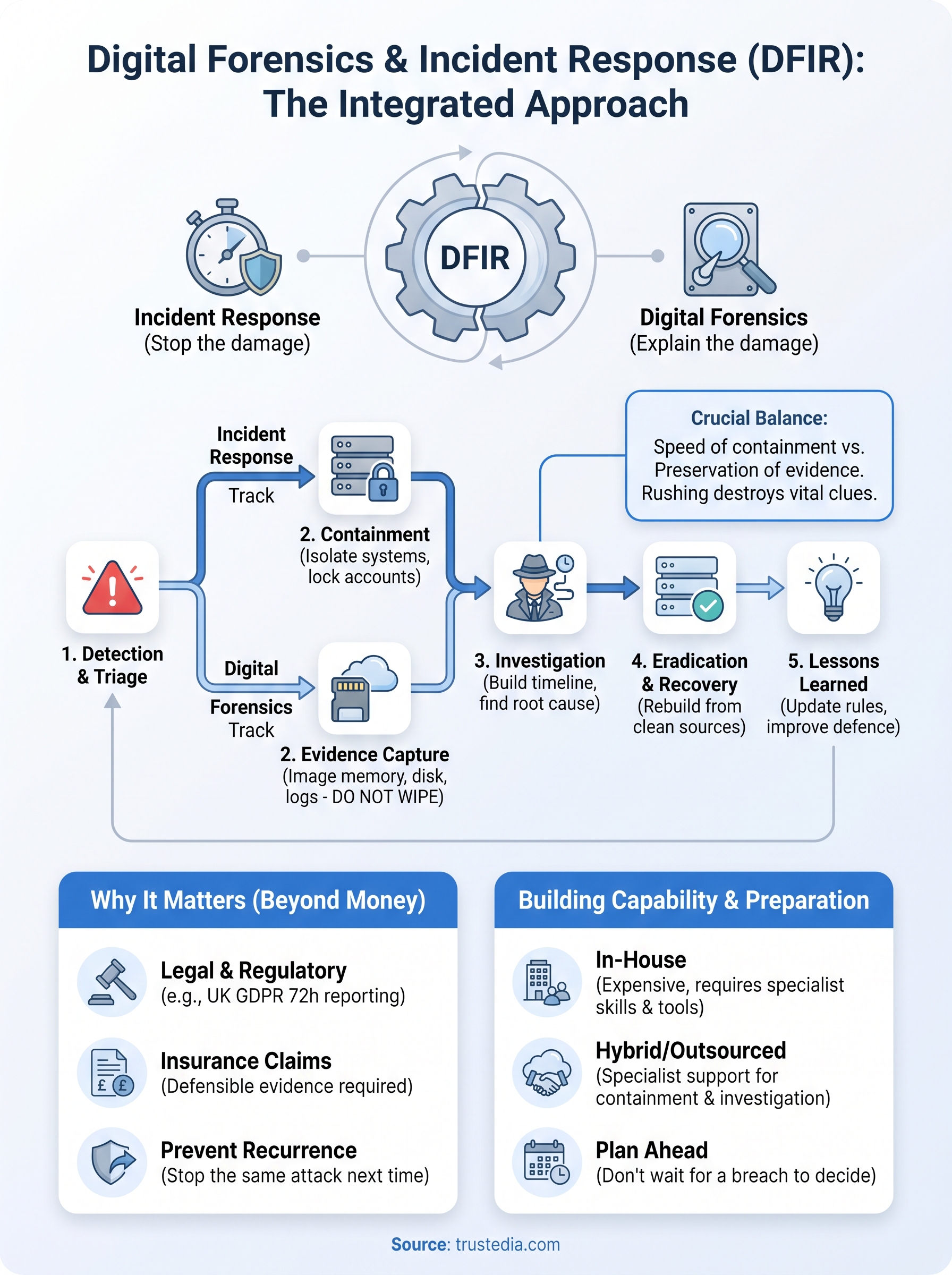
The typical DFIR sequence
Below is how a well-run incident usually unfolds, from detection through to lessons learned:
- Detection: Monitoring tools, SOC analysts, or an alert from endpoint software flags unusual activity.
- Triage: The response team scopes the affected systems and decides what needs immediate containment.
- Evidence capture: Forensic imaging of memory, disk, and logs happens before anything gets wiped or rebooted.
- Containment: Compromised accounts get locked, affected segments isolated, malicious processes killed.
- Investigation: Forensic analysts examine the captured evidence to build a timeline of the attacker’s movements.
- Eradication and recovery: Systems get rebuilt from clean sources once the root cause is confirmed.
- Lessons learned: Findings feed back into detection rules, patching priorities, and staff training.
Every containment decision should be checked against one question: does this destroy evidence we’ll need later?
Why the sequence breaks down without coordination
Often the friction shows up between steps three and four. Response teams want systems back online; forensic analysts need time to capture volatile data properly. Rushing past step three to get to containment faster is the single most common reason investigations stall later, because analysts end up trying to reconstruct an attack from partial logs and a machine that’s already been rebooted twice.
Proper coordination means the same team, or at least the same playbook, governs both functions from the first alert. Skilled DFIR providers run containment and evidence capture as near-simultaneous actions rather than sequential handoffs. That’s the operational core of incident response and digital forensics: two disciplines moving at the same pace, informed by the same evidence, working towards the same outcome, a business that’s both safe and able to explain exactly what happened.
Digital forensics vs incident response: what’s the difference
People use "DFIR" as if it’s one job, but the two halves need different skills, different mindsets, and often different people entirely. Understanding digital forensics vs incident response helps you spot gaps in your own team, or in a provider’s offering, before an incident exposes them for you.
Different questions, different skill sets
Incident response is operational. It’s about speed, containment, and keeping the business running. A good incident responder thinks like a firefighter: stop the spread, protect what’s still safe, restore services. Digital forensics is investigative. A forensic analyst thinks like a detective, working backwards through logs, memory dumps, and disk images to build a timeline that will hold up to scrutiny from a regulator, an insurer, or a court.

Incident response stops the damage; digital forensics explains it.
The table below sets out how the two disciplines diverge in practice:
| Aspect | Incident Response | Digital Forensics |
|---|---|---|
| Primary goal | Contain and recover | Investigate and evidence |
| Time pressure | Immediate, hours | Methodical, days to weeks |
| Core skill | Systems and network operations | Evidence handling and analysis |
| Output | Restored, secured systems | Timeline, root cause, legal-grade report |
| Typical tools | Firewalls, EDR, isolation controls | Disk imaging, memory forensics, log analysis |
Where the overlap causes confusion
Confusion usually starts because both disciplines touch the same systems at the same time. A response team isolating a server and a forensic analyst imaging that same server are working towards different immediate goals, even though they need each other’s output. Skip the forensics step and you’ve contained an incident you can’t explain. Skip the response step and you’ve got a beautifully documented breach that’s still actively spreading.
Recognising this distinction matters most when you’re evaluating a provider. Ask directly whether they run digital forensic incident response as one integrated service or whether forensics gets outsourced separately after containment. The second model almost always means slower investigations and weaker evidence, because the forensic team is starting cold on a scene someone else has already disturbed.
Building or outsourcing your DFIR capability
Most businesses never need a full-time DFIR team. What they need is a decision, made before an incident, about who does what when something goes wrong. Waiting until the breach is live to work out whether you’re handling forensics internally or calling in a provider guarantees a slow start, and a slow start in incident response digital forensics almost always means lost evidence.
What in-house capability actually requires
Building this internally isn’t just buying tools. It means analysts trained in evidence handling that will hold up under scrutiny, licensed forensic software, secure evidence storage, and enough headcount to run an investigation while still doing their day job. Few SMBs can justify that spend for an event they hope never happens.
The real question isn’t build or outsource, it’s whether you’ll be ready before the incident starts, not after.
What outsourcing needs to cover
If you’re outsourcing, don’t just check for a retainer. Ask these questions of any provider before you sign anything:
- Do they run forensics and response as one integrated service, or hand off between separate teams?
- What’s their guaranteed response time, and is it written into the contract?
- Can they produce evidence in a format your insurer or regulator will accept?
- Do they have experience working alongside loss adjusters and insurers directly?
- Will the same team that contains the incident also investigate it?
Why the hybrid model works for most businesses
For most organisations, the practical answer sits between the two extremes. Keep basic detection and monitoring in-house, where your team already knows the systems, and bring in specialist digital forensic incident response support for containment, investigation, and reporting when something serious happens. That’s the model behind TrustedIA’s CyberSOS service: a retained capability that activates fast, backed by forensic expertise your business doesn’t need to maintain year-round. Getting that arrangement in place now, rather than mid-breach, is the difference between a controlled recovery and a scramble.
Staying ready before the next incident
Every point in this article comes back to the same truth: digital forensics and incident response works best when it’s planned before you need it, not assembled while systems are already down. The businesses that recover fastest aren’t the ones with the biggest budgets. They’re the ones who decided, ahead of time, who handles containment, who captures evidence, and who reports to regulators and insurers with a straight timeline instead of guesswork.
Waiting for a breach to force that decision is how evidence gets destroyed and deadlines get missed. Incident response digital forensics only earns its value when it’s ready to activate the moment an alert fires, not after someone’s already rebooted the affected server.
If your business doesn’t have that arrangement in place yet, now’s the time to sort it, not during an active incident. Get in touch with TrustedIA and put a proper CyberSOS response plan behind your business before you need one.



