When a breach hits, the difference between a controlled recovery and a chaotic scramble usually comes down to whether you had a plan before the alarm went off. The incident response lifecycle nist framework gives you exactly that: a structured, repeatable approach that turns panic into process. It’s the reference point most UK businesses lean on when building or auditing their incident response capability, and for good reason.
This article breaks down the nist incident response lifecycle phase by phase, explaining what each stage actually requires in practice, not just in theory. You’ll see how preparation, detection, containment, and recovery fit together as a continuous cycle rather than a one-off checklist, and how organisations of any size can adapt the model to their own risk profile.
We’ll also cover where to find a reliable nist cyber incident response plan template and how to tailor it to your environment, so you’re not starting from a blank page. Whether you’re drafting your first plan or stress-testing an existing one, this guide gives you the practical detail needed to make it work when it matters most.
Why the NIST incident response lifecycle matters
Most cyber incidents don’t fail because of the attack itself. They fail because the response was improvised. The NIST incident response lifecycle, set out in NIST Special Publication 800-61, exists because the US National Institute of Standards and Technology recognised that organisations kept making the same mistakes: no clear roles, no defined escalation path, and no record of what actually happened once the dust settled. It has since become the closest thing to a de facto standard for structuring incident response, adopted well beyond US borders, including by UK businesses building their own cyber resilience programmes. You can read the original publication directly from NIST’s own site if you want the source material rather than a summary.
The real cost of an unstructured response
Without a defined lifecycle, every incident becomes a fresh negotiation over who does what. Teams waste critical hours deciding whether to isolate a system, who has authority to shut down a server, or whether to notify the ICO within the 72-hour window GDPR demands. That delay has a price. Industry breach reports consistently show that organisations with a tested incident response plan contain breaches faster and spend considerably less recovering from them than those working from memory and guesswork. The gap isn’t marginal, it’s the difference between a contained incident and one that spreads across your entire network overnight.
A cyber incident doesn’t wait for you to write the plan. The plan has to already exist.
Why UK businesses adopt it
Businesses turn to this framework because it maps cleanly onto obligations they already have. ISO 27001 compliance requires a documented, tested incident management process, and the NIST lifecycle gives assessors and auditors a recognisable structure to check against. Insurers ask similar questions before underwriting cyber cover, and loss adjusters handling a claim want evidence that a proper process was followed, not a story pieced together after the fact. Regulatory expectations from bodies like the ICO also assume a level of preparedness that only a documented lifecycle can demonstrate convincingly. For organisations without in-house security expertise, adopting a recognised framework also removes the guesswork of building a process from scratch.
A lifecycle, not a checklist
Calling it a lifecycle rather than a checklist matters. Checklists get completed once and filed away. A lifecycle assumes you’ll cycle through it repeatedly, and that each incident, near-miss, or drill teaches you something that improves the next round. This continuous improvement loop is what separates organisations that genuinely get better at handling incidents from those that repeat the same errors every time. The feedback loop built into the final phase, feeding lessons learned back into preparation, is arguably the most undervalued part of the entire model.
A few concrete reasons this structure pays off in practice:
- Faster containment: predefined roles mean no one wastes time working out who’s in charge.
- Cleaner communication: stakeholders, insurers, and regulators get consistent, accurate updates instead of conflicting accounts.
- Stronger compliance posture: audits move faster when your process already matches a recognised standard.
- Lower long-term cost: each incident sharpens the plan rather than exposing the same gaps repeatedly.
Getting this right isn’t about ticking a compliance box. It’s about making sure that when something does go wrong, your organisation already knows exactly what happens next.
How to apply the NIST incident response lifecycle
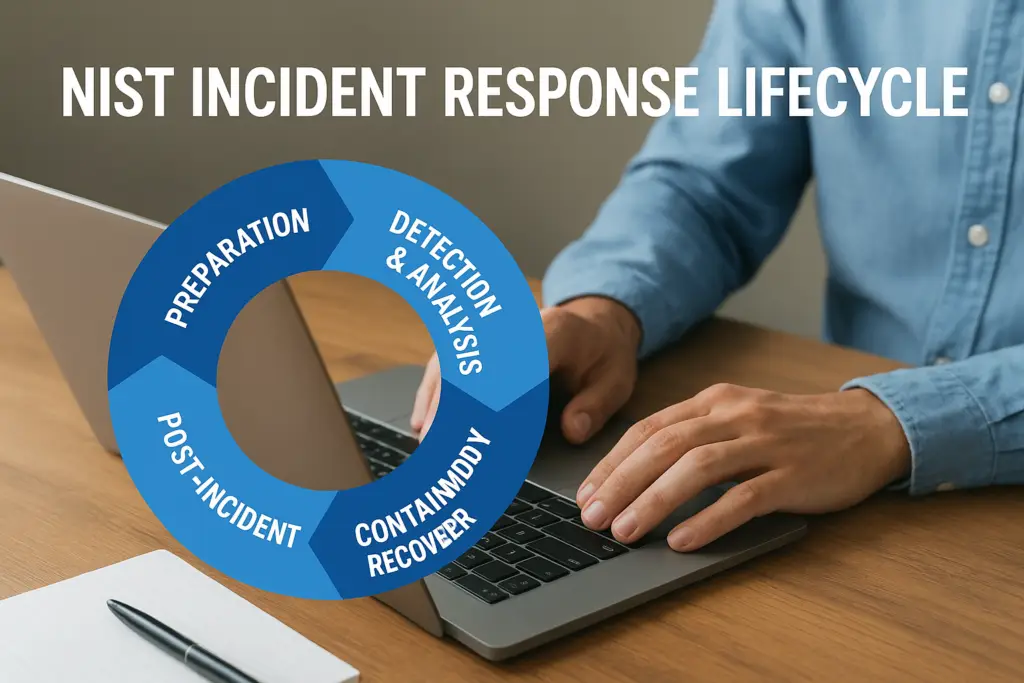
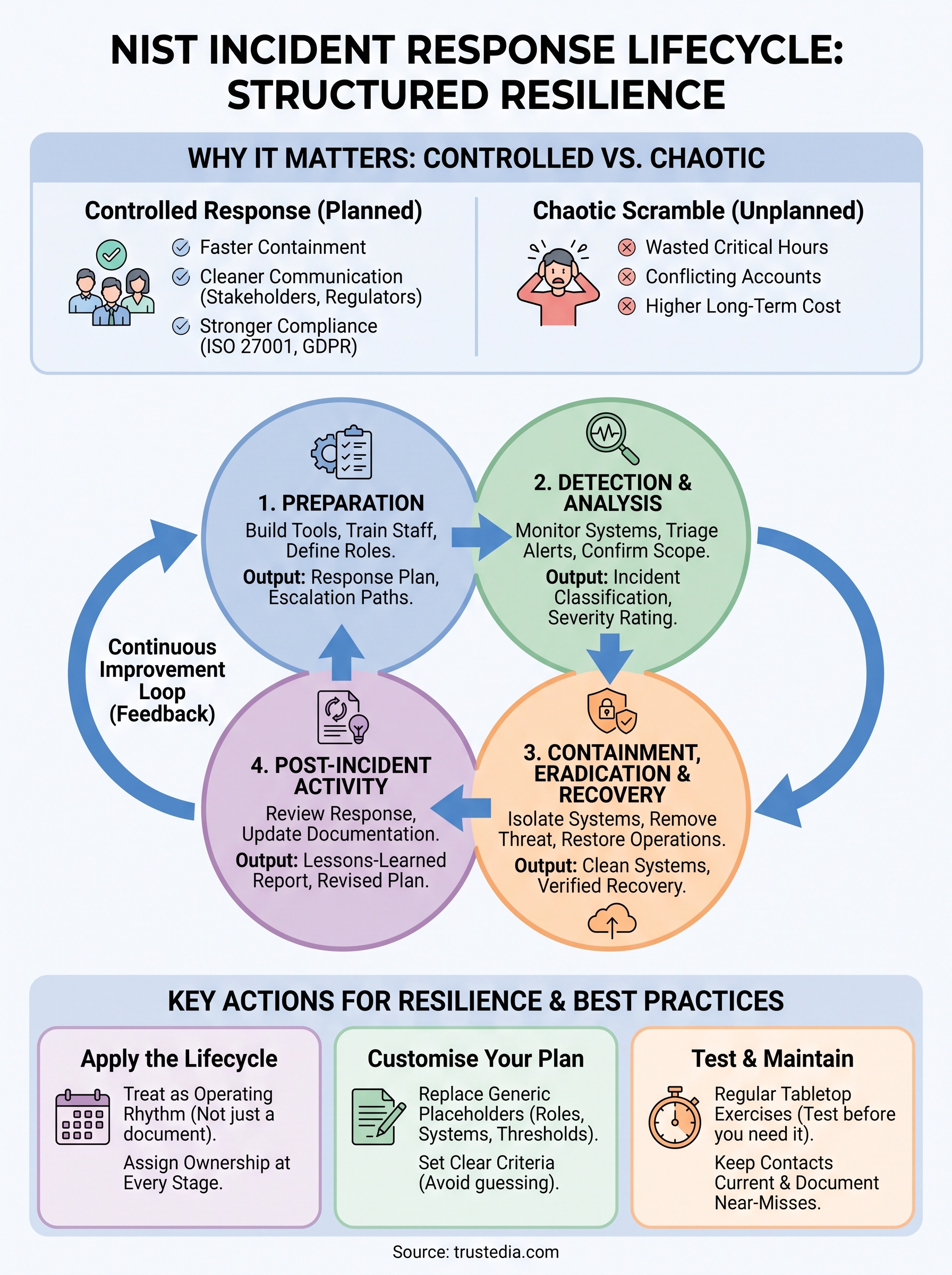
Applying the NIST incident response lifecycle means treating it as an operating rhythm rather than a document you open once a year. NIST SP 800-61 breaks the model into four phases, and each one has a specific job to do before, during, and after an attack. Skipping straight to containment without proper preparation, or closing the loop without a lessons-learned review, is where most organisations lose the value of the framework entirely.
The four phases in practice
Here’s how the phases break down and what they actually demand from your team:

| Phase | Core activity | Typical output |
|---|---|---|
| Preparation | Build tools, train staff, define roles | Response plan, contact lists, escalation paths |
| Detection & Analysis | Monitor systems, triage alerts, confirm scope | Incident classification, severity rating |
| Containment, Eradication & Recovery | Isolate systems, remove the threat, restore operations | Clean systems, verified recovery |
| Post-Incident Activity | Review response, update documentation | Lessons-learned report, revised plan |
Organisations that treat this as a straight line from top to bottom usually stumble. The incident response life cycle nist model works because the last phase feeds directly back into the first, meaning what you learn from one breach shapes how ready you are for the next.
The plan only proves its worth the second time it’s used, when last time’s lessons are already built in.
Turning phases into action
Moving from theory to a working process means assigning ownership at every stage, not just writing narrative descriptions of what should happen. A practical rollout usually looks like this:
- Preparation: Appoint an incident lead, agree escalation thresholds, and rehearse the plan with a tabletop exercise at least twice a year.
- Detection & Analysis: Set clear criteria for what counts as an incident versus routine noise, so analysts aren’t guessing under pressure.
- Containment, Eradication & Recovery: Predefine which systems can be isolated without board sign-off and which need executive approval first.
- Post-Incident Activity: Hold a structured debrief within two weeks of resolution and update the plan before the details fade.
Smaller businesses without a dedicated security team often find this stage the hardest to sustain on their own, which is exactly why many bring in outside expertise through a managed SOC or an incident response retainer, so the lifecycle keeps running even when internal resources are stretched thin.
How to build a NIST incident response plan template
Starting from a blank page wastes time you don’t have once an incident is already underway. A nist cyber incident response plan template gives you the skeleton, but you still need to fill it with your own systems, contacts, and thresholds before it’s actually usable. Copying a generic template and filing it away without customisation is almost as risky as having no plan at all, because it creates a false sense of readiness that collapses the moment something real happens.
Core sections every template needs
A workable cyber security incident response plan template nist style document should cover, at minimum:
- Purpose and scope: which systems, data, and business units the plan covers.
- Roles and responsibilities: named individuals, not just job titles, with backup contacts.
- Classification criteria: how you define severity levels and who decides escalation.
- Communication plan: internal reporting lines plus external notification duties, including the ICO’s 72-hour breach reporting requirement under UK GDPR.
- Containment and recovery procedures: system-specific steps for isolating and restoring affected assets.
- Post-incident review process: how lessons get captured and fed back into the plan.
A template only earns its place once it has your names, your systems, and your thresholds in it, not someone else’s.
Making the template your own
Genericity is the biggest weakness in most downloaded templates. Replace placeholder role names with actual staff, list your real critical systems rather than generic examples, and set severity thresholds that match your risk appetite rather than a default scale that doesn’t reflect your business. Rehearsing the plan with a tabletop exercise usually exposes gaps that reading it never would, things like an outdated phone number for your cyber insurer, or a step that assumes access to a system that’s since been decommissioned.
Keeping the template alive
Templates decay fast if nobody owns their upkeep. Assign a single person, usually the incident lead or IT manager, to review the document at least twice a year and after every real incident or drill. Version control matters too: date every revision, keep a change log, and make sure the current version is the only one circulating among staff who might need it under pressure. Businesses without the internal capacity to maintain this properly often find it more reliable to work with a specialist partner who already runs this process for other organisations, rather than letting the document quietly go stale in a shared drive.
How the lifecycle fits into the wider NIST framework
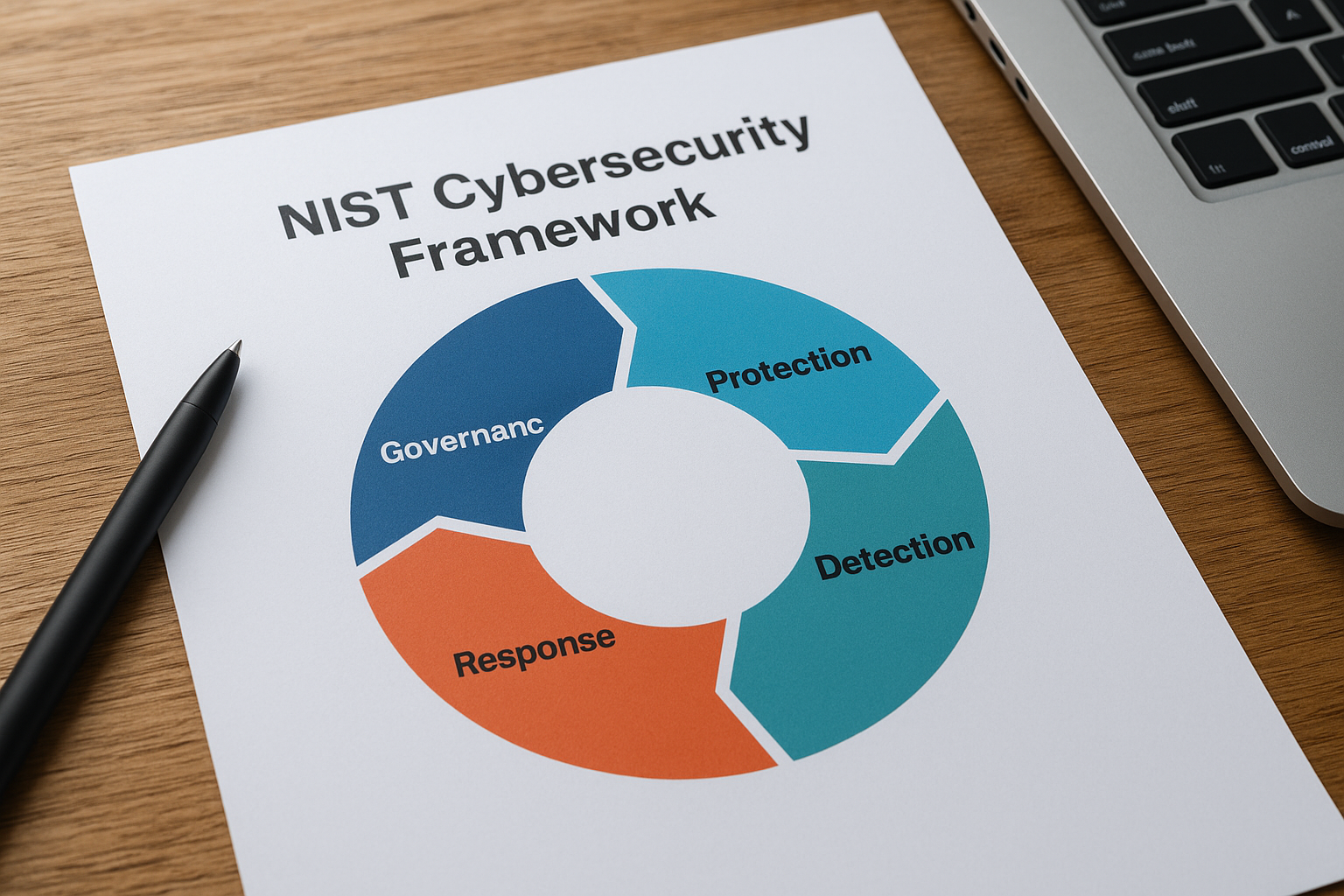
The incident response lifecycle doesn’t operate on its own. It sits inside a much larger structure that NIST has built to help organisations manage cyber risk holistically, and understanding that relationship changes how you use the lifecycle day to day. The NIST incident response framework you’ve been reading about is really one component of the NIST Cybersecurity Framework (CSF), which organises activity into broader functions covering governance, protection, detection, response, and recovery. You can see how these functions interlock directly on NIST’s Cybersecurity Framework page, which is worth reading if you want to understand how incident response connects to the rest of your security programme rather than sitting in isolation.
Where the lifecycle sits within CSF
Before an incident even happens, the CSF’s governance and protection functions are doing the groundwork that makes the lifecycle effective. Detection and response functions map almost directly onto the lifecycle’s own phases, which is why organisations already working within the CSF tend to adopt SP 800-61 without friction. Recovery, meanwhile, extends beyond the lifecycle’s own recovery phase into longer-term business continuity planning, the kind of work that determines whether you’re back to normal in days rather than weeks.
Incident response doesn’t work in isolation. It’s only as strong as the governance and protection built around it.
Why this matters for compliance and audits
Seeing the nist incident response lifecycle nist model as part of this wider structure matters practically, not just academically. Auditors assessing ISO 27001 compliance, insurers underwriting cyber cover, and regulators reviewing your preparedness all expect to see incident response sitting within a broader risk management approach, not floating as a standalone document. A plan that references your asset inventory, your risk assessments, and your existing controls demonstrates far more maturity than one that reads as a self-contained exercise disconnected from everything else you do.
Practical takeaway for your organisation
Thinking about the framework as a whole rather than the lifecycle in isolation also helps you spot gaps before an incident exposes them. If your asset inventory is out of date, your detection phase will struggle regardless of how well-drafted your response plan is. Treating incident response as one piece of a connected system, rather than a bolted-on document, is what turns a compliance exercise into genuine resilience.
Best practices for a resilient incident response plan
Building a plan that survives contact with a real incident takes more than filling in a template once and forgetting about it. Genuine resilience comes from habits that keep the plan current, tested, and understood by the people who’ll actually use it under pressure. The organisations that recover fastest aren’t necessarily the ones with the most sophisticated tools, they’re the ones that treat the incident response lifecycle nist framework as a living process rather than a filed document.
Test before you need it
Tabletop exercises expose weaknesses that reading a document never will. Run at least two scenarios a year covering different attack types, ransomware, phishing-led credential theft, a third-party supplier breach, and involve people outside the IT team, since finance, legal, and communications all have a role once an incident becomes public. Regular rehearsal turns a theoretical plan into muscle memory, so when a real alert lands at 2am, nobody is reading the plan for the first time.
A plan that’s never been tested is a guess dressed up as a strategy.
Keep roles and contacts current
Staff leave, phone numbers change, and suppliers get replaced. A quick checklist for keeping your plan accurate:
- Review named roles and backup contacts every quarter.
- Confirm your cyber insurer’s claims line and policy number are current.
- Check external contacts, forensic partners, legal counsel, PR support, are still correct.
- Remove references to decommissioned systems and add newly deployed ones.
Build in outside expertise where it’s needed
Few organisations have the internal bandwidth to run detection, containment, and recovery to a consistently high standard around the clock. Bringing in a managed SOC or a dedicated incident response retainer fills that gap without requiring a full in-house security team, and it means the lifecycle keeps running even during nights, weekends, and periods when internal staff are already stretched thin.
Document everything, even the near-misses
Lessons-learned reviews only work if there’s something to review. Log near-misses and minor incidents with the same discipline as major ones, since patterns often emerge across smaller events that never trigger a full response but still point to a weakness worth fixing. Feeding that detail back into the preparation phase is what makes the lifecycle genuinely cyclical rather than a document that gets dusted off once a year and quietly shelved again afterwards.
Putting the NIST lifecycle into practice
Getting the NIST incident response lifecycle right isn’t about owning a polished document that sits in a shared drive gathering dust. It’s about knowing, before anything goes wrong, exactly who does what, when they do it, and how the whole organisation learns from every incident and near-miss along the way. Preparation, detection, containment, and review only work as a genuine cycle when each phase feeds the next, and that only happens with regular testing and honest reviews of what didn’t go to plan.
Most businesses don’t have the internal capacity to run this properly around the clock, and that’s fine, provided you know where to get support before you need it. If you’d rather have specialists managing detection, response, and recovery for you rather than building it all from scratch, talk to TrustedIA about a plan tailored to your organisation.