
When a security incident hits, the difference between a contained disruption and a full-blown crisis often comes down to one thing: how well your response plan holds up under pressure. The NIST Computer Security Incident Handling Guide (Special Publication 800-61) is the most widely referenced framework for building that plan. It gives organisations a structured, repeatable approach to detecting, analysing, containing, and recovering from cybersecurity incidents, regardless of size or sector.
Published by the National Institute of Standards and Technology, SP 800-61 breaks incident response into clear phases with defined actions, making it practical rather than theoretical. Whether you’re building an incident response capability from scratch or pressure-testing an existing one, this guide provides the foundation. It’s also the framework that many compliance standards and cyber insurance policies expect you to align with.
At TrustedIA, incident response is core to what we do. Our CyberSOS service helps organisations recover quickly and effectively after a cyber incident, and our work with insurers, loss adjusters, and businesses of all sizes means we apply these principles daily. With over 30 years of experience in IT services and managed security, we’ve seen first-hand how proper incident-handling preparation reduces both downtime and damage.
This article walks you through the key steps outlined in the NIST Computer Security Incident Handling Guide, from preparation through to post-incident learning, so you can understand what the framework covers, how each phase works, and how to put it into practice within your own organisation.
What the NIST incident handling guide covers
The NIST Computer Security Incident Handling Guide (SP 800-61) is a comprehensive federal publication produced by the National Institute of Standards and Technology. First released in 2004 and revised in 2012, it provides detailed guidance on every stage of incident response, from setting up your team and tools through to learning from incidents after they close. It is not a high-level policy document. It is a working reference that gives you specific recommendations, process flows, and examples you can adapt to your own environment.
The scope and purpose of SP 800-61
The guide covers computer security incident response broadly, addressing threats such as malware outbreaks, unauthorised access, denial-of-service attacks, and data breaches. Its scope extends to both technical response actions and organisational process design, helping you build the right team structure and communication protocols alongside your detection and containment procedures. The underlying goal is to help organisations handle incidents consistently and efficiently, rather than improvising under pressure.
SP 800-61 is designed to be adapted, not followed rigidly. Your organisation’s size, risk profile, and existing controls all shape how you apply it.
One important aspect of the guide is that it treats incident response as a continuous organisational capability rather than a one-time project. It dedicates significant space to preparation activities, noting that what you do before an incident largely determines how effectively you respond when one occurs. This includes defining what constitutes an incident for your organisation, establishing escalation paths and communication channels, and ensuring your team has the tools and authority to act when the time comes.
The four phases at a glance
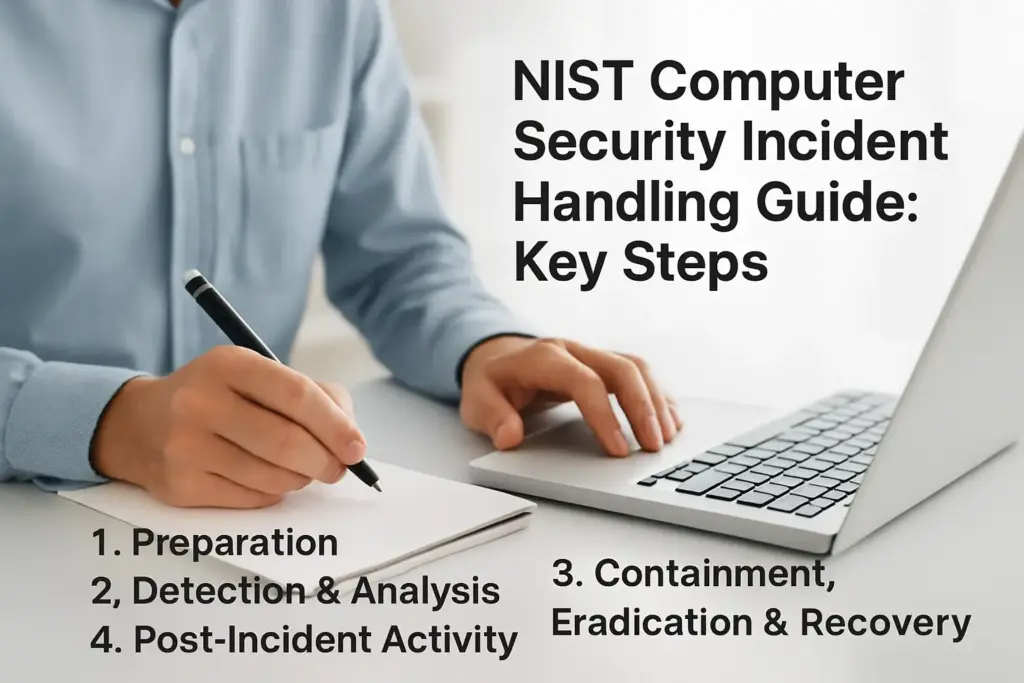
SP 800-61 organises incident response into four distinct phases: Preparation, Detection and Analysis, Containment/Eradication/Recovery, and Post-Incident Activity. Each phase has defined inputs, outputs, and activities, giving your team a shared language and a repeatable process regardless of the incident type.
Here is a brief overview of what each phase covers:
| Phase | Core focus |
|---|---|
| Preparation | Building your IR capability, tools, policies, and team before incidents occur |
| Detection and Analysis | Identifying potential incidents, triaging alerts, and confirming whether an incident is real |
| Containment, Eradication and Recovery | Limiting damage, removing the threat, and restoring normal operations |
| Post-Incident Activity | Reviewing what happened, documenting lessons, and improving future response |
Who the guide is designed for
Originally written for US federal agencies, SP 800-61’s practical framework has made it the standard reference for organisations worldwide, including businesses operating under UK and European regulatory requirements. You do not need to be a government body to benefit from it. The structured methodology applies directly to any organisation that handles sensitive data, operates critical systems, or faces regulatory obligations related to security and business continuity.
Security teams, IT managers, and CISOs will find the guide particularly useful when building or maturing an incident response programme. Beyond internal use, it also supports conversations with boards, insurers, and regulators by showing that your approach aligns with a recognised, well-established standard. If you are working towards ISO 27001 certification or aligning with the NIST Cybersecurity Framework, SP 800-61 fits naturally alongside both without requiring significant duplication of effort.
Why SP 800-61 matters for real incidents
Most organisations discover gaps in their incident response process only when an actual incident exposes them. A vague awareness that you should “contain and investigate” is not enough when your systems are compromised, and your business is losing money by the hour. The NIST Computer Security Incident Handling Guide exists precisely because ad hoc responses consistently produce worse outcomes than structured ones, even when the people involved are competent and well-intentioned.
The cost of an unstructured response
When teams lack defined procedures and clear roles, incidents take longer to contain. Evidence gets destroyed through hasty remediation. Communication breaks down between technical and management teams. Regulatory notification deadlines get missed because no one tracks the timeline. These are not edge cases. They are the predictable consequences of responding without a framework, and they play out in incidents ranging from ransomware attacks to insider threats to accidental data exposures.
The organisations that recover fastest from incidents are almost always the ones that rehearsed their response before it happened, not the ones with the most advanced tools.
The financial and reputational damage from poor incident handling often exceeds that of the incident itself. A breach that could have been contained within hours becomes a week-long crisis because containment decisions stall while waiting for unclear approvals, or because the team has no pre-agreed criteria for escalating to senior leadership.
What the guide gives you is generic advice that does not
SP 800-61 provides specific, actionable guidance that high-level security frameworks do not. It tells you how to build an incident response team structure, what tools and resources that team needs, how to categorise and prioritise incidents, and how to document response actions in a way that supports both recovery and legal review. That level of specificity is what separates it from policy documents that gesture at best practice without showing you how to implement it.
For organisations that face cyber insurance requirements or regulatory scrutiny, alignment with SP 800-61 demonstrates a level of process maturity that auditors and insurers recognise. It signals that your incident handling is repeatable and defensible, not improvised. When your insurer or a regulatory body asks how you managed an incident, showing that your response followed a structured, documented methodology carries far more weight than simply describing what your team did in the moment.
The incident response lifecycle in SP 800-61
The four-phase lifecycle described in the NIST computer security incident handling guide gives your team a clear structure to follow from the moment an incident is suspected through to the lessons captured once it closes. Each phase feeds directly into the next, creating a cycle rather than a one-time process. Your preparation informs your detection capability, your analysis shapes your containment decisions, and your post-incident review strengthens your next round of preparation.
Phase one: preparation
Preparation is the phase most organisations underinvest in, yet it most influences every phase that follows. The work here includes defining what constitutes an incident in your environment, assembling and training your incident response team, establishing communication channels, and acquiring the tools your team needs before any incident occurs.
This phase also covers policy and procedure documentation, which includes escalation paths, criteria for engaging external support, and your approach to evidence handling. Without these foundations, your team will spend time during an active incident making decisions that should have been made long in advance.
Phase two: detection and analysis
Detecting a real incident within the noise of everyday alerts is one of the most demanding aspects of incident response. SP 800-61 recommends drawing on multiple data sources, including logs, network monitoring, and endpoint telemetry, to identify indicators of compromise and separate genuine incidents from false positives.
The analysis stage is where preparation becomes visible: teams with documented baselines and defined triage criteria move significantly faster than those without.
Once an incident is confirmed, prioritisation determines the pace of your response. SP 800-61 advises categorising incidents by functional impact, information impact, and recovery effort, so your team can direct resources where they matter most.
Phase three: containment, eradication, recovery, and review
Containment decisions require both speed and judgement. SP 800-61 distinguishes between short-term containment, which limits immediate damage, and long-term containment, which stabilises the environment while full eradication and recovery proceed. Eradication removes the root cause, whether that is malware, a compromised account, or an exploited vulnerability, and recovery restores systems with appropriate verification before returning them to production.
Post-incident activity closes the lifecycle with a structured review of what happened, how your team responded, and what changes would improve future outcomes. This review should produce documented lessons and updated procedures, not simply a verbal debrief that gets forgotten before the next incident arrives.
How to apply the guide in your organisation
Applying the NIST Computer Security Incident Handling Guide to your organisation does not require a complete overhaul of your existing security operations. SP 800-61 is designed to adapt to your context, so the right starting point is understanding what you already have, what is missing, and where the biggest risks lie if an incident occurred today.
Start with an honest gap assessment.
Before writing new policies or investing in additional tools, map your existing incident response activities against the four phases of the SP 800-61 lifecycle. For most organisations, the gaps cluster heavily in preparation: no defined incident categories, unclear escalation paths, and no documented procedure for preserving evidence during a live incident. Identifying these gaps first means your effort goes where it counts, rather than adding process layers on top of an unstable foundation.
Prioritise the gaps you find by likely impact during an actual incident, not by how straightforward they are to fix. A missing communication plan will do more damage than an incomplete asset inventory because communication breakdowns consistently prolong containment and confuse technical responders and senior leadership when decisions must be made quickly. Setting a clear priority order also helps you build your programme incrementally, giving your team achievable targets rather than an overwhelming list of changes all at once.
Build your plan around the four phases
Structure your incident response plan document directly around the SP 800-61 lifecycle phases. Each phase should have clearly defined inputs, named owners, and documented exit criteria so your team knows exactly what they are responsible for and when they move on to the next stage. This structure also makes your plan far easier to validate through tabletop exercises, where you can run realistic scenarios and identify weaknesses before a real incident exposes them.
Testing your plan regularly with realistic scenarios is the most effective way to confirm that your preparation will hold when it actually matters.
Your plan does not need to be long to work. Short, specific procedures that your team has read, practised, and can locate quickly under pressure will outperform a detailed document that nobody opens until systems are already compromised. Include pre-agreed containment actions, clear contact lists, and tool access details so critical incident decisions are ones your team has already made in calmer conditions. Review and update your plan at least annually, and after any significant incident, to ensure it reflects your current environment and any lessons your team has captured.
How SP 800-61 fits with ISO/IEC 27001 and CSF
Many organisations already operate within one or more recognised security frameworks, and where the NIST Computer Security Incident Handling Guide sits relative to those frameworks is a practical question. SP 800-61 does not replace ISO 27001 or the NIST Cybersecurity Framework. Instead, it operates at a different level of detail, providing the step-by-step incident-handling procedures that broader frameworks require but leave undefined.
SP 800-61 and ISO/IEC 27001
ISO 27001 requires organisations to plan for and respond to information security incidents as part of their Information Security Management System (ISMS). Clause 16 of the standard addresses incident management directly, requiring you to establish responsibilities, define response procedures, and capture evidence from incidents. However, ISO 27001 specifies what you must do without prescribing how. SP 800-61 fills that gap precisely.
Working towards ISO 27001 certification means your incident response procedures need to demonstrate a structured, documented approach to handling incidents. Using SP 800-61 as the operational framework behind your Clause 16 controls gives auditors something concrete and internationally recognised to assess against. This makes certification conversations more straightforward and your audit evidence considerably stronger, because your procedures trace back to a well-documented standard rather than internal convention alone.
Treating SP 800-61 as the operational layer beneath your ISO/IEC 27001 ISMS means you satisfy the “what” of the standard with a tested and proven “how”.
SP 800-61 and the NIST Cybersecurity Framework
The NIST Cybersecurity Framework (CSF) organises security activity into five functions: Identify, Protect, Detect, Respond, and Recover. SP 800-61 maps most directly to the Respond and Recover functions, but it also supports Detect through its guidance on building detection capability and analysing indicators of compromise.
Using both together gives you complementary layers of guidance. The CSF helps you assess your overall security posture and identify priorities across your organisation. SP 800-61 then gives your response and recovery teams the detailed procedures they need to act effectively when an incident occurs. Neither framework duplicates the other, and implementing them together requires less additional effort than building two entirely separate programmes from scratch.
Key takeaways and next steps
The NIST Computer Security Incident Handling Guide gives your organisation a structured, repeatable approach to incident response that holds up under real pressure. SP 800-61 covers every phase from preparation through to post-incident review, and it works alongside both ISO 27001 and the NIST Cybersecurity Framework without creating unnecessary duplication. The organisations that recover fastest from incidents are not the ones with the biggest security budgets. They are the ones who documented their procedures, practised their response, and closed the gaps before an incident forced them to.
Taking the first step does not have to mean tackling everything at once. Start with an honest review of your current preparation and identify where your response would break down today if an incident occurred tomorrow. If you need experienced support to build or strengthen your incident response capability, speak to the TrustedIA team about how our managed security and CyberSOS services can help.



