
If you’re preparing for ISO 27001 certification, you’ve probably hit the same question every IT manager and compliance officer asks: does the standard actually require penetration testing? The honest answer is no, not by name. But understanding iso 27001 penetration testing requirements matters anyway, because Annex A controls around vulnerability management and technical security testing leave auditors expecting evidence that you’ve tested your defences properly, and pen testing is usually the most credible way to provide it.
So the real question isn’t whether the standard uses the words "penetration test", it’s what your auditor will accept as proof that you’ve identified and addressed technical vulnerabilities. That’s where iso 27001 pentest requirements get practical: scope, frequency, evidence, and how testing ties into your risk treatment plan and Statement of Applicability.
We’ve supported businesses through ISO 27001 implementation and certification for over 30 years, so this article covers exactly what auditors look for, which controls drive the need for testing, how often you should run assessments, and how to build penetration testing into a certification-ready security programme rather than treating it as a box-ticking exercise.
Why penetration testing matters for ISO 27001 compliance

Certification bodies don’t get to invent requirements that aren’t in the standard, but they do get to decide what counts as sufficient evidence for the controls that are in it. ISO 27001 penetration testing requirements exist in this grey area: the standard never says "you must run a penetration test", yet clause 8.1 demands that you implement plans to achieve information security objectives, and Annex A controls A.8.8 and A.8.29 explicitly call for managing technical vulnerabilities and testing security during development. Auditors have learned, often the hard way, that firewalls, patch schedules, and policy documents don’t prove your systems actually resist attack. A skilled pen tester does.
Businesses that treat this as a paperwork exercise usually get caught out. Auditors ask increasingly pointed questions during stage 2 of the ISO 27001 audit: how do you know your public-facing services are secure, what evidence supports your risk assessment for external threats, and when did you last validate that assumption independently. If your answer is "we run antivirus and patch monthly", you’ll likely walk away with a nonconformity. If your answer includes a recent, well-scoped penetration test report with remediated findings, you’ve given the auditor exactly what they need to sign off with confidence.
An ISO 27001 auditor doesn’t ask if you’ve been hacked, they ask how you know you wouldn’t be.
The commercial argument, not just the compliance one
Beyond satisfying an auditor, regular testing genuinely reduces your breach risk, and that matters because a security incident during or shortly after certification is embarrassing at best and catastrophic at worst. We’ve seen organisations achieve certification, suffer a ransomware attack three months later through an unpatched VPN endpoint, and then have to explain to clients and insurers why their "certified" security programme missed something a basic external pen test would have flagged in an afternoon. Certification without real assurance is worse than no certification at all, because it creates false confidence.
Consider what a competent test typically uncovers even in organisations that believe they’re well-defended:
- Unpatched or misconfigured internet-facing services that vulnerability scanners miss because they require manual exploitation to confirm
- Weak authentication controls, including reused credentials, missing multi-factor authentication, or default accounts left active
- Excessive user or service account privileges that widen the blast radius of any single compromised login
- Insecure application logic, such as broken access controls that let one customer view another’s data
- Gaps between documented policy and actual practice, which is exactly what your ISMS is supposed to catch
Each of these maps directly back to a risk your ISMS should already have identified in your risk assessment. Testing simply confirms whether your existing controls actually do what your Statement of Applicability claims they do.
Why insurers and clients ask for it anyway
Even if your auditor were somehow satisfied without it, your customers and cyber insurers usually won’t be. Enterprise procurement teams increasingly request penetration test evidence as a standard part of vendor due diligence, regardless of your ISO 27001 status, because certification tells them you have a management system, not that your network is impenetrable. Insurers ask similar questions when underwriting cyber cover, and a documented, recent test often translates into better premiums and fewer exclusions.
Getting this right early saves you from scrambling later. Organisations that build penetration testing into their ISMS from the start, rather than bolting it on before an audit deadline, find the whole certification process smoother. Findings get fixed in the normal course of operations rather than in a panic, evidence accumulates naturally as part of your continual improvement cycle, and you walk into the surveillance audits that keep your certificate valid with a genuine track record rather than a single test report dated suspiciously close to the audit window. If you’re weighing up how to structure this properly, TrustedIA’s penetration testing services are built specifically around what ISO 27001 auditors and insurers expect to see, not just generic testing for its own sake.
Which Annex A controls relate to penetration testing
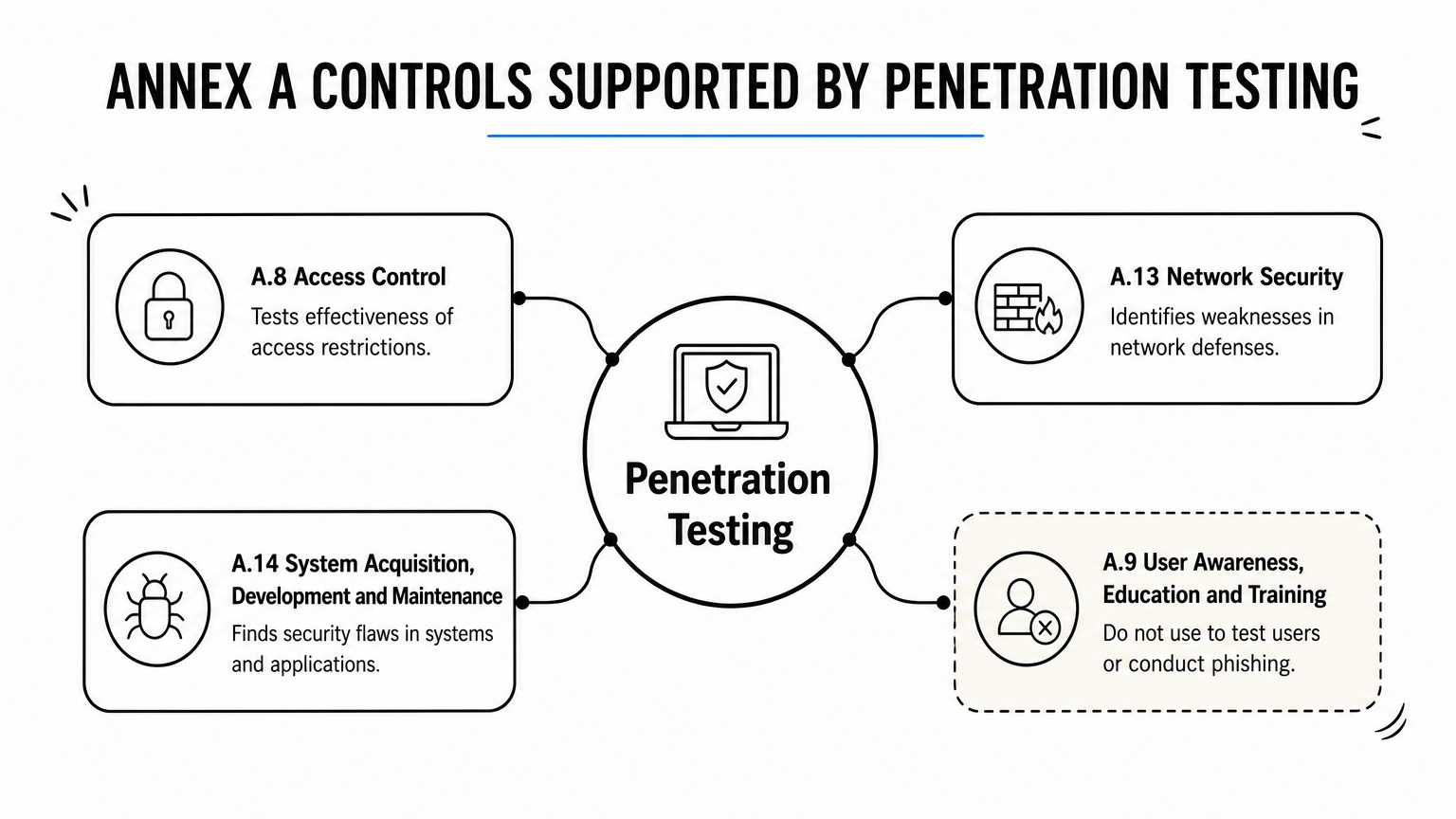
Annex A of ISO 27001:2022 and its control categories don’t include a control literally titled "penetration testing", but several controls only make sense in practice if you’ve validated them through active testing. Knowing exactly which ones apply helps you build a defensible case to your auditor and stops you scattering test effort across areas that don’t actually need it. Get this mapping right and your Statement of Applicability justification writes itself.
Core controls that demand technical validation
Two controls do most of the heavy lifting here. A.8.8 Management of technical vulnerabilities requires you to obtain timely information about technical vulnerabilities, evaluate your exposure, and take appropriate measures. A penetration test is the most rigorous way to demonstrate you’re doing more than reading vendor advisories; it proves a real attacker couldn’t exploit what you’ve assessed as low risk. A.8.29 Security testing in development and acceptance goes further, requiring that security testing happens during development and before systems go live, which is exactly where application-layer penetration testing earns its keep.
| Annex A control | What it requires | How penetration testing supports it |
|---|---|---|
| A.8.8 Management of technical vulnerabilities | Timely identification and treatment of technical vulnerabilities | Confirms vulnerabilities are exploitable in practice, not just theoretical scanner output |
| A.8.29 Security testing in development and acceptance | Testing security functionality before deployment | Validates new applications and infrastructure changes before they go live |
| A.8.16 Monitoring activities | Detection of anomalous behaviour on networks and systems | Tests whether your monitoring actually catches simulated attacker activity |
| A.5.36 Compliance with policies, rules and standards | Regular review that controls are followed in practice | Exposes gaps between documented policy and real configuration |
| A.8.9 Configuration management | Secure, consistent system configuration | Reveals configuration drift that manual review often misses |
Other controls benefit indirectly rather than being satisfied outright by testing. A.8.16 Monitoring activities asks you to detect anomalous behaviour, and a well-run test tells you whether your SOC actually noticed the simulated attack or whether alerts got lost in the noise. A.5.36 Compliance with policies, rules and standards requires periodic checks that your controls work as documented, and a test report is often the clearest evidence available that they do, or don’t.
Don’t forget the risk assessment link
None of these controls exist in isolation from your core cyber risk assessment process, which is why auditors always trace testing evidence back to it. Findings from a penetration test should update your risk register, adjust residual risk scores where appropriate, and feed into your management review under clause 9.3. Skipping that link is the single most common mistake we see: businesses run a test, fix the critical findings, and file the report away without ever updating the risk treatment plan it was meant to inform.
A penetration test that never updates your risk register is just an expensive PDF.
Auditors increasingly ask to see that connection explicitly, so keep it visible in your ISMS documentation rather than assuming the report speaks for itself.
How to plan and scope an ISO 27001 penetration test
Getting scope wrong is the fastest way to waste a test budget and still fail your audit. Scoping decisions made before a single tool touches your network, and captured in a penetration testing checklist covering scope, rules of engagement and reporting, determine whether the test actually validates the risks in your risk assessment, or just ticks a generic box. Auditors increasingly ask to see the rationale behind your scope choices, not just the final report, so document why you tested what you tested and, just as importantly, why you excluded anything else.
Define scope against your risk assessment, not your budget
Sound scoping starts with your Statement of Applicability, your risk register and the ISMS boundaries you set in your ISO 27001 scope, not with whatever your provider quotes cheapest. Include every asset that a threat actor would realistically target given your risk profile: internet-facing infrastructure, customer-facing applications, remote access points like VPNs, and any system holding data classified as high-risk in your ISMS. Skipping an asset because it’s inconvenient to test, rather than because it’s genuinely low risk, is the kind of shortcut auditors spot immediately.
- Internet-facing servers and network perimeter, the most commonly targeted attack surface
- Web and mobile applications handling customer or financial data
- Remote access infrastructure, including VPNs and remote desktop services
- Internal network segments if your threat model includes insider risk or lateral movement
- Cloud configurations, particularly for AWS, Azure, or Microsoft 365 environments, noting what AWS permits and prohibits during a penetration test
A pen test that skips your highest-risk asset to save money isn’t a scoping decision, it’s a liability.
Choose the right testing methodology and rules of engagement
Testing methodology matters as much as scope, so it helps to understand how penetration testing is carried out stage by stage. Black-box testing simulates an outsider with no prior knowledge, useful for validating perimeter defences, while grey-box testing gives the tester limited credentials to simulate an insider threat or compromised account, often more realistic for iso 27001 pentesting requirements since most breaches start with stolen credentials rather than opportunistic hacking. White-box testing, where the tester has full access to source code and architecture diagrams, suits application-heavy environments where A.8.29 compliance is the priority.
Rules of engagement should be agreed in writing before testing starts, covering testing windows, escalation contacts if something breaks, and explicit authorisation to avoid legal ambiguity. Working with an accredited provider such as a CREST-certified tester gives your auditor immediate confidence in methodology, and it protects you legally if a test causes unexpected disruption. TrustedIA’s vulnerability assessment service with a prioritised remediation plan scopes every engagement against the client’s actual risk register rather than a generic checklist, which is exactly the level of detail auditors want to see referenced in your ISMS documentation.
How often to test and what should trigger a retest
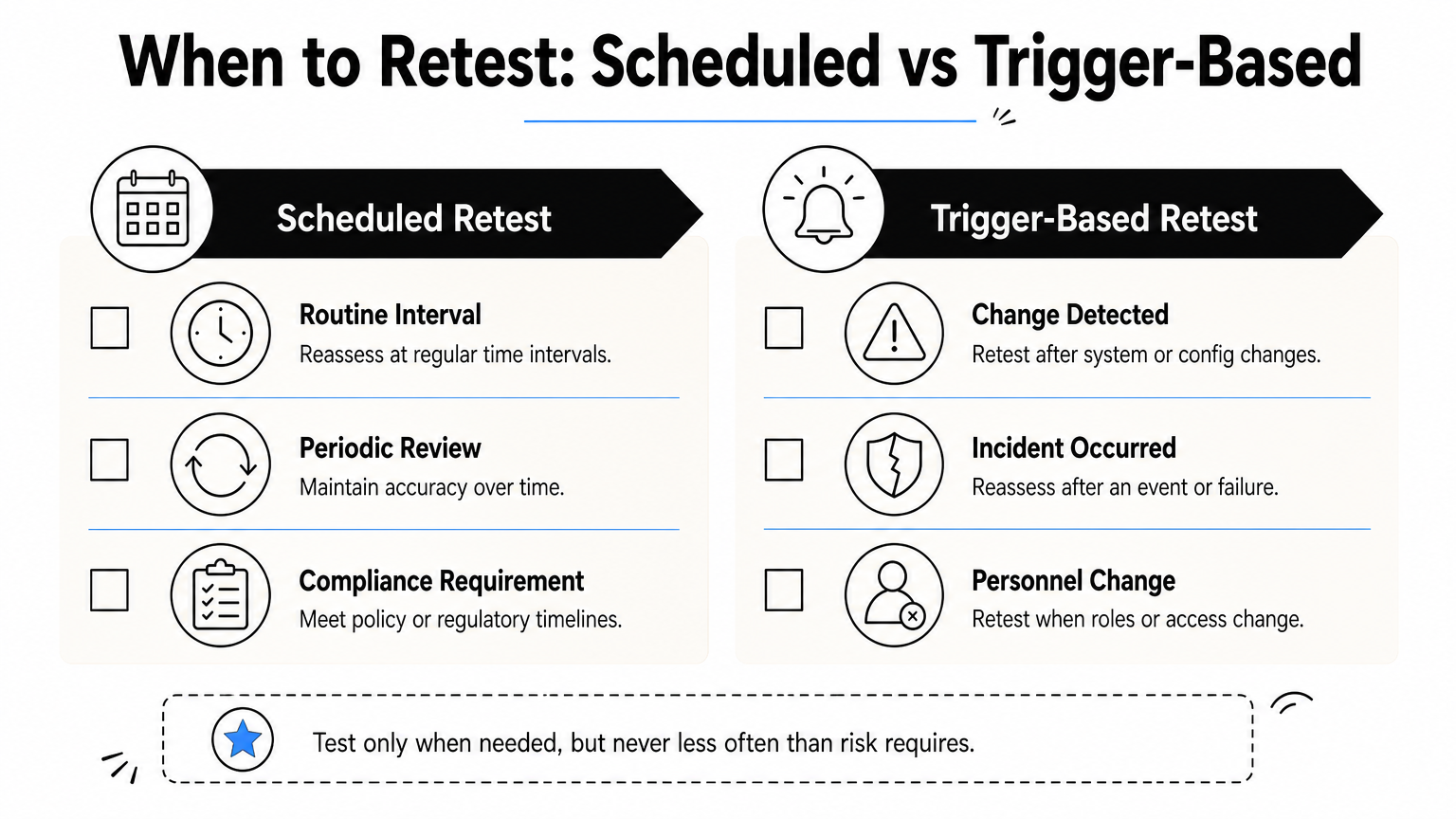
Annual testing is the baseline most certification bodies expect, but treating it as a fixed calendar event misses the point of iso 27001 pentest requirements. The standard itself doesn’t specify a number, so auditors fall back on what’s proportionate to your risk profile under clause 6.1. A business running static brochure websites needs less frequent testing than one processing payment data or handling health records. Once a year is the floor, not the ceiling, and you should say so explicitly in your risk treatment plan rather than leaving frequency to guesswork.
Set frequency against risk, not habit
Beyond the annual minimum, several factors should push you towards more frequent testing. High-risk environments handling regulated data, organisations that have suffered a previous incident, or businesses with rapidly changing infrastructure all warrant testing every six months rather than twelve. Document your reasoning in the risk assessment itself, because an auditor who sees "annual" written without justification will ask why you chose that interval over something more frequent.
Testing once a year because that’s what everyone else does isn’t risk management, it’s guesswork with a certificate attached.
Events that should trigger an unscheduled retest
Certain changes to your environment matter more than the calendar. A retest triggered by a genuine change carries far more weight with auditors than one triggered purely by a date in the diary, because it demonstrates your ISMS responds to real risk rather than a fixed schedule.
- Major infrastructure changes, including new cloud migrations, network redesigns, or a new data centre
- Significant application releases, particularly anything handling customer data or payment processing
- Mergers, acquisitions, or new third-party integrations that expand your attack surface overnight
- A confirmed security incident, even a minor one, since it often reveals a wider gap than the single exploited flaw
- Material changes to your risk assessment, such as a new threat identified through threat intelligence or a client contractual requirement
| Trigger | Typical retest urgency |
|---|---|
| New internet-facing application | Before go-live |
| Cloud provider migration | Within 30 days of cutover |
| Confirmed security incident | Immediately, scoped to the affected systems |
| Annual scheduled review | Within the certification cycle |
| Third-party or supplier integration | Before data sharing begins |
Building these triggers into your change management process, rather than relying on someone remembering to book a test, closes the gap auditors most often exploit during interviews. Change advisory boards should have a standing question: does this change require a retest under our vulnerability management procedure. Answering that consistently, and recording the answer, gives you a defensible audit trail regardless of which surveillance auditor turns up. TrustedIA structures retesting cadence around exactly this kind of trigger-based logic within our penetration testing services, so clients aren’t left guessing whether a change warrants a fresh look.
Penetration testing versus vulnerability scanning
Confusing these two is the single most common mistake we see when reviewing ISMS documentation ahead of an audit. Vulnerability scanning, whether scanning from inside or outside your perimeter, is automated, runs frequently, and flags known weaknesses against a database of signatures. It’s fast, cheap, and genuinely useful for catching low-hanging fruit like missing patches or expired certificates. But a scanner reports what might be wrong; it can’t confirm whether a flaw is actually exploitable, chained with another weakness, or sitting behind a compensating control that makes it harmless in practice. That confirmation is exactly what iso 27001 pentesting requirements are really asking for, and it’s a job that still needs a human tester with attacker logic, not just a tool with a subscription.
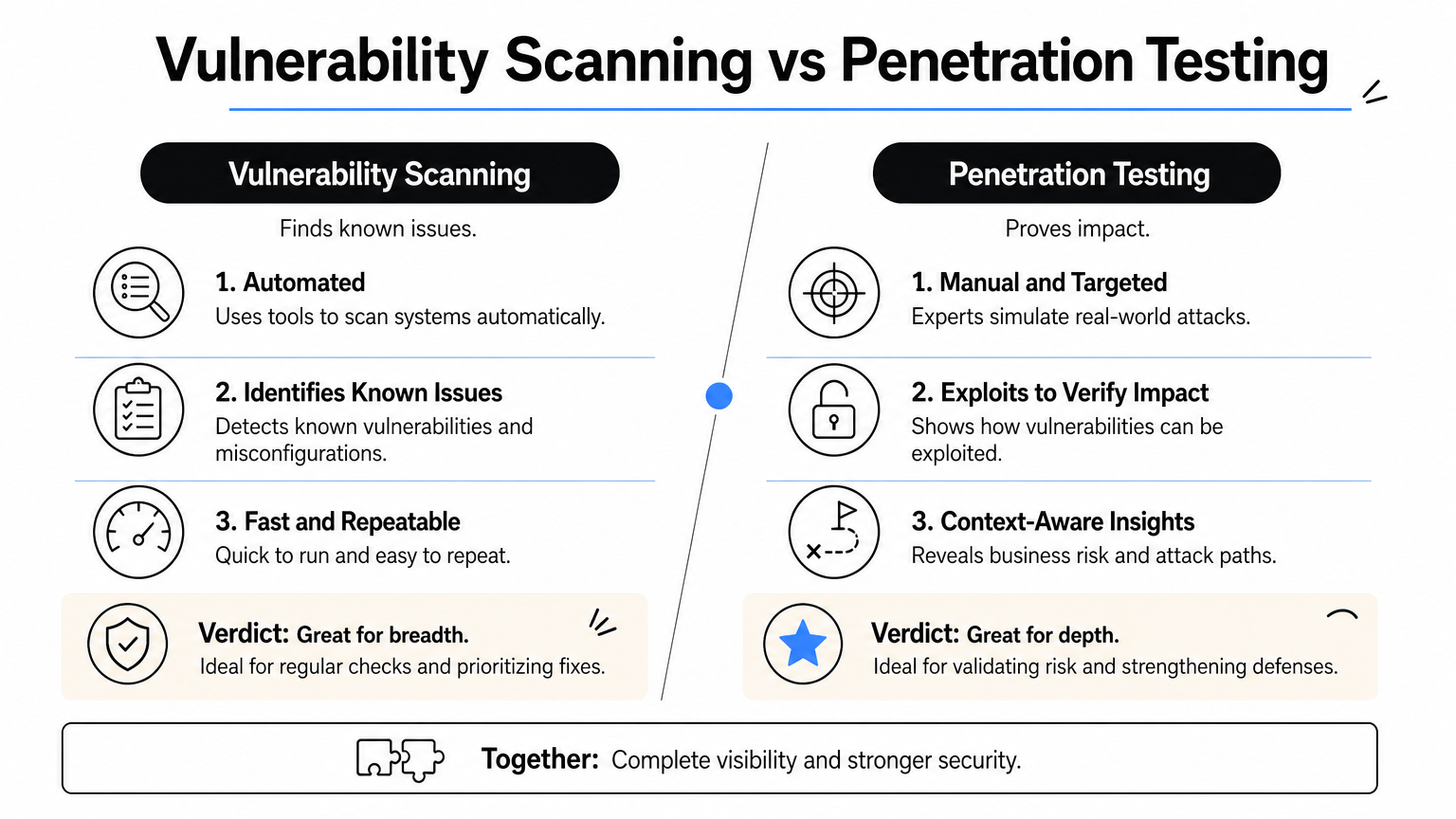
Many businesses submit a scan report to their auditor and assume it satisfies A.8.8. It rarely does. A vulnerability scan tells you a system is theoretically weak; a penetration test tells you whether someone could actually walk through the door.
A vulnerability scan finds the unlocked window; a penetration test tells you whether someone can actually climb through it.
How the two disciplines actually differ
Getting the terminology straight matters because auditors will ask which one produced your evidence, and the wrong answer undermines an otherwise solid submission.
| Factor | Vulnerability scanning | Penetration testing |
|---|---|---|
| Method | Automated tools against known signatures | Manual exploitation by a skilled tester |
| Frequency | Weekly or monthly | Typically annual, plus trigger-based retests |
| Output | List of potential weaknesses, often with false positives | Confirmed, exploitable findings with real-world impact |
| Cost | Low | Higher, reflecting skilled manual effort |
| ISO 27001 role | Supports continuous A.8.8 monitoring | Provides the deeper evidence auditors expect for higher-risk assets |
Of the two, scanning is the one you should be running constantly in the background, not the one you save for audit season. Testing, by contrast, is deliberately less frequent because it’s resource-intensive and targeted at the assets your risk assessment flags as significant.
Why auditors want to see both, not one instead of the other
Quoting one without the other is a red flag rather than a shortcut. Auditors who see only scan reports in your evidence pack will usually ask why no deeper testing has ever validated the findings, particularly for internet-facing or customer-data systems. Running only penetration tests without regular scanning in between leaves gaps too, since new vulnerabilities get disclosed daily and a once-a-year test can’t catch what emerges in month four. Together, the two form a layered assurance model: scanning gives you continuous, low-cost visibility, and testing gives you periodic, high-confidence validation that your defences hold against a determined attacker. Treat them as complementary line items in a repeatable vulnerability management programme, each with its own documented cadence, rather than interchangeable options you pick between to save budget.
What auditors expect to see in your test report
Handing over a raw scanner export or a vendor’s generic PDF rarely satisfies an ISO 27001 auditor, and it’s one of the fastest ways to earn a nonconformity during stage 2. Auditors want a report that reads as evidence within your management system, not a standalone technical artefact sitting outside it. That means clear scope statements, dated findings, risk ratings tied to your own risk assessment methodology, and proof that someone actually fixed what the test found. Test report requirements under ISO 27001 aren’t written down anywhere specific, but experienced auditors have a consistent checklist they work through, and knowing it in advance saves you an awkward conversation mid-audit.
Good reports separate technical detail from management narrative, because your auditor and your board need different things from the same document. An executive summary should state the scope tested, the overall risk posture, and the number of critical, high, medium, and low findings in plain language a director can understand without a security background. The technical body then backs that summary up with proof, not just assertions.
If your test report can’t answer "so what did we do about it" for every finding, it isn’t finished yet.
The components auditors specifically look for
Insist on these elements from any provider, much as you would when deciding what to include in a vulnerability management report, because their absence is exactly what triggers follow-up questions during certification and surveillance audits:
- Scope and methodology statement, naming exactly what was tested, what was excluded, and why
- Dated findings with severity ratings, mapped consistently to a recognised scale such as CVSS
- Evidence of exploitation, not just a theoretical description, showing the tester actually validated impact
- Remediation recommendations for each finding, specific enough that your team can act without further clarification
- A retest or verification section confirming which findings were closed and when
- Named tester credentials, such as CREST or equivalent accreditation, giving the auditor confidence in methodology
| Report element | Why auditors check for it |
|---|---|
| Scope statement | Confirms testing matched the risk assessment, not a generic package |
| Severity ratings | Lets auditors verify findings feed correctly into your risk register |
| Remediation evidence | Proves A.8.8 is a closed loop, not a list left unaddressed |
| Retest confirmation | Demonstrates fixes actually worked, rather than being assumed |
| Tester accreditation | Establishes the report as credible, defensible evidence |
Mapping matters just as much as content. Reports that reference the specific Annex A controls they support, typically A.8.8 and A.8.29, make the auditor’s job easier and your ISMS documentation more coherent. Organisations relying on TrustedIA’s penetration testing services get reports built with exactly this structure, because a report an auditor has to interpret from scratch is a report that invites more scrutiny, not less.
Building penetration testing into your ISMS
Getting iso 27001 penetration testing requirements right isn’t about finding a clause that says "pen test" in bold letters. It’s about proving, with real evidence, that A.8.8 and A.8.29 are more than paperwork, and that your risk register reflects what actually happens on your network rather than what you hoped would happen. Scope tests against genuine risk, retest when things change rather than when the calendar says so, and keep scanning running quietly in the background so testing has less to catch.
Do that consistently and certification stops feeling like a hurdle you clear once a year. It becomes a natural output of an ISMS that’s actually working. Auditors notice the difference immediately, and so do the clients and insurers asking harder questions than they used to.
If you want that built properly rather than bolted on, talk to TrustedIA about penetration testing structured around your actual risk profile.



