
Most businesses only discover the gaps in their recovery plan when an incident is already underway. That’s the wrong moment to learn who’s responsible for what. Business continuity plan training exists precisely to close that gap before disaster strikes, giving staff and decision-makers the practical skills to keep operations running through a cyber attack, outage, or disaster.
If you’re searching for this, you likely want to know what a proper course actually covers and which certifications carry real weight with auditors, insurers, and clients. This article answers that directly: we break down the core skills trained programmes build, from risk assessment through to plan testing and crisis communication, and the recognised qualifications worth pursuing, including routes aligned with ISO 22301.
We’ll walk through who needs this training within your organisation, how business continuity training compares with disaster recovery planning, and what to expect from a well-structured programme. Drawing on our work helping businesses across the UK build resilience against cyber incidents, we’ll also flag the practical mistakes that leave plans untested and teams unprepared when it matters most.
Why business continuity plan training matters
A business continuity plan is only as good as the people who execute it. You can spend months building a detailed document with recovery time objectives, contact trees, and failover procedures, but if nobody’s rehearsed it, that document becomes a liability the moment a server goes down or ransomware locks your files. Business continuity planning training turns a static plan into muscle memory, so staff act instead of scrambling to find the right PDF.
The real cost of an untested plan
When an incident hits, confusion costs money every minute it continues. We’ve seen organisations lose entire working days simply because nobody knew who had authority to invoke the plan, or which supplier to call first. Untrained teams typically face:

- Delayed decision-making because roles and escalation paths were never rehearsed
- Communication breakdowns with customers, regulators, or insurers during the critical first hours
- Repeated mistakes that a single tabletop exercise would have caught in advance
- Longer recovery times, which directly increases downtime costs and reputational damage
A plan nobody has practised is just a document waiting to fail at the worst possible moment.
Compliance and insurer expectations
Regulators and cyber insurers increasingly ask for evidence, not promises. If you’re pursuing or maintaining ISO 22301 certification, or working towards broader standards like ISO 27001, assessors want proof that staff have been trained and that the plan has been tested within a defined period. The same applies to insurers writing cyber cover: many policies now include conditions around incident response readiness, and a documented training programme is one of the clearest ways to demonstrate you meet them. Skipping this step doesn’t just leave your operations exposed, it can leave you without a valid claim when you need one most.
People, not paperwork, keep the business running
Communication under pressure is a skill, and it doesn’t come naturally to most people. During a genuine incident, whoever answers customer emails or briefs the board needs to say the right things quickly, without contradicting what a colleague told the press five minutes earlier. Trained teams handle this far better because they’ve rehearsed the scenario, not just read about it. Good training also builds cross-functional awareness, so IT understands the legal implications of a breach, and finance understands why systems might stay offline longer than expected.
Regular exercises also surface gaps that desk reviews miss entirely. Simulating a ransomware event or a site loss forces people to work through dependencies they hadn’t considered, such as a supplier contract stored only on the compromised server. This is exactly the kind of scenario our CyberSOS emergency breach response is built to support once a real incident begins, but training beforehand determines how smoothly that response actually unfolds. Without it, even the best incident responders are working with a team that’s never rehearsed its part.
How to implement business continuity training in your organisation
Rolling out business continuity plan training works best when you treat it as a programme, not a one-off event. Start by mapping who actually needs to know what. A finance director needs a different briefing than a helpdesk technician, and lumping everyone into the same generic session wastes time and dilutes the message.
Start with a phased rollout
Build the programme in stages rather than trying to train the whole business at once:
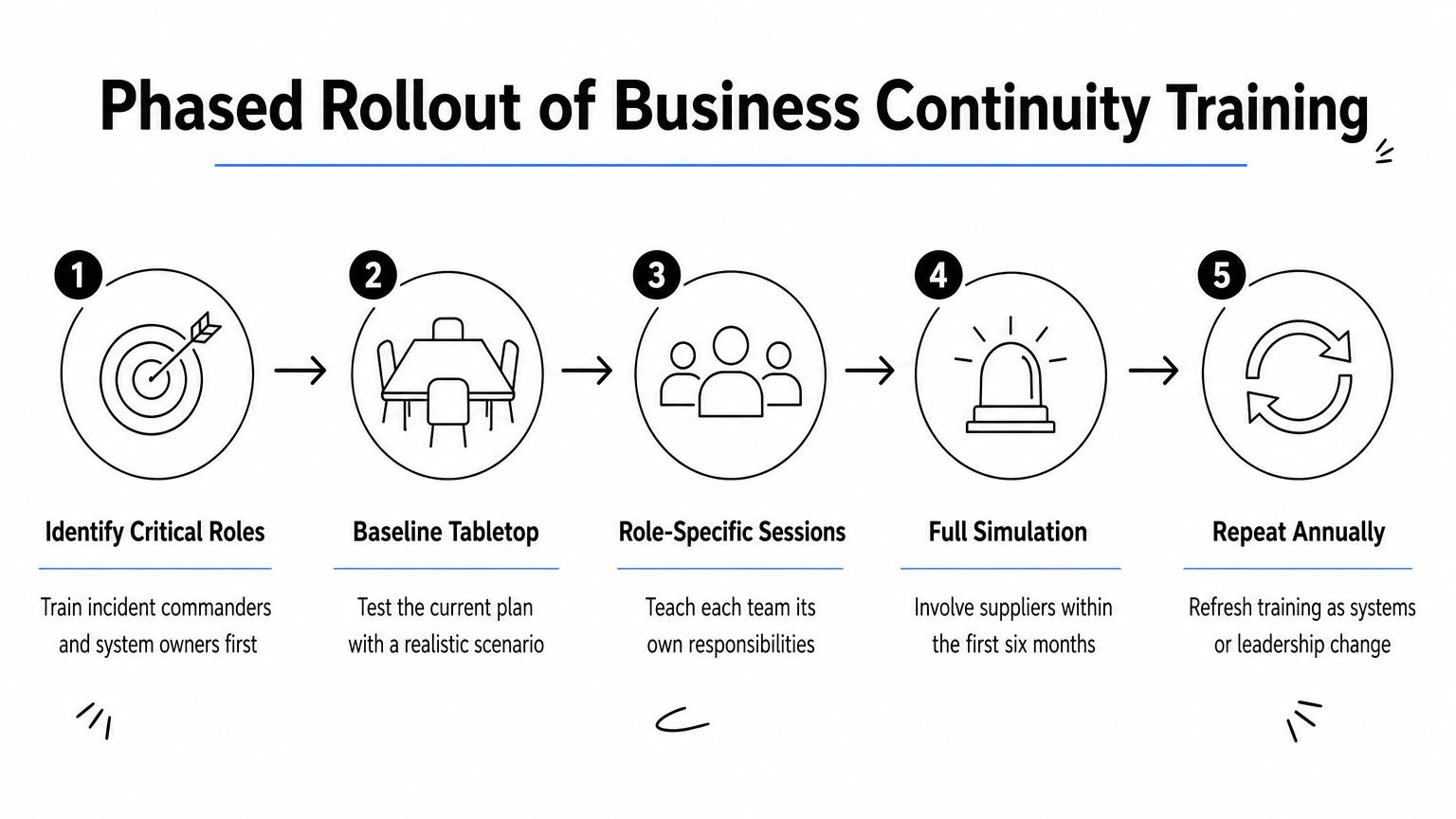
- Identify critical roles first, such as incident commanders, communications leads, and system owners, and train them before anyone else.
- Run a baseline tabletop exercise to see how the current plan holds up under a realistic scenario.
- Deliver role-specific sessions so each team understands its own responsibilities, not just the plan in general.
- Schedule a full simulation within the first six months, ideally involving suppliers or third parties who feature in your recovery process.
- Repeat annually, or sooner if your organisation changes systems, suppliers, or leadership.
Training that stops after one session is training that expires before you need it.
Assign ownership and track progress
Someone needs to own this programme, and it shouldn’t be an afterthought bolted onto someone’s existing job description. Whoever holds that responsibility should track attendance, log exercise outcomes, and update the plan based on what each session reveals. Without a named owner, training slips down the priority list the moment day-to-day operations get busy, which is precisely when gaps start reappearing.
Embed training into onboarding
New starters in critical roles should receive continuity briefing as part of their induction, not eighteen months later when the annual refresher happens to fall due. This keeps knowledge current across staff turnover and avoids a scenario where half your incident team has never actually seen the plan. Organisations that treat this as routine, rather than reactive, tend to recover faster and with far less internal confusion. If you’re building this internally, our cyber training for staff can help structure the phased approach above around your specific risk profile and team structure.
Types of courses and certifications to consider
Not every role needs the same depth of training. Some staff only need to understand their part in an existing plan, while others, particularly incident commanders and compliance leads, benefit from formal, examined qualifications that carry weight with auditors and insurers. Business continuity plan training ranges from half-day awareness sessions right up to multi-year professional certifications, so it helps to know what sits where before you commit budget to one route.
Foundational and practitioner-level options

Short courses work well for general staff awareness. These typically run a few hours to a day and cover plan basics, escalation routes, and individual responsibilities without diving into technical methodology. For anyone building or maintaining the plan itself, practitioner-level courses go deeper into business impact analysis, recovery strategy design, and exercise facilitation. Bodies such as the Business Continuity Institute and DRI International both offer recognised practitioner certifications that many UK organisations use as a benchmark for competence.
A certificate on the wall means nothing if the person holding it has never run a live exercise.
ISO 22301 aligned certifications
Organisations pursuing formal certification often look specifically for ISO 22301 lead implementer or lead auditor training, since these map directly onto the standard’s requirements and produce evidence assessors expect to see.
| Course type | Typical duration | Best suited to |
|---|---|---|
| Awareness session | Half day | All staff |
| Practitioner certificate | 3 to 5 days | Plan owners, coordinators |
| ISO 22301 lead implementer | 4 to 5 days | Compliance leads, project managers |
| ISO 22301 lead auditor | 4 to 5 days | Internal auditors, assessors |
Assessing your current competence and compliance requirements before booking any of the above saves wasted spend, and it’s exactly the kind of gap analysis against ISO 22301 covered in our audit services.
What good training covers, from BIA to crisis exercises
Good business continuity plan training follows a logical sequence, starting with analysis and ending with practice under pressure. Skip a stage and the rest of the course loses its foundation, because you can’t rehearse a response to a risk you never properly assessed.
Business impact analysis and risk assessment
Every credible programme opens with business impact analysis (BIA), teaching participants how to identify critical processes, acceptable downtime, and the knock-on effects of losing a key system or supplier. This stage also covers risk assessment, mapping threats such as ransomware, power loss, or supplier failure against the likelihood and severity of each. Without this groundwork, the plan you build and the exercises that follow end up testing the wrong scenarios entirely.
Recovery strategy and plan documentation
Participants then move into designing recovery strategies, including recovery time objectives, alternative working arrangements, and communication protocols for staff, customers, and regulators. Documentation skills matter here too, since a plan that only makes sense to the person who wrote it fails the moment that person is unavailable during a real incident.
Crisis communication and decision-making under pressure
Handling pressure is where most plans actually break, not on paper but in the room. Training should include practical exercises in briefing leadership, managing media enquiries, and keeping messaging consistent across departments during the first chaotic hours of an incident.
The plan that survives contact with a real incident is the one that’s been rehearsed, not the one that’s simply well written.
Testing through tabletop and live simulation exercises
Simulation is where theory becomes competence. Courses typically progress through:

- Discussion-based tabletop exercises, walking through a scenario verbally to test decision-making
- Functional exercises, testing specific systems or communication tools in isolation
- Full-scale simulations, involving suppliers and third parties to test the entire response chain
Varying scenario types across these stages, rather than repeating the same ransomware example each year, keeps teams sharp and exposes fresh gaps your existing plan hasn’t yet addressed.
Choosing the right training provider for your business
Picking a provider matters as much as picking the course content itself. A polished slide deck means little if the trainer has never actually run an incident response for a business your size, in your sector, facing your specific risks. Business continuity plan training should feel grounded in real scenarios, not generic theory lifted from a textbook.
What to check before you commit
Before signing up, ask providers directly about their delivery methods and track record. Look for:
- Accredited trainers with recognised qualifications from bodies like the Business Continuity Institute or DRI International
- Sector-relevant case studies, ideally from businesses similar in size and risk profile to yours
- Post-course support, such as follow-up exercises or plan reviews, rather than a single session with no continuation
- Evidence of live exercise experience, not just classroom delivery
- Alignment with ISO 22301 or ISO 27001, if certification is part of your goal
The best provider is the one who’s actually managed a real incident, not just taught about one.
Sector experience and practical delivery
Generic courses aimed at a broad audience rarely address the nuances of your industry. A manufacturer worrying about supply chain disruption needs different scenarios to a professional services firm worried about data breaches and client confidentiality. Question providers about how they tailor exercises to your operational reality, and ask to see an example scenario before booking.
Combining training with wider cyber resilience
Training works best as one part of a broader resilience programme, not an isolated tick-box exercise. Pairing it with regular audits, vulnerability assessments, and a tested incident response capability gives you a far stronger position than training alone. That’s the approach behind our 24/7 monitoring and response service, which combines ongoing assessment with the practical skills your teams need to respond when something actually goes wrong. Choosing a provider who understands that connection, rather than treating training as a standalone product, pays off the day you need it most.
Building lasting resilience through training
Getting a plan written is the easy part. Business continuity plan training is what turns that document into something your team can actually execute when systems go down or an attacker locks your files. Skip it, and you’re gambling that everyone remembers their role under pressure, on a day when pressure is exactly what’s working against them.
Every organisation we’ve helped recover faster shared one trait: staff who’d rehearsed the plan before they needed it, not after. Regular exercises, role-specific briefings, and recognised certifications for the people who own the process build that readiness over time, not overnight.
If you’re ready to move beyond a plan sitting untested in a drawer, talk to us about security education and training for your team, and we’ll help you build a programme, and a wider resilience strategy, that actually holds up when it’s tested for real.



