A cyber attack, a fire, or a power outage does not wait for you to finish writing a plan. If you are trying to understand the business continuity planning life cycle, you are probably already sensing that a one-off document gathering dust in a drawer will not protect your business when something actually goes wrong.
The short answer is that business continuity planning is not a single task but an ongoing cycle, one that keeps your organisation prepared as risks, systems, and staff change. Most frameworks break the phases of business continuity planning into a handful of connected stages, from analysing risk through to testing and review, so the plan stays current rather than becoming a compliance exercise nobody trusts.
In this article, we walk through each stage of the business continuity planning cycle in plain terms, explaining what happens at each point and why it matters. We also look at the simplified 3 stages of business continuity planning some organisations use, so you can see how the detailed lifecycle maps onto a practical, repeatable process for keeping your business running.
Why the business continuity planning life cycle matters
A plan written once and filed away is already out of date the moment your systems, staff, or suppliers change. Businesses grow, swap software, hire new people, and shift office locations constantly, and each of those changes quietly breaks assumptions baked into a static plan. Treating business continuity planning as a cycle rather than a project is what keeps your response realistic when an actual incident hits, rather than a document that describes a company that no longer exists.
Plans decay faster than businesses expect
Consider a plan built around a specific supplier, a particular office, or a named IT contact. Within a year, that supplier may have changed terms, that office may have relocated, and that contact may have left the business. Without a structured business continuity planning lifecycle that revisits these details on a schedule, gaps accumulate silently. Nobody notices until a real disruption forces the plan into action, and by then it is too late to fix the assumptions.
A continuity plan that is never revisited is a plan you cannot trust when you need it most.
The cost of skipping the cycle
Organisations that skip stages, particularly testing and review, tend to discover failures during the actual incident rather than beforehand. Regulators and insurers increasingly expect evidence of an active, maintained programme rather than a static file, and standards such as ISO 22301 are built entirely around this idea of continual improvement. For UK businesses working towards ISO 27001 or facing insurer scrutiny after a claim, a demonstrable, living cycle is often the difference between a smooth recovery and a drawn-out dispute over what should have been in place.
Going further, the value of the cycle is not just about compliance paperwork. Repeated testing surfaces problems you would never spot on paper, such as a backup that silently stopped running or a call tree with three disconnected numbers. Every stage of the cycle exists to catch these issues before an incident does, which is exactly why our ongoing continuity and disaster recovery support is built around ongoing management rather than a single deliverable.
How to work through each stage of the life cycle

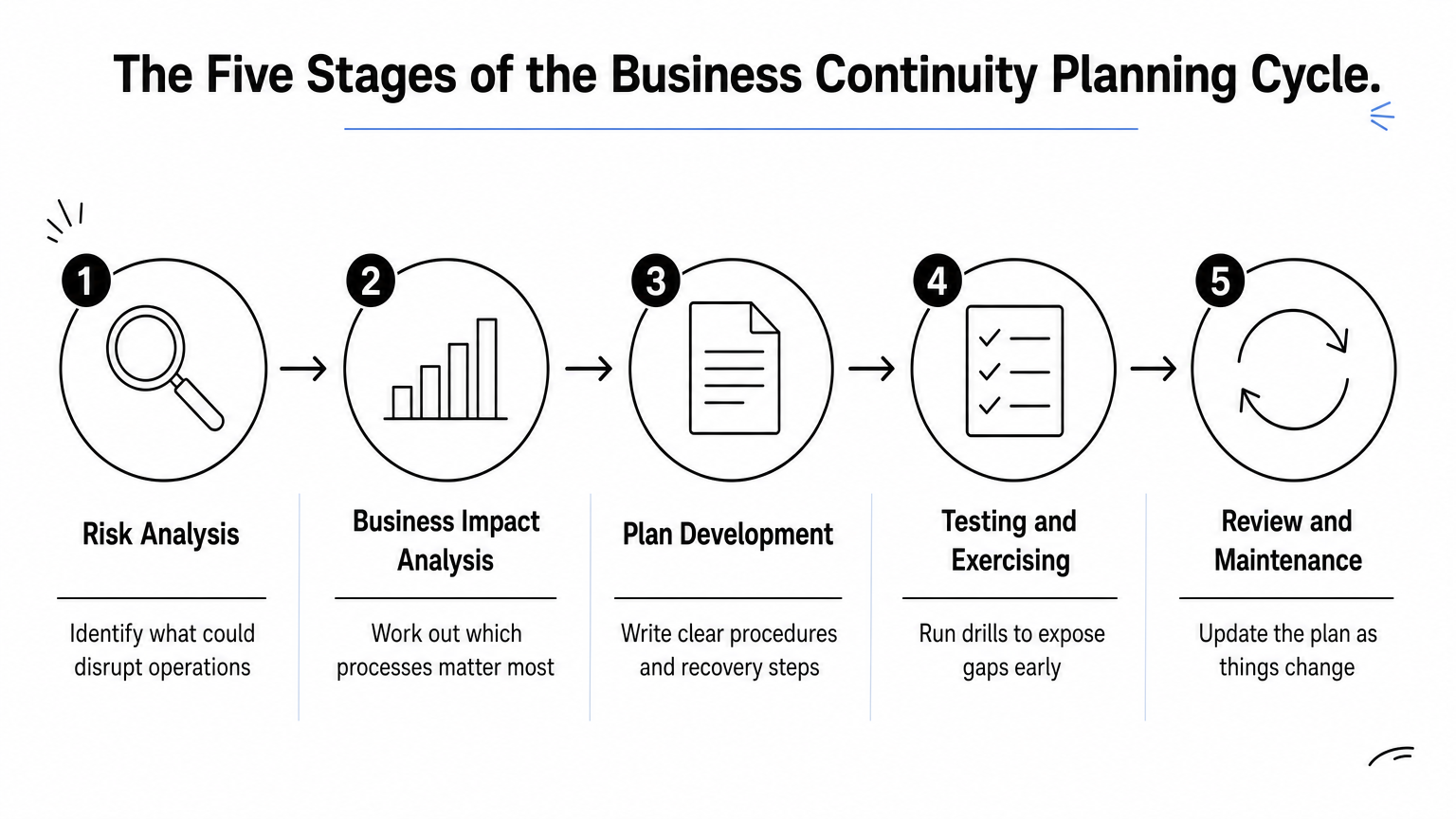
Working through the business continuity planning life cycle means treating each stage as a discrete task with a clear owner and deadline, not a vague ambition. Most frameworks group the work into five connected stages: risk analysis, business impact analysis, plan development, testing and exercising, and review and maintenance. Skipping straight to writing a document without the analysis stages first is why so many plans fail under real pressure.
The five core stages
- Risk analysis: identify what could disrupt operations, from cyber attacks to power loss.
- Business impact analysis: work out which processes matter most and how fast they need to recover.
- Plan development: write the plan step by step, covering clear procedures, roles, and recovery steps for each critical process.
- Testing and exercising: run continuity drills and test scenarios to expose gaps before a real incident does.
- Review and maintenance: update the plan as people, systems, and suppliers change.
Skip the analysis stages, and your plan solves the wrong problems.
Mapping it to the simplified 3 stages
Some organisations prefer a simplified 3 stages of business continuity planning: preparation, response, and recovery. Preparation covers risk analysis, impact analysis, and plan development. Response covers the immediate actions during an incident. Recovery covers restoring normal operations and feeding lessons back into the next planning cycle, closing the loop rather than starting from scratch each time.
Common mistakes that break the life cycle
Even organisations that understand the business continuity planning life cycle in theory often trip up in practice. The same handful of mistakes show up again and again, and each one quietly turns a working cycle back into a static document.

The recurring failures
- Treating the plan as a one-off project rather than a recurring cycle, so it is never revisited after sign-off.
- Skipping the business impact analysis and jumping straight to writing procedures, which means the plan protects the wrong processes first.
- Testing on paper only, walking through a tabletop exercise without ever simulating a real outage or system failure.
- Leaving ownership unclear, so nobody is actually accountable for updating contact lists, supplier details, or recovery steps.
- Ignoring third-party dependencies, assuming a supplier or cloud provider will simply cope during a wider incident.
Few of these mistakes are deliberate. Most happen because a plan gets built during a compliance push, then nobody schedules the next review. Given enough time, even a well-written plan drifts away from how the business actually operates, and the gap only becomes visible once something goes wrong.
A plan nobody owns is a plan nobody will follow when it matters.
Hiring an outside pair of eyes helps catch these gaps early. Independent audits and vulnerability assessments, like those we run through our audit services, routinely surface exactly these kinds of blind spots before they turn into costly surprises during an actual incident.
How to keep the life cycle working year after year
Keeping the business continuity planning life cycle alive long after the launch meeting is where most organisations struggle. The trick is building maintenance into your calendar rather than hoping someone remembers, and assigning that maintenance to a named role rather than a team.
Build a maintenance schedule
Set fixed review points rather than vague intentions to "check it sometime", in line with the six continuity planning practices we recommend to UK SMEs. A workable rhythm looks like this:
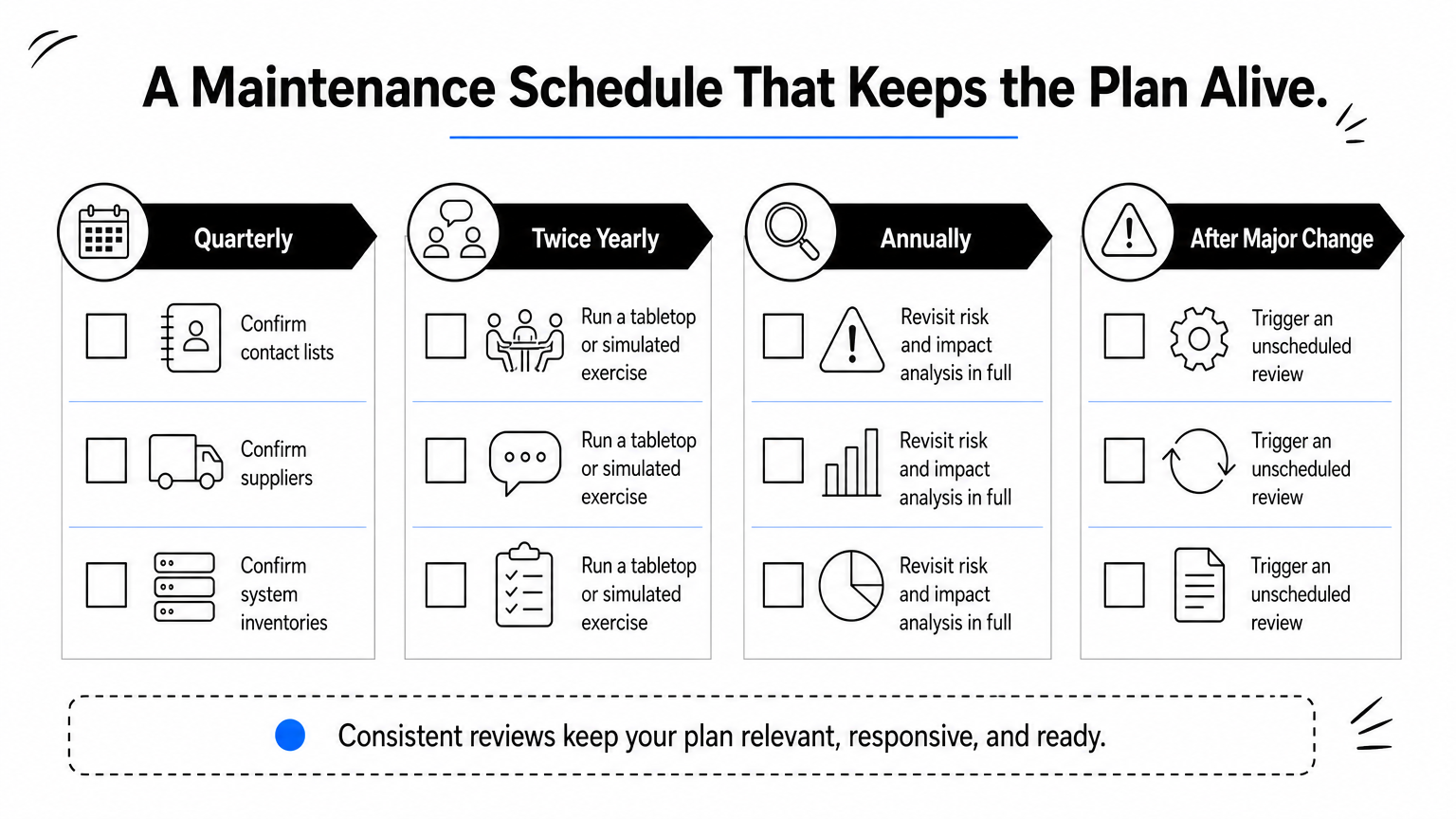
- Quarterly: confirm contact lists, supplier details, and system inventories are still accurate.
- Twice yearly: run a tabletop or simulated exercise against a realistic scenario.
- Annually: revisit the risk analysis and business impact analysis in full, since priorities shift as the business grows.
- After any major change: office move, new supplier, or system migration, trigger an unscheduled review.
A schedule you actually follow beats a perfect plan you never revisit.
Assign real ownership
Nominate a specific person, not a department, to own the plan’s upkeep. That person should have the authority to chase updates from IT, HR, and facilities, and a deadline attached to every review. Without a named owner, updates slip quietly until the plan no longer matches reality.
Bring in outside expertise when it stalls
Many businesses find the cycle stalls internally because staff are stretched across other priorities. A managed partner keeps the schedule moving regardless of internal workload. Our Business Continuity and Disaster Recovery services exist precisely to carry that ongoing burden, so the cycle keeps turning even when your team is focused elsewhere.
Turning the life cycle into lasting resilience
Getting the business continuity planning life cycle right is not about producing a perfect document once. It is about building a habit: analyse the risks, understand the impact, write the plan, test it properly, and review it on a schedule you actually keep. Do that consistently and your organisation stops fearing disruption because it already knows how it will respond.
Skip any stage, or let the reviews lapse, and the cycle quietly turns back into a static file that nobody trusts when an incident actually strikes. That gap between paper and reality is exactly where businesses get caught out, often at the worst possible moment.
If keeping that cycle turning feels like more than your team can manage alongside everything else, you do not have to carry it alone. Talk to TrustedIA about having your continuity programme managed for you, so the plan stays accurate, tested, and ready long after the first draft is signed off.