
If your organisation handles personal data, GDPR probably keeps you up at night. Appointing a Data Protection Officer isn’t optional for many public authorities, large-scale data processors, or businesses handling sensitive information, yet hiring a full-time specialist can cost £60,000 or more a year. That’s why so many IT managers and compliance officers are searching for data protection officer services that deliver the same expertise without the overhead, and why getting this decision right matters for your regulatory standing.
Outsourced DPO services give you a qualified professional who monitors compliance, advises on data protection impact assessments, and acts as your point of contact for the ICO, all without sitting on your payroll. Think of it as independent oversight you can scale up or down as your data processing activities change, backed by people who’ve handled breach notifications and audits before. This approach answers the practical question every business asks: how do we get proper DPO coverage without building an entire compliance function from scratch, while keeping audit readiness front and centre.
In this article, we’ll break down exactly what a DPO does, who legally needs one, and how outsourced services compare with hiring in-house. We’ll also show where this fits alongside broader security work like ISO 27001 certification and incident response, drawing on what actually works when businesses face real GDPR obligations rather than theoretical ones.
Why data protection officer services matter for your business
The regulatory risk you can’t ignore

Regulators don’t hand out fines lightly, but when they do, the numbers get attention. The ICO can issue penalties up to £17.5 million or 4% of global annual turnover, whichever is higher, for serious breaches of UK GDPR (ICO enforcement action). Data protection officer services exist precisely to catch problems before they escalate that far, whether that’s a missed data subject access request deadline or a supplier processing personal data without a proper agreement in place. Beyond the headline fines, there’s the cost of the investigation itself: staff time, legal fees, and months spent answering regulator questions instead of running your business.
A DPO who spots a compliance gap in week one is far cheaper than a regulator who finds it in year three.
Trust is now a competitive advantage
Customers, suppliers, and insurers increasingly ask hard questions about how you handle their data before they’ll sign a contract. Having a named DPO or a credible virtual DPO arrangement gives procurement teams and auditors a clear answer, rather than a shrug. Many public sector tenders and enterprise supply chains now require evidence of formal data protection governance as a condition of doing business, which means the absence of one can cost you contracts you never even knew you’d lost. This is where DPO oversight starts paying for itself well beyond avoiding fines, becoming part of your commercial credibility rather than a box-ticking exercise.
What happens when oversight slips
Without dedicated oversight, data protection tends to become everyone’s job and nobody’s responsibility. Requests get answered late, retention policies drift, and new tools get adopted without anyone checking whether they process personal data lawfully. A properly resourced DPO function catches these gaps through routine monitoring rather than after a breach forces the issue. Here’s what typically goes wrong in businesses without proper coverage:
- Subject access requests missed or answered outside the statutory one-month window
- New software or marketing tools rolled out without a data protection impact assessment
- Third-party contracts signed without data processing clauses
- Breach response steps delayed because nobody owns the decision to notify the ICO
- Staff unaware of basic handling rules for sensitive personal data
Signing up for proper outsourced DPO support closes these gaps systematically, giving you a single point of accountability instead of scattered responsibility spread across departments that already have their own priorities to manage.
How outsourced DPO services work in practice
Getting started: the onboarding phase
Providers typically start with a data mapping exercise, working through what personal data you hold, where it lives, and who touches it. This isn’t a box-ticking questionnaire, it’s a genuine audit of your systems, contracts, and internal processes that usually takes two to four weeks depending on your size. Expect the provider to review your existing privacy notices, retention schedules, and any prior breach history before they set priorities. A good onboarding process also identifies quick wins, things like an outdated cookie banner or a supplier contract missing a data processing clause, that get fixed within the first month rather than sitting on a backlog.
The ongoing rhythm of the service
Once onboarding finishes, most data protection officer services settle into a predictable monthly or quarterly cadence. Your DPO reviews new projects for privacy risk, so that privacy is designed in from the start, checks that subject access requests are being handled within statutory deadlines, and reports to your board or senior management on compliance status. Many providers offer a named contact who joins your team calls, rather than a rotating pool of unfamiliar staff, which matters when you’re trying to build institutional knowledge of your specific data flows.
The value of an outsourced DPO isn’t the paperwork, it’s having someone who already knows your data before a regulator asks about it.
When something goes wrong
Escalation is where outsourced DPO arrangements prove their worth. If a breach occurs, your provider should have a documented process for assessing severity, deciding whether the ICO needs notifying within 72 hours, and drafting the required communications. This is typically governed by a service level agreement setting response times, for example a four-hour acknowledgement for urgent breach queries against a next-business-day turnaround for routine advice. Reputable providers also run periodic reviews with you, checking whether your risk register, staff training, and technical controls have kept pace with new processing activities. That regular touchpoint stops the relationship becoming a once-a-year formality, and it’s what separates genuine oversight from a certificate on the wall.
What’s included in a typical DPO service package
Core advisory and monitoring
Most data protection officer services bundle a set of recurring duties that mirror what a full-time DPO would handle: advising on data protection impact assessments, monitoring compliance with UK GDPR, acting as the point of contact for the data protection regulator, and training staff on handling personal data correctly. Providers usually cap the number of advisory hours or queries included each month, then bill extra for anything beyond that, so it pays to ask exactly what "unlimited advice" actually means before you sign. Genuine DPO consultancy should also cover reviewing new supplier contracts and flagging risky data flows before a project launches, not just after something breaks.
If your package doesn’t name what’s included and what costs extra, you’ll find out the hard way at renewal time.
Documentation, reporting, and audit support
Expect a written record of activity, not just verbal reassurance. A solid package includes a data processing register, updated privacy notices, a breach log, and quarterly or annual reports suitable for your board or your ISO 27001 audit trail. Reports should show what changed since the last review, not repeat the same boilerplate every quarter.
| Package element | What it typically covers |
|---|---|
| Data mapping and register | Record of what personal data you hold and where it flows |
| DPIA support | Reviewing new projects and tools for privacy risk |
| ICO liaison | Named contact for regulator correspondence and notifications |
| Breach response | Documented process, severity assessment, 72-hour ICO deadline management |
| Staff training | Annual or rolling awareness sessions for employees |
| Reporting | Quarterly or annual compliance summaries for management |
Governance, meanwhile, is where cheaper packages often fall short. A virtual DPO worth paying for attends senior management meetings when needed, signs off on your annual data protection statement, and keeps a documented log of every decision made on your behalf, which matters enormously if a regulator ever asks to see evidence of oversight. Without that paper trail, you’re relying on memory and goodwill rather than proof, and that’s a poor position to be in during an investigation.
In-house DPO vs outsourced DPO: which suits your business
Deciding between a full-time hire and an outsourced DPO usually comes down to three things: budget, the volume of personal data you process, and how quickly your organisation is growing. There’s no universally right answer, but the trade-offs are predictable enough that you can map them against your own situation before you commit to either route.
The case for an in-house DPO
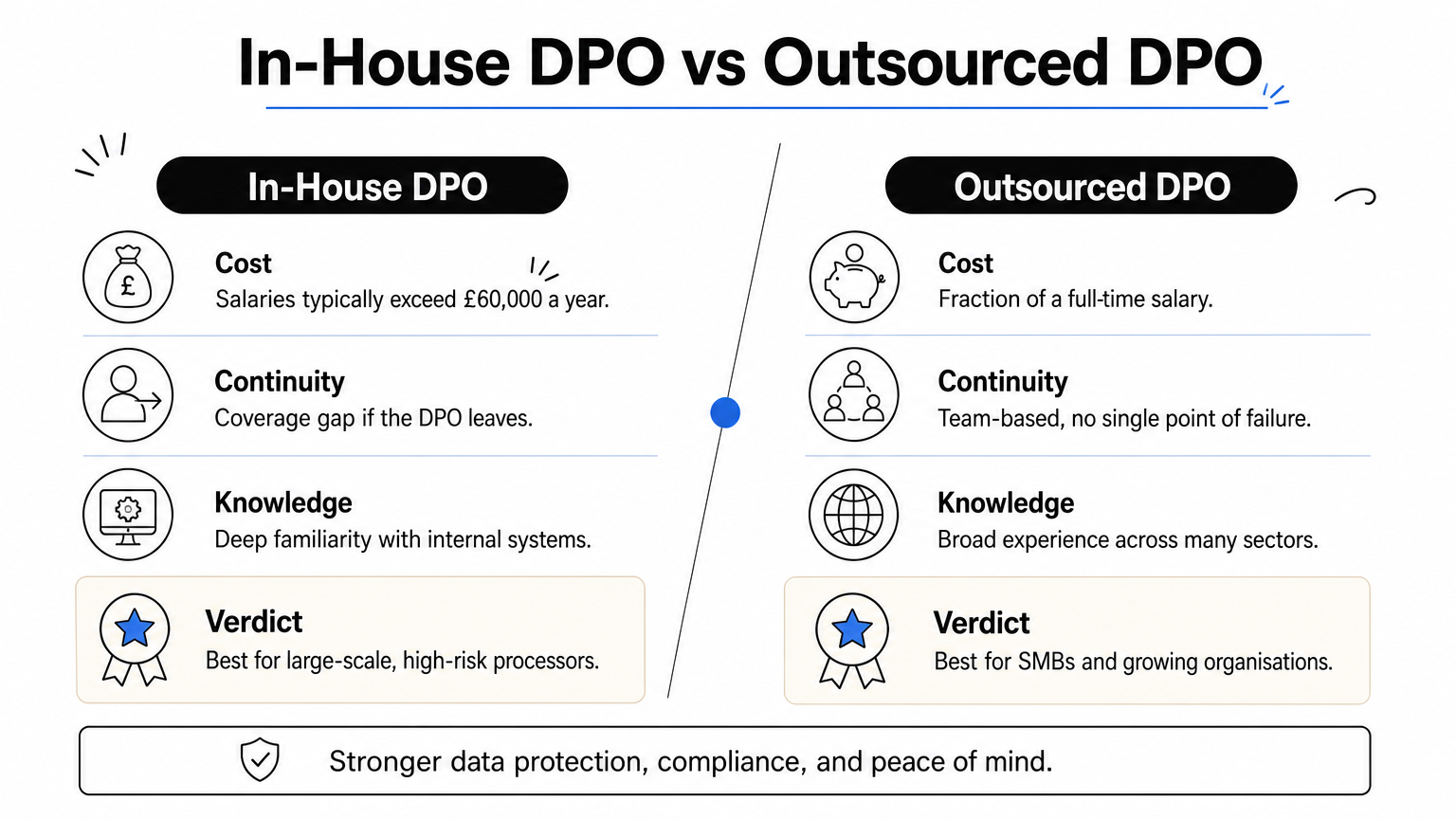
Hiring internally makes sense when data protection sits at the core of what you do, think healthcare providers, large financial institutions, or public authorities processing sensitive data at scale every day. An in-house DPO builds deep institutional knowledge, sits in on strategic meetings without needing a briefing, and is physically present when something urgent lands on someone’s desk. The downside is cost and continuity: salaries for experienced DPOs regularly exceed £60,000, and if that person leaves, you’re left with a compliance gap while you recruit a replacement who then needs months to learn your systems from scratch.
The case for outsourcing
For most SMBs and mid-sized enterprises, outsourced DPO services deliver the same regulatory coverage at a fraction of the cost, with the added benefit of a team behind the named contact rather than a single point of failure. Providers bring exposure to dozens of businesses across sectors, so they’ve usually already handled the exact scenario you’re facing. This is also where a fractional DPO arrangement shines: you get senior expertise on a retainer, scaled to your actual processing volume, rather than paying full-time wages for a role that might only need ten hours a month.
Buying expertise by the hour beats paying a full salary for work that doesn’t fill a full week.
| Factor | In-house DPO | Outsourced DPO |
|---|---|---|
| Typical annual cost | £60,000+ | Fraction of a full salary |
| Continuity if staff leave | Coverage gap during recruitment | Team-based, no single point of failure |
| Breadth of experience | Limited to your organisation | Exposure across multiple sectors |
| Best suited to | Large-scale, high-risk processors | SMBs and growing organisations |
Weigh these factors against your own risk profile rather than defaulting to whichever option feels more traditional.
Do you need a DPO under UK GDPR

Article 37 of UK GDPR sets out a clear legal test, and most businesses get it wrong by assuming it only applies to giant corporations. The rule actually hinges on what you process and how much of it, not on your headcount or turnover. Meeting your UK GDPR obligations starts with working out whether you fall into one of three defined categories, because guessing wrong leaves you exposed either to a missed legal obligation or to paying for cover you didn’t strictly need. The ICO’s own guidance sets out these triggers in detail, and it’s worth checking against your own processing activities rather than relying on assumptions from a previous employer or a generic template.
The three legal triggers
You’re legally required to appoint a DPO if any of the following apply to your organisation:
- You’re a public authority or body, regardless of what data you process
- Your core activities require large-scale, regular and systematic monitoring of individuals, such as tracking online behaviour or location data
- Your core activities involve large-scale processing of special category data, including health records, biometric data, or criminal conviction information
If your organisation ticks one of those three boxes, appointing a DPO isn’t a nice-to-have, it’s a statutory requirement you can’t opt out of.
When it’s optional but still smart
Falling outside those three categories doesn’t mean you’re off the hook entirely. Many businesses voluntarily bring in DPO as a service arrangements because their data processing has grown past what a part-time compliance lead can realistically manage, or because a client or insurer has asked for evidence of formal oversight. Smaller UK firms working through GDPR compliance while handling customer databases, marketing lists, or employee records often discover during a contract review that a named DPO, even a voluntary one, closes gaps that a generic privacy policy never covers. Testing your own position against these triggers now saves an awkward conversation with the ICO later, particularly if your data processing has expanded since you last reviewed it.
How to choose the right DPO service provider
Selecting a provider for data protection officer services shouldn’t feel like a leap of faith. The market has grown crowded with generalist consultants who added "DPO" to their service list without the depth to back it up, so it pays to look past the marketing and check what actually sits behind the offer.

Credentials and sector experience
Ask for evidence of qualifications, such as ISO 27001 lead auditor training or recognised data protection certifications, and request references from clients in your sector. GDPR expertise built on paper alone rarely translates into practical judgement when a real breach lands on someone’s desk at 9pm on a Friday. A provider who’s already handled incidents in retail, healthcare, or financial services brings pattern recognition that a generalist simply hasn’t earned yet.
A provider’s real value shows up during your first breach, not during the sales pitch.
Questions worth asking before you sign
Get clear, written answers on these points before committing to any outsourced DPO provider:
- What’s the named contact structure, and who covers holiday or sickness absence?
- What response times sit inside the service level agreement for urgent versus routine queries?
- Are DPIA reviews, ICO liaison, and staff training included, or billed separately?
- Can they show a sample compliance report from an existing client relationship?
- What happens if you need to escalate beyond the assigned DPO?
Red flags that suggest you should look elsewhere
Beware providers who quote a flat annual fee without explaining what triggers extra charges, since that usually means surprise invoices later. Similarly, treat vague answers about breach response timescales as a warning sign rather than reassurance. Independence matters too: a provider tied to selling you specific software or insurance products has an obvious conflict of interest when advising on your risk. Look instead for a solution-agnostic approach that recommends what actually fits your processing activities, not whatever earns the biggest commission.
Making the right call for your organisation
Getting data protection officer services right isn’t about ticking a compliance box, it’s about knowing exactly where your organisation stands and choosing cover that matches your real risk. Work through the three legal triggers, weigh the in-house versus outsourced trade-offs against your budget and growth plans, then hold any provider to the same standard: clear pricing, named contacts, documented breach response, and genuine sector experience rather than a generic sales pitch.
Regulatory scrutiny isn’t going away, and neither is client pressure for proof of proper governance. Businesses that get ahead of this now spend far less time firefighting later, and far more time running the business they actually set out to build.
If you’re ready to put that oversight in place, talk to TrustedIA about fast-tracking UK GDPR and DPA 2018 compliance and get a partner who already knows what regulators expect.



