
A ransomware attack on an NHS trust doesn’t just lock down files. It cancels operations, delays diagnoses, and puts patients at risk within hours. If you work in NHS IT, governance, or emergency planning, you already know that downtime here carries a weight that most sectors never face. A properly documented NHS business continuity plan is what stands between a disruption and a genuine patient safety incident.
This article explains exactly what a business continuity plan for the NHS needs to cover, from clinical service prioritisation to IT failover and third-party supplier risk, and how it fits alongside statutory requirements like the NHS Emergency Preparedness, Resilience and Response (EPRR) framework. You’ll get a clear breakdown of the plan’s core components, not just generic templates that ignore healthcare-specific risks.
We’ll walk through how to structure a plan step by step, what evidence auditors and CQC inspectors expect to see, and where most trusts fall short when incidents actually happen. Whether you’re building a plan from scratch or reviewing an existing one against current cyber threats, this gives you a practical starting point grounded in real incident response experience.
Why business continuity planning matters for the NHS
Every hour an NHS system stays offline translates into cancelled clinics, delayed test results, and clinicians reverting to paper records they haven’t used in years. Unlike a retail outage that costs revenue, a disruption in a hospital or GP practice can directly affect patient safety. This is why an NHS business continuity plan isn’t a compliance box to tick, it’s operational infrastructure that keeps care running when the systems you rely on fail.
A business continuity plan for the NHS exists to protect patients first and systems second.
Patient safety is what’s actually on the line
Healthcare runs on continuous access to information: patient records, imaging, prescribing systems, bed management tools. When these go down, staff can’t simply pause and wait. Maternity units still deliver babies, A&E still triages trauma cases, and pharmacies still dispense medication. A well-built business continuity plan nhs teams can actually execute under pressure identifies which clinical services absolutely cannot stop, and builds manual workarounds for each one before an incident happens, not during it. Without that groundwork, staff are left improvising decisions that should have been settled weeks in advance.
EPRR and regulatory expectations
Continuity planning in the NHS sits inside a formal statutory framework, not a voluntary best-practice guide. NHS England’s Emergency Preparedness, Resilience and Response (EPRR) framework requires every provider and commissioner to maintain, test, and evidence business continuity arrangements as part of their core standards. The Care Quality Commission also expects to see documented continuity plans during inspections, particularly evidence that plans have been rehearsed rather than just filed away. You can review the current requirements directly through NHS England’s EPRR guidance.
Meeting these expectations means your plan needs to demonstrate more than intent. Auditors typically look for:
- A documented risk assessment covering clinical, IT, and third-party dependencies
- Evidence of at least one live exercise or simulation within the past 12 months
- Named roles and escalation paths, not just generic job titles
- A recovery time objective for each critical system, agreed with clinical leads
- Records showing lessons learned from previous incidents have actually changed the plan
Real-world incidents show the cost of inaction
Nothing illustrates the stakes better than what already happened. The 2017 WannaCry ransomware attack affected roughly a third of NHS trusts in England, forcing the cancellation of thousands of appointments and operations because outdated systems and unclear continuity procedures left staff with no fallback. A National Audit Office review of the incident found that many affected organisations lacked basic patching and had no tested plan for isolating infected systems quickly. That single event reshaped how seriously trusts now treat cyber resilience, but gaps remain, particularly around third-party suppliers and legacy medical devices that can’t simply be patched overnight.
Governance boards increasingly treat continuity planning as inseparable from cyber risk management, and rightly so. Ransomware, supplier outages, and infrastructure failures now sit alongside pandemics and severe weather as scenarios every plan must address. Insurers assessing NHS-adjacent risk, and the loss adjusters who work alongside them, routinely ask to see continuity documentation before agreeing cover terms, which puts additional pressure on trusts to keep plans current rather than dusting them off once a year. Ultimately, the case for investing time in a proper plan isn’t theoretical. It’s the difference between an IT incident and a front-page patient safety failure.
How to build an NHS business continuity plan
Building a working plan starts long before anyone writes a document. Start by mapping every clinical and operational service the organisation delivers, then work out what happens if the systems supporting each one disappear without warning. This groundwork, often called a business impact analysis, is what separates a plan that survives contact with a real incident from one that just sits in a folder waiting for an inspection.
Run a business impact analysis first
Gather clinical leads, IT, estates, and information governance into the same room and ask a blunt question for every service: how long can this run without its usual systems before patients are at risk? Answers vary wildly. A maternity ward might tolerate minutes without electronic records before reverting to paper, while a back-office finance function might cope for days. Recording these tolerances gives you the recovery time objectives that shape everything else in the plan, and it stops the document from treating every system as equally urgent when they clearly aren’t.
The strongest NHS business continuity plan is built from real recovery time objectives, not assumptions about what should be urgent.
Assign ownership, not job titles
Generic statements like "IT will manage the response" fall apart within the first hour of a real incident. Name individuals, give them deputies, and write down exactly who has the authority to declare a major incident, invoke the plan, and communicate with NHS England, commissioners, and patients. Escalation paths need phone numbers and out-of-hours contacts, not just email addresses that nobody checks at 2am. This is also where the plan needs to align with your organisation’s wider EPRR arrangements so responsibilities don’t overlap or, worse, get missed entirely.
Build the response in layers
A usable plan separates the first hour from the first week. Structure it something like this:
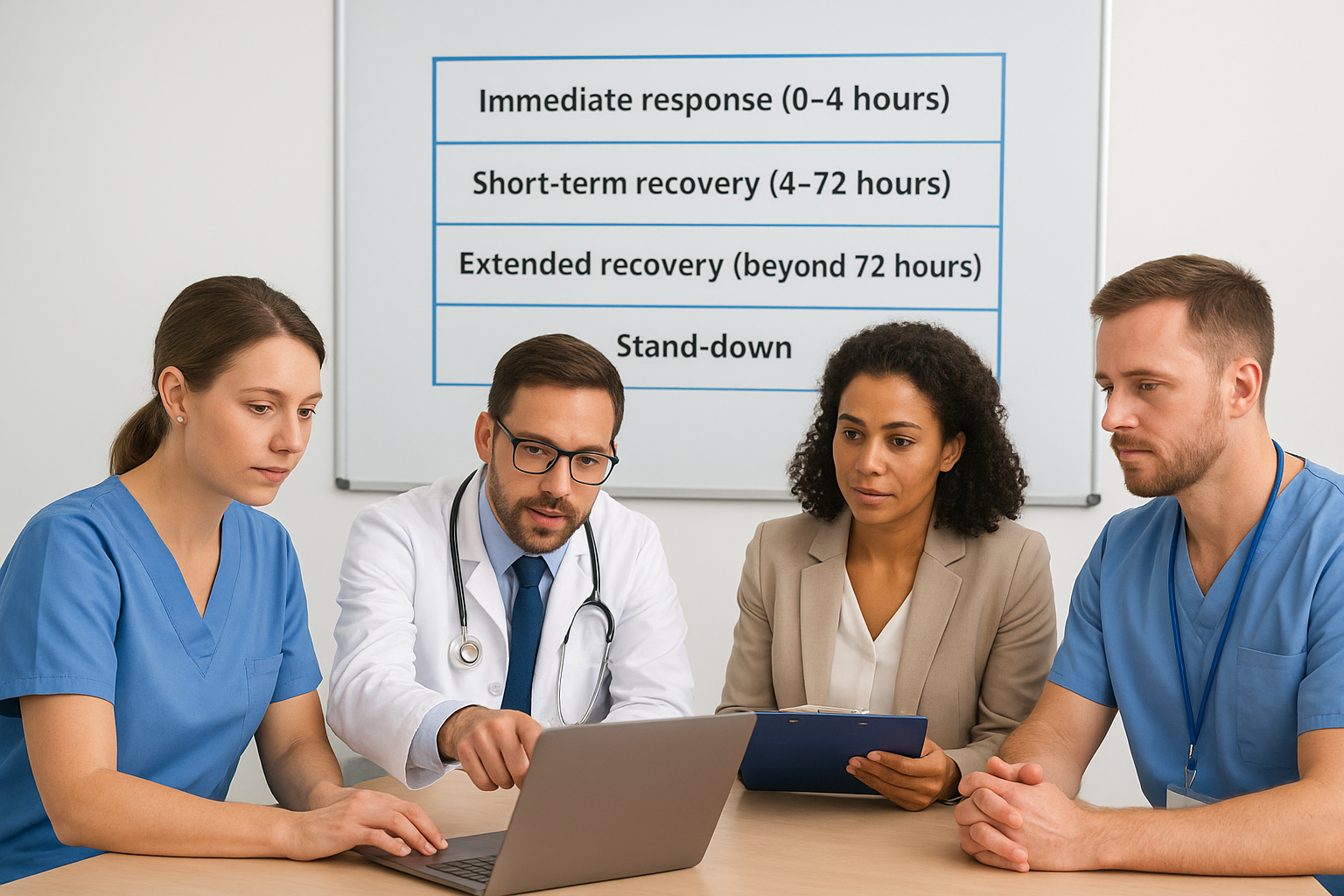
- Immediate response (0-4 hours): contain the incident, activate manual workarounds, notify the incident commander
- Short-term recovery (4-72 hours): restore priority systems in order of clinical risk, maintain patient communication
- Extended recovery (beyond 72 hours): rebuild remaining services, begin post-incident review
- Stand-down: confirm return to normal operations and log lessons learned
Get sign-off and embed it operationally
Finally, the plan needs formal sign-off from the board or a delegated governance committee, not just approval from the IT department that wrote it. Ownership at that level signals that continuity planning is a patient safety responsibility, not a technical afterthought. Once signed off, the plan should feed into induction training, ward-level briefings, and the organisation’s wider EPRR documentation so it becomes something staff actually recognise rather than a document produced solely for auditors.
What to include in an effective business continuity plan
A finished NHS business continuity plan reads like an instruction manual, not a policy statement. Anyone picking it up during an incident, including someone who’s never seen it before, should be able to follow it without needing to phone the author for clarification. That means concrete detail: exact system names, specific manual workarounds, and named contacts, rather than vague references to "appropriate action being taken."
Core components every plan needs
Every version should cover the same ground, even if the detail differs by department. At minimum, include:
- A business impact analysis with recovery time objectives for each critical service
- A full asset and system inventory, including third-party suppliers and legacy medical devices
- Named incident roles, deputies, and 24/7 contact details
- Step-by-step manual workaround procedures for clinical and administrative functions
- A communication plan for staff, patients, commissioners, and NHS England
- A recovery sequence showing which systems get restored first and why
- A post-incident review process with a template for capturing lessons learned
If a section of your plan can’t survive being read aloud by someone unfamiliar with it, it isn’t finished yet.
Manual workarounds for clinical systems
This is where most plans fall short. Writing "revert to paper records" isn’t a workaround, it’s a placeholder. A proper procedure specifies which paper forms staff use, where they’re stored, how data gets reconciled once systems come back online, and who checks for errors introduced during the outage. Pharmacy, pathology, and bed management each need their own version, because a generic instruction rarely fits the reality of a busy ward at 3am.
Communication protocols staff can actually follow
During a live incident, staff need pre-approved language they can send immediately, not something drafted under pressure. A short template like this, held in the plan itself, saves valuable time:
Subject: [Trust Name] Service Disruption Notice
Status: [Investigating/Contained/Resolved]
Affected services: [list]
Expected impact: [patient-facing/internal only]
Next update: [time]
Contact: [incident commander name and number]
A business continuity plan nhs teams trust under real pressure treats communication as seriously as technical recovery, because confused messaging to patients or commissioners can do as much reputational damage as the outage itself. Building these elements in advance, rather than improvising them mid-crisis, is what turns a document into something genuinely operational.
Common risks and disruption scenarios to plan for
A plan built around one type of incident, usually ransomware, leaves an organisation exposed the moment something different happens. Effective NHS business continuity planning has to account for a wide spread of scenarios, from cyber attacks to power failures to a supplier going bust overnight. Trusts that only rehearse the scenario they’ve already experienced tend to freeze when the next incident looks nothing like the last one.
A plan that only covers cyber attacks isn’t a business continuity plan, it’s an incident response plan wearing a bigger label.
Cyber and technology failures
Ransomware remains the headline risk, but it’s far from the only technology threat worth planning for. Software failures during routine updates, cloud service outages from major providers, and network hardware faults can all take critical systems offline just as effectively as an attack. Legacy medical devices deserve particular attention here, since many can’t be patched or isolated quickly without disrupting clinical use. Reviewing guidance from the National Cyber Security Centre helps ground these scenarios in current threat intelligence rather than outdated assumptions.
Physical and environmental disruption
Buildings fail too, and plans need to reflect that reality. Flooding, fire, extreme weather, and power cuts have all forced NHS sites into emergency continuity mode in recent years, sometimes with far less warning than a cyber incident allows. Estates and facilities teams should be involved in the same business impact analysis as IT, because a burst pipe in a server room causes exactly the same clinical impact as a ransomware attack, just with a different root cause.

Third-party and supply chain failures
Outsourced IT providers, pathology labs, pharmacy suppliers, and cloud hosting partners all sit outside direct trust control, yet a failure at any of them can stop care delivery just as fast as an internal fault. Supplier resilience should be checked, not assumed, and contracts should specify what continuity support the supplier itself commits to during an outage.
| Risk category | Example scenario | Typical impact |
|---|---|---|
| Cyber | Ransomware, phishing-led breach | System lockout, cancelled appointments |
| Technology | Cloud outage, failed update | Loss of records access, delayed diagnostics |
| Physical | Flood, fire, power cut | Site evacuation, equipment loss |
| Supply chain | Supplier insolvency, pathology outage | Delayed results, stock shortages |
| Workforce | Pandemic, mass staff absence | Reduced clinical capacity |
Mapping scenarios against likely impact this way, rather than listing them loosely in prose, makes it far easier to prioritise which risks need the most detailed manual workarounds and which simply need monitoring.
Testing, reviewing and maintaining your plan
A plan that’s never been rehearsed is just a theory. Regular testing turns a written document into something staff can execute under pressure, and it exposes gaps that no amount of desk-based review ever will. NHS England’s EPRR exercising guidance sets a minimum expectation of testing continuity arrangements annually, but trusts handling high-risk clinical services should treat that as a floor, not a target. Without this discipline, a business continuity plan for the NHS becomes exactly what auditors dread finding: a polished document nobody has actually tried to follow.
Exercise the plan through realistic scenarios
Exercises work best when they mirror the disruption scenarios covered earlier in the plan rather than a single generic drill repeated every year. Consider rotating through:
- Tabletop exercises for department leads, walking through a simulated ransomware or supplier failure
- Live simulations on a ward or in a pharmacy, testing manual workarounds under time pressure
- Communications drills, checking that pre-approved messaging actually reaches staff and patients on time
- Unannounced tests of escalation contacts, to confirm the numbers on paper still work at 2am
Documenting outcomes from each exercise, including what failed, matters more than the exercise itself.
Review triggers that go beyond the calendar
Every organisational change is a reason to revisit the plan, not just the date on the calendar. New IT systems, restructured departments, revised supplier contracts, and staff turnover in named incident roles should each trigger an update rather than waiting for the annual review cycle to catch up. Following a real incident, the review needs to happen quickly, while details are fresh, and any lessons identified must produce an actual change to the document.
A plan that’s reviewed once a year and never touched otherwise is already out of date the day something changes.
Governance boards should ask for evidence of these triggered reviews specifically, since a stack of annual sign-offs tells you very little about whether the plan reflects current reality.
Keep documentation audit ready
Inspectors and auditors want to see a trail, not a single finished document. Keep a version history showing what changed and why, retain records of every exercise and its outcomes, and store sign-offs from the board or governance committee alongside the plan itself. Maintaining this paper trail alongside the plan means that when CQC or an insurer asks for evidence, the answer is already assembled rather than reconstructed under deadline pressure.
Staying ready for whatever comes next
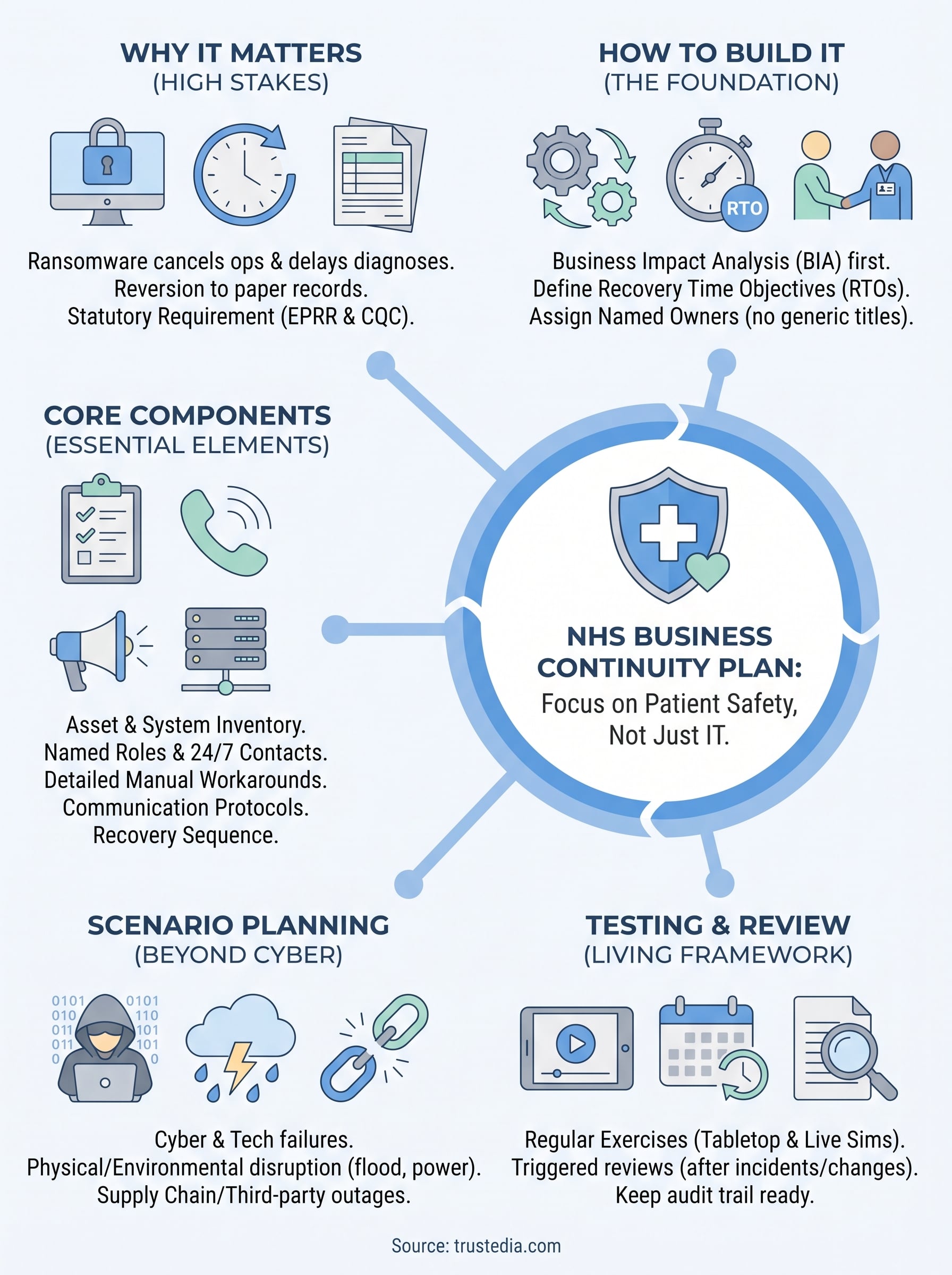
A strong NHS business continuity plan isn’t a document you finish once and file away. It’s a living framework that changes as your systems, suppliers, and staff change, and it only proves its worth the moment something actually goes wrong. Get the fundamentals right, a solid business impact analysis, named ownership, tested manual workarounds, and honest post-incident reviews, and you’ve built something that protects patients rather than just satisfying an auditor’s checklist.
Most trusts don’t lack the intention to plan properly. They lack the time, specialist resource, or independent perspective to stress-test what they’ve already written. That’s exactly where an experienced partner earns its place, spotting the gaps before an incident does. If you want expert support building, testing, or reviewing your continuity arrangements against real cyber threats, talk to TrustedIA about getting your plan genuinely incident-ready.



