
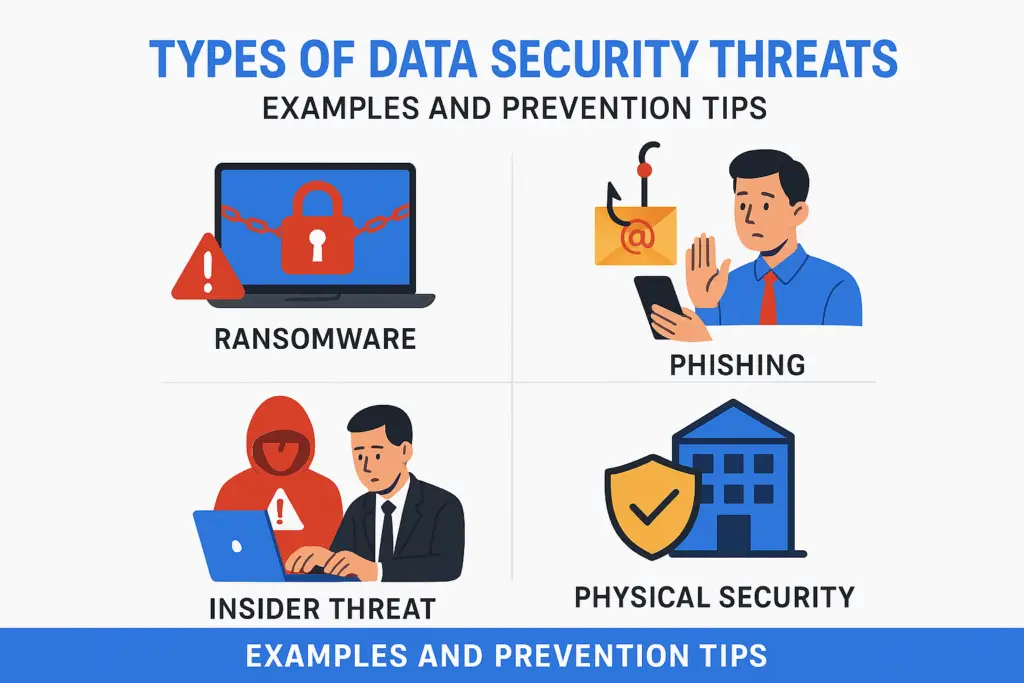
Every organisation holds data that someone else wants, customer records, financial information, intellectual property, credentials. The types of data security threats targeting that information have grown more varied and more damaging over the past decade. From ransomware that locks entire networks to phishing emails that trick a single employee into handing over login details, each threat exploits a different weakness. Understanding what you’re up against is the first step toward building a real defence.
The trouble is, many businesses only learn about these threats after an incident has already disrupted operations. At TrustedIA, we’ve spent over 30 years helping organisations across the UK prepare for and respond to cyber threats, through managed security services, vulnerability assessments, penetration testing, and our dedicated CyberSOS Incident Response service. That hands-on experience has shown us which threats cause the most harm and, critically, which prevention measures actually work.
This article breaks down the most common and dangerous data security threats your organisation is likely to face. For each one, you’ll find clear explanations of how the attack works, real-world context, and practical steps to reduce your exposure. Whether you’re an IT manager tightening controls or a business owner trying to understand where your risks sit, this guide gives you the knowledge to act before a breach forces your hand.
What data security threats are
A data security threat is any action, event, or condition that could lead to unauthorised access, theft, corruption, or loss of your organisation’s data. That definition covers a wide range: a criminal stealing login credentials, an employee accidentally forwarding sensitive files to the wrong address, a misconfigured server exposing a database to the open internet, or a ransomware attack encrypting your entire file system overnight. What all these types of data security threats share is that they exploit a gap between where your data currently sits and where it should be protected.
Understanding what counts as a threat, rather than waiting to learn from an incident, is what separates organisations that recover quickly from those that don’t.
The difference between a threat, a vulnerability, and a risk
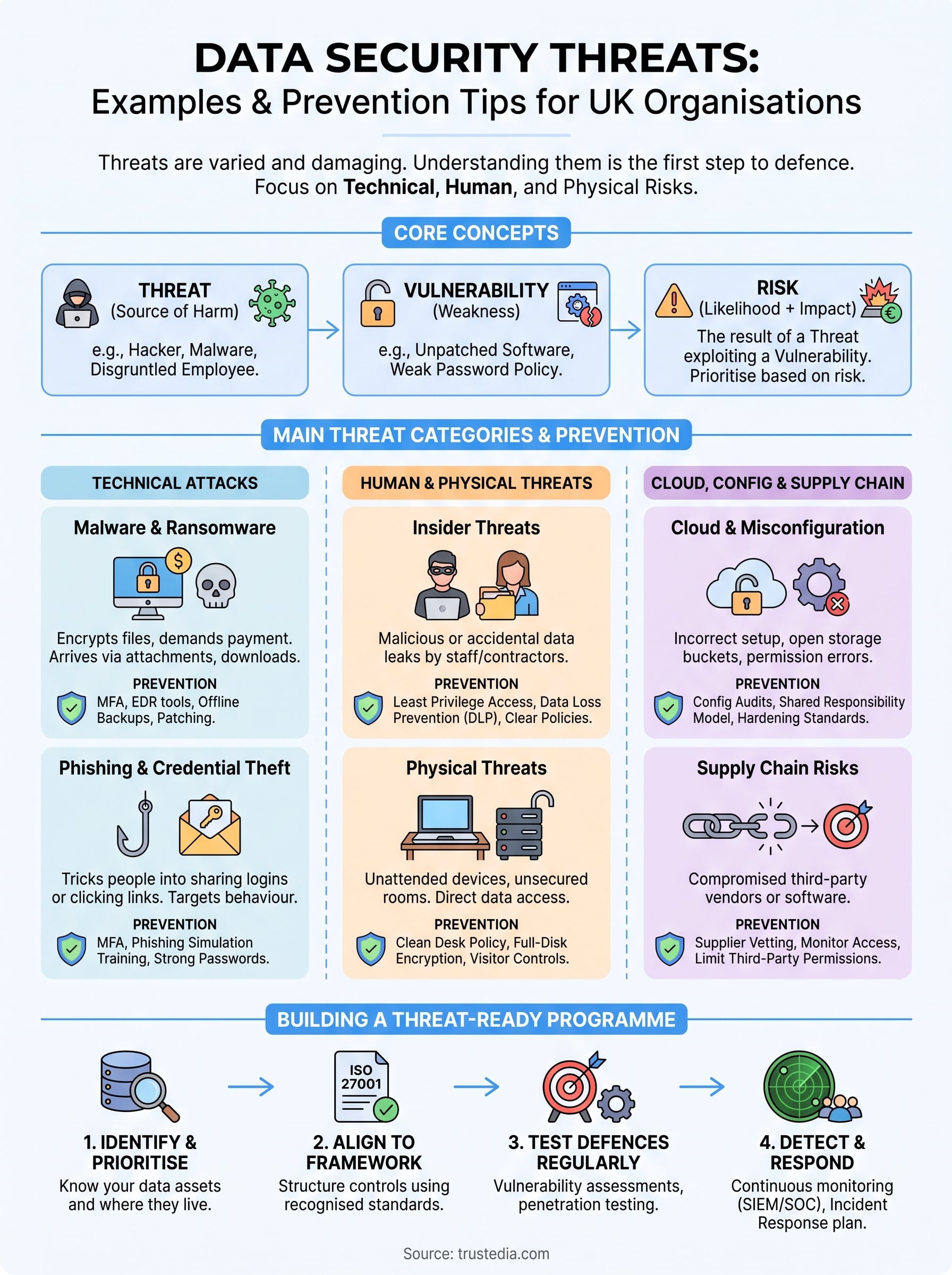
These three terms often get used interchangeably, but they mean different things, and mixing them up leads to confused security decisions. A threat is the potential source of harm, whether that’s a hacker, a piece of malware, or a disgruntled employee. A vulnerability is a weakness in your systems, processes, or people that a threat can exploit, such as an unpatched software flaw or a weak password policy. Risk is the combination of both: the likelihood that a specific threat will exploit a specific vulnerability, and the impact that would follow.
When you understand the distinction, you can prioritise your defences more accurately. Patching a vulnerability reduces risk even if the threat itself remains. Blocking a known attack vector reduces risk even if a vulnerability still exists. Security programmes that confuse these concepts tend to focus on the wrong problems, spending budget on low-risk areas while leaving high-risk ones exposed.
How threats target your data
Threats reach your data through several distinct routes, and knowing those routes helps you understand where controls belong. Technical attacks target software, hardware, and network infrastructure directly. Phishing campaigns and social engineering attacks target human behaviour, manipulating people into taking actions that expose data or grant access. Physical threats target the devices and locations where data is stored or processed.
Most real-world breaches involve more than one of these routes working in sequence. An attacker might start with a phishing email that harvests credentials, use those credentials to access a cloud system, then move across the network until they reach high-value data. No single layer of defence stops a multi-stage attack on its own, which is why layered security, often called defence in depth, remains the most reliable approach.
Why categories matter in practice
Organising threats into categories is not just an academic exercise. It directly shapes how you build your security programme. If you only focus on malware because it’s the most publicised threat type, you’ll miss the misconfigured database left open by a third-party supplier, or the employee walking out of the building with data on a personal USB drive. A structured view of the threat landscape forces you to think broadly across technical, human, physical, and supply chain risks.
Matching the right people to the right threat categories also means your organisation responds faster and with the right expertise. Technical threats sit with your IT and security teams. Human threats connect to HR, training, and management. Physical threats involve facilities and access control policies. When responsibility is clearly assigned, gaps in coverage become far easier to spot and close before an attacker finds them first.
Why data security threats matter for UK organisations
UK businesses operate in one of the most heavily regulated data environments in the world. The UK GDPR and the Data Protection Act 2018 place legal obligations on any organisation that collects, stores, or processes personal data, and a breach that results from poor security can trigger investigations, fines, and mandatory breach notifications. Beyond compliance, the simple reality is that UK organisations are actively targeted: the UK government’s Cyber Security Breaches Survey consistently shows that the majority of medium and large businesses identify a cyber attack or breach each year.
The UK regulatory and legal context
The Information Commissioner’s Office (ICO) has the authority to issue fines of up to £17.5 million or 4% of annual global turnover for the most serious breaches of UK GDPR, whichever is higher. Failing to implement appropriate technical and organisational measures to protect personal data is itself a breach of the regulation, regardless of whether an attacker actually succeeds in stealing anything. Your legal obligation is to the security of the data, not just to cleaning up after a breach has happened.
Regulators judge organisations not only on whether a breach occurred, but on whether reasonable steps were taken to prevent it in the first place.
Sector-specific rules add further layers. Organisations in financial services must satisfy the Financial Conduct Authority’s operational resilience requirements. Healthcare providers are bound by NHS data security standards. If your business works across borders or processes data from EU citizens, you also need to consider how UK and EU rules interact, particularly for data transfers.
The financial and operational cost of a breach
The cost of a cyber incident extends well beyond any regulatory fine. Operational downtime during an incident response can halt sales, disrupt supply chains, and prevent staff from accessing the systems they need to do their jobs. Recovery costs include forensic investigation, rebuilding infrastructure, notifying affected individuals, and managing reputational damage, all of which accumulate fast.
Understanding the full range of types of data security threats your organisation faces makes it easier to build a business case for investment in prevention. When decision-makers see the potential costs of ransomware recovery, an insider data theft incident, or a third-party breach laid out clearly, the case for proactive security spending becomes straightforward. Prevention is consistently cheaper than incident response, and the businesses that treat security as an ongoing programme rather than a one-time project are the ones that recover fastest when something does go wrong.
Common cyber threats and how they work
Cyber threats that attack your data through technical means are the ones most organisations think of first, and for good reason. Malware, ransomware, and phishing account for the majority of reported incidents across UK businesses each year, and each one exploits a different combination of software weaknesses and human behaviour. Knowing how these attacks actually work gives you the foundation to build controls that stop them at the right point, rather than discovering the gap after the damage is done.
Malware and ransomware
Malware is any software designed to damage, disrupt, or gain unauthorised access to your systems. It arrives through infected email attachments, compromised websites, or malicious downloads, and once it executes, it can steal data, log keystrokes, or open a back door for attackers to control your environment remotely. Ransomware is a specific and particularly destructive form of malware that encrypts your files and demands payment for the decryption key. Attackers typically move across your network quietly before triggering the encryption, ensuring they’ve locked as much data as possible before you notice anything is wrong.

Recovery from a ransomware attack without reliable backups is extremely difficult, and paying the ransom does not guarantee your data returns intact or unmodified.
Organisations that maintain tested, offline backups significantly reduce the leverage ransomware gives an attacker, since restoring from backup removes the need to negotiate at all.
Phishing and credential theft
Phishing sits among the most persistent types of data security threats because it targets people rather than systems directly. An attacker sends a message that appears to come from a trusted source, a bank, a supplier, or a colleague, and tricks the recipient into clicking a link, entering credentials, or approving a fraudulent transaction. Spear phishing goes further by personalising the message using information gathered from social media or previous data breaches, which makes it far harder for staff to detect without specific training.
Once an attacker holds your credentials, they can access cloud services, email accounts, and internal systems without triggering many traditional security controls. Multi-factor authentication (MFA) significantly limits the damage a stolen password can cause, because the attacker still needs a second verification factor they don’t possess. Combining MFA with regular phishing simulation training means your staff build the habit of spotting and reporting suspicious messages before a real attack tests them under pressure, rather than learning the lesson the hard way.
Insider, human, and physical threats
Not every threat to your data arrives through a firewall. Insider threats, human error, and physical security weaknesses account for a substantial share of data breaches each year, yet they receive far less attention than technical attacks. Recognising these risks means looking beyond your network perimeter and examining the people, behaviours, and physical spaces your organisation depends on every day.
Insider threats
Insider threats involve people who already hold legitimate access to your systems: employees, contractors, and partners. Malicious insiders steal, alter, or delete data deliberately, driven by financial gain, personal grievance, or external coercion. Detecting them is hard because their access patterns look normal to most security tools, which is why behavioural monitoring and granular access logging sit alongside technical defences as essential controls.
Accidental insider incidents cause just as much damage. A staff member emailing a customer spreadsheet to their personal account to finish work at home creates the same exposure as a deliberate leak, without any harmful intent. Clear data handling policies and technical controls such as data loss prevention (DLP) tools reduce the risk of well-meaning employees creating serious breaches without realising it.
Applying least-privilege access, so staff can only reach data their role genuinely requires, limits the potential damage from any single insider incident considerably.
Social engineering beyond phishing
Phishing is one form of social engineering, but attackers also use tactics that avoid email entirely. Vishing (voice phishing) uses phone calls where an attacker poses as IT support, a bank, or a supplier to extract credentials or approve a fraudulent payment. Pretexting builds a convincing false backstory to pressure a target into sharing information they would normally protect.
These types of data security threats succeed because they exploit trust rather than software vulnerabilities. Training your staff to verify identities through a second, independent channel before acting on an unexpected request closes the gap social engineers rely on most.
Physical threats
Physical security and data security overlap more than many organisations acknowledge. Unattended devices, unlocked screens, and unsecured server rooms create real opportunities for data theft that no software control can fully address. An attacker with brief physical access to a device can install malware, copy files directly, or photograph sensitive content displayed on screen.

Applying clean desk policies, strict visitor access controls, and full-disk encryption on every device significantly reduces your organisation’s physical exposure without requiring large investment.
Cloud, misconfiguration, and third-party threats
Moving data and workloads to cloud platforms introduces a different set of exposures that many organisations underestimate because the infrastructure itself feels invisible. The types of data security threats that originate in cloud environments, misconfigurations, and third-party supply chains are responsible for some of the most damaging breaches on record, yet they receive far less attention than malware in most security conversations. Understanding them requires looking beyond your own network and examining every system and supplier that touches your data.
Cloud storage and access risks
Cloud services are not inherently insecure, but they rely on your configuration choices being correct from the start. A storage bucket left publicly accessible, permissions set too broadly during a rushed deployment, or an old test environment left running all create real exposure points. Attackers actively scan for misconfigured cloud resources using automated tools, which means a mistake made during setup can be discovered and exploited within hours rather than days.

Treating cloud security as the provider’s responsibility rather than a shared one is one of the most common and costly assumptions organisations make.
Microsoft and Amazon both publish shared responsibility models for their cloud services that spell out exactly where provider responsibility ends and yours begins. Reviewing those models against your current configuration is a practical first step toward closing gaps without specialist tooling.
Misconfiguration as a standalone threat
Misconfiguration deserves its own category because it functions differently from other threats. No attacker needs to break through your defences when an open door already exists in your environment. A single overly permissive firewall rule, an admin account left active after a staff member leaves, or a database exposed to the internet without authentication all represent configuration failures that create direct, exploitable pathways to your data.
Regular configuration audits and automated scanning tools that flag deviations from your security baseline reduce this risk substantially. Applying consistent hardening standards across every system, including cloud, on-premise, and hybrid environments, ensures new deployments don’t quietly inherit old weaknesses.
Third-party and supply chain risks
Your suppliers, contractors, and software vendors all connect to parts of your environment, and each connection is a potential entry point for an attacker who has already compromised one of them. Supply chain attacks work by targeting a trusted third party rather than your organisation directly, using that access to reach multiple downstream customers at once. Vetting your suppliers’ security practices, limiting the access each third party holds to the minimum required, and monitoring third-party activity within your environment all reduce the exposure their connections create.
How to prevent and detect data security threats
Prevention and detection work best when they operate together. Preventing access reduces the chance of a breach occurring; detecting anomalies early limits the damage when prevention alone isn’t enough. Layering these two approaches across your technical controls, processes, and staff training gives you the strongest defence against the full range of types of data security threats your organisation faces.
Build technical controls that block the most common attack paths
The majority of successful breaches exploit a small set of known weaknesses: unpatched software, weak credentials, and overly broad access permissions. Keeping all software and operating systems patched removes the vulnerabilities attackers rely on most. Applying multi-factor authentication (MFA) across every external-facing system and enforcing strong password policies through a password manager closes the credential gap that phishing attacks exploit.
Firewalls, endpoint detection and response (EDR) tools, and network segmentation limit how far an attacker can move if they do gain initial access. These controls don’t need to be complex to be effective; consistent, well-configured basics outperform sophisticated tools that aren’t maintained properly.
Monitor your environment to catch what prevention misses
Detection depends on having clear visibility into your environment at all times. Security Information and Event Management (SIEM) tools aggregate logs from across your network and surface suspicious patterns that individual system alerts would miss. Pairing SIEM with a Security Operations Centre (SOC), whether internal or managed, means someone is actively reviewing those signals rather than logs sitting unread in a dashboard.
The gap between when an attacker first gains access and when an organisation detects them is often measured in weeks, which is why continuous monitoring matters far more than point-in-time assessments.
Train your staff to recognise and report threats
Technical controls alone won’t stop a phishing email that a staff member responds to before any automated system intervenes. Regular phishing simulation training conditions your team to spot suspicious messages and builds the habit of reporting them through the right channel rather than ignoring or acting on them. Combining simulations with clear reporting procedures ensures that when a staff member does recognise a threat, the information reaches your security team quickly enough to act.
Reviewing training results by team and department helps you identify where knowledge gaps are most concentrated, so you can target follow-up sessions where they’ll have the greatest impact rather than running the same generic training for everyone.
How to build a threat-ready security programme
Understanding the individual types of data security threats your organisation faces is only useful if that knowledge shapes how you build your security programme. A reactive approach, where you respond to each incident as it arrives, leaves you permanently behind the attackers. A structured, proactive programme gives you a clear view of your risks, assigns responsibility for addressing them, and ensures your defences keep pace as threats change.
Start with a clear picture of what you’re protecting
Before you can defend your data effectively, you need to know what data you hold, where it lives, and who has access to it. Many organisations discover during a breach that sensitive data existed in systems they had forgotten about or assumed were secured. Conducting a data asset inventory as a foundational step removes that uncertainty and gives your security controls a concrete target to protect rather than a vague perimeter.
Once you know what matters most, you can apply risk prioritisation to direct your budget and attention toward the assets an attacker would value most, rather than spreading controls thinly across everything equally.
Align your programme to a recognised framework
Building a security programme around a recognised standard gives your controls structure, consistency, and a measurable baseline to improve from. ISO 27001 is the most widely adopted international standard for information security management and covers the full scope of controls needed to address technical, human, and organisational risks.
Achieving ISO 27001 certification demonstrates to clients, regulators, and insurers that your security programme meets an independently verified standard, which carries real commercial and reputational value.
Working with specialists who hold proven experience in ISO 27001 implementation, rather than attempting to navigate the standard alone, significantly reduces the time and risk involved in reaching certification.
Test your defences regularly
A security programme that never gets tested is a programme that accumulates hidden gaps over time. Regular vulnerability assessments identify weaknesses in your systems before attackers do. Penetration testing goes further by simulating a real attack to determine how far an adversary could actually get using the weaknesses found.
Scheduling these tests at fixed intervals, rather than treating them as one-time exercises, ensures your programme responds to changes in your environment, new systems, new staff, new suppliers, and new attack techniques. Pairing testing with a clear remediation process closes the loop, turning findings into concrete improvements rather than reports that sit unread.
Next steps to protect your data
The types of data security threats covered in this article share one thing in common: they all become significantly more damaging when an organisation hasn’t prepared for them in advance. Malware, phishing, insider incidents, misconfigurations, and supply chain risks each exploit gaps that proactive security work closes before an attacker finds them. Knowing where those gaps are is where the work begins.
Your next step is to move from understanding to action. That means auditing what data you hold, testing your current controls, and building a programme that addresses technical, human, and organisational risks together. If you’re not sure where to start or want an expert view of your current exposure, TrustedIA’s team has over 30 years of experience helping UK businesses do exactly that.
Get in touch with TrustedIA to discuss your cyber security needs and find out where your organisation stands before an incident forces your hand.



