
A ransomware alert lands at 2am and nobody knows who’s supposed to make the first call. That’s the moment most businesses realise they never actually built a proper response plan, only a vague assumption that IT would
Why your organisation needs an incident response team
Handle. That’s usually where the sentence ends and the panic begins, because "IT would handle it" isn’t a plan, it’s a hope. A cyber incident response team exists precisely to remove that hope from the equation and replace it with a rehearsed, accountable process. Without one, even a technically capable IT department ends up making decisions under pressure that a calmer, better-prepared team would never make, like paying a ransom before checking backups, or restoring a server before preserving the evidence needed for an insurance claim.

The financial cost of hesitation
Speed matters more than most business owners realise. IBM’s Cost of a Data Breach Report consistently shows that organisations with a tested incident response plan and a dedicated team contain breaches significantly faster, and containment speed correlates directly with lower total cost. Every hour a ransomware strain sits undetected on your network, it spreads further, encrypts more systems, and multiplies your recovery bill, which is why knowing how to plan, contain, and recover from ransomware matters so much. A cyber incident response team that knows its job cuts that window dramatically, because the decisions about isolating systems, engaging forensic specialists, and communicating with stakeholders have already been mapped out in advance rather than argued over live.
A business without a named incident response team isn’t avoiding the cost of preparation, it’s just paying it later, with interest.
Regulatory and legal pressure
UK businesses handling personal data face strict reporting deadlines once a breach is confirmed. Under UK GDPR, you generally have 72 hours to notify the Information Commissioner’s Office once you become aware of a qualifying breach. That clock doesn’t pause while you figure out who’s in charge internally. An established incident response team already knows who assesses the breach, who drafts the notification, and who signs it off, so the deadline becomes manageable rather than terrifying. Miss it, or fumble the notification because nobody owned the task, and you’re looking at regulatory scrutiny on top of the breach itself, so it pays to understand when a breach becomes reportable before one happens.
Operational and reputational damage control
Customers and partners forgive a breach far more readily than they forgive a chaotic response to one. When ransomware or a data leak hits headlines, the businesses that recover their reputation fastest are the ones who can point to a clear, confident response: systems isolated within minutes, customers informed accurately, operations restored on a known timeline. That confidence doesn’t appear by accident. It comes from a team that has drilled the scenario before it ever happened for real.
| Without a dedicated IR team | With a dedicated IR team |
|---|---|
| Decisions made ad hoc under pressure | Decisions follow a pre-agreed playbook |
| Breach containment often takes days | Containment measured in hours |
| Regulatory deadlines missed or rushed | Notifications handled by a named owner |
| Evidence lost during panicked recovery | Evidence preserved for forensics and insurers |
| Recovery cost climbs with each delay | Costs contained through faster action |
Finally, consider the insurance angle. Cyber insurers increasingly ask whether you have a formal response capability before they’ll even quote, let alone pay out cleanly on a claim. Services like TrustedIA’s CyberSOS incident response exist because insurers, loss adjusters, and businesses alike have learned the hard way that recovery goes faster and cheaper when a dedicated team, internal or outsourced, is already on standby rather than assembled from scratch at 2am.
How to build an incident response team

Building a cyber incident response team isn’t a hiring exercise, it’s a design exercise. You’re not looking for five new job titles on an org chart, you’re mapping out who does what the moment an alert fires, and making sure that map survives contact with a real crisis. Most organisations get this wrong by starting with tools (buying a SOC platform, subscribing to a threat feed) before they’ve settled who actually owns the decisions those tools inform.
Start with a risk assessment
Begin by working out what you’re actually protecting and what would hurt most if it disappeared, got encrypted, or leaked. A manufacturing firm worries about production line downtime; a law firm worries about client confidentiality; a retailer worries about payment data. This assessment shapes everything downstream, from who sits on the team to how fast you need to respond. TrustedIA’s network auditing and vulnerability assessments give you the concrete starting point most businesses lack: a documented picture of where you’re exposed before you decide how to respond to it.
You can’t build a response team around risks nobody has bothered to name.
Assign roles and secure executive buy-in
Next, decide who holds each responsibility, and get a senior sponsor to formally approve it, because a plan with no executive backing collapses the first time someone questions the authority to isolate a production server. Cover these decisions early:
- Who declares an incident officially, and at what threshold?
- Who has authority to take systems offline without further sign-off?
- Who talks to customers, regulators, and the press?
- Who calls external specialists, insurers, or law enforcement?
Document, train, and test the plan
Write the answers down as a playbook, not a memory, and use an incident response plan template to make sure nothing important gets left out. Untested plans fail quietly until the night they’re needed, so run tabletop exercises at least twice a year and treat every real incident afterwards as a chance to revise the document. Many businesses combine this internal groundwork with an outsourced retainer, keeping named internal owners while leaning on specialists like TrustedIA’s CyberSOS for the technical depth a small in-house team can’t maintain alone.
Incident response team roles and structure
A cyber security incident response team structure works because every person knows their lane before the alert ever fires, not because they’re clever improvisers on the day. Most teams borrow a version of the same core structure, then adapt it to the size of the business. Smaller firms often fold two or three roles into one person; larger ones split each into a dedicated seat. What matters isn’t the headcount, it’s that every function below has a named owner, even if that owner also has a day job.
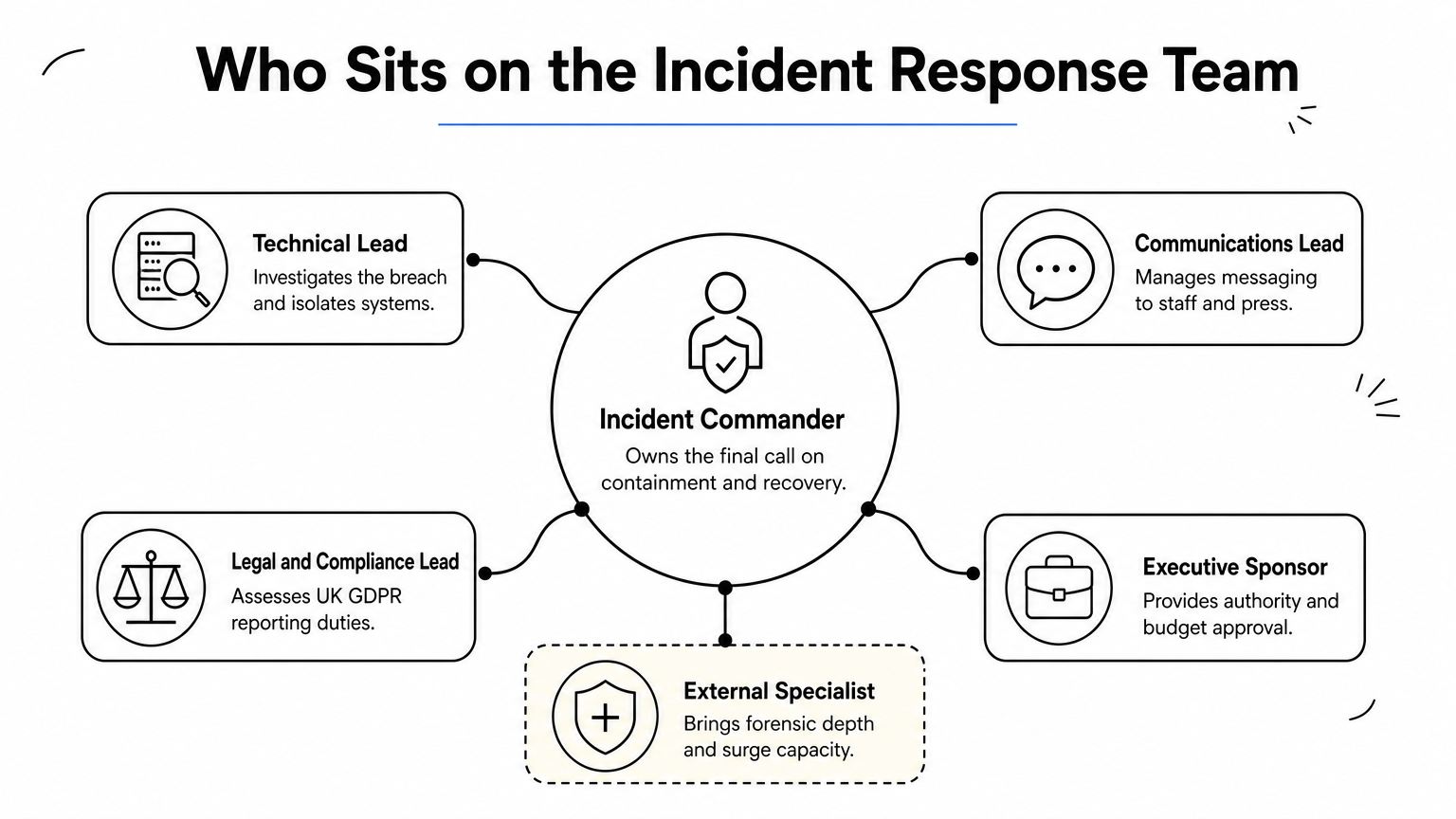
Core roles in a typical incident response team
The table below sets out how each response role breaks down for most incident response teams, whether the team sits entirely in-house or blends internal staff with an outsourced partner.
| Role | Responsibility |
|---|---|
| Incident commander | Owns the overall response, makes the final call on containment and recovery decisions |
| Technical lead | Investigates the breach, isolates affected systems, coordinates forensics |
| Communications lead | Manages messaging to staff, customers, regulators, and the press |
| Legal and compliance lead | Assesses reporting obligations under UK GDPR and contractual duties |
| Executive sponsor | Provides authority and budget approval for major decisions |
| External specialist | Brings forensic depth and surge capacity, such as through TrustedIA’s CyberSOS |
The incident commander sits at the centre
Every workable structure has one person who can say "we’re doing this" and be obeyed without a committee vote. That’s the incident commander, and their job isn’t technical, it’s decisive. They weigh the technical lead’s findings against the legal lead’s obligations and the executive sponsor’s risk appetite, then commit to a course of action.
A response team without a single decision-maker isn’t a team, it’s a group chat waiting for consensus that never arrives.
Extended roles for larger incidents
Beyond the core roles, larger or longer-running incidents pull in HR for staff communication, IT operations for system rebuilds, and finance for tracking recovery costs against insurance cover. None of these need permanent seats on the team, but the plan should already list who fills them, so nobody’s improvising an org chart mid-crisis.
Types of incident response teams explained
Ask ten security consultants what is cyber incident response team in practice and you’ll get ten slightly different answers, because the model varies with the size and risk profile of the business. What stays constant is the function: someone owns detection, someone owns containment, someone owns communication. How you staff that function is where the real choice lies, and most businesses fall into one of four patterns.

Internal, dedicated teams
Larger enterprises with constant exposure, think financial services or healthcare, often build a permanent, in-house team whose entire job is security monitoring and response. These cyber incident response teams sit within or alongside the IT department, run their own tooling, and answer to a CISO. The advantage is deep institutional knowledge of the network; the drawback is cost, because staffing a 24/7 rota with skilled analysts is expensive and hard to recruit for.
Hybrid teams blending in-house and outsourced expertise
Most mid-sized businesses land here, and for good reason. A hybrid model keeps a small internal core, usually the incident commander and IT lead, while leaning on an outsourced partner for the technical depth and around-the-clock monitoring a small team can’t sustain alone. TrustedIA’s round-the-clock Security Operations Centre works this way, extending an internal team’s reach without forcing them to hire specialists they’d only need occasionally.
The strongest incident response teams aren’t the biggest ones, they’re the ones matched honestly to the risk they’re meant to cover.
Fully outsourced or managed teams
Smaller businesses without any dedicated security staff often outsource the whole function. A managed provider handles detection, response, and reporting under a retainer, giving the business enterprise-grade capability it could never justify hiring in-house. TrustedIA’s CyberSOS fits this model, stepping in as the named response capability insurers and loss adjusters expect to see already on standby.
Virtual and ad hoc teams
Some organisations assemble a team only when an incident hits, pulling named individuals from their day jobs into a temporary structure. It’s cheaper than a permanent team but riskier, because nobody’s rehearsed the handoffs, and speed suffers exactly when speed matters most.
Essential skills and tools for incident response teams
A well-designed structure still fails if the people filling it can’t do the work under pressure. Incident response teams need a mix of technical depth and calm judgement, because the same analyst who can read a malware sample at 3pm needs to stay level-headed explaining a containment decision to a nervous board at 3am. Skills matter as much as headcount, and most businesses underinvest in both, which is why training the wider team to respond pays off quickly.
Technical skills that keep the response moving
Your technical lead and analysts need working knowledge of network forensics, log analysis, and malware behaviour, but they also need the discipline to preserve evidence rather than just fix the problem. Rushing to wipe an infected server destroys the trail an insurer or law enforcement will later ask for. This is where cyber incident response teams often lean on outside specialists for forensic-grade evidence handling, since maintaining those skills in-house is expensive to sustain for an event that, hopefully, happens rarely.
The best incident response teams treat evidence preservation as seriously as they treat containment, because losing the trail costs you twice.
Non-technical skills that get overlooked
Communication under pressure is a skill in its own right, not a bonus, and planning your incident communications in advance makes it far easier to get right. A technically brilliant lead who can’t explain a decision clearly to the executive sponsor slows the whole response down. Look for these traits when assigning roles:
- Clear, jargon-free communication under time pressure
- Comfort making a call with incomplete information
- Familiarity with UK GDPR reporting obligations
- Willingness to document decisions as they happen, not afterwards
Tools that support rather than replace the team
Tooling matters, but it’s the servant of the process, not the substitute for it. Endpoint detection, SIEM platforms, and dark web threat intelligence give a team visibility, while a documented playbook and a tested communication tree turn that visibility into action. TrustedIA’s managed endpoint detection and dark web surveillance give smaller teams the same visibility a large enterprise SOC would have, without the overhead of building it from scratch. Buying tools before defining roles is the most common mistake businesses make, and it’s exactly backwards: decide who acts on an alert before you decide which platform generates it.
Common challenges and best practices for IRTs
Even a well-designed incident response team runs into the same handful of problems, and recognising them early saves you from relearning the lesson mid-crisis. Alert fatigue is the quiet killer: analysts drowning in false positives start ignoring the warnings that matter, so the real breach sits unnoticed for hours. Turnover is another, because losing the one person who knew the playbook by heart resets institutional knowledge to zero overnight. Add unclear authority, where two people both think they can order a system offline, and you get delay exactly when speed decides the cost.
Why plans go stale
Documentation written once and never revisited is worse than no documentation at all, because it gives false confidence. Systems change, staff move on, and a playbook built around last year’s network map won’t match this year’s reality. Cyber incident response teams that treat the plan as a living document, updated after every tabletop exercise and every real incident, avoid this trap. Those that file it away and forget it usually discover the gaps live, in front of a customer or regulator.
A plan nobody has opened since it was written isn’t preparation, it’s paperwork.
Best practices worth adopting
Build these habits into your team’s routine rather than treating them as one-off tasks:
- Run tabletop exercises at least twice a year, using scenarios drawn from your actual risk assessment and a detection-to-recovery checklist to keep the drill honest
- Review and update the playbook after every drill and every genuine incident
- Rotate the incident commander role during drills so more than one person can step up
- Keep contact details for your external specialists, insurers, and the ICO current and easy to find under pressure
- Track metrics like detection time and containment time, then work to shrink both
Treat every incident as a lesson
Following any real event, hold a blameless review focused on what the process missed, not who missed it. Businesses that skip this step tend to repeat the same failure with the next attacker. Pairing internal reviews with an outsourced partner like TrustedIA’s CyberSOS adds an outside perspective that internal teams, too close to the incident, often miss.
Bringing it all together
A strong incident response team isn’t built the night of the breach, it’s built months before, in the quiet decisions about roles, playbooks, and rehearsals nobody wants to spend time on until they suddenly do. Every point in this guide comes back to the same idea: name the owners, document the decisions, and test the plan before a real attacker forces you to test it live. Whether you build a fully internal team, blend internal staff with a managed partner, or outsource the whole function, the goal stays the same, replacing panic with a rehearsed, accountable response.
Getting there alone is hard, and most businesses don’t have the spare capacity to build forensic-grade skills in-house for an event they hope never happens. That’s exactly the gap TrustedIA fills. Talk to TrustedIA about expert-led breach containment and recovery and build your response capability before the next 2am alert lands, not after.



