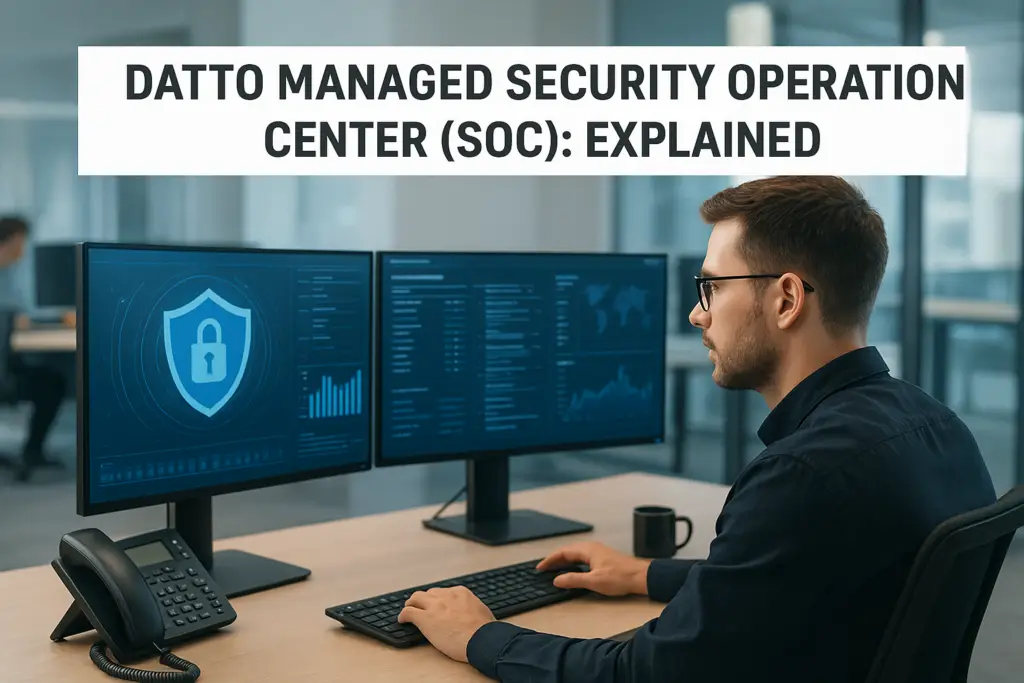
Most businesses don’t have the resources to staff a security operations centre around the clock, and most MSPs don’t either. That’s exactly the gap Datto Managed Security Operation Centre (SOC) is designed to fill. It gives MSPs access to 24/7 threat monitoring, detection, and response without the overhead of building and running a SOC from scratch.
But what does that actually look like in practice? How does it work alongside tools like endpoint detection and response (EDR)? And is it the right fit for the businesses you’re trying to protect? These are fair questions, and ones worth answering properly before committing to any platform. At TrustedIA, we operate as solution-agnostic cybersecurity specialists with over 30 years of experience delivering managed security services, including our own SOC capabilities. We’ve worked with a range of tools and vendors, so we’re well placed to break down what Datto’s Managed SOC offers without a sales pitch attached.
This article explains how Datto’s Managed SOC works, what it includes, how it integrates with broader security tooling, and where it fits within real-world threat management. Whether you’re an MSP evaluating options or a business trying to understand what your provider is offering, you’ll walk away with a clear, practical understanding of the service.
What Datto Managed SOC is and who it’s for
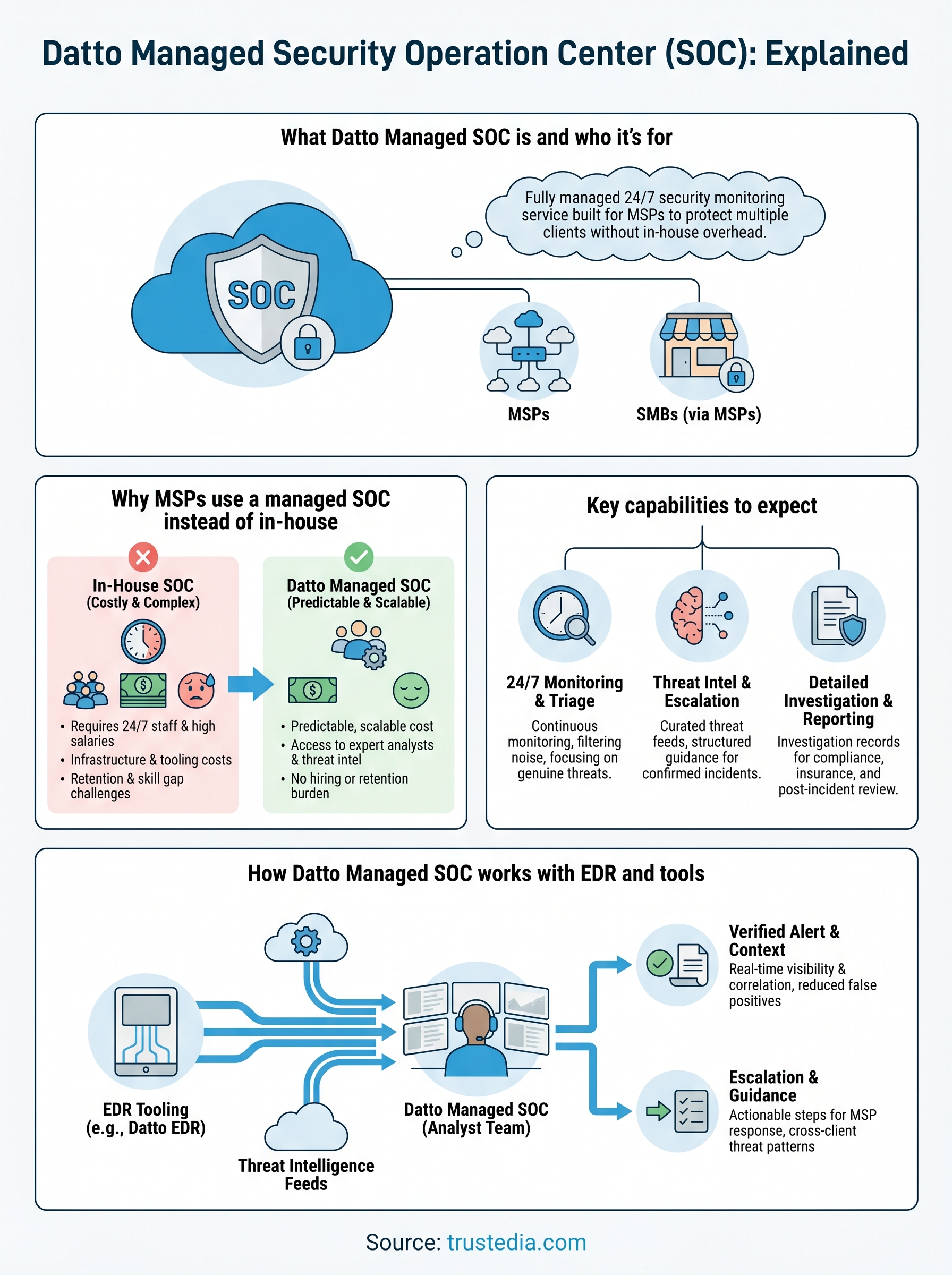
Datto Managed Security Operation Centre (SOC) is a fully managed security monitoring service built for Managed Service Providers (MSPs). Rather than building your own SOC with dedicated analysts, infrastructure, and shift patterns, you get access to a team of security professionals who monitor your clients’ environments around the clock. The service sits within Datto’s broader cybersecurity portfolio and connects directly with their endpoint detection and response tools, giving you a joined-up view of threats across your client base.

How it’s structured as a service
At its core, the Datto Managed SOC functions as an outsourced security team that plugs into your existing MSP stack. Datto’s SOC analysts monitor alerts, investigate suspicious activity, and escalate confirmed threats, providing clear guidance on next steps. You’re not left to read raw alerts and make calls alone. The analyst team triages events on your behalf, reducing the volume of noise you have to deal with and helping you focus on genuine, actionable threats rather than false positives.
The real value of a managed SOC model is not just coverage hours. It’s the human expertise behind the alerts that turns data into decisions.
Analysts within the SOC use pre-built detection logic and threat intelligence feeds to identify patterns that automated tools alone would miss. This means the SOC is not just watching dashboards. They actively correlate data from multiple sources, including endpoint telemetry, network behaviour, and known threat actor techniques, to give you a fuller picture of what is happening inside a client’s environment.
Who it’s built for
Built primarily for MSPs managing cybersecurity across multiple clients, this service bridges the gap without requiring you to hire, train, or retain specialist security staff. It is also relevant for MSPs whose clients face compliance requirements, such as those tied to cyber insurance policies or sector-specific regulations, where demonstrable 24/7 monitoring is increasingly expected.
Smaller businesses under your management also benefit directly. Many SMBs cannot sustain enterprise-grade security operations on their own. Still, by partnering with an MSP that leverages Datto’s Managed SOC, they gain access to a level of protection that would otherwise be out of reach. That is a meaningful capability to offer, particularly as cyber threats targeting smaller organisations continue to grow in frequency and sophistication.
Why MSPs use a managed SOC instead of in-house
Running a SOC in-house sounds straightforward until you price it out. You need trained analysts working in shifts, purpose-built tooling, ongoing threat intelligence subscriptions, and a management layer to keep it all running. For most MSPs, that bill quickly outpaces what the business can justify, especially when your clients are primarily small and mid-sized businesses operating on tight budgets.
The real cost of staffing around the clock
A genuine 24/7 in-house SOC requires a minimum of four to six analysts just to cover shifts without burning people out. Add recruitment costs, salaries, benefits, and continuous training to keep skills current, and the annual expenditure can reach hundreds of thousands of pounds before you factor in infrastructure. Many MSPs find that the cost per client becomes unsustainable at that scale, particularly when client volumes fluctuate.
Outsourcing SOC functions through a service like Datto Managed Security Operation Center (SOC) converts a large fixed cost into a predictable, scalable one tied directly to your client base.
Skill gaps and staff retention
Security talent is genuinely hard to retain. Experienced analysts have options, and they tend to move toward larger organisations or specialist security firms that offer more complex work and better career progression. When you rely on one or two in-house security staff, you create a dependency that leaves you exposed whenever someone leaves or takes time off. A managed SOC eliminates that single point of failure entirely, providing consistent, expert coverage regardless of what happens internally.
Key capabilities to expect from Datto Managed SOC
When you’re evaluating Datto Managed Security Operation Centre (SOC), understanding exactly what the service includes helps you set accurate expectations with clients and build reliable service packages around it. The capabilities break down into a few core areas that define how the SOC operates across your client base daily.
24/7 threat monitoring and alert triage
The SOC provides continuous monitoring across your client environments, watching for suspicious activity at any hour, including nights, weekends, and bank holidays. Analysts review incoming alerts, filter out the noise, and surface only the events that require your attention, so you’re spending time on confirmed threats rather than chasing false positives. For an MSP managing multiple clients simultaneously, that triage function alone recovers significant time and reduces analyst fatigue.
Consistent monitoring coverage is often the difference between catching a threat in its early stages and discovering a breach days after the damage is done.
Threat intelligence and incident escalation
Datto’s SOC analysts use curated threat intelligence feeds to spot patterns tied to known attack techniques and active threat actors. When a genuine incident is confirmed, you receive structured escalation guidance explaining what occurred, which systems are affected, and the next steps to take. This removes the guesswork from response and helps you act quickly rather than spending time reconstructing events under pressure.
Alongside escalation, the SOC produces detailed investigation records covering the timeline, indicators of compromise, and actions taken. Those records support post-incident reviews and satisfy reporting requirements your clients may face under cyber insurance policies or compliance frameworks, giving you tangible evidence of due diligence when it matters most.
How Datto Managed SOC works with EDR and tools
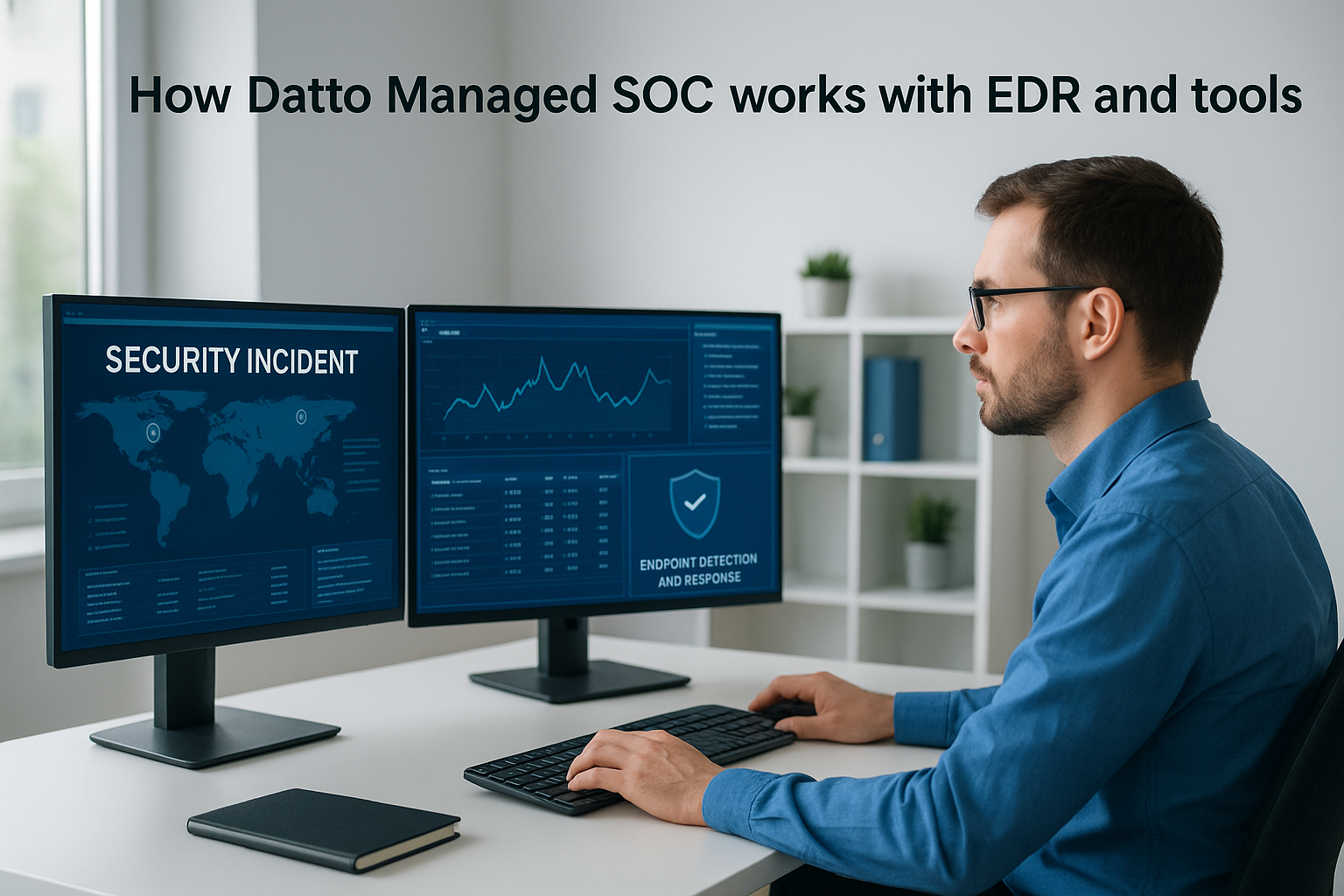
The Datto Managed Security Operation Centre (SOC) does not operate in isolation. It connects directly with endpoint detection and response (EDR) tooling, using the data those tools generate as the foundation for what analysts investigate. Understanding how that relationship works helps you design a more coherent security stack for your clients rather than running parallel tools that never communicate.
EDR as the data foundation
Datto’s Managed SOC integrates tightly with Datto EDR, pulling in endpoint telemetry that captures process activity, file changes, network connections, and behavioural signals across managed devices. This gives SOC analysts real-time visibility into endpoint-level activity, rather than relying solely on network-level data or logs that arrive with a delay. When an analyst spots a suspicious pattern, they can trace it back through endpoint activity to establish whether a genuine attack is in progress or the event is benign.
Combining EDR data with analyst-led investigation closes the gap between detection and understanding, which is where most automated-only approaches fall short.
What the SOC does with that data
Analysts cross-reference endpoint signals with threat intelligence to identify attack techniques mapped to frameworks like MITRE ATT&CK, providing context that raw alerts alone cannot. They also correlate activity across multiple client environments, so a threat pattern spotted in one environment can inform faster detection across others in your portfolio. This cross-client visibility is something you cannot replicate easily with siloed, per-client tooling, and it strengthens the overall protection you deliver without adding complexity to your day-to-day operations.
How to evaluate fit and plan a rollout
Before committing to the Datto Managed Security Operation Centre (SOC), you need to assess whether it aligns with the specific needs of your client base and your operational model. The right questions at this stage prevent misaligned expectations later and help you build a rollout plan that actually holds up.
Assessing client readiness
Start by reviewing which clients generate the highest volume of security alerts or carry the most exposure. Clients in regulated industries, such as financial services or healthcare, or those subject to cyber insurance conditions, are typically your strongest candidates for immediate inclusion. Look at their existing endpoint coverage and whether Datto EDR is already deployed, since the SOC integrates most effectively when that data layer is already in place.
Getting the baseline tooling right before you activate SOC coverage means analysts have the context they need from day one, rather than spending the first weeks filling gaps.
Check whether clients have documented incident response procedures. The SOC will escalate confirmed threats, but your team needs a clear internal process for receiving and acting on those escalations with minimal delay.
Planning the rollout in stages
Roll out in phases rather than all at once. Start with one or two clients where you have strong visibility and established working relationships, use that experience to refine your escalation workflows, then expand from there. Document what works, track response times, and use that data to demonstrate value to both existing and prospective clients as you scale the service across your portfolio.
Next steps
Datto Managed Security Operation Centre (SOC) gives MSPs a practical path to delivering 24/7 threat monitoring without the overhead of building and staffing that capability internally. If you’ve read this far, you have a solid understanding of what the service covers, how it integrates with EDR tooling, and how to approach a rollout to avoid common early mistakes.
Your next move depends on where you are right now. If you’re still deciding whether a managed SOC is the right model for your clients, the fastest way forward is to speak with someone who has run these deployments before and can give you honest, vendor-neutral guidance based on your specific situation.
That’s exactly what TrustedIA offers. With over 30 years of experience in managed security services and a solution-agnostic approach, we help you make decisions that actually fit your business. Talk to our team about your SOC options, and we’ll help you take it from there.