A breach doesn’t wait for you to figure out who does what. If your team is still assigning roles and drafting customer emails three hours after discovering an attack, you’ve already lost the window that matters most. That’s why so many businesses search for a data breach response plan template: they want a structure they can adapt now, not a theory they’ll get around to later.
This guide gives you exactly that. Rather than handing you a generic checklist, we walk through how to build a plan that reflects your own systems, your own regulatory obligations under UK GDPR, and your own team’s capacity to act under pressure. You’ll see the core sections every template needs, from detection and containment through to notification and post-incident review, plus the details most templates leave out, like who signs off on regulator communications and how you test the plan before you ever need it.
We’ve built and reviewed these plans for organisations across sectors through our incident response work, so what follows reflects what actually holds up during a real breach, not just what looks good on paper. By the end, you’ll have a practical framework ready to customise and put in front of your leadership team this week.
What is a data breach response plan and why you need one
A data breach response plan is the documented set of procedures your organisation follows the moment you suspect or confirm that personal or sensitive data has been accessed, lost, or exposed without authorisation. It’s not the same as a disaster recovery plan, which deals with restoring systems after an outage, or a business continuity plan, which keeps operations running through disruption. A breach response plan is narrower and more urgent: it tells you who does what, in what order, within the first hours of discovery, when confusion costs you the most.
Why a documented plan beats improvisation
Without a written plan, every breach becomes a debate. Someone has to decide who leads the response, whether to shut down affected systems, who talks to customers, and whether the Information Commissioner’s Office needs a call. Those decisions take minutes when they’re pre-agreed and hours, sometimes days, when they’re not. Improvised responses almost always produce the same failures: duplicated effort, missed evidence, and communications sent before anyone’s checked they’re accurate.
A breach response plan doesn’t prevent incidents; it prevents panic from making them worse.
Organisations with a tested plan typically contain incidents faster and with far less internal chaos, because the plan has already answered the questions people would otherwise argue about mid-crisis. That speed matters directly to your bottom line and to your regulatory exposure, which brings us to what the law actually expects of you.
What UK GDPR and the ICO actually require
UK GDPR doesn’t just encourage a response plan, it effectively assumes you have one. Under the ICO’s guidance on personal data breaches, you must notify the regulator within 72 hours of becoming aware of a breach that risks people’s rights and freedoms, and you must tell affected individuals without undue delay if the risk is high. Meeting a 72-hour deadline without a plan is close to impossible once you factor in investigation, evidence gathering, and internal sign-off.
Your plan needs to address several specific obligations, not just a general intention to "respond quickly":
- Assessment timeline: how you determine, within hours, whether a breach is notifiable
- Regulator notification: who drafts and approves the ICO report, and using what evidence
- Individual notification: the criteria for deciding when affected people must be told directly
- Record-keeping: documenting every breach, even ones you decide not to report, since the ICO can request these records at any time
What it costs when you don’t have one
Breaches without a documented response tend to run longer, cost more, and generate more regulatory scrutiny than those handled against a rehearsed plan. The gap isn’t marginal. It shows up in containment time, in the volume of data exposed before systems get isolated, and in whether the ICO views your organisation as having taken "appropriate technical and organisational measures", a phrase that appears throughout UK GDPR and that regulators weigh heavily when deciding on enforcement action.
| Without a plan | With a tested plan |
|---|---|
| Roles debated during the incident | Roles assigned before the incident |
| Notification timeline often missed | 72-hour deadline built into the process |
| Inconsistent internal communication | Pre-approved templates and sign-off chain |
| Evidence gathered ad hoc | Evidence collection standardised |
Building that plan is what the rest of this guide walks you through, starting with the team that will actually run it.
Step 1. Build your incident response team
Every data breach response plan starts with people, not paperwork. Before you write a single procedure, decide who sits on your incident response team and what authority each person has the moment a breach is suspected. Skip this step and your plan becomes a document nobody’s actually empowered to act on.

Assign core roles before you need them
Your team needs clear ownership, not a committee that debates every decision. At minimum, name an incident lead who coordinates the response and has authority to make fast calls, someone from IT or security who can isolate systems, someone from legal or compliance who understands your ICO reporting obligations, and someone from communications who owns customer and media messaging. Smaller organisations often combine roles; that’s fine, as long as each role has a named owner and a backup.
| Role | Responsibility | Backup needed? |
|---|---|---|
| Incident lead | Coordinates response, makes final calls | Yes |
| Technical lead | Contains threat, preserves evidence | Yes |
| Legal/compliance lead | Assesses notification duty, liaises with ICO | Yes |
| Communications lead | Manages internal and external messaging | Yes |
| Executive sponsor | Authorises resources, signs off major decisions | Recommended |
A plan without named owners is just a list of good intentions.
Bring in external expertise where you lack it
Most SMBs don’t have a forensic investigator or a dedicated legal specialist on staff, and that’s fine as long as you’ve arranged access before an incident, not during one. Include external contacts in your plan: your cyber insurance provider, a legal adviser familiar with UK GDPR, and a specialist incident response partner who can step in for containment and forensics. This is exactly why services like TrustedIA’s CyberSOS exist, so you’re not searching for a provider while your systems are compromised.
Document contact details and escalation paths
List every team member’s direct phone number, not just their work email, since email may be inaccessible during an incident. Add:
-
Out-of-hours contact numbers for each core role
-
A clear escalation path if the incident lead is unreachable
-
Third-party contacts, including your insurer’s claims line and any external IR partner
Review this list every quarter. People change roles and phone numbers more often than most plans get updated, and a stale contact list defeats the purpose of having a team at all.
Step 2. Map your data and assess your risks
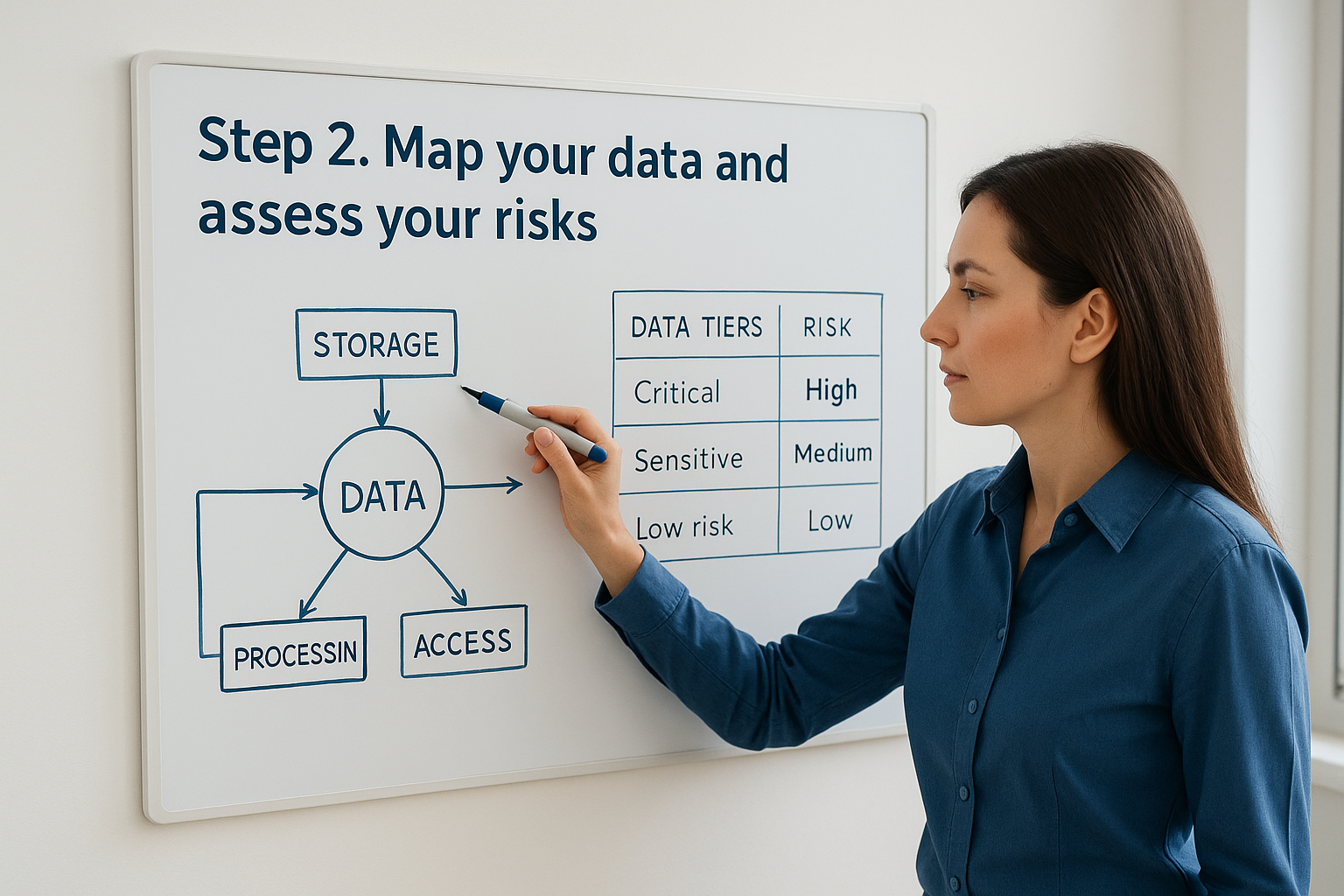
You can’t protect data you can’t locate. Before you write detection or notification procedures, you need a clear picture of what personal data you hold, where it lives, and who can access it. This data mapping exercise is the foundation your whole plan sits on, because it tells you what’s actually at stake when something goes wrong.
Build a data inventory
Start by cataloguing every system, database, and third-party service that touches personal data. Don’t rely on memory or assumptions; walk through each department and ask what they collect, store, and share. Your inventory should capture:
- What data you hold (names, financial details, health records, credentials)
- Where it’s stored (on-premises servers, cloud platforms, third-party processors)
- Who has access, including vendors and contractors
- How long you retain it and why
The ICO’s guidance on documentation expects most organisations to maintain a record of processing activities anyway, so this exercise often doubles as compliance groundwork you already owe under UK GDPR.
Classify data by sensitivity
Not all data carries the same risk if it’s exposed. Sort your inventory into tiers so your response plan can scale proportionately to what’s actually been compromised.
| Data tier | Examples | Breach impact |
|---|---|---|
| Critical | Health records, financial details, passwords | Severe harm, mandatory notification likely |
| Sensitive | Names, addresses, contact details | Moderate harm, notification often required |
| Low risk | Publicly available or anonymised data | Limited harm, notification rarely needed |
You can’t scale your response correctly if you don’t already know what you’re protecting.
Assess where your risks actually sit
Once you know what you hold, work out where it’s most exposed. Legacy systems, unencrypted backups, and third-party processors with weak controls are consistently where breaches originate. Run a simple risk assessment against each system: how likely is a breach, and how severe would the impact be if it happened? Prioritise your containment procedures around the systems that score highest on both counts, rather than treating every system as equally urgent. This mapping work feeds directly into the detection and containment procedures you’ll build next, because you can only isolate what you already know exists.
Step 3. Set out detection and containment procedures
Detection and containment are where your plan earns its keep. Everything you’ve built so far, your team, your data map, exists to support fast, decisive action once you spot something wrong. Vague guidance like "investigate and respond appropriately" won’t help anyone at 2am; your plan needs specific triggers and specific actions tied to each one.

Define what actually triggers a response
Start by listing the signals that should trigger your incident process, rather than waiting for someone to declare a "breach" formally. Common triggers include unusual login activity, unexpected data transfers, ransomware alerts, reports from staff or customers, and notifications from your endpoint detection or SOC provider. Give every employee a simple way to report suspicious activity immediately, since early reports from ordinary staff often beat automated alerts by hours.
Set containment actions by severity
Once a trigger fires, your team needs pre-agreed containment steps rather than a debate about proportionality. Map your actions against severity so the technical lead can move without waiting for sign-off on every step.
| Severity | Trigger example | Containment action |
|---|---|---|
| Low | Isolated phishing click, no data access confirmed | Reset credentials, monitor account |
| Medium | Confirmed unauthorised access, limited scope | Isolate affected systems, preserve logs |
| High | Active ransomware, large-scale data exposure | Disconnect network segments, engage IR partner |
Containment decided in advance is fast; containment debated mid-incident is slow and often wrong.
Preserve evidence while you contain
Don’t let containment destroy the evidence you’ll need for your ICO report and any insurance claim. Before shutting down or wiping a system, your technical lead should capture logs, take system images where feasible, and record a timeline of what was observed and when. This is exactly the sort of technical judgement call that’s hard to get right without prior experience, which is why many organisations lean on external specialists such as TrustedIA’s vulnerability assessments and penetration testing to identify weak points before an incident, and a dedicated incident response partner to guide containment when one actually happens.
Write the steps down as a checklist
Your plan should include a short, literal checklist your technical lead can follow under pressure:
- Confirm the trigger and record the time of detection
- Isolate affected systems or accounts
- Preserve logs and evidence before remediation
- Notify the incident lead and legal/compliance lead
- Begin the notification timeline assessment covered next
That last point moves you straight into deciding who needs to hear about the breach, and how quickly.
Step 4. Create your notification and reporting plan
Once you’ve contained the incident, the clock on notification is already running. Your notification plan needs to answer two questions fast: does this breach meet the threshold for reporting to the ICO, and does it meet the higher threshold for telling affected individuals directly? Guessing at either question under pressure is how organisations miss the 72-hour deadline.
Decide whether the breach is notifiable
Build a simple decision framework into your plan so your legal or compliance lead isn’t starting from scratch. The ICO’s self-assessment tool is a useful reference point, but your plan should translate that guidance into your own criteria.
| Question | If yes |
|---|---|
| Could this cause harm, distress, or financial loss to individuals? | Likely notifiable to the ICO |
| Is the risk to individuals high (identity theft, financial fraud, safety risk)? | Individuals must also be told directly |
| Was the data encrypted or otherwise unusable to an attacker? | May reduce or remove notification duty |
If you’re still debating notifiability after 24 hours, your plan has already failed its purpose.
Build your ICO notification workflow
Assign one person, usually your legal or compliance lead, to own the ICO submission. Your plan should specify:
- What evidence must accompany the report (timeline, scope, containment actions taken)
- Who reviews the draft before submission
- How you’ll provide supplementary information if the investigation is still ongoing at 72 hours
Submitting an early, partial report is far better than missing the deadline while you chase complete answers.
Notify affected individuals without delay
When the risk is high, individuals need clear, honest communication, not corporate hedging. Draft a template in advance so your communications lead only needs to fill in specifics:
Subject: Important notice about your personal data

Dear [Name],

We're writing to let you know that on [date], we identified unauthorised access to [systems/data type]. We believe the following information may have been affected: [details].

We've taken the following steps: [containment actions]. We recommend you: [specific actions, e.g. reset passwords, monitor statements].

If you have questions, contact [dedicated contact/line].

[Signed, senior contact]
Keep records regardless of the outcome
Document every breach you assess, even ones you decide not to report, including your reasoning. The ICO can request these records during an audit, and a well-kept log demonstrates the accountability regulators expect under UK GDPR. This record also feeds directly into the review process covered next.
Step 5. Test, review and maintain your plan
A plan that’s never been tested is still a theory. Untested procedures fail in predictable ways: contact numbers are wrong, the incident lead is on leave, or the notification template references a system you retired last year. This is why any credible data breach response plan template must build in testing and maintenance from day one, not treat them as an afterthought once the document’s signed off.
Run tabletop exercises before you need the real thing
Schedule a tabletop exercise at least twice a year, walking your team through a realistic scenario, ransomware hitting a file server, or a contractor losing an unencrypted laptop, and timing how long each step actually takes. Watch for gaps: does the technical lead know how to preserve logs before isolating a system? Does the communications lead have the notification template ready to adapt? These exercises consistently surface weaknesses that reading the document never would.
A plan that’s never been rehearsed will fail in exactly the places you didn’t expect.
Update the plan after every incident and every organisational change
Treat every real incident, and every near miss, as a live test of your plan. Run a short post-incident review asking what worked, what took too long, and what decision nobody was ready to make. Feed those answers straight back into the document. Also update the plan whenever your organisation changes shape:
- New systems or third-party processors added to your data map
- Staff changes affecting named roles or contacts
- Changes to your cyber insurance policy or IR partner
- Updates to ICO guidance or UK GDPR obligations
Set a review schedule and stick to it
Don’t leave reviews to chance. Build a fixed cadence into your governance calendar so the plan doesn’t quietly go stale.
| Review activity | Frequency |
|---|---|
| Contact list and escalation paths | Quarterly |
| Full tabletop exercise | Twice yearly |
| Data inventory refresh | Annually |
| Full plan review against ICO guidance | Annually |
Assign ownership of this schedule to one person, usually your incident lead or compliance lead, so reviews happen even when everyone’s busy with other priorities. A plan that’s reviewed on schedule stays useful; one that isn’t becomes shelfware within a year.
Turning your plan into everyday practice
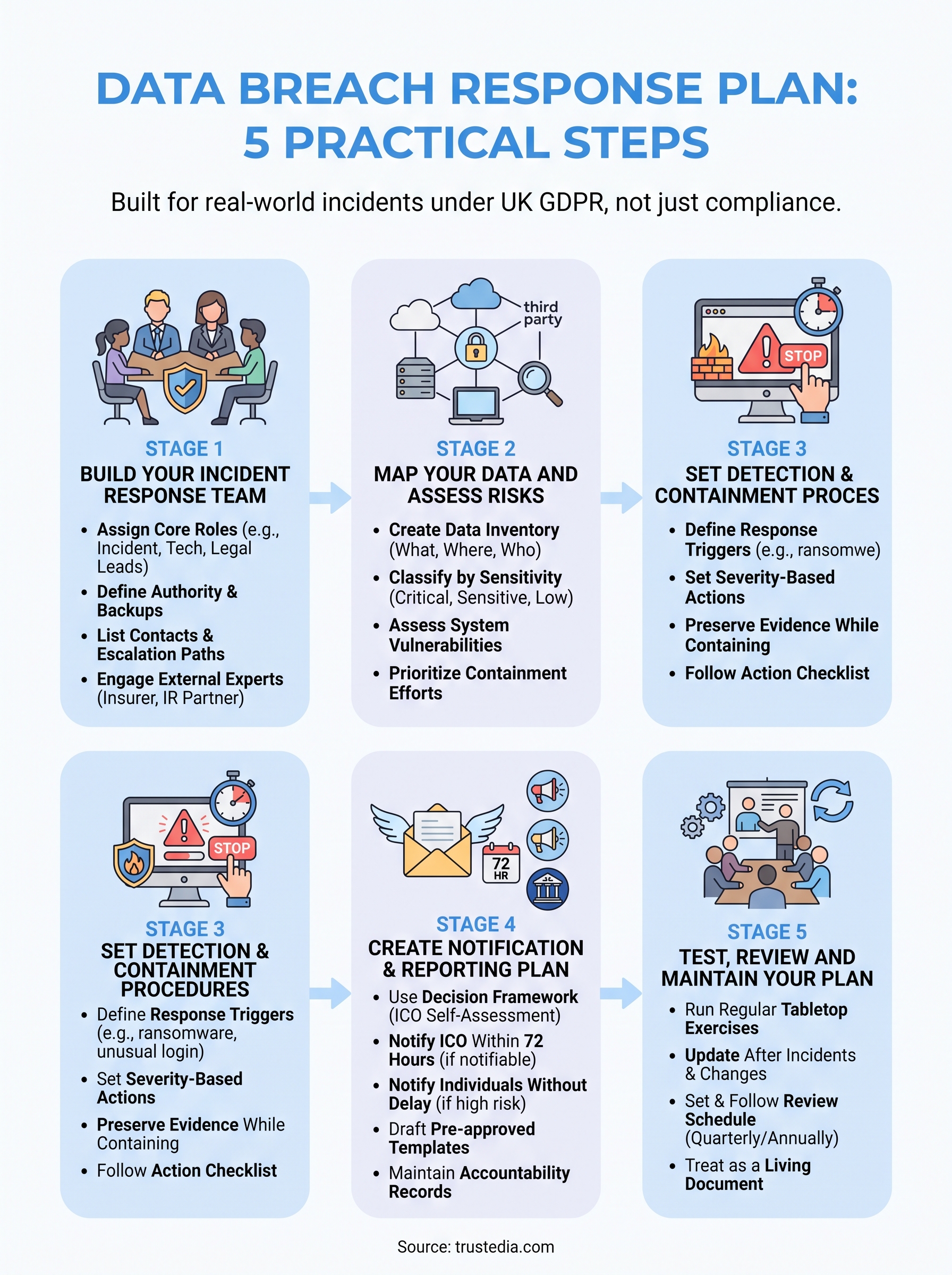
A data breach response plan template only earns its keep when it stops being a document and becomes muscle memory. You’ve now got the five building blocks: a named team, a clear data map, containment triggers, a notification workflow, and a testing schedule that keeps everything current. None of that works if it sits in a folder nobody’s opened since the last audit.
Start small if you need to. Assign roles this week, run a tabletop exercise this quarter, and build from there. Real preparation shows up in the minutes after detection, not in how polished the document looks on paper.
If you’d rather not build and stress-test this alone, talk to TrustedIA about incident response support and get a plan that’s actually ready before you need it.