The best business continuity planning consultants have delivered your kind of plan before, name the person who will do the work, and leave you able to run the plan yourself. If your biggest risk is a cyber attack or IT outage, a cyber-led provider such as TrustedIA fits best. If you need a programme across every function, choose a specialist continuity consultancy. Large advisory firms suit regulated groups, independents suit tight budgets and defined scopes, and broker advisory teams suit reviews driven by insurance.
Choosing is hard because "consultant" covers everyone from BCI-qualified practitioners to generalists who learn the subject at your expense. Proposals look alike on paper. You often find out who was good only when the first exercise goes wrong.
This article explains what a consultant actually delivers, then compares five types of provider, including our own. It ends with a checklist and a comparison table to help you decide. We list TrustedIA first because it is our business, and we say where it does not fit.
What business continuity planning consultants do
A business continuity planning consultant works out what your organisation must keep running, how quickly it must recover, and how you will prove the plan works. They build the plan with your people, test it, and hand it over so you can maintain it yourself. The best ones leave you less dependent on them, not more.
The core deliverables
Most engagements produce the same outputs, whatever the firm calls them. Expect a business impact analysis first, because every later decision depends on it. You should also expect a written plan that your staff can follow without phoning its author.
- Business impact analysis (BIA): interviews with each department to identify critical activities, how long you can tolerate them being down, and what they depend on.
- Risk assessment: threats such as cyber attack, supplier failure, loss of premises, staff absence and utilities failure, scored against those critical activities.
- Recovery objectives: recovery time objectives (RTO) for processes and recovery point objectives (RPO) for data.
- Continuity strategies: workarounds, alternative sites, remote working arrangements and backup suppliers.
- Written plans: business continuity plans per function, a disaster recovery plan for IT, and crisis management and communications arrangements.
- Exercises and training: desktop scenarios, technical recovery tests, and awareness sessions for staff and leadership.
A continuity plan that nobody has exercised is a document, not a capability.
How an engagement runs
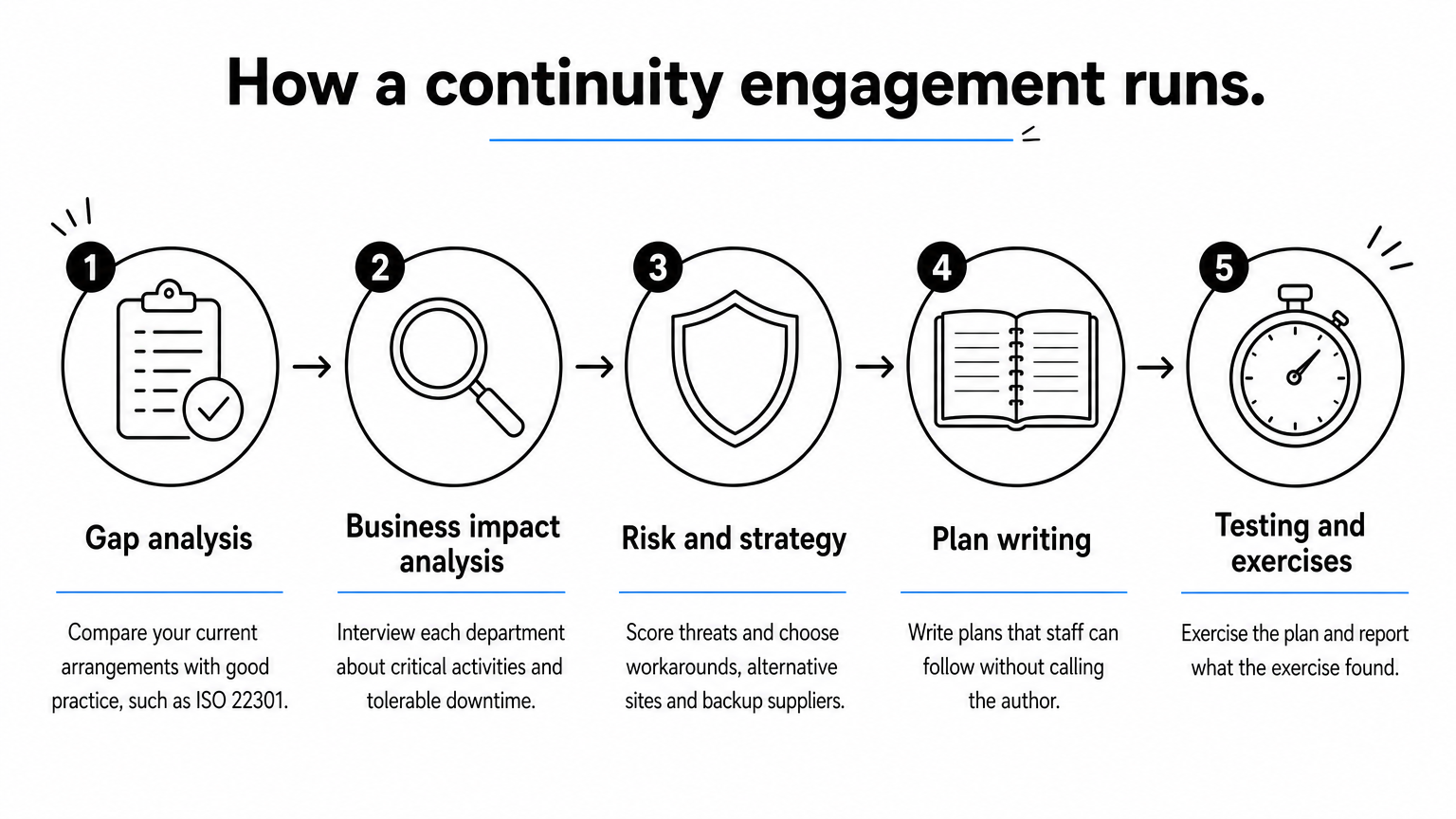
Expect five stages of the business continuity planning life cycle. It starts with a gap analysis against good practice, such as ISO 22301, the international standard for business continuity management systems, so you know your baseline. Then come the BIA and risk work, strategy selection, plan writing and finally testing.
Scope drives duration more than anything else. A single-site firm with one main IT platform finishes far faster than a multi-site group answering to several regulators. Ask for a timeline tied to named milestones, and agree what you will provide, such as interview time from department heads. Most delays come from the client side.
Continuity plan versus disaster recovery plan
A business continuity plan covers how the whole organisation keeps operating. A disaster recovery plan covers restoring IT systems and data to the recovery objectives set by the BIA. The two must agree with each other, even though business continuity differs from disaster recovery planning in scope. If a consultant writes one without the other, the recovery times promised in one will not match what the other can deliver.
1. TrustedIA: cyber-led continuity and recovery
TrustedIA suits organisations whose continuity risk is mostly technology and data. Among business continuity planning consultants, it comes from the managed security side rather than the traditional risk-consultancy side, and that shapes what it does well.
How it works
TrustedIA brings over 30 years of IT services experience. Its Business Continuity and Disaster Recovery managed service sits alongside a Security Operations Centre, endpoint detection, vulnerability assessments, penetration testing, phishing simulation and dark web surveillance. Its internally developed CRAFT tool measures your cyber security posture, so the plan starts from evidence rather than opinion.
If an incident does happen, the CyberSOS incident response service supports recovery. Insurers, loss adjusters and organisations use it. TrustedIA is also solution agnostic, so it recommends what solves the problem rather than a favoured brand.
Who it suits
It suits small and medium-sized businesses and enterprises with no in-house cyber expertise. IT managers, CISOs, business owners and compliance officers get most from it, especially when ISO 27001 is also on the agenda. TrustedIA has a track record in ISO 27001 implementation and certification support, and the same controls feed directly into a credible recovery plan.
Strengths and watch-outs
- Continuity planning, recovery tooling and cyber controls come from one team, so the plan and the technology agree.
- Vendor-neutral advice avoids a plan built around one product.
- If you need a certification project for ISO 22301, or scenarios that go well beyond IT, such as premises or workforce loss, confirm the scope at the first meeting.
If a cyber attack is the likeliest way your business stops, put the plan in the hands of people who respond to cyber attacks.
2. Specialist business continuity consultancies
Specialist consultancies are firms whose entire practice is continuity and resilience. They are the closest match to what most buyers imagine when searching for business continuity planning consultants, and they suit organisations building a programme from nothing.
How it works
A specialist runs the full lifecycle, from gap analysis and BIA through to exercising, using its own repeatable methodology. Good ones assign two consultants to your project, so illness does not halt the work. Their deliverables look consistent from one engagement to the next, which makes quality easier to judge.
Check who actually turns up. Ask whether your named consultant is a full-time employee or an associate brought in when the firm is busy. An associate may not know the firm’s methodology, which removes the advantage you are paying for.
Who it suits
Choose a specialist if you operate across several sites or functions and want the plan to cover people, premises, suppliers and IT equally. It also suits firms working towards ISO 22301, where an auditor will test how well the programme is embedded, not just whether documents exist.
Strengths and watch-outs
- Deep, current knowledge of the whole continuity lifecycle.
- Consistent method and a second person for cover.
- Small teams have limited capacity, so ask when they can start.
- Technical disaster recovery and cyber depth can be thin, so you may need an IT partner offering disaster recovery consulting services to build the recovery side.
A specialist gives you the best continuity knowledge, but check that it can also deliver the technical recovery.
3. Large multi-discipline consultancies
Large advisory and accountancy firms offer continuity as one service among many. They fit big or heavily regulated organisations, and business continuity planning consultants from these firms usually work inside a wider resilience or risk programme.

How it works
These firms assemble a team with project management, reporting lines and board-level governance. Continuity often sits beside operational resilience, risk, audit and technology consulting, so one supplier can cover related workstreams. Rates sit at the top of the market, and you pay for the brand and the structure as well as the expertise.
Who it suits
They suit multi-country groups, regulated firms and organisations where the board wants a recognised name on the work. They also suit programmes where continuity is one part of a bigger transformation and needs a single point of accountability.
Strengths and watch-outs
- Scale, governance and the ability to work across regions.
- Ask who will do the work. Some firms use generalists or subcontract to individual contractors when busy, which can mean paying a premium for what an independent would deliver directly.
- Check any gap analysis sample. Some reports are mostly generic text and a long list of things to buy, with little analysis specific to your organisation.
With a large firm, you are buying structure, so make sure it still delivers a named continuity specialist.
4. Independent consultants and contractors
An independent consultant is one experienced practitioner who works directly for you, usually for a day rate or a fixed fee. For a well-defined scope, this is often the best value among business continuity planning consultants.

How it works
Many independents are former in-house heads of continuity or ex-consultancy staff. They often work locally, so travel costs are low, and you deal with the senior person throughout. Typical projects include a BIA and plan refresh, facilitating an exercise, or acting as interim programme lead for a few months while you recruit.
Who it suits
Independents suit small and medium-sized organisations with a defined problem and limited budget. They also suit larger organisations that need a short-term specialist to fill a gap. If you already have an owner for continuity in-house, an independent can coach that person and review the work.
Strengths and watch-outs
- Lower overhead and direct access to real experience.
- A single point of failure: if they fall ill or move on, your programme stalls and a replacement may restart the work.
- Check recent hands-on delivery. Some senior people have spent years managing others and have not written a plan recently.
- UK off-payroll working rules (IR35) may affect how you engage a contractor, so take advice before you sign.
An independent gives you the most experience per pound, provided you plan for the day they are unavailable.
5. Insurance broker risk advisory teams
Many insurance brokers and insurers run risk advisory teams that review continuity arrangements. This option works as an entry point, and these teams can be useful business continuity planning consultants for a first plan where insurance requirements drive the work.
How it works
The service is often linked to your cover. It may include a continuity review, a BIA workshop, or help to estimate business interruption exposure. Some of it comes bundled with a policy, and some is paid advice. The scope tends to be advisory and review-based rather than a full build and test.
Who it suits
This route suits organisations whose insurer or broker is asking for evidence of continuity arrangements, or those preparing for a renewal. It also suits firms that need to quantify the cost of downtime before deciding how much to invest in recovery.
Strengths and watch-outs
- Strong grasp of the financial impact of an outage and how it relates to your cover.
- Depth varies between teams, so ask who writes the plans and what qualifications they hold.
- Treat the advice as one input. A team that also sells you cover has a commercial interest, so ask for specific deliverables and test the plan independently.
Insurance teams are good at pricing the loss, and you still need someone to build and test the plan.
How to choose business continuity planning consultants
Choose on proven delivery of your scope, named people and testing, not on brand or price alone. Use the checks below to challenge any proposal, then match your situation to the type in the table.
Checks that separate good from poor
- Qualifications: the lead should hold Business Continuity Institute credentials, such as MBCI or FBCI. Supporting staff should hold AMBCI or CBCI, or be working towards them.
- Named people in the contract: the person you meet must be the person who does the work.
- Relevant experience: if you need BIA interviews or a disaster recovery plan, ask for recent examples and speak to references.
- ISO 22301: ask how many clients they have taken all the way to certification. Use a certification body accredited by UKAS, and not the consultant who wrote your system.
- Testing: the proposal should include an exercise and a written report of what it found.
- Handover: you should receive editable plans, not documents locked behind the consultant’s licence.
Comparing the five types
| Type | Best for | Main risk |
|---|---|---|
| TrustedIA (cyber-led) | Technology and data resilience, ISO 27001 | Confirm scope beyond IT |
| Specialist consultancy | Full programme from scratch | Capacity, thin technical depth |
| Large multi-discipline firm | Regulated, multi-country groups | Premium cost, generalist delivery |
| Independent consultant | Defined scope, tight budget | Single point of failure |
| Broker advisory team | Insurance-led first review | Advisory only, commercial interest |
Pricing and scoping
Consultants usually quote a day rate or a fixed project fee. A fixed fee is easier to budget, but only if the proposal lists deliverables, interviews, exercises and revisions. A vague proposal is where cost overruns begin.
Ask each shortlisted firm to price the same scope, and compare what is included, not just the total. Check that the quote covers testing and handover. A cheap proposal that stops at a written plan leaves you to discover its flaws during a real incident.
Where to start
The right consultant is the one who matches your biggest risk, names the people doing the work, and tests the plan before you need it. Cyber-led providers fit technology risk, specialists fit full programmes, large firms fit regulated groups, independents fit defined scopes, and broker teams fit insurance-led reviews.
Write down your scope, your critical systems and your recovery expectations before you ask for quotes. You will get better proposals and spot weak ones faster. If a cyber incident or system outage is your main worry, talk to TrustedIA about your continuity and recovery planning.