The best ISO 27001 compliance training is the training that matches each person’s role in your information security management system (ISMS). Everyone needs short awareness training. The person running the project needs a foundation course and an implementation course. The people who check your ISMS need an internal auditor course. A lead implementer or lead auditor course only makes sense if you want a career-level qualification or you will audit other organisations’ systems.
The problem is that providers sell these courses as a ladder, and it is easy to overspend. ISO 27001 does not ask you to hold a lead qualification. It asks you to show that the people who affect your ISMS are competent and aware. This article sets out what the standard requires, compares six course types by content, audience, length and cost, and ends with a training path you can copy.
TrustedIA supports UK organisations through ISO 27001 implementation and certification, so the advice below is written with the certification audit in mind.
What ISO 27001 requires for training
ISO/IEC 27001:2022 requires you to make sure that the people who affect your ISMS are competent and aware, and to keep evidence that you did so. The standard names no course, provider or qualification. The training requirements for ISO 27001 are therefore about outcomes and records, not about certificates.
Clauses 7.2 and 7.3 in plain terms
Clause 7.2 covers competence. You must decide what competence each role needs, make sure people have it through education, training or experience, act where they fall short, and judge whether the action worked. You must also keep documented information as evidence. Clause 7.3 covers awareness. Everyone working under your control must know the information security policy, how they contribute to the ISMS, and what follows if they do not conform.
Annex A control 6.3 adds awareness, education and training with regular updates. Clause 9.2 requires an internal audit programme run by objective and impartial auditors. Those two points explain why awareness training and internal auditor training sit at the centre of any plan.

What the standard does not require
No lead implementer certificate is mandatory. Competence can come from education, training or experience, so a manager with ten years of risk work can qualify without a course. What matters is that you can show your reasoning. Auditors at the Stage 1 and Stage 2 audits ask who does what, then check training records and staff answers against it.
One check is worth making before you book. Confirm that the course teaches the 2022 version of the standard. The transition period for the 2013 version ended on 31 October 2025, so material built on that edition is out of date. You can read the scope of the current standard on the ISO page for ISO/IEC 27001.
The standard asks for evidence of competence, not for a particular certificate.
Training evidence by role
The table below is a sensible baseline. It is a practical recommendation, not wording from the standard.
| Role | Requirement behind it | Sensible training | Evidence to keep |
|---|---|---|---|
| All staff and contractors | Clause 7.3, Annex A 6.3 | Awareness training with testing | Completion and test records |
| Top management | Clause 5.1 leadership | Foundation course or briefing | Attendance, management review minutes |
| ISMS lead | Clauses 6 and 8 | Foundation plus implementation course | Certificates, competence record |
| Internal auditors | Clause 9.2 | Foundation plus internal auditor course | Certificates, audit reports |
| Technical staff | Annex A technological controls | Role-specific technical training | Course and assessment records |
1. Staff awareness training with phishing simulation
TrustedIA’s Cyber Training & Phishing Simulations is the first pick because it covers the one requirement that applies to every person in scope. It is also the course type that most directly reduces day-to-day risk.

What it covers and who it suits
The service combines phishing simulation, security training and testing so employees learn to recognise and respond to threats such as fraudulent phishing emails. It aims to reduce human risk, which is what clause 7.3 and Annex A control 6.3 are about.
Every employee and contractor needs this layer, from the finance team to the person who answers the phone. It suits organisations without an in-house trainer. A simulated phishing email also gives an auditor proof that awareness was tested, not just delivered.
Awareness training is the one course that everybody inside your ISMS scope needs.
Length, format and cost
Unlike the classroom courses below, this reaches your whole workforce, so the question is coverage rather than seat price. Whichever awareness programme you pick, ask for per-person completion and test results and file them with your clause 7.2 competence records.
Speak to TrustedIA about format and pricing for your headcount. Pair the programme with a foundation course for managers, so that leaders understand what staff are being asked to do.
2. ISO 27001 foundation course
A foundation course (often called a requirements or introduction course) is the entry point for anyone who needs to understand the standard. It is the cheapest paid step and the prerequisite for most auditor courses.
What it covers and who it suits
The course explains the requirements of ISO/IEC 27001:2022, how clauses 4 to 10 fit together, what Annex A contains and how an ISMS benefits an organisation. You leave knowing the vocabulary: scope, risk assessment, risk treatment and Statement of Applicability.
It suits IT managers, information security staff, compliance officers and anyone advising senior management. It is also the step before the auditor courses, because providers expect you to understand the standard before you learn to audit it.
Start everyone who touches the ISMS on a foundation course before you spend on anything longer.
Length, format and cost
Expect about one day, delivered live online, in person or as self-paced eLearning. Short free introductions of around 20 minutes exist, but they will not stand as competence evidence for a role that carries real responsibility.
Prices vary by provider and format, so compare what each fee includes, such as course materials, an assessment and a certificate. Choose a course that tests understanding, because a test result is the evidence you will file under clause 7.2.
3. ISMS implementation course
An implementation course teaches you how to build an ISMS and take it to certification. It sits between the foundation course and the five-day lead implementer course.

What it covers and who it suits
Typical content includes the benefits, structure and scope of the standard, implementation planning, gap analysis, risk assessment and treatment, and the route to gaining and maintaining certification. Good courses use exercises, so you draft part of a scope statement or risk register while you learn.
It suits the person who will lead your project, plus colleagues who will support them. A small business with one ISMS and one site rarely needs more than this level for its project lead.
For most small and mid-sized organisations, a two-day implementation course is enough to run the project.
Length, format and cost
Most providers run it over two days, online or in a classroom. You should arrive with foundation-level knowledge, so book the foundation course first or confirm that the provider’s course includes it.
Cost sits in the middle of the range: above the foundation course, well below the lead courses. Check whether the fee includes templates or a worked case study, because those save time when you write your own documents afterwards.
4. ISO 27001 lead implementer course
A lead implementer course is the intensive route for people who will run an ISMS as a career or for many clients. It is longer, more practical and examined.
What it covers and who it suits
Over about five days you learn why an ISMS matters, how to carry out a gap assessment and how to apply management tools and techniques to meet the requirements. Expect practical activities, group discussion and an exam on the final day.
It suits full-time security managers, consultants and anyone responsible for several sites or business units. It is usually more than a single-site SMB needs. If you would rather not take someone out of work for a week, TrustedIA’s ISO 27001 implementation and certification support is the alternative, tailored to your business context and covering the Stage 1 and Stage 2 audits.
Pay for a lead implementer course only if implementation will be part of someone’s job for years.
Length, format and cost
Plan for five days plus preparation, with live online and classroom options at most providers. It is the most expensive implementation option, and the exam fee may or may not be included, so ask.
Make sure the qualification is recognised by the audience that matters to you. Clients and employers value a named, well-known provider more than an obscure certificate.
5. ISO 27001 internal auditor course
An internal auditor course trains the people who will test your ISMS before the certification body does. Clause 9.2 requires an internal audit, so this course earns its place in almost every plan.
What it covers and who it suits
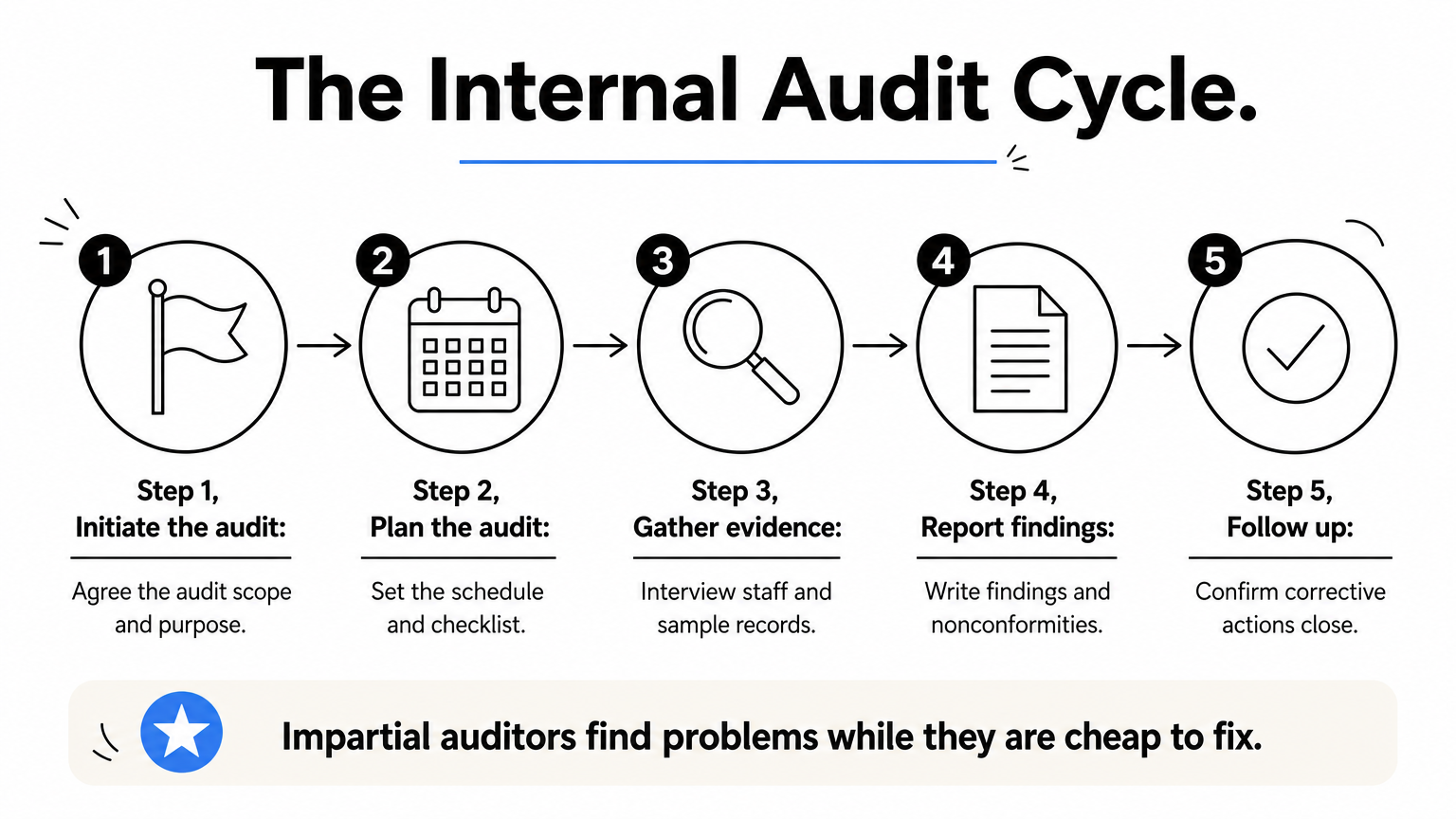
You learn the full audit cycle: initiating an audit, planning, gathering evidence, reporting findings and following up. Good courses base the method on ISO 19011, the guidance for auditing management systems. You also practise writing nonconformities that a manager can act on.
It suits staff and managers who will audit your ISMS, and auditees who want to understand the process. Auditors must be objective and impartial, so they should not audit their own work. Pick people from outside the team that runs the ISMS.
An internal audit run by a trained, impartial colleague finds problems while they are still cheap to fix.
Length, format and cost
The course usually takes two days, and online delivery works well because audit practice is mostly discussion and role-play. Attendees should already understand ISO 27001:2022, so they need the foundation course or equivalent knowledge first.
Pricing is similar to an implementation course. You will normally train two or three people, so ask for a group rate if you book several places.
6. ISO 27001 lead auditor course
A lead auditor course is the professional audit qualification. It is built for people who lead audits of others, not for staff who check their own organisation once a year.
What it covers and who it suits
The intensive five-day course builds on the internal auditor content and teaches you to plan, lead and report a full ISMS audit. Courses approved by CQI and IRCA are the benchmark if you want to progress to professional auditor registration.
It suits supplier auditors, consultants and people moving into certification work. Existing lead auditors in another discipline, such as quality management, can take a shorter conversion course of about three days instead.
Lead auditor training is a career qualification, not a requirement of your own ISMS.
Length, format and cost
Allow five days with a detailed understanding of the requirements beforehand. Providers often expect you to have taken the internal auditor course or hold equivalent experience.
Expect this to be the highest fee on the list. For an organisation that only audits itself, the internal auditor course gives the same competence for far less time and money.
How to choose the right mix of courses
Choose courses by role, not by seniority. Give everyone awareness training, give your project lead the implementation path, and give your auditors the internal auditor course. Lead courses come last, and only for a clear reason.
Side-by-side comparison
| Course | Typical length | Best for | Outcome |
|---|---|---|---|
| Awareness with phishing simulation | Varies by programme | All staff and contractors | Evidence for clause 7.3 |
| Foundation | 1 day | Managers, IT, compliance | Understanding of the requirements |
| ISMS implementation | 2 days | Project lead and supporters | Ability to plan and deliver the ISMS |
| Lead implementer | 5 days with exam | Full-time implementers, consultants | Professional implementation skills |
| Internal auditor | 2 days | Staff who audit the ISMS | Ability to run internal audits |
| Lead auditor | 5 days | Audit leaders, consultants | Skills to lead ISMS audits |
A worked example for a 40-person firm
Take a 40-person UK firm with one IT manager leading the project and two staff from outside IT acting as internal auditors. The manager takes the foundation course (1 day) and the implementation course (2 days), a total of 3 days. Each auditor takes the foundation course (1 day) and the internal auditor course (2 days), 3 days each, or 6 days for both. That makes 9 specialist person-days in total. All 40 staff complete awareness training. Nobody needs a lead course.
Sequence it like this:
- Send the project lead and auditors on the foundation course.
- Add the implementation course for the project lead.
- Roll out awareness training to all staff before the certification audit.
- Train the auditors on the internal auditor course before the first internal audit, which must be completed before the certification audit.
If you are unsure where your people stand, a gap analysis against the standard shows where you fall short before you book anything. TrustedIA’s ISO 27001 Gap Analysis does this and produces a roadmap for continuous improvement.
Where to start with your training plan
Start with the requirement, not the catalogue. ISO 27001 wants competent, aware people and records that prove it. Give everyone awareness training, send your project lead and auditors on the foundation, implementation and internal auditor courses, and keep lead courses for people whose careers need them.
Write down the competence each role needs, record who has it, and file the certificates and test results as you go. If you want help building that plan or taking the whole project to certification, talk to TrustedIA about ISO 27001 implementation and certification support.